
Hydrangea Dataset
A comprehensive collection of images of Hydrangea plants native to Asia and the Americas, enabling the development of plant classification models for invasive and non-invasive species identification.
- Labeling Type: Is_invasive
- Data Format: Image
- Data Type: Synthetic Data
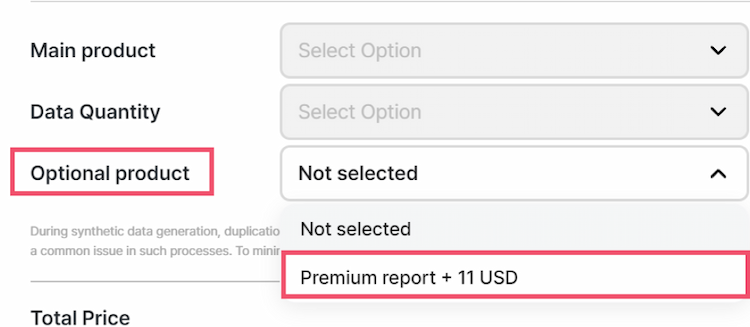
Main Product
Data Quantity (Samples)
Total Price
$ 6,800
(VAT Included)Looking for custom-made dataset or researcher-accessible data? Please contact us for inquiries.
About Dataset
1) Data Introduction
• The Hydrangea Dataset is constructed based on images of Hydrangea plants native to Asia and the Americas, with the goal of classifying them into invasive and non-invasive categories.2) Data Utilization
(1) Characteristics of the Hydrangea Dataset: • The dataset includes images of various Hydrangea species, encompassing both invasive and non-invasive types that may impact local ecosystems. • It consists of images captured in real outdoor environments, making it suitable for training plant classification models in natural settings. (2) Applications of the Hydrangea Dataset: • Development of invasive plant classification models: The dataset can be used to train image classification models that determine whether a Hydrangea plant is invasive, supporting ecosystem protection and invasive species management. • Environmental monitoring system research: It can be utilized in developing AI-powered systems that analyze images collected from drones or mobile devices to detect invasive species in real time.Meta Data
Normal

Outstanding
Data Samples 5


Utility
| Downstream Classification (▲) | KID (▼) | One Class Classification (▼) | |
|---|---|---|---|
| Total | 0 | 0 | 0 |
| Suitability | OK | OK | OK |
The higher the value, the better (▲)
Model Performance
Downstream classification accuracy is an indicator used to evaluate the usefulness of synthetic data. It measures whether synthetic data performs similarly to real data. The method involves training the same model separately on real data and synthetic data, and then comparing the accuracies of the two models. Interpretation: A high accuracy rate means that the model trained on synthetic data performs similarly to the one trained on real data, indicating that the synthetic data is of high quality and well represents the real data.
The closer to zero or the lower the value, the better (▼)
Quality
KID (Kernel Inception Distance) is a metric used to evaluate the similarity between generated images and real images. It compares the differences between the two sample distributions using Kernel Mean Embedding, without assuming a normal distribution. Interpretation: A lower KID score suggests that generated images are more similar to real images, with a score close to 0 being ideal. Specifically, a score below 0.01 indicates very high similarity.
Privacy
| LPIPS (▲) | SSIM (▼) | |
|---|---|---|
| Total | 0 | 0 |
| Suitability | OK | OK |
The higher the value, the better (▲)
Perceptual Similarity
Learned Perceptual Image Patch Similarity (LPIPS) is a metric used to measure the visual similarity between two images by utilizing neural networks to extract key features and calculate the distance between them. High LPIPS value: Indicates high similarity between images, raising the risk of information leakage. Low LPIPS value: Suggests that synthetic images are perceptually different from real images, indicating a lower risk of sensitive information leakage.
The closer to zero or the lower the value, the better (▼)
Structural Similarity
The Structural Similarity Index Measure (SSIM) is a metric used to assess the similarity between two images. It is primarily used to compare the quality of a restored or compressed image with the original image. SSIM measures visual similarity by considering brightness, contrast, and structure.
High SSIM value (0.9 or above): Indicates that the synthetic image is very similar to the real image, which may increase the risk of information leakage.
Low SSIM value (0.6 or below): Indicates low similarity and reduced risk of leakage.
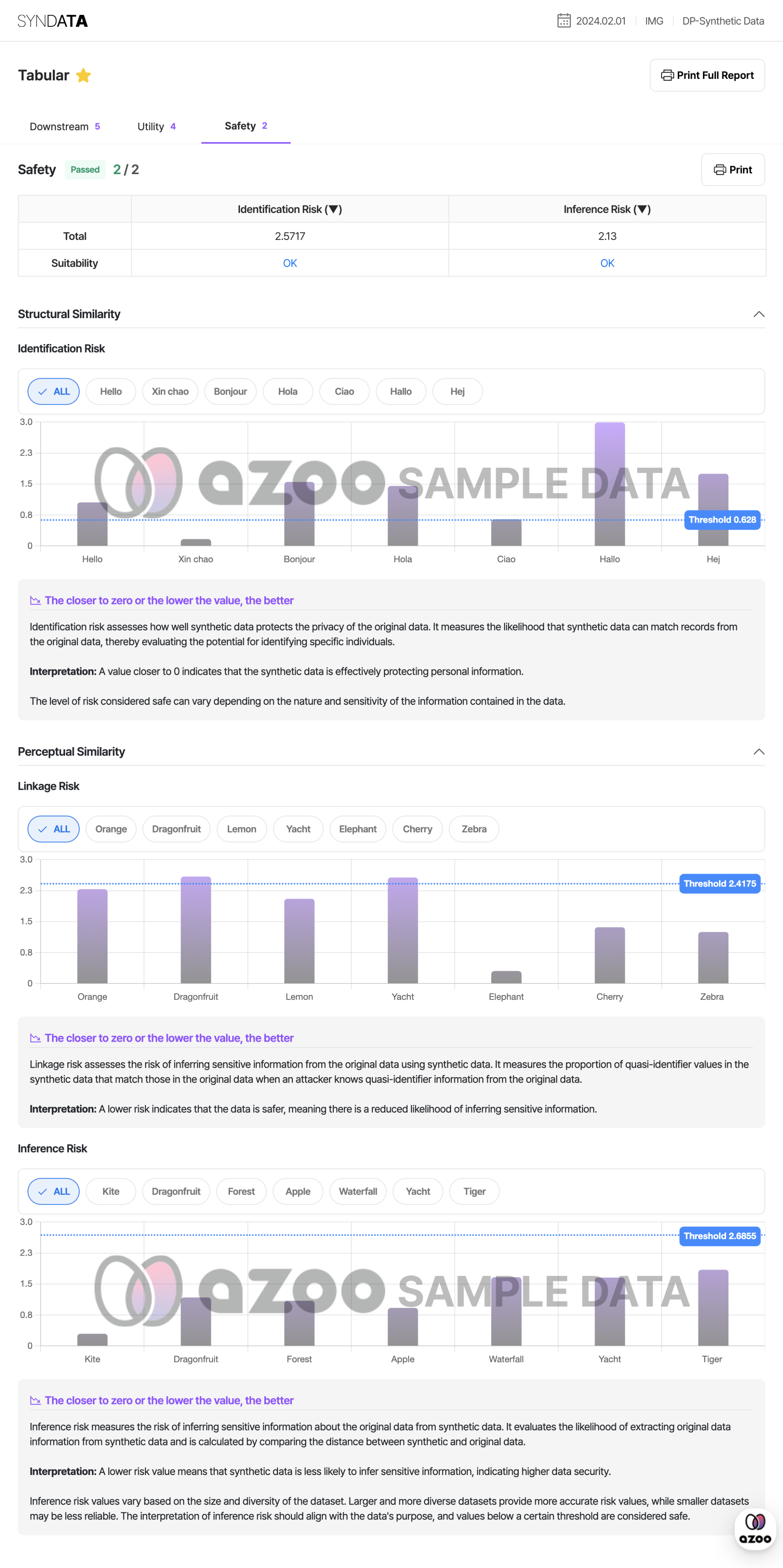
Premium Report Information
Premium dataset sample