The Agentic AI Wall: Why Faster Infrastructure Won’t Fix Unusable Data
Table of Contents
Summary
Corporate leaders are aggressively funding enterprise rollout plans, pouring millions into compute clusters and high-bandwidth networks. They believe the artificial intelligence transformation is a simple train you board once the budget is approved. Reality looks very different on the engineering floor.
Gartner’s February 2025 report predicts a brutal reckoning. Sixty percent of AI projects will halt by 2026 due to a severe lack of AI-ready data. Companies are feeding broken, restricted, and legacy inputs into highly advanced models, expecting autonomous miracles.
The foundation is cracked. Usable data barely exists in the wild. We have to stop obsessing over faster infrastructure and start restructuring our unusable enterprise records into mathematical formats that models can actually execute against without hallucinating.
The Boardroom Infrastructure Illusion
South Korean tech executives recently celebrated the departure of the “AX Train,” signaling a massive push toward artificial intelligence transformation across major industries. 📃“AX Train”… “Light and Shadows” that needs to be solved details how conglomerates are shifting their entire operational focus toward model-driven solutions. Kakao aims to discover one hundred new tech companies by 2030, while manufacturers pivot strictly to solution-based business models. Boardrooms are practically vibrating with optimism. They view the transition as a pure infrastructure challenge.
Vendors are rushing to supply the plumbing for this massive shift. Hardware providers like AurCore are delivering open, high-bandwidth networking solutions designed specifically to handle massive enterprise workloads. 📃AurCore Delivers Open, High-Bandwidth Networking Solutions for the Enterprise shows the capital expenditure flowing into physical connectivity. Companies are buying wider pipes and faster switches.
Speed means nothing if the payload is toxic. Pushing unstructured, legacy database exports through an 800Gbps switch just helps your systems fail faster. Hardware upgrades solve the bottlenecks of 2015, not the execution challenges of 2026. The actual roadblock is data unusability.
I see Chief Information Officers sign off on massive networking contracts while ignoring the actual state of their data lakes. You can route JSON files at light speed across the globe. If those files contain null values, heavily restricted regional information, or biased historical samples, your million-dollar cluster will simply generate high-speed errors.
Community Pulse and the Agentic Execution Wall

Developers on Hacker News live in a different reality than the executives funding their projects. Discussions around recent startup launches reveal a deep, systemic fear of giving autonomous agents any actual purchasing or execution power. One engineer in a recent thread about travel booking agents noted the sheer terror of letting a model finalize a corporate flight. If the system misreads a minor detail due to messy context, the resulting incorrect booking causes immediate financial damage.
These engineers are not doubting the reasoning capabilities of modern large language models. They doubt the environment the models are forced to operate within. Another recurring theme in practitioner discussions is the brutal architectural shift required to handle bad data in autonomous loops. One developer explicitly stated that the hardest mental shift for their team was treating exceptions as observations.
What does that mean in practice? Traditional software crashes when it hits a null pointer exception. Agentic loops are designed to observe that failure, adjust, and try another path. When enterprise data is deeply broken, the agent spends all its compute observing failures rather than executing tasks.
We are watching brilliant software engineers burn their cycles building massive LLM debugging tools and root-cause analysis platforms. They are writing endless layers of error-handling code because the raw material they feed their models is inherently flawed. The community is begging for a stable state, but they are being handed raw database dumps.
Why do we force intelligent systems to parse garbage?
The solution requires intervening before the prompt ever fires. If we restructure the underlying context into an optimized, original-replacement data generation format, the exception loops disappear. The model can simply execute.
Diagnosing Data Unusability at the Source
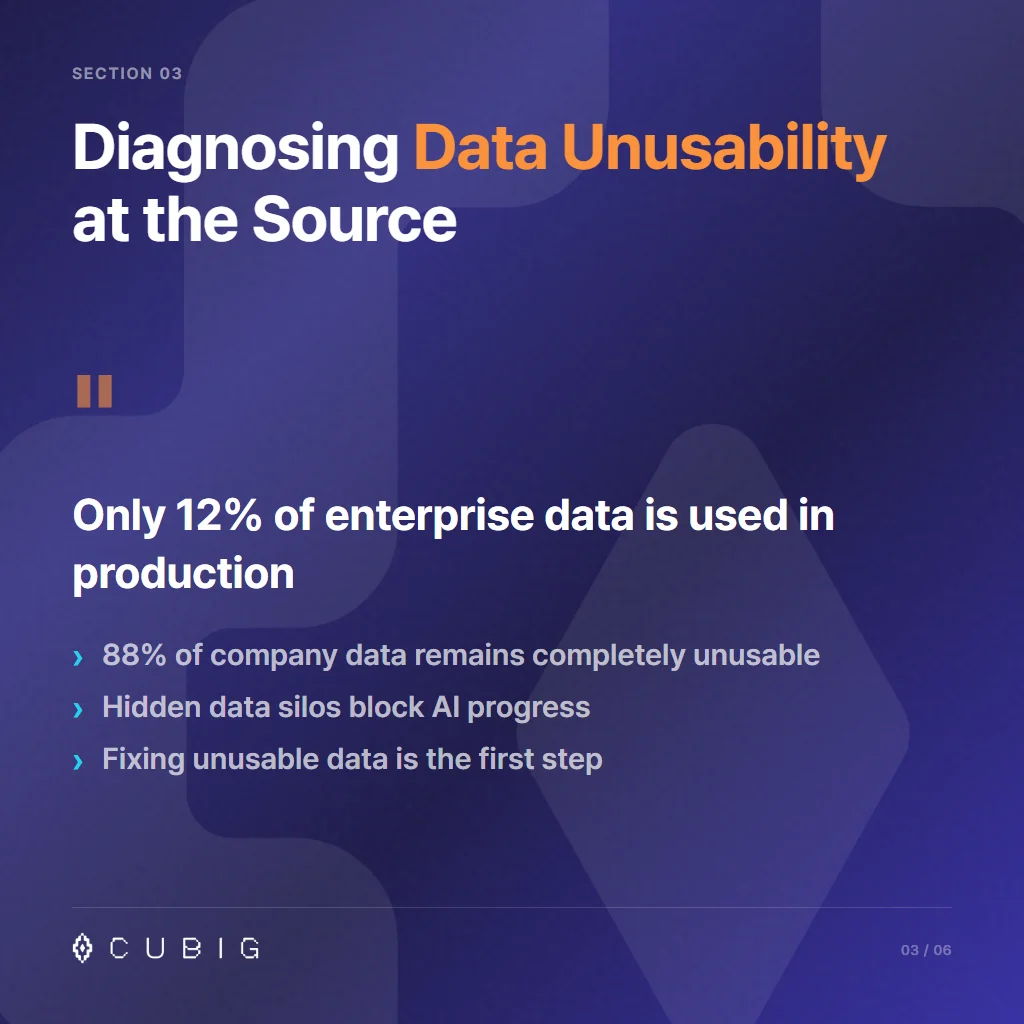
Gartner reports that only twelve percent of enterprise data is actually used in production environments. Eighty-eight percent remains completely unusable. This massive dark data problem falls into three highly specific categories that traditional pipeline tools fail to address. We have to dissect these categories to understand why ad-hoc Python scripts are no longer sufficient for modern architectures.
Uncollectable data represents the first major hurdle. These are the rare events, edge-case anomalies, and systemic failures that rarely occur but dictate business survival. A logistics company cannot train a predictive maintenance model on engine failures if their new fleet has never experienced a breakdown. The historical record is silent.
trapped or restricted data forms the second barrier. Multinational organizations constantly fight regulation boundaries, region-binds, and strict departmental silos. A global bank might have twenty years of incredible consumer behavior trends sitting in European servers. They cannot legally use a single row of it to train their North American risk models without violating strict cross-border transmission rules.
Low-quality or broken data is the most insidious of the three. Missing values, biased historical collection methods, and legacy format issues pollute the remaining active datasets. A telecommunications provider might try to build a churn prediction model using ten-year-old CRM records. Those records are riddled with manual entry errors, mismatched schema migrations, and undocumented categorical variables.
Data activation happens when we systematically attack all three categories simultaneously. We must reconstruct the missing events, restructure the restricted records into regulation-friendly mathematical equivalents, and auto-cure the broken schemas. That is the only path to a stable execution state.
Legislative Reality and the New Government Baseline
Government bodies are finally recognizing the severity of the data quality crisis. The White House recently released its national AI legislative framework, outlining the exact policies it expects Congress to enact. 📃The White House released its national AI legislative framework reveals a deliberate push to override fragmented state laws with a unified, pro-business national standard.
One specific mandate buried in this four-page framework changes the game for data engineering teams. The administration demands that federal datasets be opened to the public in explicitly “AI-ready formats.” This is no longer just a marketing phrase used by database vendors. It is a recognized federal standard acknowledging that raw data requires deep, structural transformation before it can be safely consumed by intelligent systems.
If the federal government acknowledges that legacy formats are natively unusable for model training, enterprise boards must stop pretending otherwise. You cannot download a raw CSV from a state portal, feed it into a retrieval-augmented generation pipeline, and expect a legally compliant answer. The data must be mathematically restructured.
Zoomex is already seeing this play out in high-stakes automated environments. 📃Zoomex Outlines AI-Ready Liquidity and Execution Framework as Automated Trading Expands highlights how financial trading platforms are building specialized frameworks specifically to ensure liquidity data is structurally flawless before algorithms touch it. When trades execute in milliseconds, there is zero tolerance for formatting exceptions.
From PoC Graveyard to Production Pipelines
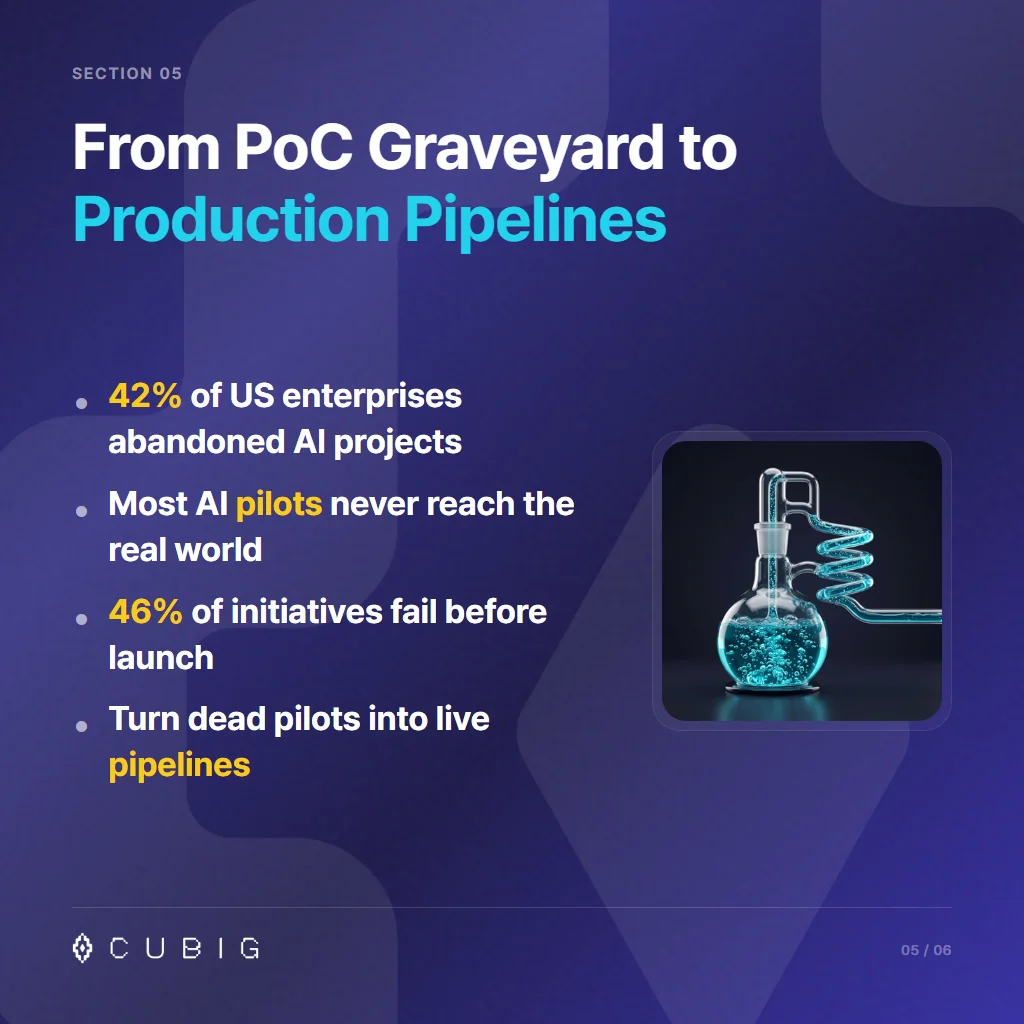
Forty-two percent of US enterprises abandoned most of their AI initiatives entirely last year. S&P Global’s 2025 research also showed that 46% of artificial intelligence proofs-of-concept were discarded before ever reaching a production environment. I have watched engineering teams work miracles in a sandbox, only to watch the entire architecture collapse the moment it connects to a live production database.
During a pilot phase, data engineers manually clean the inputs. They drop the null rows, standardize the date formats, and carefully balance the categories. The model looks brilliant in the executive demo. Then the system goes live. Live production databases are chaotic, volatile, and deeply unusable.
The manual interventions simply snap under the pressure of real-time enterprise streams. The model itself did not fail. The data state at execution time drifted wildly from the data state during the pilot. Building a strategic foundation requires automating that exact restructuring process into a rigorous, verifiable pipeline.
How CUBIG Addresses This
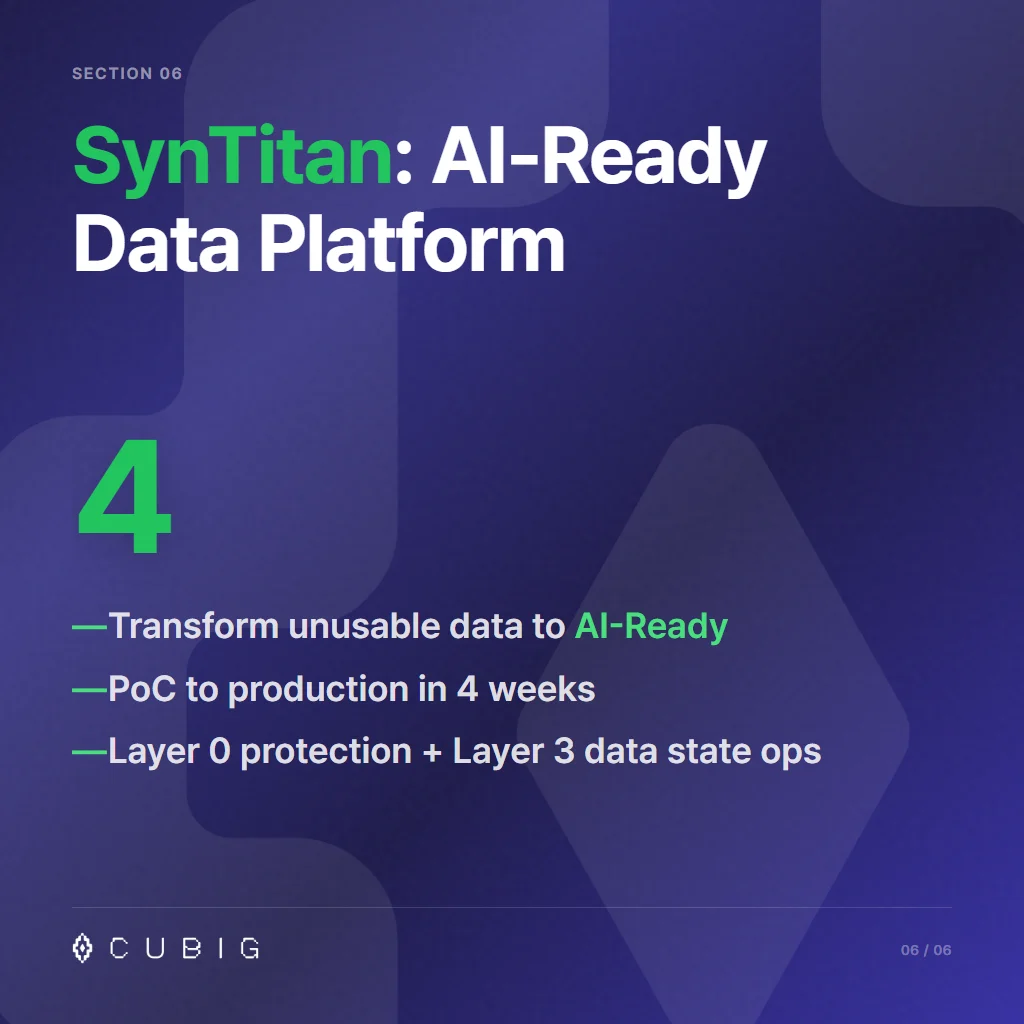
SynTitan operates as a comprehensive AI-Ready Data Platform designed specifically to eliminate the execution drift that kills production deployments. We built this architecture because routing raw, unusable records into advanced inference engines is a guaranteed path to failure. The platform systematically transforms trapped enterprise assets into a hardened, highly usable state.
The process begins at Layer 0 with the Data Gate. This initial boundary leverages LLM Capsule for precise PII detection and applies DTS synthetic conversion to safely restructure the inputs. The original, highly sensitive enterprise records remain entirely untouched. The pipeline only moves forward with mathematically equivalent, regulation-friendly representations.
Layers 1 and 2 handle the heavy lifting of Data Quality and AI-Ready Transformation. SynTitan automatically cures the missing values, balances historical biases, and repairs the broken legacy formats that typically crash agentic loops. It then optimizes the schema specifically for model consumption while rigidly preserving the original business context and metadata.
Layer 3 is where the actual production stability happens through the Verifiable Data Statehouse. SynTitan freezes the transformed data into an immutable Release State. Every single operational run is strictly bound to a specific release_id. Teams can run exact diff comparisons and reproduce any prior data state on demand. AI systems fail in production not because of models, but because of data state at execution time. We fix the state, so your models can finally execute.
FAQ
What exactly defines an AI-ready data format in a legacy enterprise?
An AI-ready format is mathematically complete, structurally predictable, and entirely free of restricted attributes. It means replacing null values with statistically valid synthetic equivalents and normalizing schemas so language models can parse relationships without custom reasoning logic. The data must be transformed from human-readable ledger entries into flat, context-rich vector candidates.
How do we handle agentic AI exceptions caused by broken data?
You stop trying to handle them at the application layer. Writing complex loops to treat data exceptions as system observations burns compute and causes severe model hallucination. The solution is restructuring the underlying data before the prompt executes, ensuring the agent only receives mathematically verified inputs.
Can SynTitan manage region-trapped data across international teams?
Yes. The platform uses the DTS restructuring engine to convert regulation-trapped European or Asian records into statistically equivalent original-replacement data. Through the SynConnect cross-domain join layer, distributed teams can safely combine these restructured datasets for global model training without ever transmitting the underlying restricted originals.
Why does manual data cleaning work for PoCs but fail in production?
Pilots operate in a frozen data state. Production systems constantly drift as new, broken, or anomalous records enter the pipeline. Unless you bind your model’s execution to an immutable, verifiable release state, the chaotic nature of live enterprise data will eventually crash the precise formatting your PoC relied upon.

CUBIG's Service Line




Recommended Posts