The 2026 AI Reckoning: Fixing the Enterprise AI Data Pipeline
Table of Contents
Summary
42% of US enterprises abandoned most AI initiatives this year. That number should terrify any executive pouring millions into generative models. And the root cause has nothing to do with the algorithms.
Gartner’s 2026 projections paint an even bleaker picture: 60% of enterprise AI projects will be scrapped before production, mostly because of unstructured data bottlenecks and missing AI-ready practices. The foundation is cracked. Usable data barely exists in most corporate environments — and you simply cannot build reliable systems on messy spreadsheets and siloed documents.
Stop blaming the models. The real problem is an enterprise AI data pipeline that chokes on unusable data.
The Infrastructure Illusion

Companies spend billions cooling data centers for AI workloads. Vertiv just acquired ThermoKey to expand their heat rejection portfolio for converged physical infrastructure. Executives happily sign off on massive budgets for high-density compute environments. Fastest processors. Most robust server racks. The works.
All that hardware just processes garbage faster. High-performance compute means nothing when the underlying information stays unusable. Teams architect elaborate physical systems while ignoring the messy reality buried in their own corporate records. It’s like buying a sports car and filling it with muddy water.
Forrester reported in 2026 that 25% of enterprise AI spending is stalled — executives are pivoting away from LLM experimentation toward fixing enterprise AI data pipelines and proving ROI.
This marks the end of the pilot phase. Leaders are waking up to a hard truth: pouring capital into compute without addressing data unusability guarantees failure. They’re finally staring at the root of the problem. You cannot scale business impact without first making your internal knowledge operable.
Why Do AI Projects Fail in Production?
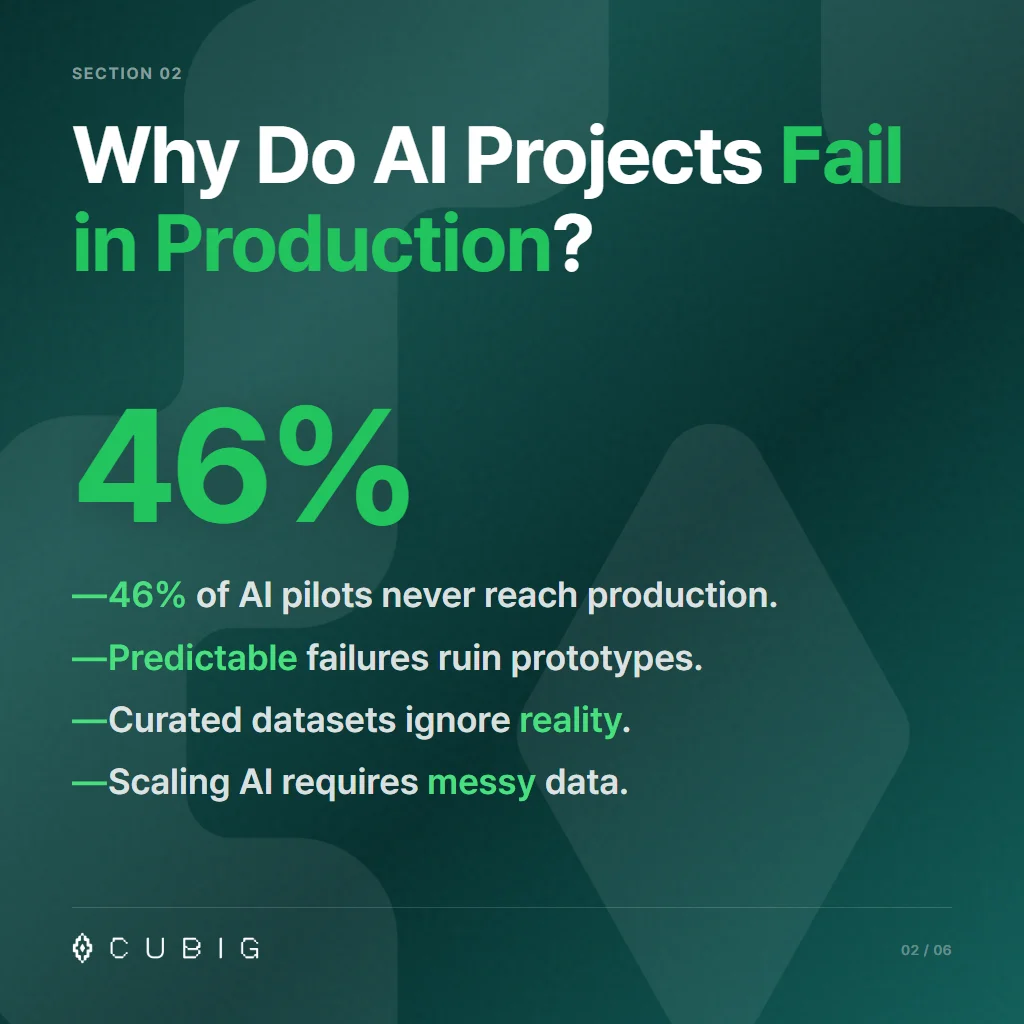
S&P Global found 46% of AI PoCs never reach production. The pattern is painfully predictable. You build a beautiful prototype on a carefully curated dataset. Everyone applauds during the demo. Then you connect it to real corporate systems and everything falls apart.
Data engineers on Reddit have been venting about this cycle for months. One highly upvoted comment on a data science forum nailed it — models don’t fail because the model is bad. They fail because the data is inconsistent, biased, missing, or just straight-up garbage.
“Models don’t fail because the model is bad. They fail because the data is inconsistent, biased, missing, or just straight-up garbage.”
Only 12% of enterprise data actually gets used. The other 88% sits locked in restrictive silos or trapped in broken formats. You can’t build a reliable enterprise AI data pipeline when nearly all your inputs are toxic. What you get instead: endless debugging, abandoned projects, and a lot of wasted budget.
The Dark Data Trap Paralyzing Operations
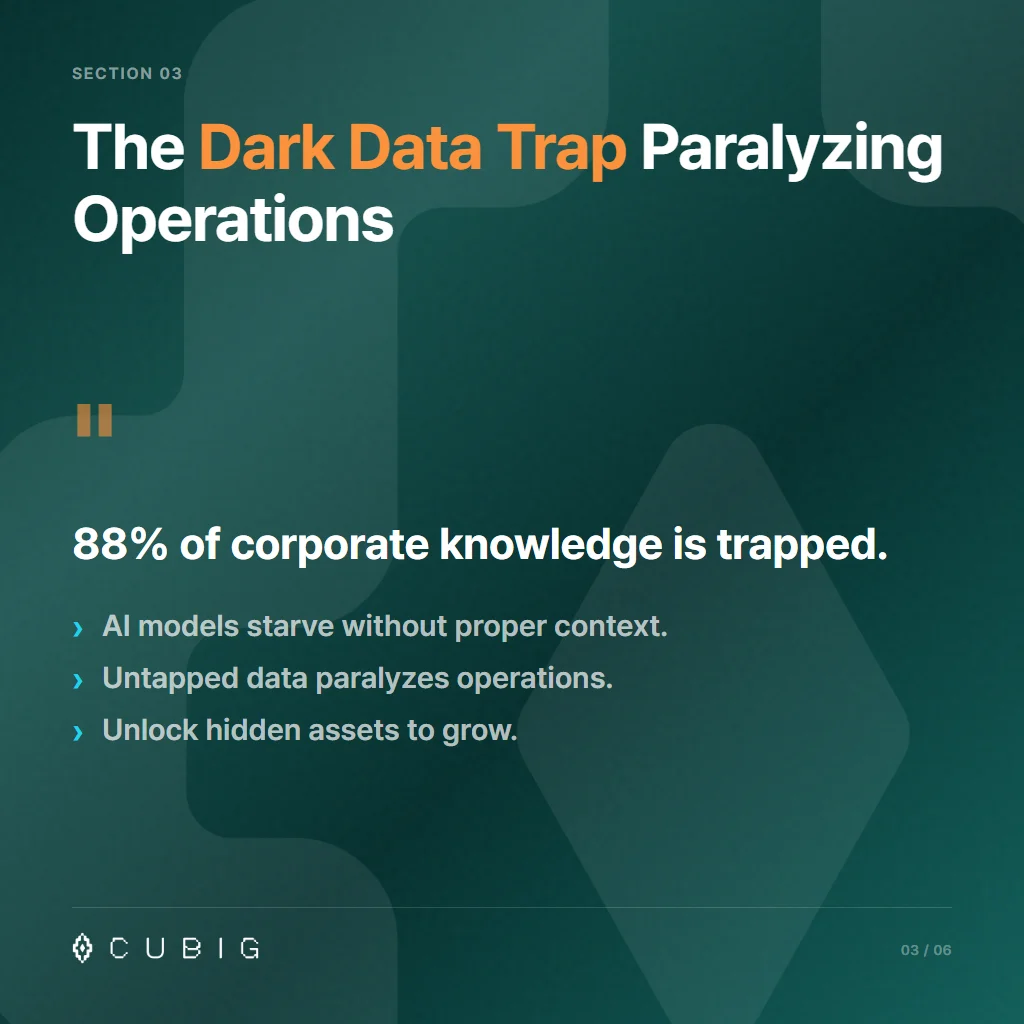
88% of your corporate knowledge sits completely out of reach for AI models. SiliconANGLE recently covered how Capital One Software is tokenizing assets to bring “reliable dark data” into the light. Dark data — those unstructured, undocumented records organizations have ignored for years — is suddenly the biggest bottleneck.
IDC research puts unstructured formats at a 30% compound annual growth rate. That growth creates a massive wall for any organization trying to automate decisions. Feed a tangled mess of PDFs and legacy code into an autonomous workflow and the system will either reject it outright or generate catastrophic errors.
This paralysis breaks down into three types of unusability. Uncollectable data covers rare events or anomalies your systems never captured. Regulation-restricted data sits behind compliance walls and regional binds. Broken data means missing values and historical biases baked into your records.
Most teams try building custom scripts to work around these issues. They throw their best engineers at fragile code that scrapes internal databases. The maintenance burden is crushing. Every time a vendor updates an API, the whole workflow collapses and someone loses a weekend.
A systematic approach to data restructuring is the only way out. Your enterprise AI data pipeline needs to convert regulation-bound information into usable form — automatically.
What Happens When Agentic Loops Hit Trapped Data?
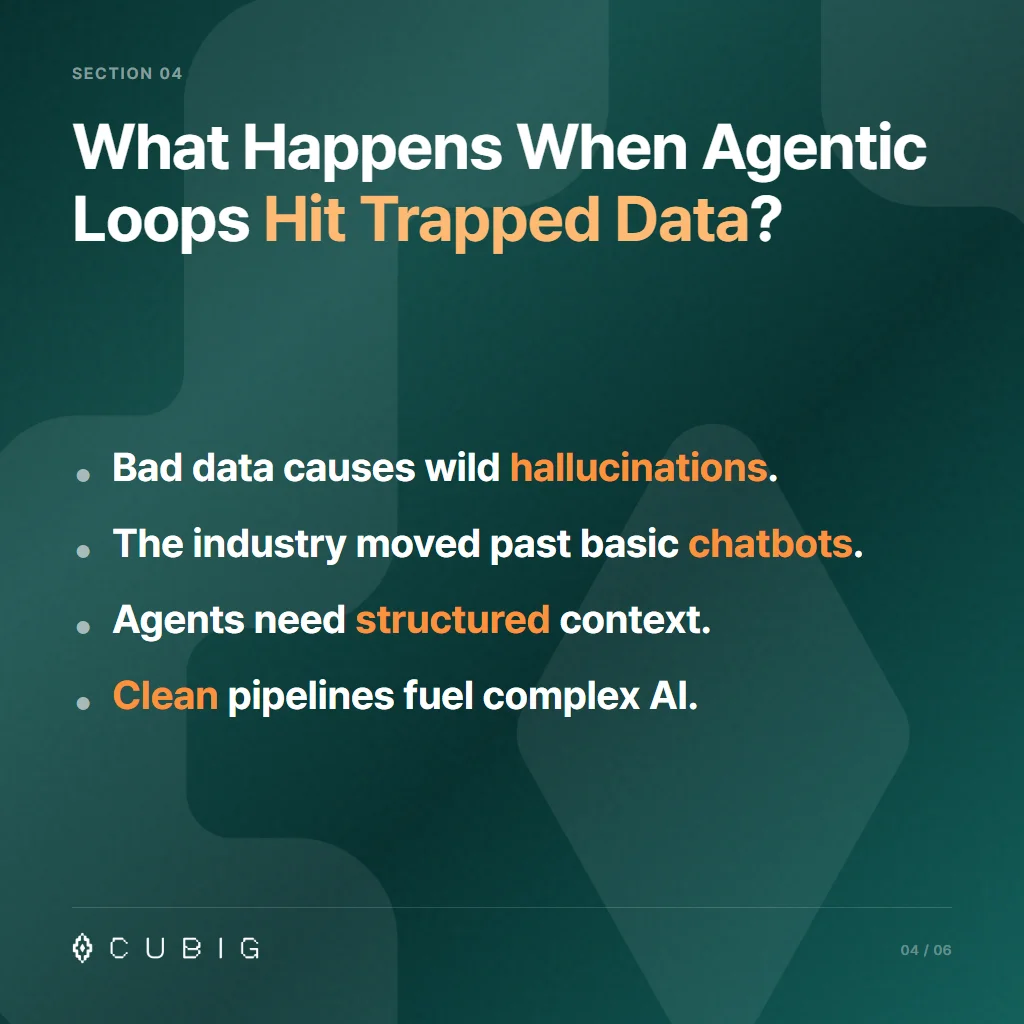
Autonomous agents hallucinate wildly when fed unvalidated or unstructured information. The industry has moved past simple chatbots. Organizations want agentic workflows that take independent actions across multiple systems. These agents demand absolute precision in their inputs — a single bad variable can trigger a cascade of incorrect automated actions.
Data engineers consistently flag unstructured data preprocessing as the leading cause of agentic AI failure, which is pushing organizations toward platforms that transform unusable dark data into structured, vectorized assets. A recurring thread on Hacker News captures the pain perfectly. Practitioners say the biggest hurdle isn’t individual model context protocols. It’s combining them. When an agent queries a database and an email server in a single request, bad data quality breaks everything downstream.
What Data Engineers Are Actually Complaining About
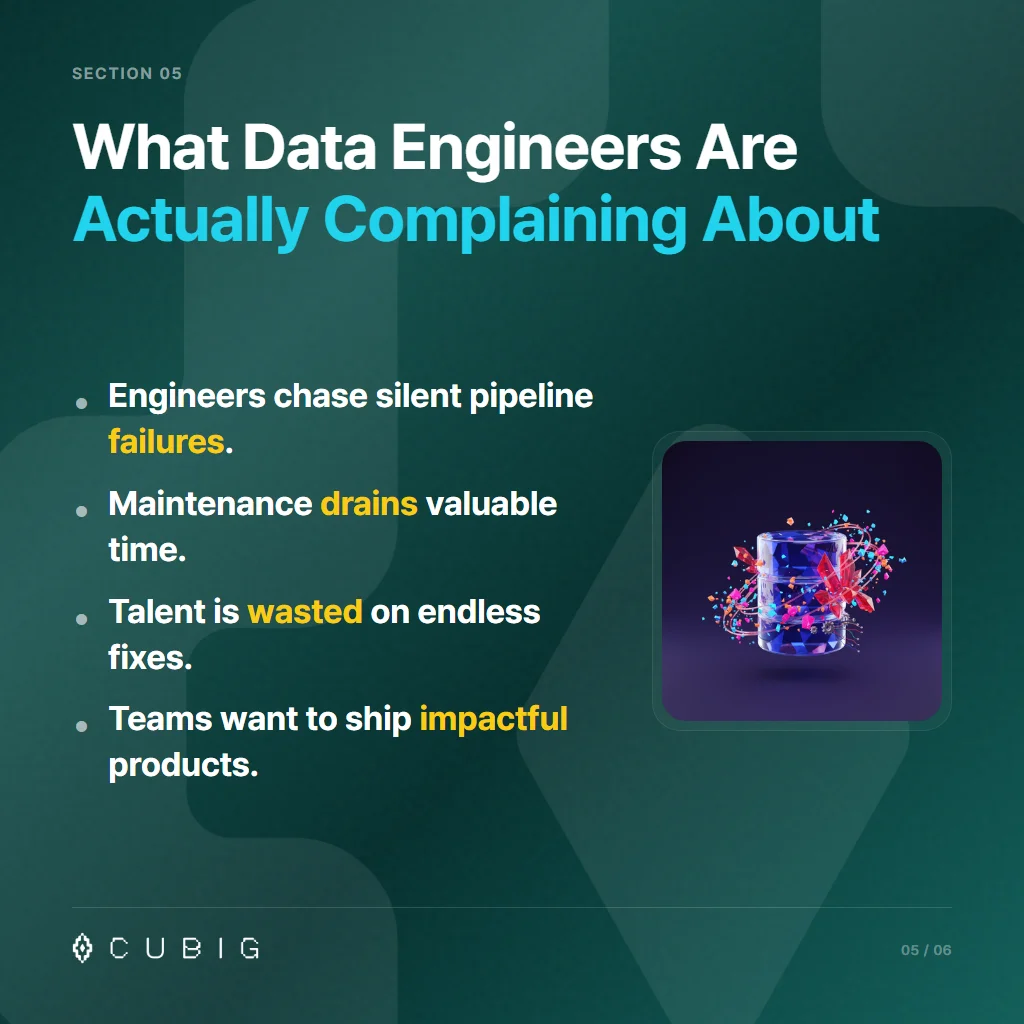
Senior engineers hate spending their days chasing silent pipeline failures. They signed up to build sophisticated workflows and ship impactful products. Instead, 80% of their time goes to finding, cleaning, and formatting records. Grunt work.
Manual labeling and constant pipeline maintenance drain morale fast. You hire brilliant developers and turn them into digital janitors. That misallocation kills any chance of positive ROI. The legacy products you want to replace have a decade of structured iteration behind them — an LLM can’t replicate that value if you’re feeding it disjointed spreadsheets.
Automated data restructuring is the fix. Your enterprise AI data pipeline needs to handle broken records and missing values without someone babysitting it around the clock.
Overcoming the Unstructured Data Bottleneck
Manual extraction workflows break the moment your document formats change. Dnotitia recently launched the Seahorse Cloud platform to speed up AI deployment, specifically targeting the unstructured data bottleneck through advanced preprocessing.
That launch reflects a broader market realization: you can’t manually parse your way out of data chaos. The industry is shifting toward unified platforms that automatically turn document disorder into vectorized assets.
Your compliance wall vanishes when you stop moving raw files around. Instead, you restructure trapped information into a regulation-friendly format through automated original-replacement data generation. The technology layer handles translation behind the scenes. You get pristine records without exposing sensitive attributes.
This approach kills the need for manual ETL maintenance entirely. Your engineering team gets their time back. Your models get clean inputs. Everyone wins.
The Non-Negotiable Data Checklist for 2026
Halt your pilot programs until the underlying information becomes usable. Seriously. You need a strict framework for evaluating operational readiness. Do you know exactly how much of your corporate knowledge is currently uncollectable? Have you mapped the missing values and biases in your historical records? Scaling is impossible until you answer these basic questions.
Every modern enterprise AI data pipeline needs an automated restructuring engine. One that activates trapped data for real business impact. One that locks results into immutable release states so you can compare outcomes precisely. Your foundation is only as strong as the usability of your inputs.
How CUBIG Addresses This
Raw information scattered across dozens of isolated systems. Messy, incomplete, and bound by strict regulations. Your models are starving while your engineering team drowns in manual cleanup requests. If you’ve ever tried getting approval for AI training data and hit a wall of compliance objections — you know this feeling.
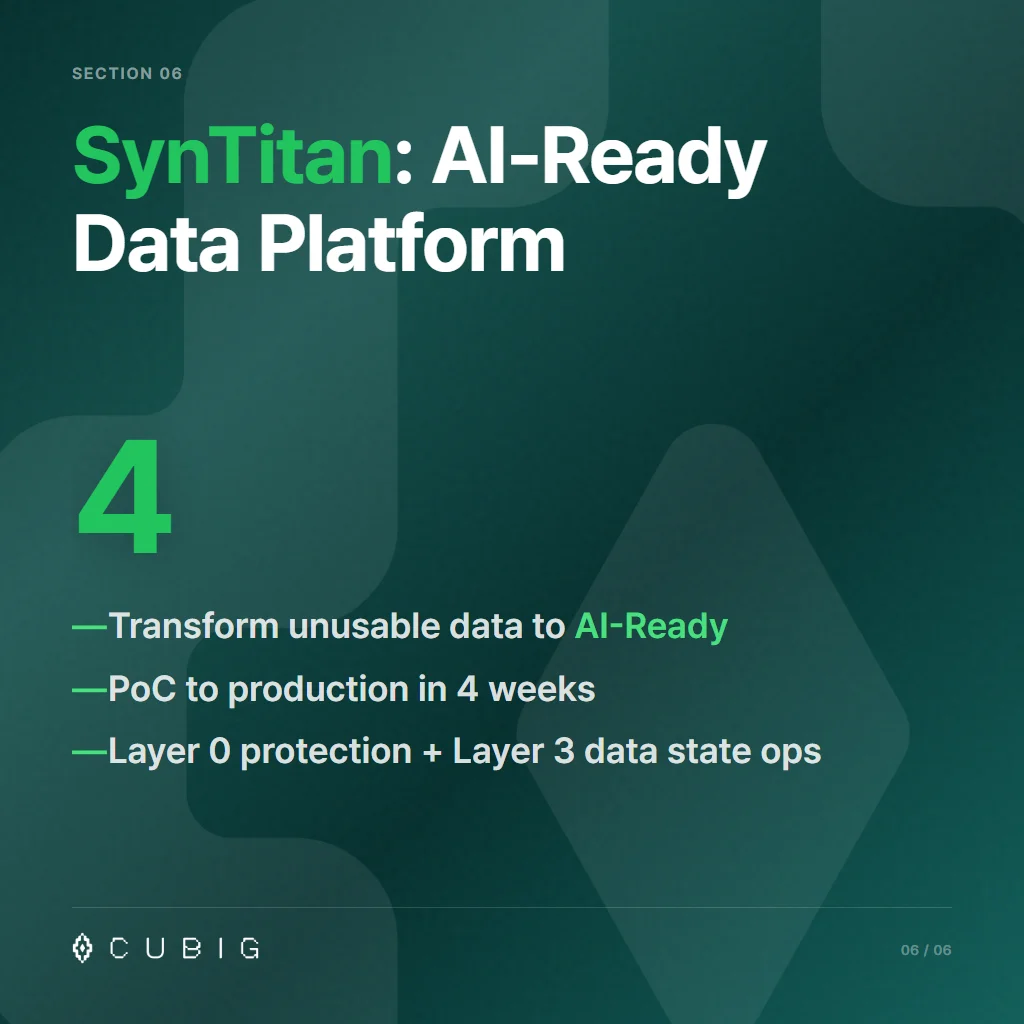
SynTitan takes that messy corporate reality and makes it usable. Sensitive details get handled without exposing a single personal record. Missing values and historical biases are fixed automatically. Think of it as a purification plant for your digital assets — it pulls in unusable water and pumps out clean hydration for your algorithms.
Picture your Monday morning changing completely. Instead of patching broken extraction scripts, your team runs models on information that’s already verified and ready. SynTitan activates trapped data for real business impact. The foundation becomes solid — and your team can finally focus on what they were hired to do.
FAQ
Why does unstructured data bottleneck agentic AI so badly?
Agentic workflows take independent actions based on context they receive. Feed them unstructured text or unvalidated PDFs and they start guessing. That guessing leads to automated hallucinations. A reliable enterprise AI data pipeline has to structure all inputs before the agent ever touches them — otherwise you’re looking at catastrophic execution errors.
How do we fix an enterprise AI data pipeline that constantly breaks?
Stop relying on fragile manual extraction scripts. They break every time an internal system updates its formatting. The modern approach uses automated data restructuring to bypass manual ETL entirely — replacing rigid rules with dynamic restructuring engines that adapt to format changes without developer intervention.
What makes data unusable for modern LLMs?
Three categories. First, uncollectable data — rare anomalies your systems never captured. Second, regulation-restricted data trapped behind compliance walls. Third, broken data riddled with missing values or historical biases. LLMs can’t magically fix these problems during inference. They just degrade output quality.
How does SynTitan handle regulation-restricted information without violating compliance?
SynTitan converts raw enterprise records into an AI-Ready state through original-replacement data generation. It restructures trapped information into a regulation-friendly format without ever moving raw files into exposed environments. What you get: fully usable statistical representations that keep all the business value of the originals — without triggering privacy violations.
Why are data engineers complaining about manual labeling in 2026?
Because they want to build, not babysit. Community discussions keep highlighting the same disconnect: engineers are hired to ship AI products but spend most of their time preparing inputs. Manual labeling is slow and error-prone. Organizations that trap developers in endless data cleaning cycles face high turnover and stalled deployments.
Can we just buy more compute to brute-force messy datasets?
No. More compute just processes bad information faster. High-density server racks and expensive cooling systems do nothing for missing values or unstructured document chaos. Throwing hardware at data unusability is a waste of capital. Fix the data execution architecture first, then scale your physical infrastructure.
How do we measure the ROI of automated data restructuring?
Track two things: stalled pilot programs going down and engineering hours freed from pipeline maintenance. When an enterprise AI data pipeline runs on its own, your developers ship features instead of fixing broken extraction scripts. Then measure the financial impact of safely activating historical records that were previously untouchable.

CUBIG's Service Line




Recommended Posts