Table of Contents
Summary
The dominant narrative tells us compute is the bottleneck. Everyone says you need better models and faster chips to win the AI race. That narrative is entirely backwards. The problem isn’t data scarcity — it’s data unusability.
Hardware investments are surging globally, yet 42% of US enterprises abandon their AI initiatives before reaching production. S&P Global reported these numbers just this year. Throwing raw compute power at unusable data simply accelerates the rate at which projects fail. Your models starve when fed restricted, low-quality, or missing information.
Organizations must stop treating AI as a software deployment challenge. AI systems fail in production because of the data state at execution time. Fixing this requires a fundamental shift toward agentic AI data architectures that restructure broken inputs into an AI-ready state.
The Hardware Boom Masks a Pipeline Crisis
Capital is flooding into physical AI infrastructure. Planners just greenlit a £1bn data center in London’s Park Royal to handle unprecedented power demands. Dell is aggressively rolling out new commercial PCs packed with dedicated neural processing units. The physical capacity to run complex models sits waiting on our desks and in our server racks.
This abundance of hardware creates a dangerous illusion for technology leaders. Executives assume that buying premium silicon guarantees working artificial intelligence. They ignore the messy reality hiding inside their enterprise storage networks. Raw storage holds massive volumes of trapped, restricted, and broken records.
Nobody wants to talk about the 88% of enterprise data that Gartner classifies as unusable. Data engineering teams spend months trying to clean legacy formats and handle missing values manually. These manual cleaning efforts buckle under the weight of production workloads.
A shiny new server rack cannot read an encrypted, regulation-trapped customer database. The compute is ready. The pipelines are broken.
Why Do Enterprise AI Projects Fail at the Finish Line?
Engineers build flawless proofs of concept on clean sample sets. Production environments rarely offer that same luxury. You deploy your application into the real world and immediately encounter infrastructure drift in AI workloads. Kubernetes environments drift out of alignment as raw data schemas mutate without warning.
A recent deep dive in The New Stack highlighted how this drift destroys containerized AI applications. Models expect standardized inputs. Real-world business systems generate anomalies, rare events, and regional formatting quirks constantly. The system breaks when the incoming stream no longer matches the training distribution.
* According to Gartner’s 2026 projections, organizations will abandon 60% of AI projects if they are unsupported by AI-ready data, highlighting that data unusability is the primary cause of generative AI failure. Building resilient applications requires locking results into immutable release states before execution.
The Shift from Coding to Agentic AI Data
Software development is undergoing a brutal market correction. Netcompany CEO Andre Rogaczewski recently noted that agentic AI will split the IT market into distinct winners and losers. Vendors selling simple peripheral software or commoditized programming hours will vanish. AI agents can now write basic code, set up tests, and generate documentation faster than any human.
This automation pushes the true value of enterprise technology up the stack. A recurring theme in Reddit’s data engineering communities highlights this exact shift. One senior developer noted that writing code is now the easy part. Translating complex business logic into a format that machines can process is the new engineering bottleneck.
Autonomous agents are useless without clean, structured context. You cannot ask an agent to audit your supply chain if your inventory records are trapped across three different regional silos. The agent will simply hallucinate or return an error.
This is where agentic AI data becomes the ultimate competitive moat. You must provide these autonomous systems with continuous access to verified information. The foundation of automation relies on converting uncollectable events into usable formats.
Organizations that master this transition will build entirely new operational workflows. Those who stick to manual pipeline maintenance will watch their highly paid developers waste hours fixing broken agents.
What Happens When Agentic Loops Hit Trapped Data?
Community discussions on Hacker News consistently reveal a massive fear regarding training AI on sensitive enterprise data. Practitioners describe the threat of reverse-engineering model weights to extract private information as an insurmountable barrier. Traditional masking tools destroy the statistical utility of the dataset. Your compliance team blocks the deployment entirely.
* While agentic AI can automate peripheral enterprise tasks, complex deployments require advanced data restructuring to ensure agents have reliable context without exposing sensitive proprietary information. You replace original sensitive records with mathematically equivalent alternatives. This approach activates trapped data for business impact while keeping the compliance wall intact.
Domain Expertise in AI Development Demands Specialization
Generic language models perform terribly in highly specialized industries. Domain expertise in AI development requires industry-specific context that general models simply do not possess. The market is aggressively pivoting toward hyper-specialized data foundations.
Look at the recent launch of STELA by Bioptimus. They partnered with 10x Genomics to build the world’s largest clinically linked spatial biology atlas. Financial markets show the exact same trend. BMLL and Tradefeedr just launched a year-long pilot to build AI-ready trading analytics using highly specific historical order book records. South Korea’s KIMM opened a new platform entirely dedicated to physical machine data.
These initiatives succeed because they focus on restructuring messy domain knowledge into a usable state. A generic model cannot trade stocks or analyze cell structures out of the box. It needs a curated, high-quality feed of specialized information.
Your organization likely sits on decades of unique operational history. That history is currently unusable due to legacy formats and missing values. Activating that specific domain history transforms a generic AI tool into a bespoke business engine.
How to Build Agentic AI Data Pipelines
Building for the future requires abandoning the old extract-transform-load mindset. You need an architecture that actively cures bias and handles missing values before the model ever sees the information. This means establishing a verifiable data state where every operational run binds to a specific release ID.
* IDC forecasts that by 2027, enterprises failing to prioritize AI-ready data for their agentic workflows will experience a 15% productivity loss due to scaling limitations and infrastructure drift. You avoid this fate by implementing original-replacement data generation. This technique restructures quality-impaired inputs into regulation-friendly formats.
Stop trying to bypass your air-gapped systems. Bring the restructuring process directly to the source. Converting unusable raw inputs into an operable state is the only path to production.
How CUBIG Addresses This
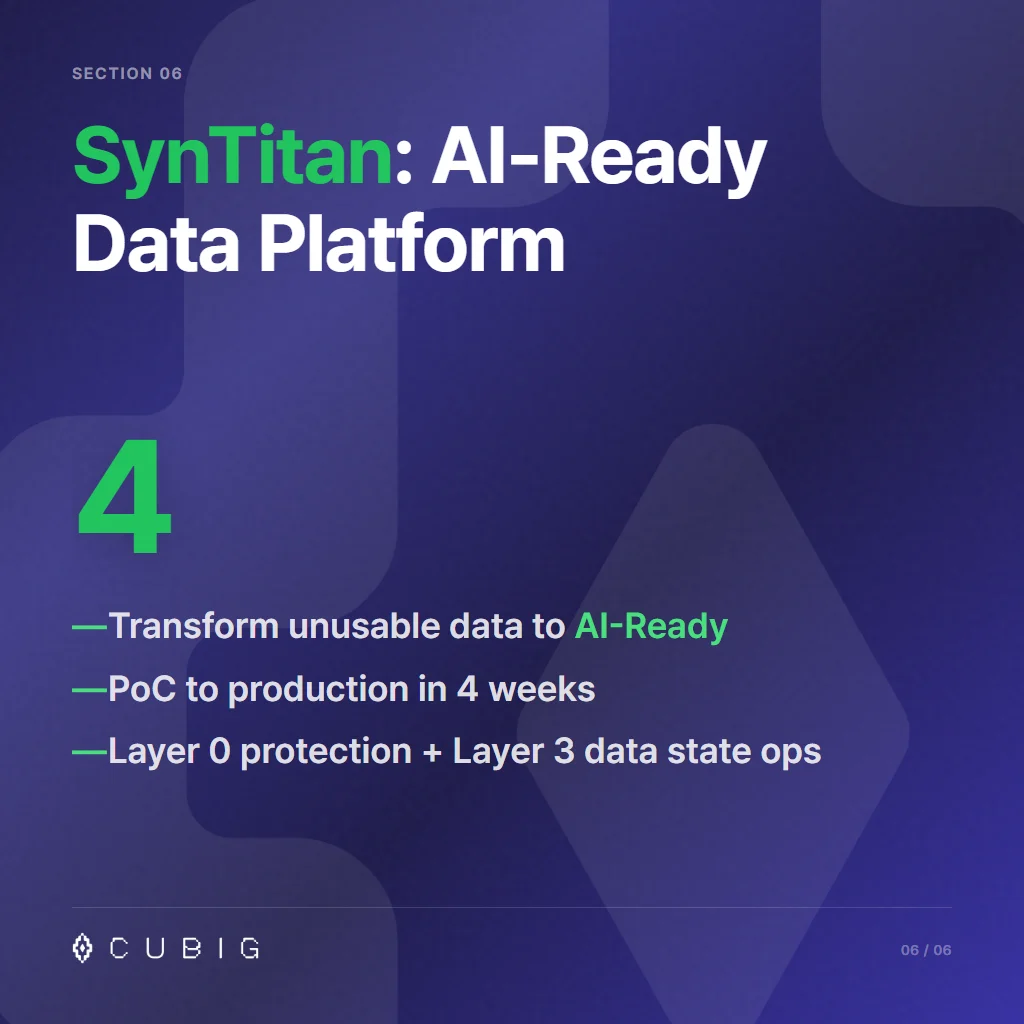
If you’ve been dealing with AI projects that look great in a demo but fail in production, you know the frustration of unusable data. Your data science team spends 80% of their week cleaning spreadsheets, fighting missing values, and arguing with compliance officers over access to sensitive records. By the time the data is ready, the business requirement has changed. Your highly paid engineers are functioning as digital janitors.
Your compliance wall disappears and your models gain immediate access. SynTitan restructures raw enterprise data into a regulation-friendly, AI-ready state. Sensitive personal information gets handled without ever exposing a single original record. Missing values, biased distributions, and broken legacy formats are automatically cured. Think of it as a translation engine that takes the chaotic reality of your business and turns it into a clean, verifiable format that AI can actually understand.
Imagine a Monday where your team skips the pipeline triage. Instead of writing custom scripts to handle infrastructure drift, they run their models on data that is already verified, frozen in a specific state, and ready for execution. You can reproduce any past model run with total accuracy because the exact data state was saved. Most AI projects fail because the data wasn’t ready. SynTitan ensures yours is.
FAQ
How do we integrate agentic AI data with our existing legacy databases?
You stop trying to connect agents directly to raw legacy tables. Create a dedicated intermediate layer that restructures legacy formats into context-rich, standard schemas. SynTitan handles this exact process by transforming your broken historical records into an AI-ready state. The agent queries this clean replica instead of your fragile core systems.
Does model context protocol enterprise integration solve the data quality problem?
No. Model Context Protocol standardizes how agents talk to your tools, but it does not fix the underlying information. If your database contains biased or missing values, MCP will simply feed those errors to the model faster. You must restructure the inputs into agentic AI data before establishing the protocol connection.
Why does traditional data masking fail in production AI workloads?
Traditional masking replaces names with asterisks or random strings. This destroys the statistical relationships and distributions that machine learning algorithms need to find patterns. When comparing data restructuring vs data masking enterprise strategies, restructuring wins because it generates original-replacement data. The new dataset maintains total analytical utility while remaining regulation-friendly.
How can we prevent infrastructure drift from breaking our machine learning pipelines?
You must freeze your datasets into immutable release states before execution. When a model runs, it should bind mathematically to a specific release ID. If the upstream schema changes, your current run continues operating on the verified frozen state. This allows your team to run diff comparisons and reproduce previous results precisely.
How do we handle uncollectable rare events when training models?
You generate structurally identical alternative records to fill the gaps in your distribution. Real-world anomalies happen too infrequently to train a reliable classifier. By analyzing the statistical properties of the rare events you do have, you can synthesize a robust volume of usable data. This cures the imbalance without fabricating false patterns.