SyntheticData
🔐 CUBIG Proposes a Synthetic-Data Strategy to Reduce PIA Burden and Build AI-Ready Infrastructure
Dec 24, 2025
🌱 Welcome to CUBIG – making sensitive data usable without anxiety
As large-scale data breach incidents continue to rise, public and financial institutions are facing growing pressure to strengthen privacy controls while still moving forward with AI adoption.
In many cases, organizations have the data they need, but practical barriers such as PIA requirements, operational risk, and compliance uncertainty slow down real execution.
CUBIG presents a synthetic-data-driven strategy that allows institutions to address privacy risks structurally, not only procedurally.
By shifting high-risk processing areas away from original personal data, institutions can reduce exposure while keeping AI initiatives on track.
This update aligns with the 2025.10 revision of the PIA guidelines and the broader push for AI-ready, regulation-aligned data operations.
🚨 Why PIA is changing: new AI evaluation items and rising breach risk
Recent breach reports have intensified public concern, especially as major incidents across telecom and card sectors have affected large populations.
Against this backdrop, the Personal Information Protection Commission and KISA released an updated Public Institutions PIA Guideline in October 2025.
The most notable change is the introduction of a dedicated AI evaluation area, covering privacy risks across both development and training stages as well as operational governance.
For large-scale or sensitive-data projects, the guideline emphasizes early assessment, technical safeguards, and credible alternative measures that reduce risk in practice.
This means institutions need not only documentation, but also an implementable method to lower risk while still enabling analysis and AI workflows.
🧩 Synthetic data as a practical alternative for safe analysis and AI training
In parallel, the Personal Information Protection Commission has highlighted synthetic data through separate guidance on generation and usage.
Synthetic data can reproduce structural and statistical characteristics without directly using real data, enabling analytics, model training, and policy research with reduced leakage risk.
In other words, PIA identifies and quantifies risk, while synthetic data provides a concrete way to reduce that risk at the data layer.
For high-sensitivity domains, this approach makes it easier to move from “risk management on paper” to “risk reduction by design.”
CUBIG’s proposal is built around this shift, helping institutions adopt AI with confidence under tightening privacy expectations.
🔐 DTS: Non-Access architecture plus Differential Privacy for AI-ready datasets
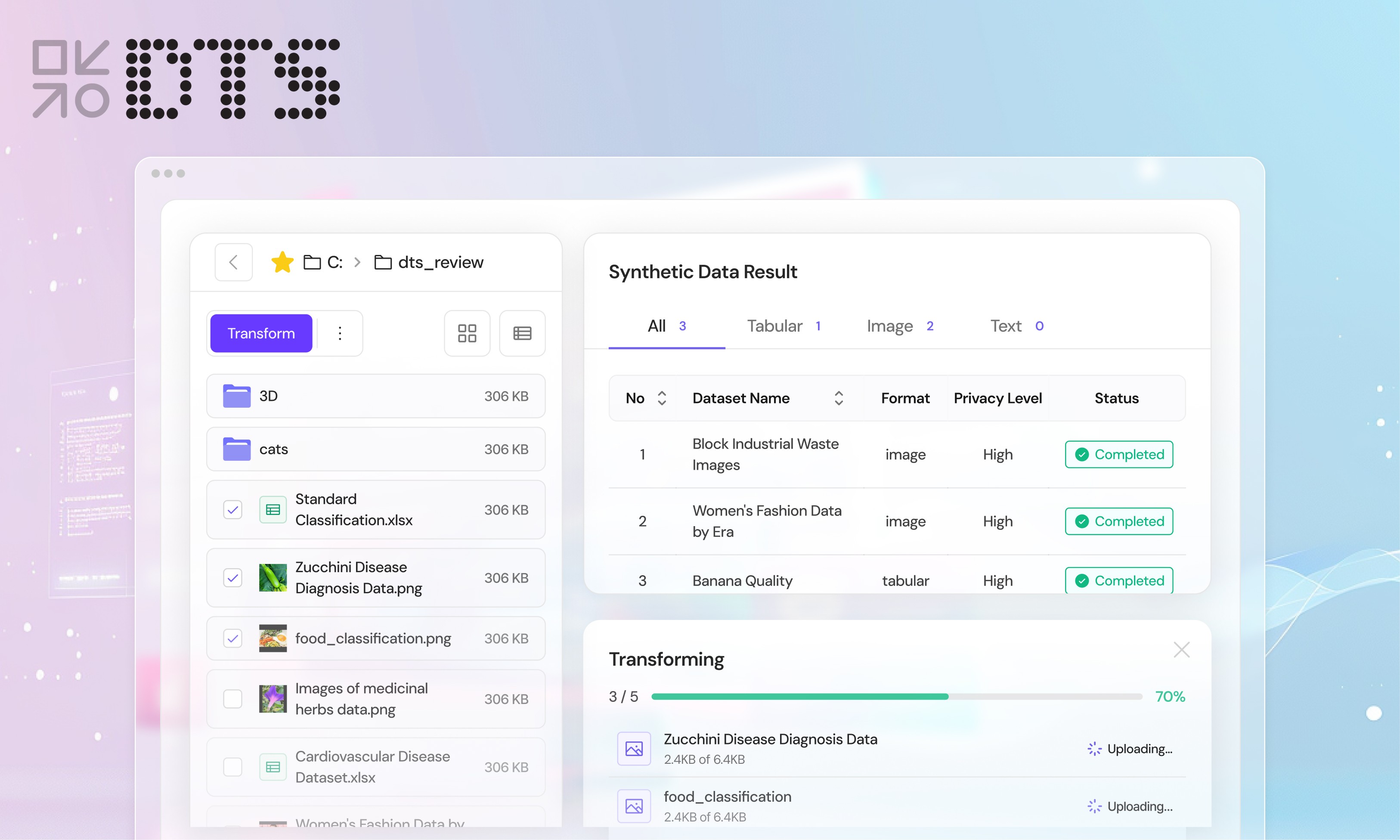
CUBIG’s DTS is designed to help institutions replace high-risk processing areas identified during PIA with privacy-preserving synthetic datasets.
DTS follows a Non-Access architecture: original data remains inside the institution’s internal network while the system learns statistical patterns and generates entirely new synthetic data.
By combining this with Differential Privacy, DTS mathematically controls re-identification risk and supports compliance-ready operation for sensitive environments.
This approach is intended to align with key requirements across Korea’s data laws, the Personal Information Protection Act, and GDPR-level expectations.
The result is an AI-ready dataset that supports analysis and model development while keeping strict control over original sensitive data.
📄 SynData Report: quantitative evidence you can attach to PIA deliverables
DTS supports multiple data formats, including tables, text, images, and time-series data, reflecting real-world public and financial data complexity.
After generation, DTS automatically produces a SynData Report that measures statistical similarity, machine learning performance, and re-identification risk.
This gives institutions measurable evidence for both safety and utility—two areas that PIA deliverables increasingly require in concrete terms.
Instead of relying on narrative explanations alone, teams can provide metrics and verification outputs as part of their assessment documentation.
Over time, this improves internal review confidence and helps shorten the cycle from assessment to real deployment.
🚀 Moving toward AI-ready public and financial operations, powered by infrastructure
CUBIG’s CEO Ho Bae noted that repeated large-scale breaches have increased concerns that PIA can become a documentation-only process if there is no practical way to reduce risk.
DTS addresses this gap by enabling institutions to build AI-ready synthetic data without using sensitive originals, and by generating verification outputs that can be attached directly to assessment reports.
CUBIG plans to expand PIA-linked synthetic data models through public-sector consulting, AI-ready dataset projects, and cross-organization synthetic data combination pilots.
By connecting regulation, assessment, and data operations into a single workflow, institutions can advance both compliance and digital transformation.
CUBIG will continue developing practical standards for trustworthy AI adoption in highly regulated environments.
📎 Read more
Read the full article(Click)📰
#CUBIG #DTS #SyntheticData #AIprivacy #PrivacyImpactAssessment #PIA #DifferentialPrivacy #PublicSectorAI #FinancialAI #AIReady