Hello, this is CUBIG the company behind Syntitan, the AI-ready data platform for enterprise AI. 💎
The AI delivery layer is the work of putting AI to use inside real enterprise workflows:
the layer between a capable model and a result a business can trust.
On June 14, 2026, OpenAI put real money behind that layer.
Its Partner Network commits roughly $150 million to train and support about 300,000 certified consultants by the end of 2026, with Accenture, BCG, McKinsey, Bain, and PwC among the launch partners.
The line worth reading twice is not the budget. OpenAI states that
“the limiting factor for seeing value from AI in the enterprise is no longer model capabilities.”
The company that sells the models just told the market the model is not where the difficulty lives.
This piece reads that announcement through one lens: what it does to the economics of enterprise AI adoption, and where the cost moves once the model stops being the scarce thing.
OpenAI just made AI delivery a volume business
Train 300,000 people to do the same category of work and you have not created a craft. You have created a volume business. The point of certifying that many consultants is to make AI delivery repeatable at scale, so deploying an LLM into a bank or a hospital becomes a known process instead of a custom expedition each time. OpenAI’s separate Frontier Alliance, announced in February 2026 with McKinsey, BCG, Accenture, and Capgemini, says the same thing in plainer words: define strategy, integrate systems, redesign workflows, scale deployment. That is the supply side of enterprise AI adoption being built in the open.
The firms have been preparing for volume from the inside. McKinsey runs Lilli, an internal generative-AI platform now active with more than 70% of the firm, doing the research, summaries, and first-draft slides that used to occupy armies of analysts. That work is being standardized away. What grows in its place is delivery: getting AI to actually run inside a client’s environment, again and again, in a way the client can rely on after the consultants leave.
So the announcement is best read as an industrial bet. The room has concluded that whoever certifies the most deployers wins the decade. The bet is sound on its own terms. It also exposes a question the headline skips, which is where the money in a volume business actually goes.
In a volume business, the margin leaks where nothing standardizes
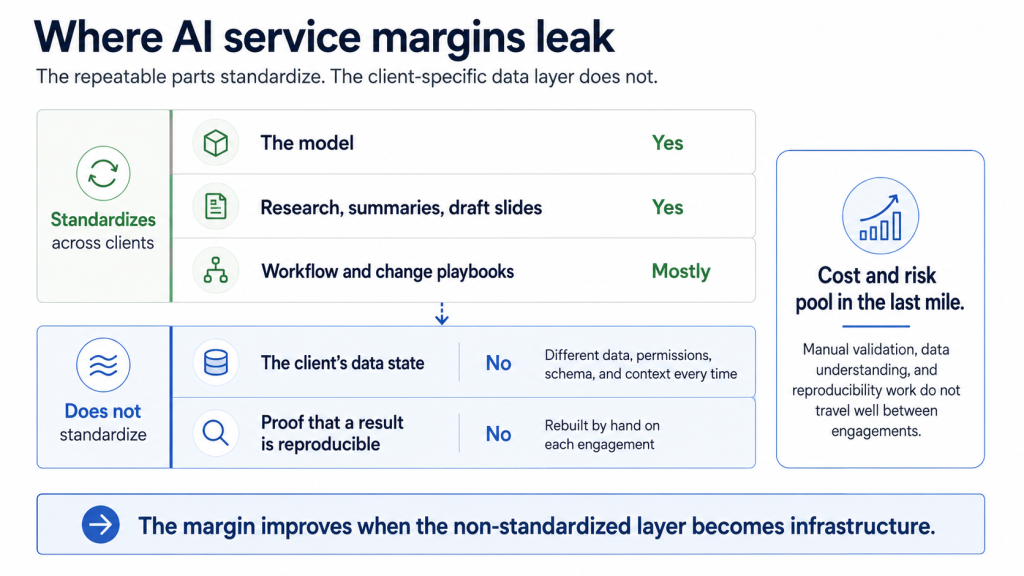
A volume business earns its margin on the parts that repeat cleanly from one client to the next. Everything that has to be rebuilt by hand for each engagement is where the money quietly drains out. So the useful question for anyone selling AI implementation services is not whether AI delivery is growing. It is which parts of an AI engagement standardize, and which do not.
| Part of an AI engagement | Standardizes across clients? | Why |
|---|---|---|
| The model | Yes | Same API and capabilities for everyone |
| Research, summaries, draft slides | Yes | Already automated, as McKinsey’s Lilli shows |
| Workflow and change playbooks | Mostly | Repeatable methodology, sold many times |
| The client’s data state | No | Different data, permissions, schema, and context every time |
| Proof that a result is reproducible | No | Rebuilt by hand on each engagement, if it is built at all |
The top of the table is what OpenAI just subsidized toward commodity. The bottom two rows are what no certification makes easier. They are specific to each client and they do not travel between engagements. In a volume business, that is exactly where cost and risk pool.
Now multiply those two rows by 300,000 consultants and every project they touch. On each engagement, someone checks whether the data is usable by AI, records which data a given result came from, and assembles enough evidence to defend it later. Today that is hand work, redone from scratch every time. It is the line item nobody puts in the deck, and it grows in step with the volume OpenAI just funded. The deployers compound. The data state under each project does not, unless someone turns it into a product instead of a slide assembled the night before the readout.
Measuring AI impact is a reproducibility problem
There is a second discourse running alongside the deployment one, and it is louder. The standard read on weak AI impact is that it is a skills problem. Teams are not strategic enough, not mature enough, not bought in. Fund more enablement, the argument goes, and the impact follows.
Underneath that sits a measurement problem no amount of enablement reaches. If the same model runs against a different data state every time, you cannot attribute the result. It worked in the first quarter. It did not in the second. Was that the model, the prompt, the people, or the fact that the input state had quietly moved between the two runs? With no way to reproduce the state, the question has no answer, and an answer is what the next budget cycle demands.
Impact you cannot attribute is impact you cannot defend. The precondition for measuring AI is reproducing the conditions it ran under. That is a data state question, and it sits before the strategy conversation, not after it. A delivery firm can run a flawless workflow redesign and still fail this test, because the test is about the data, not the deck.
Why most AI readiness is theater
The same blind spot shows up in how readiness gets sold. Every AI readiness assessment shares one weakness. It is a claim you make once. You assemble the slide, present the score, the room nods. Nothing in that ritual requires the state you described to still be true next week, or to have been reproducible in the first place. A one-time claim can be staged, and a staged claim is theater.
A better assessment framework does not fix this. The fix is structural. Readiness has to become a property that regenerates and verifies on every run, rather than a number asserted in a deck. When the same data state has to reproduce each time the system executes, there is no slide to hide behind, and the score stops being a story you tell once.
This is the part of the certification wave worth watching. It will train a great many people to produce the assessment. Far fewer are being trained to ask whether the thing being assessed survives a second look. A certificate signals that someone learned the method. It does not signal that the result they produced will hold next quarter.
The wall every AI deployment hits in production
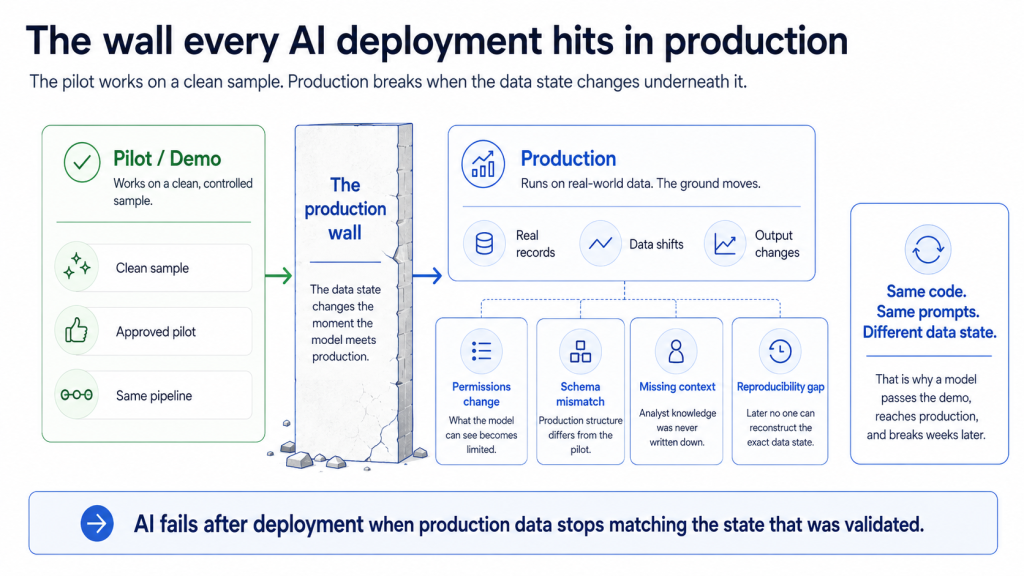
Sit with one project and the abstraction turns concrete. The proof-of-concept runs on a clean sample, the demo lands, the client approves the pilot. Then the work moves into production and the data shifts underneath it. The model now runs on real records instead of the sample. Permissions limit what it can see. The schema does not match the one the pilot was built on. Context that lived in one analyst’s head was never written down. Weeks later a result looks wrong, and no one can reconstruct the exact data the model ran on to explain why.
Much of the current engineering conversation is about controlling this with specs, gates, and evaluation loops. That is good practice, and it controls one kind of drift: the code and the process. It does not touch the other kind. Same pipeline, same prompts, next month’s data, and a field that was clean in March is half-null in June. Nothing in the code changed. The output did. A model rarely fails the way a verification loop is built to catch. It passes the demo, reaches production, and breaks three weeks later when the data state under it is no longer the state it was validated against.
Gartner has put a number on the cost. It expects organizations to abandon 60% of AI projects through 2026 for lack of AI-ready data, and a 2024 survey found 63% of organizations either lacked the right data practices for AI or were unsure they had them. Data state is not the only thing that breaks an AI project. Strategy, integration, and adoption all take their share. It is the one that does not standardize across clients, which is why it scales into cost rather than out of it. We trace the mechanics in why AI fails after deployment.
Where this leaves CUBIG, and the firms doing the delivery
CUBIG does not compete with the delivery firms. It removes their unstandardized cost. The repeated work on the bottom two rows of the table, confirming data is AI-ready, recording the data state behind a result, and reproducing it on demand, is what CUBIG turns into a product layer instead of per-project hand work. A few terms make the layer concrete:
- Data state. The condition of the data a model ran on: its contents, schema, permissions, and context at the moment a result was produced.
- Release State. A referenceable version of a data state, so a result is tied to the data it came from.
- Run Binding. The link between a run, the model, and the data state it used, so the output can be reproduced rather than recalled.
- Diff and Reproduce. The ability to compare two data states and to re-run an earlier one, so a result can be defended with evidence rather than a screenshot.
This is what AI-ready data actually means. It is not clean data. It is data in a state AI can use, that records how it was used, and that can be reproduced later. As enterprise AI adoption scales through the delivery layer, the firms that win the volume game will be the ones that stop rebuilding data state by hand and start treating it as infrastructure. The release discipline a delivery team would otherwise reassemble on every project becomes something they configure once and carry into the next engagement.
Before your next AI engagement
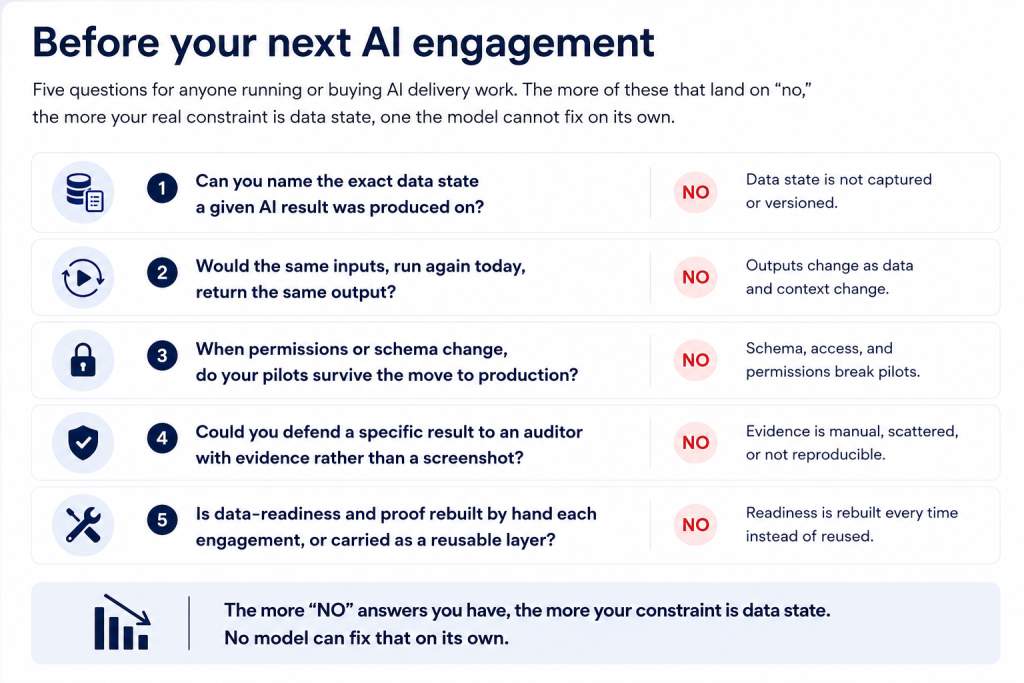
Five questions for anyone running or buying AI delivery work. The more of these that land on “no,” the more your real constraint is data state, one the model cannot fix on its own.
- Can you name the exact data state a given AI result was produced on?
- Would the same inputs, run again today, return the same output?
- When permissions or schema change, do your pilots survive the move to production?
- Could you defend a specific result to an auditor with evidence rather than a screenshot?
- Is data-readiness and proof rebuilt by hand each engagement, or carried as a reusable layer?
AI may reduce parts of consulting work.
It does not remove the need to prove how AI was executed.
As AI projects multiply, the delivery layer becomes harder to ignore.
About CUBIG
CUBIG is an AI-ready data operating layer for regulated enterprises and the firms that deploy AI for them. Between where data management ends and AI execution begins sits a missing layer: making real, restricted, or unstable data usable by AI, recording the exact data state behind each result, and reproducing it on demand. CUBIG fills it.
Its platform, Syntitan, operates that layer through Release State, Run Binding, Diff, and Reproduce, so every AI result is tied to the data it came from and can be re-run.
Its transformation engine, DTS, rebuilds restricted or unusable data into an AI-ready state in the first place. LLM Capsule lets teams run AI workflows on sensitive data by keeping the original inside the enterprise boundary while AI works on its structure, with results restored for real use.
Try it on your data, free.
Run a sample proof and see your own data state, recorded and reproducible.