


AI-Ready Data
Foundations5

Data Blockers: Restricted, Unusable, Unstable in Enterprise AI
The three data blockers are the three specific reasons enterprise AI stalls on its data: it is restricted, so you cannot use…

AI-Ready Data: Every Platform Claims AI Readiness — Ready for What?
Catalogs, governance suites, lakehouses, and synthetic data tools all describe themselves as making data AI-ready. They mean different things by the word.…

Agent-Ready Data Needs Semantic Context
By Bae Ho, Founder & CEO, CUBIG Corp. · Updated June 2026. Agent-ready data is enterprise data that carries the business meaning,…

AI-Ready Data vs Clean Data: Why Clean Isn’t Enough
Clean data passes type, null, duplicate, and compliance checks. AI-ready data clears one more bar: a model can still learn from what’s left, and…

What Is AI-Ready Data? (And Why Clean Data Isn’t Enough)
AI-ready data is enterprise data that scores well across six readiness axes, carries the semantic context a model needs, and is fixed…
Release State and Run Binding6
Release State vs Dataset Snapshot: What Reproducible AI Needs
Release State vs dataset snapshot comes down to one difference: a dataset snapshot is a passive copy of data at a point…

How Diff Works on Data State: See What Changed in an AI Run
A diff on data state is a field-level, structural comparison between two Verifiable Data States that shows exactly what changed in the…

Model Versioning Is Not Enough for Reproducible AI
Your model registry can't reproduce a run. Data state, preprocessing, and permissions shift under the same model version. Here's what closes the…

What Is Run Binding? Tying AI Runs to Data State
Run Binding ties every AI run to the exact data state it executed on. How it makes results traceable, comparable, and reproducible…

What Is Release State? Reproducing the Exact Data Your AI Ran On
Release State seals the exact data your AI ran on, so any run can be reproduced months later. What it is, why…

AI Readiness Assessment: The Six Readiness Axes
An AI readiness assessment scores your data on six readiness axes: Usability, Integrity, Context, Consistency, Reproducibility, and Traceability. It turns “AI-ready data”…
Production AI Failure Patterns5

The Hidden Cost of Stale Reference Data in Production AI
Stale reference data is the silent failure mode where the lookups, mappings, and rules an AI model relies on for context have…

Preprocessing Drift in Production AI
Preprocessing drift is what happens when the steps between raw data and model input change, so the model receives different inputs while…

Schema Changes Break Production AI: The Silent Release
Schema changes break production AI because a renamed column, a new category, or a type shift alters what actually reaches the model,…

How to Reproduce an AI Incident: A 6-Step Playbook
To reproduce an AI incident, you rebuild the exact data state and execution conditions that produced the wrong output, then rerun the…

Why AI Fails After Deployment: It’s the Data State
Why AI fails after deployment is rarely a model problem: the model that passed the pilot is usually unchanged, and what moved…
Comparisons11
Operating Control vs AI Governance Frameworks: Policy and Proof
AI governance frameworks define what an organization is allowed and required to do with AI; operating control is the run-level layer that…

Operating Control vs CI/CD for ML: What Each Reproduces
Operating control vs CI/CD for ML is the difference between a pipeline that ships reliably and a production result you can reproduce:…

Operating Control vs Feature Store: What Each One Records
Operating control vs feature store is a division of labor, not a rivalry: a feature store serves consistent features to training and…

Operating Control vs Data Catalog: Discovery vs Reproducibility
Operating control vs data catalog is not a choice between two versions of the same tool: a data catalog helps people find,…

Operating Control vs AI Monitoring Tools: Detect vs Reproduce
AI monitoring tells you a model’s output has drifted; operating control tells you which data state caused the drift and lets you…

Operating Control vs Generic MLOps: Versioning the Data State
Operating control is the layer that records which data state each AI run executed on and lets you reproduce that run exactly,…
Operating Control vs Model Registry: Which Reproducibility Gap Are You Missing?
Operating control vs model registry is not a choice between two tools: a model registry versions the model artifact and tells you…

Operating Control vs MLflow: Where Reproducibility Breaks
Operating control vs MLflow is not a contest between two tools: MLflow tracks the model lifecycle, while operating control records the data…
Databricks vs Syntitan: governing the estate, reproducing the run
Databricks Unity Catalog governs the broader data and AI estate, and Lakebase extends the platform into operational workloads. Syntitan captures and versions…

Snowflake Horizon vs Syntitan: semantic meaning and reproducible AI runs
Snowflake Horizon provides semantic context, governance, and policy across the data estate. Syntitan captures and versions the data state behind a single…
Collibra vs Syntitan: two answers to two different questions
Collibra governs whether an organization may use its data. Syntitan proves whether an AI result can be reproduced. The two answer different…
Proof Examples3

OT Data Reproducibility: Making Manufacturing AI Repeatable
OT data reproducibility is the ability to rebuild the exact operational-technology data state, sensor calibrations, sampling rates, line configuration, and tag mappings,…

Backtest Reproducibility Under Audit in Finance
Backtest reproducibility means being able to restore the exact data state a model backtest ran on, so an auditor can confirm the…

Reproducible Cohort Analysis in Healthcare: A Proof Example
Reproducible cohort analysis means any patient population you define for research or clinical work can be rebuilt later, exactly as it was,…
AI-Ready Transformation
DTS foundations1

What is DTS? The AI-Ready Data Transformation Engine
DTS is CUBIG’s AI-ready data transformation engine: it rebuilds restricted, scarce, or structurally unusable enterprise data into data a model can learn…
Sensitive AI workflow
Substitute · Execute · Reconstruct1

What is Sensitive AI Workflow Enablement?
Sensitive AI workflow enablement allows enterprises to run AI workflows on confidential data without exposing raw sensitive values to the model. Sensitive…
Structure and Multimodal1

Document Layout Preservation: Why Visual Structure Matters to AI
AI reads structure, not just words. Why tables, headers, and layout carry meaning models need, and how to keep document structure intact…
Workflow patterns1

LLM Data Egress: What Actually Crosses Into the Model and What Should
Every prompt is data leaving your control. What LLM data egress is, why it resists old controls, and how teams run AI…
Industry workflows1
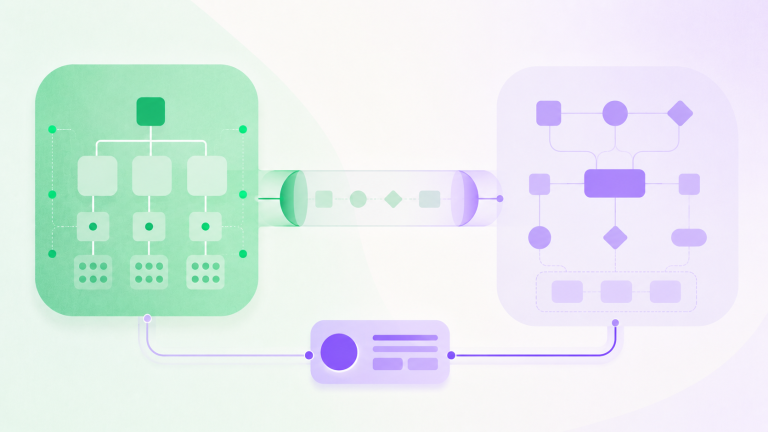
Public Sector: Running AI on Citizen Service Workflows
Running AI on citizen service workflows means sending an external model the structure of a case, not the resident’s real records, so…
Decision & comparison
Discovery — When the question changes1
PHI Masking vs Synthetic Data: Which Does Your Healthcare AI Actually Need?
PHI masking means altering or removing the identifiers inside protected health information, such as names, dates, and record numbers, so the data…
Adjacent comparisons1

Why an AI Gateway Alone Isn’t Enough for Regulated AI
An AI gateway routes and logs model traffic, but it can't make the data inside sendable or the run reproducible. What it…
No articles match the current filters.