The Agentic AI Bottleneck: Why Trillions in Hardware Won’t Fix Your Data
Table of Contents
Summary
The enterprise AI hardware boom is hiding a much quieter, catastrophic software failure. Right now, compute power completely dominates executive conversations. Massive capital investments are pouring into new chip architectures, advanced military digital signal processors, and mega data centers worldwide.
But all that spending tells a misleading story about where the actual operational friction lies. The primary bottleneck shifted away from model capabilities and processing limits months ago. Today, the crisis centers on one thing: unusable data.
Enterprise AI data readiness determines whether an ambitious technical initiative actually scales or dies on the vine. Algorithms starve. Feed them a steady diet of uncollectable, restricted, or structurally broken records, and they fail. Fix this foundational data layer, and you change everything about how your engineering teams deploy automation.
The Billion-Dollar Hardware Delusion

London just approved a massive billion-pound data center project in Park Royal to support next-generation workloads. Dell recently rolled out a new line of commercial PCs featuring processors designed specifically for heavy on-device computing. Pacific Defense is actively shipping edge AI digital signal processors for highly constrained military applications. 📃Dell Commercial PCs
Hardware vendors are clearly winning this technology cycle. You can buy all the raw compute capacity your budget allows. Yet, 42% of US enterprises still abandoned their machine learning initiatives last year according to S&P Global. 📃S&P Global AI Report
A sports car won’t win a race without refined fuel. Meanwhile, raw organizational information remains completely trapped behind rigid compliance walls and siloed legacy formats. Today, only 12% of enterprise data actually drives measurable business impact.
Why Do AI Projects Fail in Production?
Executive boards routinely authorize massive budgets for pilot programs. They look magical in a carefully controlled sandbox. Then reality hits. Nearly half of those proofs-of-concept are thrown out before ever reaching a live environment. Real-world deployment shatters the sandbox illusion immediately.
MIT Project NANDA research reveals a harsh truth. A staggering 95% of generative AI deployments generate zero measurable business return [1]. Why? Their underlying enterprise data pipelines aren’t built for real-time agentic workflows. Algorithms fail because the execution state of the inputs is deeply broken. Missing values, historical bias, and legacy formatting create a toxic ingestion stream. Complex neural networks simply choke on it.
The New Stack recently highlighted how Kubernetes infrastructure drift actively kills these deployments. Training environments rarely match the messy, unpredictable reality of live production clusters. Environmental mismatches destroy predictive accuracy overnight. 📃The New Stack Kubernetes Drift
True enterprise AI data readiness means facing facts. Manual cleaning won’t fix structural rot. Human engineers get completely bogged down parsing spreadsheets instead of building core architecture. It is exhausting. You have to systematically restructure your data before writing a single line of inference code.
What Are the Real Agentic AI Data Quality Requirements?
Agentic workflows will aggressively split the IT market into clear winners and losers over the next year. Andre Rogaczewski, CEO of Netcompany, notes that automation will commoditize basic software creation. At the same time, the value of core transactional systems will skyrocket. Those surviving core systems? They rely entirely on deep, proprietary domain expertise. 📃Netcompany CEO Interview
Generic coding skills just don’t offer a competitive edge anymore. A lead data engineer on Reddit recently pointed out that deep domain knowledge remains the top priority for hiring managers. You have to know how to solve specific business problems. Autonomous agents need a massive amount of exact business context to make safe decisions.
That critical context cannot come from scattered, unverified CSV files. BMLL and Tradefeedr recently launched a year-long pilot program to harmonize historical order book data for institutional trading analytics. They understand the stakes. Autonomous financial systems need a precisely standardized execution data layer to operate safely. 📃BMLL Data Partnership
Agentic loops fall apart when they hit uncollectable information. Think about rare market anomalies or specific hardware failures. They rarely exist in high enough volumes within current databases to train reliable decision engines. It is like asking a machine to predict the weather without showing it a single storm record.
Every successful AI initiative starts with usable data. Transforming your raw inputs gives your agentic systems the precise, high-fidelity context they crave. It is the only way they can execute complex tasks without catastrophic hallucinations.
The End of the Federated Learning Trap
There is a dangerous myth floating around modern data science. It claims that distributed model training solves organizational privacy problems. Vendors love selling the idea of training algorithms on local devices to avoid centralizing raw records. But this creates a massive false sense of security.
Recent technical discussions on Hacker News expose the fatal flaw in this architecture. Machine learning researchers point out a scary reality. Raw input data can often be mathematically reverse-engineered straight from the gradient updates sent to the central server. Your customers’ original records are never truly hidden from a determined adversary.
Outdated federated learning techniques aren’t enough anymore. To stop sensitive data from leaking through AI model weights, modern enterprise data pipelines rely on original-replacement data generation and deep data restructuring.
You have to fundamentally alter the structural shape of the information itself. Original-replacement tools create mathematically identical datasets containing zero real personal identifiers. Suddenly, that restrictive compliance wall disappears. The underlying records no longer belong to real humans.
How to Make Enterprise Data AI-Ready
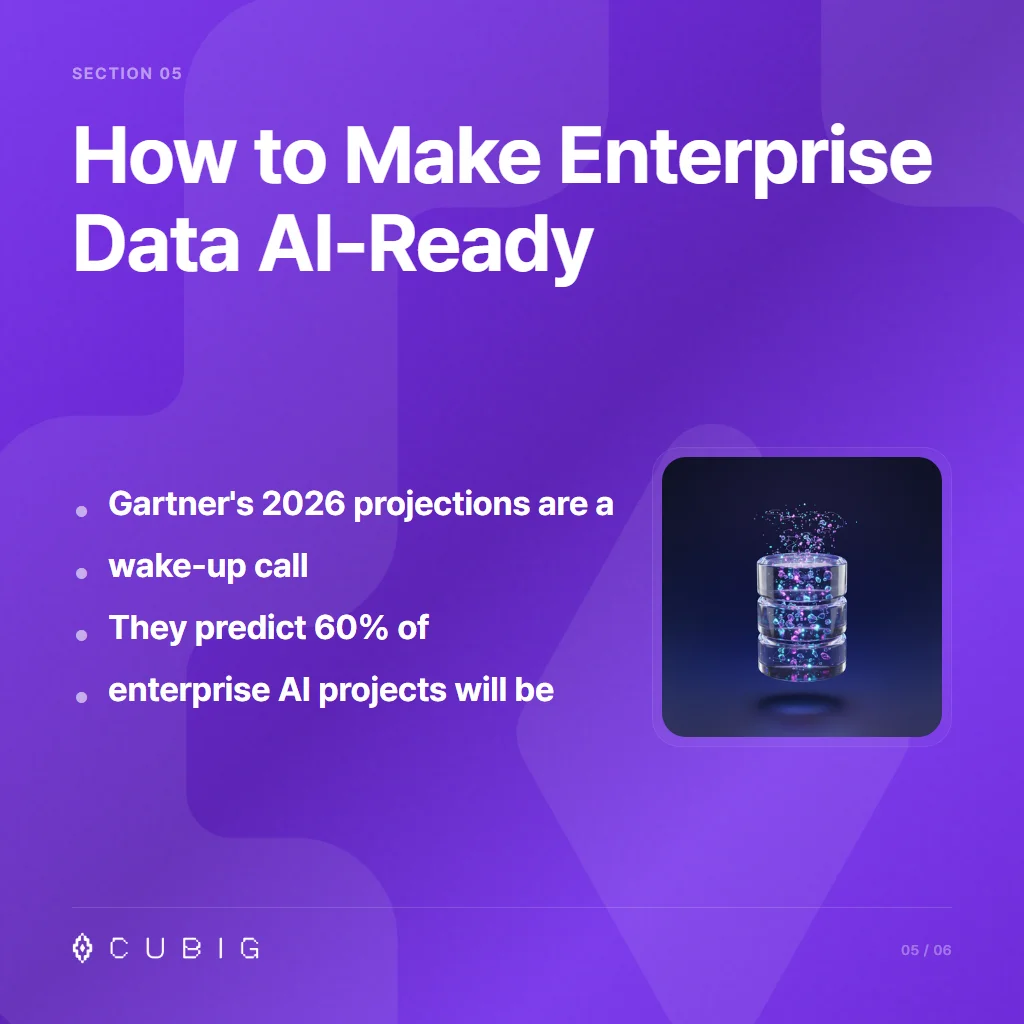
Gartner’s 2026 projections are a wake-up call. They predict 60% of enterprise AI projects will be abandoned due to a lack of AI-ready data [1]. Data unusability—not model capability—is the absolute biggest bottleneck for business ROI.
Fixing Kubernetes infrastructure drift for AI workloads means establishing an immutable state for all your training sets. You need a verifiable foundation that binds results into specific release states. This ties all operational runs to exact versions, ensuring robust reproduction when you need it later.
Enterprise AI data readiness is now a mandatory operational discipline. Activating that trapped data builds the exact engineering foundation your teams need. It is how you finally cross the finish line into live production.
How CUBIG Addresses This
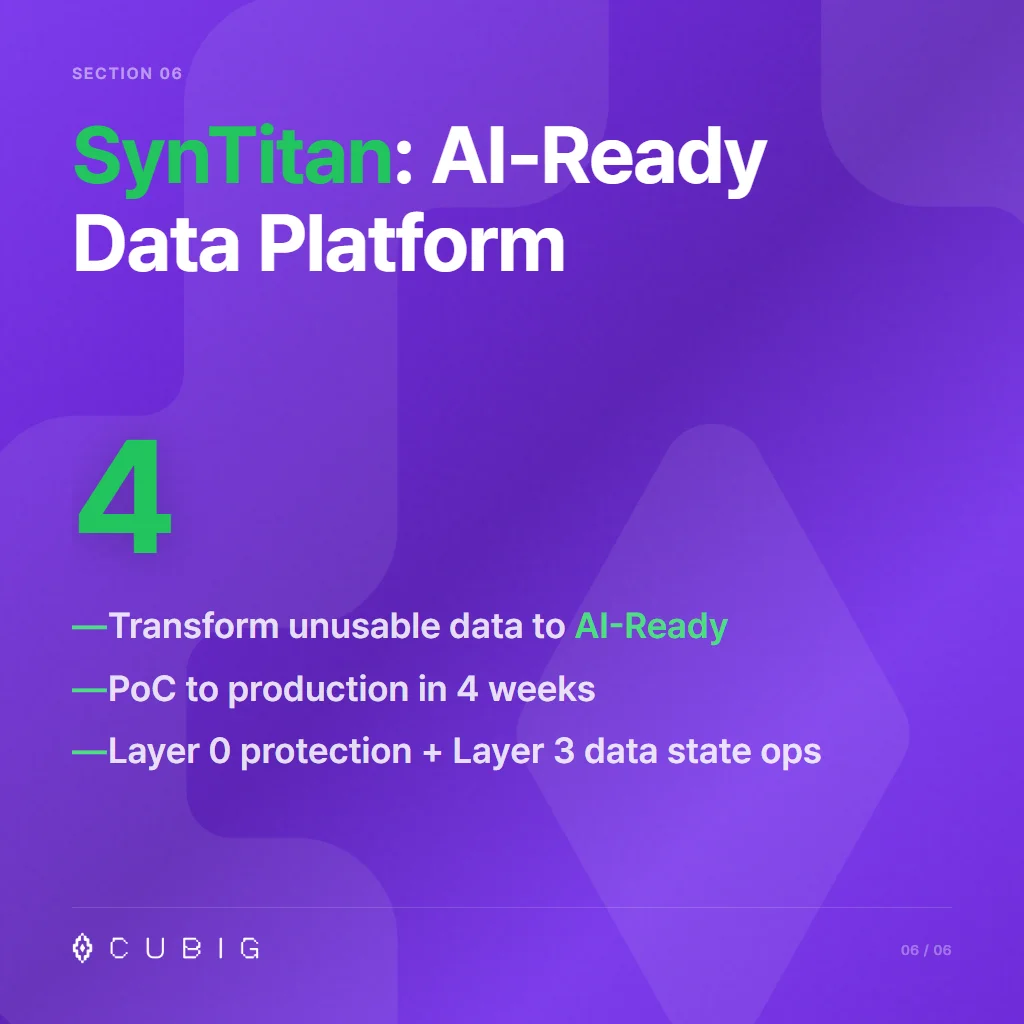
You likely have data scattered everywhere. It is messy, structurally incomplete, and stuck behind rigid internal regulations. We have all been there—watching engineering teams spend weeks begging legal for access. They waste months manually cleaning spreadsheets while your expensive models starve for reliable inputs.
SynTitan steps in to make that messy, regulation-trapped information actually usable. Think of it as an automated refinery for your raw organizational records. It restructures sensitive employee or customer details into a compliance-friendly format without exposing a single real person. Missing values? Historical biases? They get automatically cured before they ever touch your algorithms.
Imagine a better Monday morning workflow for your team. Instead of fighting with compliance officers over network access rights, developers run models on data that is already verified, standardized, and ready for agentic execution. You can even bind every single run to a specific release state. When auditors eventually knock, you have perfect reproducibility.
Enterprise AI data readiness doesn’t have to be a multi-year consulting nightmare. With SynTitan, your pipeline hums with high-quality inputs. Those perpetually stalled pilot programs can finally cross the threshold into real, revenue-generating production.
FAQ
Who actually owns enterprise AI data readiness within a modern corporate structure?
Today, the Chief Data Officer usually owns this metric. Historically, the burden fell entirely on IT infrastructure teams. But the massive shift toward agentic workflows demands deep domain expertise. CDOs align engineering pipelines directly with strategic business goals. They make sure data restructuring efforts provide the exact context those automated decision engines need to operate safely.
Can we achieve AI-ready data just by hiring a larger team of data engineers?
Throwing raw headcount at unusable data rarely solves the root structural problem. Manual cleaning simply can’t keep pace with the ingestion speed of modern machine learning pipelines. Human engineers get completely bogged down in repetitive parsing tasks instead of building core system architecture. You need automated platforms to handle the baseline standardizing and curing before a human ever touches the records.
How does SynTitan handle critical edge cases where the historical data does not exist yet?
Large organizations struggle heavily with uncollectable data—think rare market anomalies or infrequent hardware failures. SynTitan generates original-replacement data to mathematically fill those exact pipeline gaps. It analyzes your system’s statistical properties and creates regulation-friendly sets to accurately represent missing edge cases. This gives your decision models the complete structural picture required for accurate predictive analysis.
What specific role does data lineage play in fixing infrastructure drift for AI?
Data lineage tracking shows exactly where your organizational information originated and how it transformed over the pipeline lifecycle. When Kubernetes clusters drift between environments, poor lineage makes production debugging a nightmare. Establishing a verifiable data state lets your team reproduce the exact conditions of any previous model run. You instantly know if the inference code broke or if the underlying inputs shifted.
Are traditional enterprise data lakes sufficient to meet agentic AI data quality requirements?
Not anymore. Traditional corporate lakes operate mostly as massive dumping grounds for raw, unverified information. Agentic AI requires highly structured, context-rich inputs that cold storage just can’t provide. Autonomous agents need operable, decidable records to execute complex tasks without human supervision. Upgrading to an AI-ready lakehouse forces your organization to actively organize that raw data into a functional digital twin of your business.
Why do strict compliance teams continually reject federated learning pilot programs?
Compliance officers now understand that exposed model weights can easily leak personal customer information. Federated learning keeps the raw database local. But the mathematical gradient updates sent back to the central server still carry deep traces of the original inputs. Deep data restructuring removes this specific risk entirely. It systematically replaces sensitive elements while keeping the data structurally useful for the algorithm.

CUBIG's Service Line




Recommended Posts