The AI Agent Blast Radius and the New Era of Responsible AI
Table of Contents
Key Takeaways
- According to Gartner research from 2025, forty percent of enterprise applications will feature task-specific AI agents by the end of 2026.
- Enterprises with high unapproved generative tool usage face breach costs averaging $670,000 higher than the global baseline.
- LLM Capsule, developed by CUBIG, is a document-based AI Gateway that actively restructures organizational documents into an LLM-friendly form without exposing originals.
Responsible AI is often discussed as a philosophical exercise. Corporate ethics boards publish broad guidelines about bias and fairness while employees paste strategic roadmaps into consumer chatbots. In practice, ethics documents do not stop data leaks. Responsible AI requires tangible data boundaries.
A functioning AI strategy requires more than just trust. When employees need to analyze a spreadsheet, they will find a way to get an AI to read it. If IT restricts the approved channels, employees will use unapproved ones. There is a direct conflict between strict compliance mandates and user demand.
Organizations need a different approach.
We need infrastructure that assumes data will travel across dozens of external models. CUBIG approaches this challenge by creating reversible boundaries. LLM Capsule handles this exact friction point by letting teams use powerful AI features while keeping the underlying enterprise context isolated.
Why the Corporate Version of Responsible AI Failed
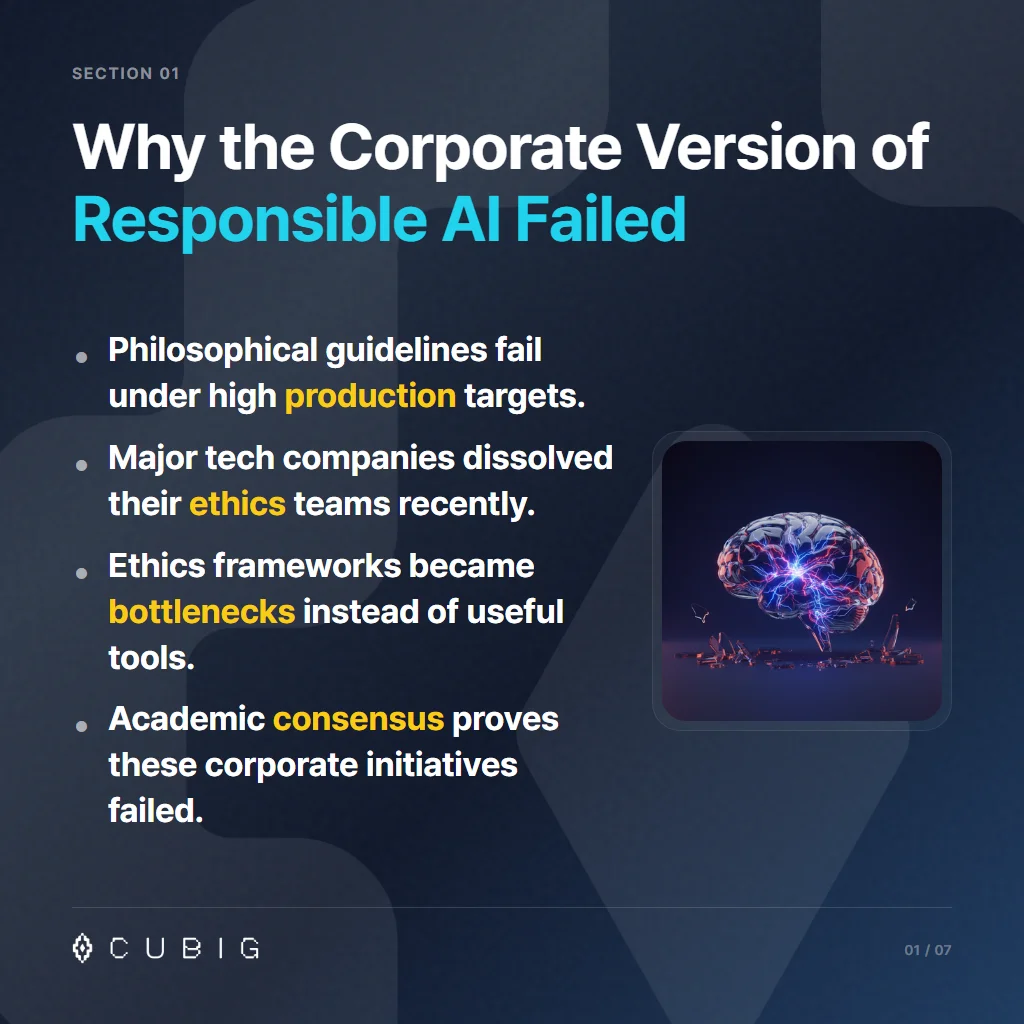
Philosophical guidelines fail when they meet aggressive production targets. Technical practitioners are often skeptical of corporate responsible AI initiatives. When major technology companies dissolved their ethics teams over the last two years, the developer consensus was loud and clear. Ethics had become a bottleneck to shipping products rather than a functional governance framework.
Academic consensus proves this point. Researchers in the Trustworthy and Responsible AI Network consortium recently published findings showing that governance must uphold legitimate business interests through continuous feedback loops. The problem arises when organizations try to bolt governance onto finished products. True responsible AI must act as an architectural data layer that continuously monitors the boundary where organizational data meets external models.
Forty-six percent of AI proofs of concept get discarded before reaching production according to a 2025 S&P Global report. Teams build advanced prototypes using sensitive customer records. Legal reviews the data flow right before launch and immediately shuts the project down. Businesses lose significant development time because governance was treated as an afterthought instead of a foundational layer.
Only four percent of organizations have high maturity in both data and AI governance according to Dataversity reports. Companies are rushing to deploy advanced language models without establishing a high-quality data foundation first. This implementation gap shows that abstract principles are useless without structural enforcement.
Are We Really Letting AI Agents Run Wild in Production?
Yes, unmonitored AI agents are actively executing downstream API calls and running SQL queries on live corporate databases today. The AI agent itself acts as a major vulnerability when deployed without strict data boundaries. Autonomous routines are no longer just passive chat interfaces.
Engineers are raising alarms about YOLO mode deployments on critical infrastructure platforms. Practitioners on developer forums report seeing agents write and execute queries directly on production databases. A malicious input hidden in a PDF can easily trick an agent into exfiltrating thousands of rows of customer data through indirect prompt injection. Red-team researchers with the Agents of Chaos group recently deployed over 191 attack probes proving exactly how easily agents fall victim to these invisible text manipulations.
AI agent compliance is now the most critical vector for enterprise risk management. Wendi Whitmore of Palo Alto Networks recently noted in a compliance intelligence briefing that the AI agent itself is becoming the new insider threat. The blast radius of a compromised agent extends far beyond a single compromised password.
To safely handle these new risks without outright bans, enterprises use platforms like CUBIG’s LLM Capsule to enable reversible data capsulation. An agent interacting with capsulated data cannot exfiltrate raw trade secrets because it only ever sees a mathematical representation of the document.
The Hidden Costs of Strict Shadow AI Prevention
Over 90 percent of companies have workers using personal chatbot accounts for daily tasks. IT departments respond to this by restricting IP addresses and browser extensions. This reactive shadow AI prevention strategy actively damages the business.
Restricting approved AI tools simply drives the behavior underground. Employees still use language models to format reports and write code. They just do it on their personal devices or through unmonitored network connections. Accorian Research notes that enterprises with high unapproved usage experience $670,000 higher breach costs than the global average. You are paying a significant financial penalty for pretending your employees are not using these tools.
This creates a hidden technology spend. Different departments buy redundant SaaS applications just to get access to embedded AI features. Marketing buys one tool while HR buys another. The data becomes completely siloed across a dozen different vendors.
A functional data activation strategy provides an approved path of least resistance. Employees will use internal gateways if those gateways actually work.
How Do You Enforce Rules Across Multiple AI Models?
Organizations enforce rules across disparate AI models by routing all generative traffic through a vendor-neutral data layer. This centralized infrastructure ensures every prompt follows identical governance policies regardless of which external model processes the request. The gateway standardizes the audit trail before any data leaves the corporate network.
The enterprise ecosystem is fragmented. Teams want to use Anthropic for coding tasks and Google Gemini for long-document analysis. Setting up individual data governance rules for every single endpoint is a major operational challenge. You need a single checkpoint that understands your enterprise context control policies.
Unlike Nightfall AI or Cloudflare AI Gateway, one architecture gaining traction is the AI Gateway model with built-in Cross-Model Execution. CUBIG’s implementation ensures you can switch workloads between OpenAI, Anthropic, and Google freely. You apply the exact same rules and audit logs everywhere to maintain zero vendor lock-in.
LLM data compliance relies entirely on consistent enforcement. A single layer across all model boundaries guarantees that a sensitive pricing document receives the exact same handling whether it goes to a local small language model or a large-scale commercial API.
Why Traditional Data Masking Breaks Generative Workflows
Salesforce Einstein Trust Layer and similar platforms rely heavily on placeholder masking. This legacy approach replaces real names and numbers with generic tags before sending the text to a language model. The model receives a sentence like “[PERSON] went to [LOCATION] to buy [PRODUCT] for [CURRENCY].”
The AI struggles to analyze that text effectively.
Language models require deep semantic context to generate useful insights. If you replace fifty different numerical values with identical [NUMBER] tags, the AI cannot perform basic comparisons or trend analysis. It cannot tell if revenue is growing or shrinking. The resulting output is usually a generic summary that adds zero business value.
Only twelve percent of enterprise data is actually used while 88 percent remains unusable according to Gartner. Masking guarantees that your most valuable documents stay trapped away and unusable. The AI era requires an entirely new approach to structural preservation.
Reversible processing changes this dynamic entirely. A system must maintain the structural relationships between words and numbers without exposing the literal values.
What Happens When We Decouple Context From Exposure?
Decoupling context from exposure allows an enterprise to extract deep analytical insights from proprietary documents without handing raw data to third-party vendors. The language model analyzes a mathematically capsulated version of the document while the original file remains isolated internally. The enterprise gets the analytical power of the model without the exposure risk.
Many engineers assume this extra step will cause significant latency in their applications. They worry that running heavy restructuring algorithms on every prompt will destroy the user experience. Modern boundary layers run these operations in milliseconds. The architectural overhead is practically invisible to the end user.
Decoupling enables true Enterprise Context Control. You get to decide exactly what constitutes sensitive information. It is not just about finding government ID numbers or credit cards anymore. Your internal pricing margins and future product roadmaps are highly valuable to govern.
Claroty uses verified deployments of these architectures to perform factory data analysis. They process sensitive industrial data through external models without exposing the raw operational metrics. This is the practical application of responsible AI in high-stakes environments.
Building an Enterprise AI Data Strategy for 2026
Gartner predicts that 60 percent of AI projects will halt by 2026 due to a lack of optimized data. The companies that survive this reckoning will be the ones that build compliance-ready infrastructure today. You cannot scale autonomous workflows on a foundation of unmanaged spreadsheets and fragmented APIs.
A robust responsible AI strategy treats data as a fluid asset that needs continuous boundary management. The pipeline must handle incoming unstructured text, structured database queries, and autonomous agent outputs simultaneously. This requires active data activation frameworks rather than passive storage rules.
Every organization must audit their current model boundaries immediately. You need to know exactly which applications are sending data outward and which agents have access to internal databases. Visibility is the first step toward actual governance.
Stop treating governance as an ethics committee agenda item. It is an engineering requirement. The tools exist to build this correctly.
How CUBIG Addresses This
Data teams frequently experience this frustration. You know your company could save thousands of hours if you could just feed your real contracts and financial histories into a modern language model. Legal says no. Compliance says no. Your most valuable data sits trapped and unusable because nobody wants to be the person who leaked the corporate roadmap to a public model.
Your documents stay inside your walls. LLM Capsule restructures them into an LLM-friendly form without exposing originals through our Zero Exposure architecture. The AI gets exactly what it needs to give capable answers. That is the entire concept of Rehydration Restoration. You send a capsulated query, the model does its heavy lifting, and the response comes back with your original names, numbers, and formatting automatically restored locally.
Look at how public institutions operate. Gangnam District Office uses this exact approach for air-gapped government document automation. They analyze restricted public records without those records ever touching a commercial server. DB Insurance does the same thing for customer data analysis. They process complex claims using powerful AI features while maintaining strict isolation of the raw data.
You do not have to choose between falling behind on AI and risking your company’s proprietary data. You just need the right boundary layer to manage the traffic.
FAQ
How does responsible AI differ from standard IT compliance?
Standard IT compliance focuses on access controls and storage encryption. Responsible AI specifically addresses the behavioral risks of generative models and autonomous systems. It requires active boundary layers that evaluate prompt intent, manage LLM data compliance in real time, and ensure that AI agent compliance protocols prevent autonomous tools from executing unauthorized workflows.
What is the most effective method for shadow AI prevention?
The most effective shadow AI prevention strategy is providing a superior, compliant alternative. When organizations deploy internal AI Gateways like LLM Capsule, employees gain access to top-tier models like Claude and GPT without restrictions. This eliminates the motivation to use personal accounts while keeping all interactions logged within the corporate network.
Can indirect prompt injections compromise internal databases?
Yes. If an AI agent reads a PDF containing hidden malicious instructions, it can be tricked into running unauthorized database queries. Proper AI agent compliance requires decoupling the reading mechanism from the execution mechanism. A vendor-neutral data layer strips out execution capabilities before the agent processes external unstructured documents.
How do we preserve document structure during data capsulation?
Structure-Preserving Processing maintains the layout of tables, lists, and JSON formats by applying mathematical transformations only to the specific text values. The structural metadata remains intact. The language model receives a precisely formatted spreadsheet filled with capsulated tokens, allowing it to perform accurate column-based comparisons and complex trend analysis.
What is Cross-Model Execution in the context of LLM data compliance?
Cross-Model Execution allows a company to route queries to any available language model through a single governance checkpoint. This ensures consistent LLM data compliance regardless of the vendor. If a team switches from OpenAI to Gemini, the exact same capsulation rules and audit logs apply automatically without requiring new configuration.
Why do traditional redaction tools fail with generative AI?
Traditional redaction tools delete contextual information permanently. If you redact fifty different financial figures with identical black boxes, the AI cannot understand the relationship between those numbers. Responsible AI workflows require reversibility. The system must maintain relational context during analysis and restore the exact original values when generating the final response.
How does Rehydration Restoration actually work for end users?
An end user uploads a proprietary contract into their company portal. LLM Capsule swaps sensitive clauses with mathematically mapped tokens before sending the query. The AI vendor processes the tokens and generates a response. As the response travels back into the corporate network, the gateway automatically maps the original text back into the sentence seamlessly.

CUBIG's Service Line



Recommended Posts