Summary
Models are very cheap right now. Open-source options are catching up to proprietary giants every single week. The real battleground is your enterprise data pipeline — the messy plumbing nobody wants to talk about.
We keep seeing companies buy massive GPU clusters only to watch them sit idle. The engineering teams are waiting for data that never arrives. The foundation is completely cracked. Usable data barely exists in the wild.
This article breaks down why we are failing to ship reliable AI. I will show you how to stop wasting budget on model tweaking. We are going to focus on transforming raw, trapped data into an operational state that actually works.
Why Do AI Projects Fail in Production?
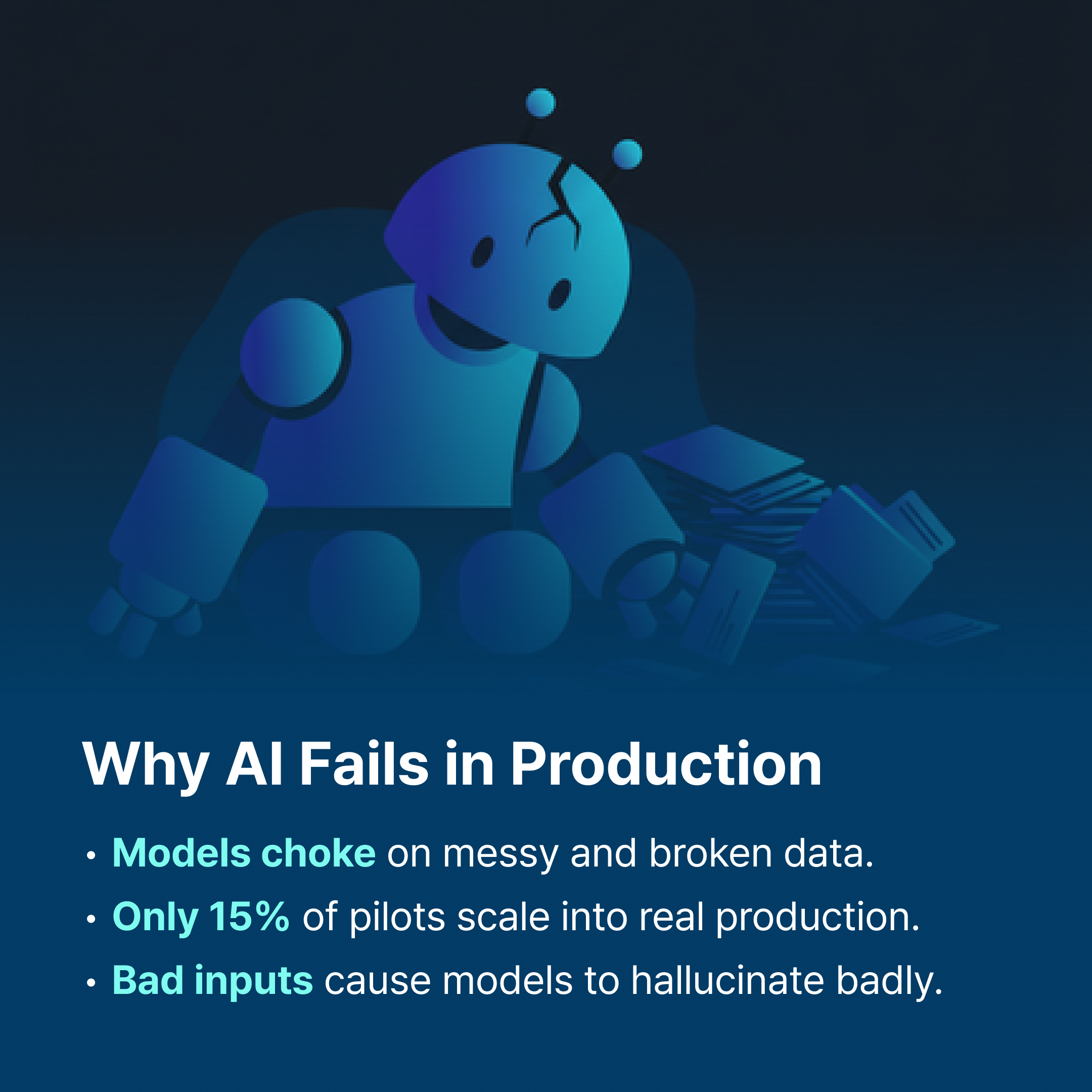
AI projects fail in production because organizations feed advanced models with deeply unusable data. Proof-of-concepts look absolutely flawless on sanitized datasets. Real-world systems quickly choke on messy, restricted, and broken formats. This disconnect kills momentum and guarantees deployment failure.
Forrester market analysis indicates that only 10% to 15% of generative AI pilots successfully scale into sustained production, largely due to data pipeline integration failures and poor data quality. You build a nice chat tool in a staging environment. You point it at the live database, and everything breaks instantly. The nice tabular structure you relied on is completely missing in the wild. Real data is full of uncollectable edge cases and missing fields.
According to Gartner research, organizations will abandon 60% of their enterprise AI projects through 2026 primarily because their underlying data is unusable or not AI-ready. That number should terrify any data leader. You cannot engineer your way out of bad data by prompting a model harder. The issue starts at the source. If the inputs are restricted by regional binds or completely broken, the best LLM in the world will just hallucinate with extreme confidence.
The Truth About the Enterprise Data Pipeline Bottleneck Solution
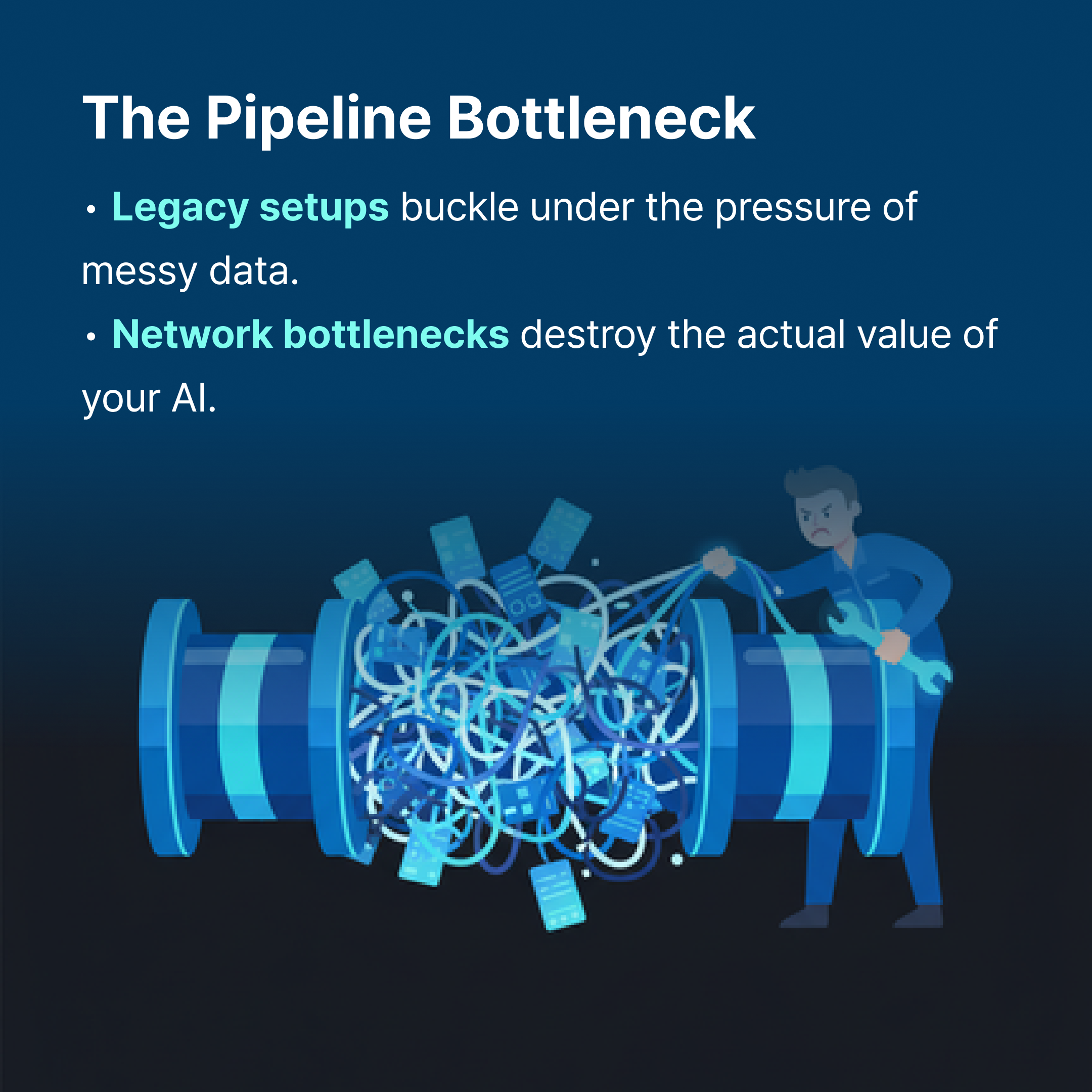
Your infrastructure is actively working against your most expensive AI ambitions. An effective enterprise data pipeline cannot just transport raw bytes across servers. It must transform restricted, low-quality inputs into an AI-ready state before hitting the model. Legacy setups simply buckle under this pressure.
There was a viral April Fool’s post on Reddit recently telling people to stop calling themselves Data Engineers. The joke hit too close to home. Engineers are completely exhausted. Executives demand magical AI outcomes while providing them with fragmented, siloed data that hasn’t been cleaned since 2018. The team spends ninety hours writing custom regex scripts just to parse dates from a legacy mainframe. That is a massive waste of human talent.
The physical transport layer is also failing us. Kate Johnson, CEO of Lumen Technologies, recently published an open letter warning that network bottlenecks destroy AI value. You cannot move petabytes of unstructured files across old architecture without massive latency. The compute sits there burning cash while waiting for the payload. The enterprise data pipeline has to evolve.
We need to restructure the data closer to where it lives. The goal is to shrink the payload and increase the quality simultaneously. Your enterprise data pipeline has to evolve from a dumb pipe into an active data restructuring engine. You activate trapped data right at the source.
What Happens Under an Agentic AI Data Governance Framework?
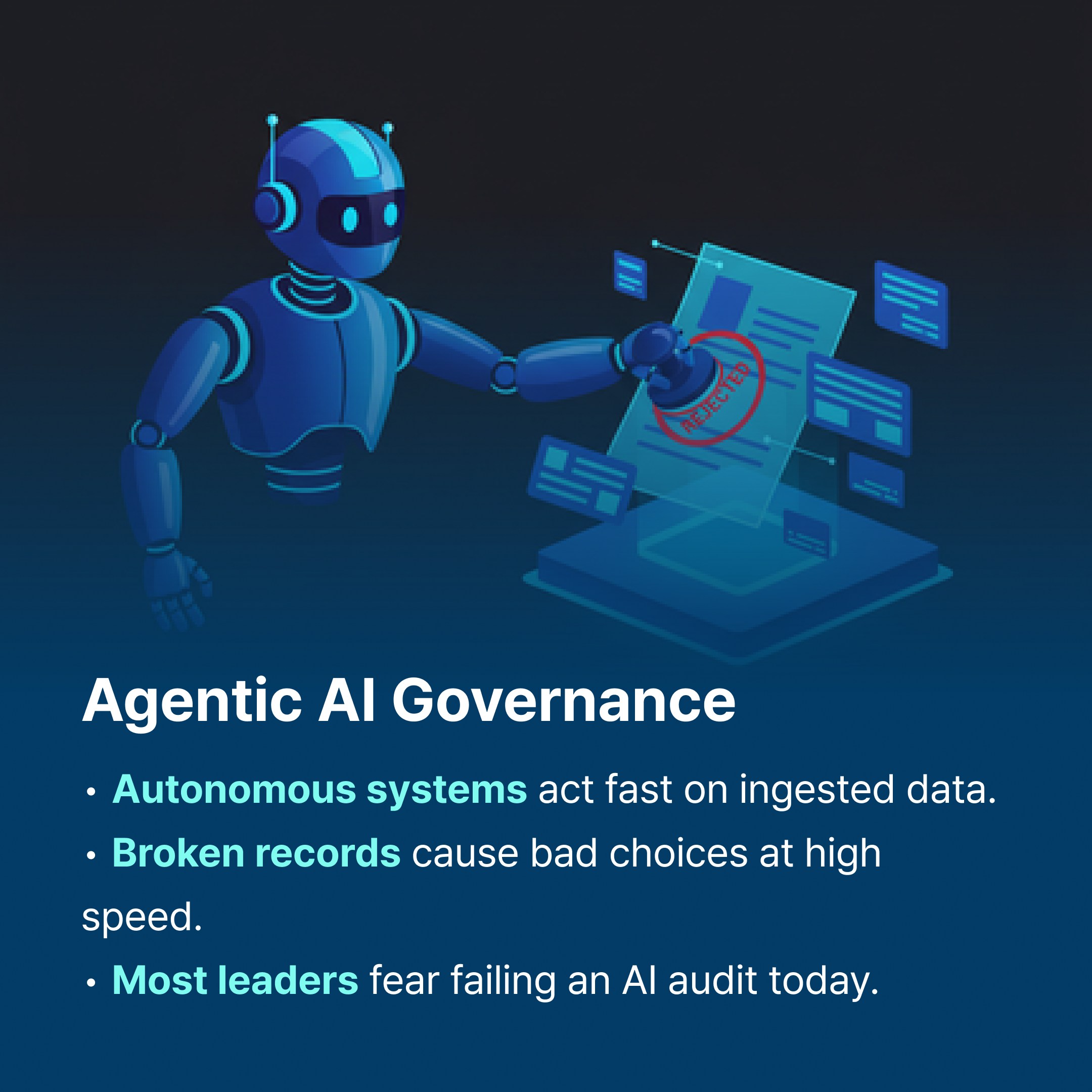
Agentic AI requires flawless data governance because autonomous systems act on ingested information. If you feed an agentic loop broken or biased records, it will make bad decisions at machine speed. Governance ensures the inputs are mathematically sound and compliant before execution.
A 2026 Grant Thornton survey revealed that 78% of business leaders lack confidence in their ability to pass an independent AI governance audit, highlighting a massive gap between AI investment and data accountability. We are giving software the power to send emails, approve loans, and route physical shipments. These autonomous systems will execute tasks based on the data they ingest . And right now, they are ingesting garbage. A single null value in a critical field can trigger a catastrophic cascade of automated actions.
Real practitioners know exactly how dangerous this is. A recurring theme in Hacker News discussions revolves around the inability to audit what exactly went into a model’s training run. Developers are terrified of reverse-engineering attacks that extract raw personally identifiable information from model weights. You cannot just cross your fingers and hope the model behaves.
You need strict rules governing the execution state. Every single run within your enterprise data pipeline needs to be bound to a specific, verifiable release state. If the agent makes a massive mistake on a Thursday afternoon, you need to reproduce the exact data state from Thursday to debug it. Lineage tracking is not optional anymore.
Without this level of control, agentic AI is a massive corporate liability. Your infrastructure must provide full capabilities to track and verify the lineage of every token. The business needs original-replacement data that carries zero regulatory risk.
Data Restructuring vs Data Masking Enterprise Realities
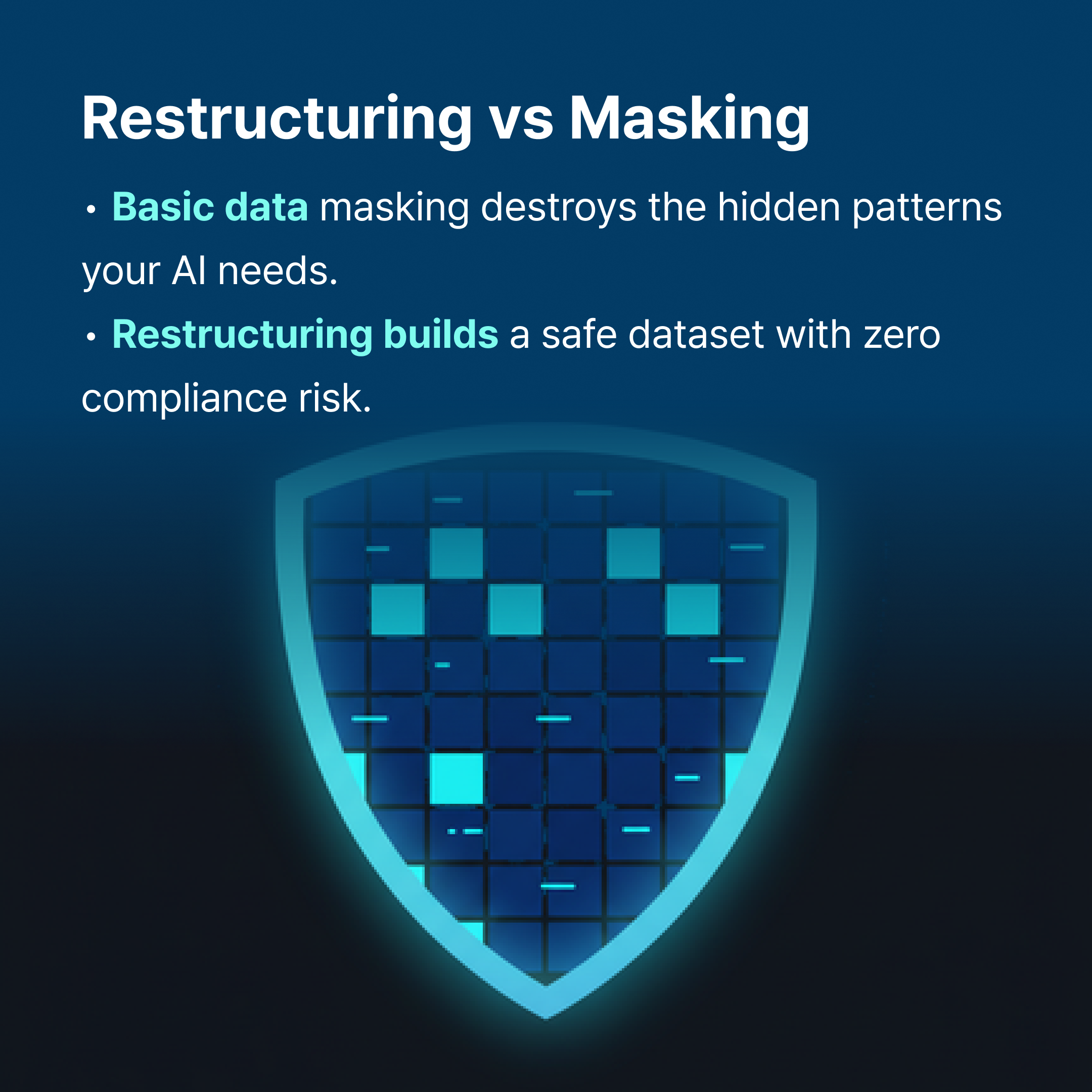
Basic data masking destroys the mathematical relationships your AI needs to learn. Data restructuring rebuilds the dataset entirely. It creates original-replacement data that maintains the exact statistical behavior of your raw records without exposing a single actual entity to the model.
I have watched too many compliance reviews kill solid projects because standard masking left too much risk on the table. Redacting names and replacing phone numbers with random zeros breaks the clustering logic. The models fail to find the hidden patterns because the data was deeply altered. Data restructuring bypasses this entirely by generating a completely new dataset. You get the insights of the original data with zero compliance baggage. Your enterprise data pipeline flows freely again.
Overcoming the AI Proof Gap with Usable Data
You close the AI proof gap by treating data usability as your primary engineering metric. When models ingest clean, restructured data bound to a verified release state, deployments succeed. Your enterprise data pipeline stops being a blocker and becomes a measurable driver of business value.
The operational state of a working system is a beautiful thing. Your engineers stop writing custom scripts for bizarre edge cases. Missing values are auto-cured before they ever reach the data lake. The business starts seeing actual return on investment because the models are finally eating high-quality fuel. Everything is regulation-friendly by default.
Success means your data is trapped in a state you can reproduce. You activate trapped data and turn it into something operable. That is exactly how you survive the AI hype cycle and actually deliver results to the business.
How CUBIG Addresses This
If you have been dealing with pilot purgatory, you know the frustration well. You have got data scattered everywhere across the company. It is messy, incomplete, and trapped behind heavy compliance rules. Your AI models are starving while drowning in a sea of raw information.
Think of SynTitan as your automated data refinery. It takes unusable inputs and makes them AI-ready. Sensitive data gets handled without exposing the actual records to the engineering team. Missing values and bias profiles are automatically cured before they break your pipelines.
SynTitan takes your messy, regulation-trapped data and makes it usable . Without exposing a single personal record. Imagine your Monday morning. Instead of cleaning spreadsheets and fighting compliance officers for access, your team is running models on data that is already verified, restructured, and ready to go.
Your enterprise data pipeline goes from a massive headache to your biggest competitive advantage. Your team gets their nights and weekends back.
FAQ
Why do AI models fail when moved from staging to production?
Production environments lack the sanitized inputs used during testing. Real enterprise systems generate uncollectable anomalies and broken formats constantly. When a model encounters this chaos, its accuracy drops to zero. You must build pipelines that handle data unusability automatically before execution.
How does data restructuring differ from synthetic data generation?
Traditional synthetic data often involves creating fake scenarios for vision or simulation. Data restructuring focuses on replacing your exact, existing enterprise records with a mathematically identical substitute. It solves the usability problem for trapped data without losing the original business context.
What makes a dataset truly AI-ready?
AI-ready data is cleaned, verified, and trapped in a state you can reproduce. It has no missing values or unchecked bias. Most importantly, it is regulation-friendly, meaning your team can actually run operations on it without triggering compliance alerts from legal.
How can we speed up compliance approvals for AI training?
You stop asking for permission to use raw data. Instead, you process it through SynTitan to generate original-replacement data. The compliance wall disappears because the resulting dataset contains zero personal exposure while retaining full analytical utility for your data scientists.
Why is pipeline monitoring not enough for agentic AI data governance?
Monitoring tells you when a pipe broke. Agentic AI needs state verification to know exactly what the data looked like at the millisecond it made a decision. You need an immutable release state to debug autonomous actions effectively when things go wrong.
Should we hire more data engineers to fix our enterprise data pipeline?
Throwing headcount at broken data is a losing strategy. Human engineers burn out doing repetitive cleanup tasks on uncollectable formats. You need automated systems that transform unusable data into usable data continuously. Your engineers should be building features, not parsing legacy CSV files.