Table of Contents
Summary
Hardware investments are breaking records while actual AI deployments crash and burn. According to Gartner’s 2026 forecasts, 60% of enterprise AI projects will be abandoned due to a lack of AI-ready data, underscoring that raw enterprise data remains largely unusable for modern AI models. Companies are buying compute power at an astonishing rate. They are completely ignoring the state of the information feeding those processors.
You cannot solve a data unusability problem by throwing more GPUs at it. The models are fine. The infrastructure is powerful. The foundation is simply cracked. Fixing this requires rethinking the enterprise AI data pipeline from the ground up. We have to stop moving raw garbage and start engineering usable assets.
Why Do AI Projects Fail in Production?
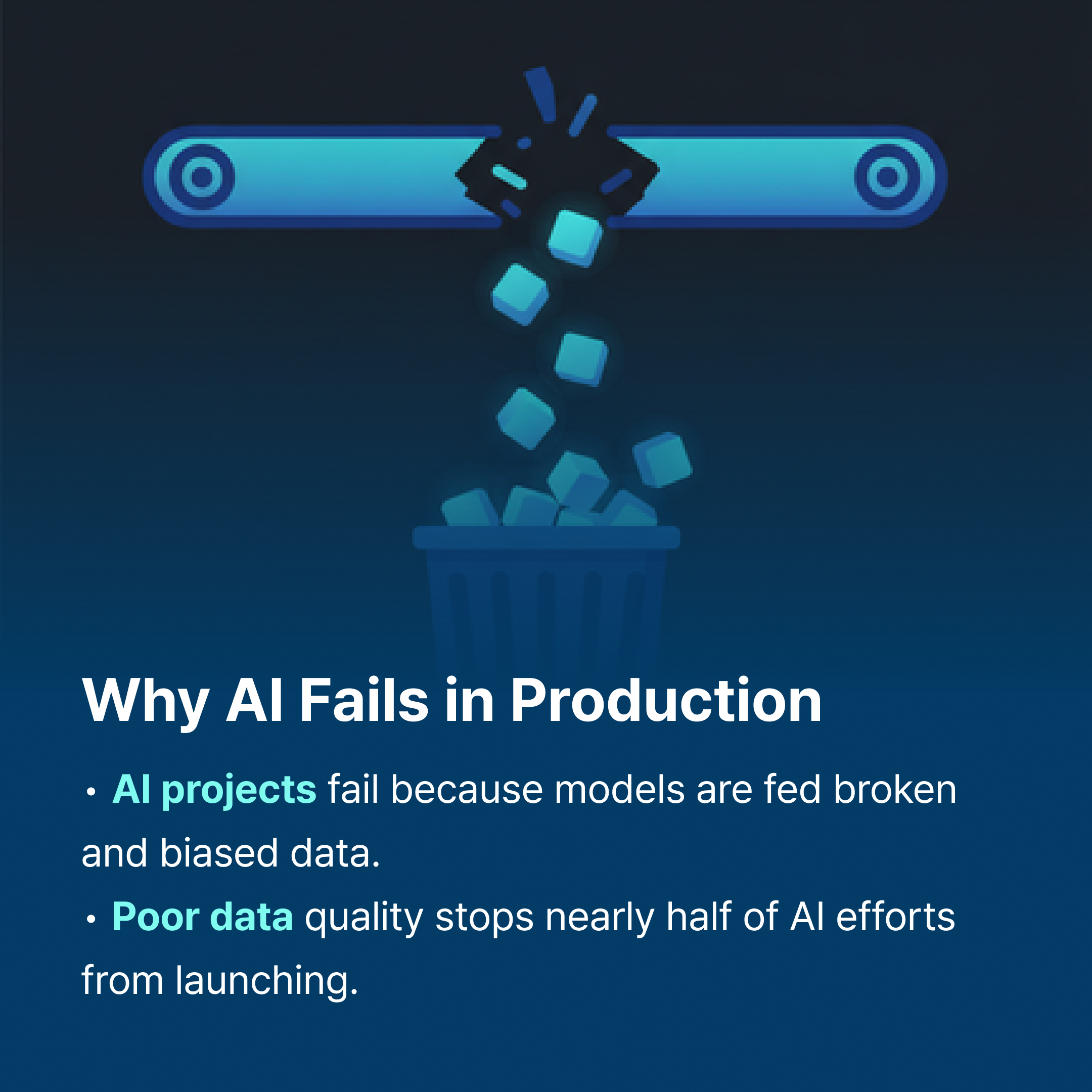
AI projects fail in production because the underlying data is largely unusable for machine learning models. Teams spend millions on compute power and algorithm tuning. They then feed those models broken, biased, or restricted data. This guarantees inaccurate outputs and rapid project cancellation across the board.
IDC research from 2026 indicates that 44% of organizations report data quality issues as the primary bottleneck preventing AI initiatives from reaching production. We see this play out every single sprint. You build a flawless enterprise AI data pipeline in staging using a clean subset of curated records. The demo works beautifully. The executives applaud the results. Then you deploy that exact same code against real production databases.
The entire system collapses almost immediately. Your ingestion layer chokes on nested JSON formats that drift without warning. Your transformation jobs fail because half the regional tables are restricted by compliance rules. The models start hallucinating because the training set contained massive statistical imbalances that nobody caught. The code is not the problem. Usable data barely exists in the wild.
This is the harsh reality of modern data operations.
The Infrastructure Trap In A Hardware Boom
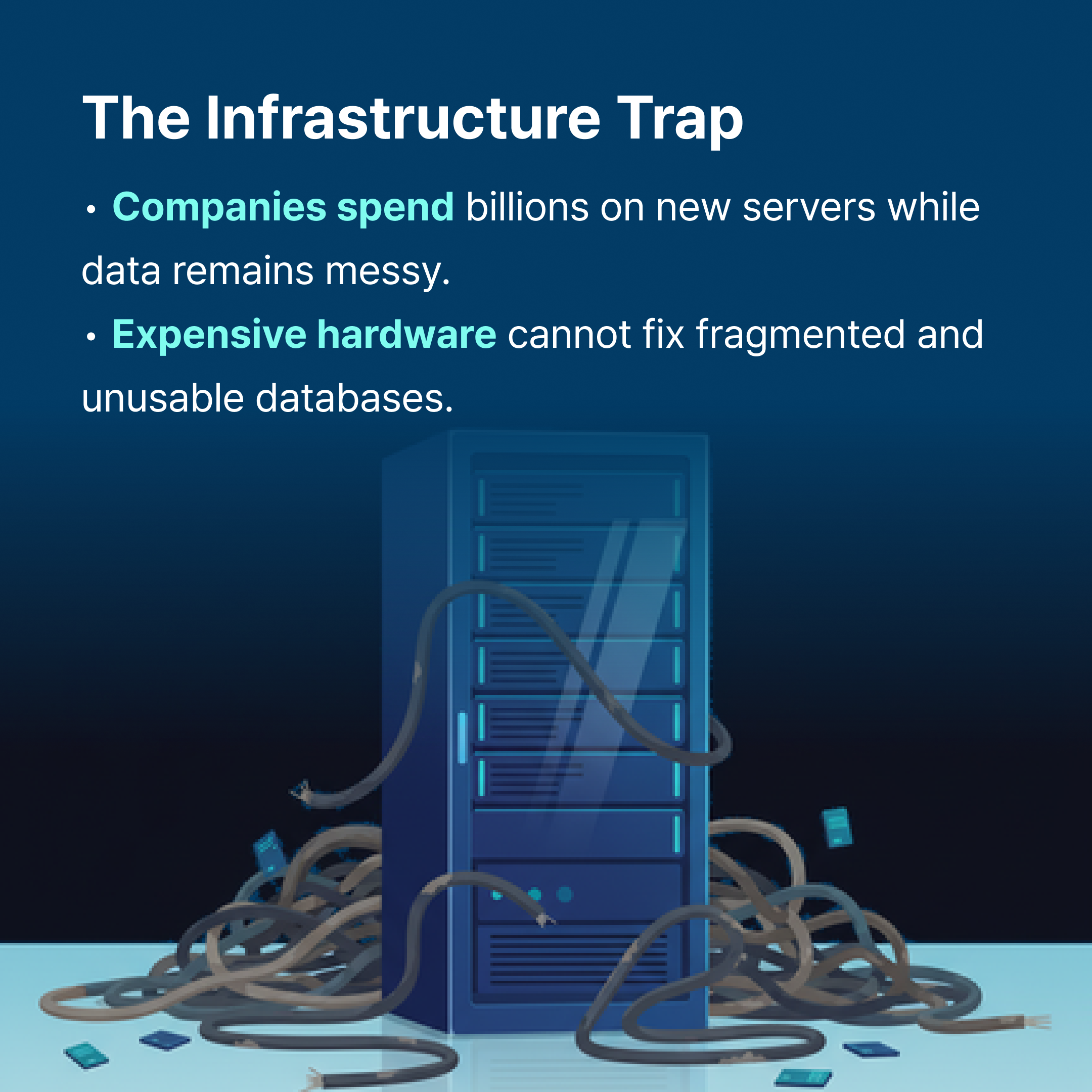
Buying massive compute infrastructure without fixing your underlying data unusability creates an expensive bottleneck. Companies are deploying high-performance data center hardware at unprecedented rates. They still lack the structured, regulation-friendly data necessary to actually train or run models on that expensive new equipment.
The market numbers validate this massive hardware push. Vertiv reported a 26% organic sales growth in 2025 reaching $10.2 billion on the back of AI data center demand. They project another 28% growth in 2026. Dell Technologies is seeing massive institutional investments for enterprise AI positioning. Server racks are expanding in every major corporate data center.
Data quality is completely stagnant. We are buying physical compute like it will magically clean our fragmented databases.
A recent Reddit thread with thousands of upvotes highlighted a brutal truth about the modern enterprise AI data pipeline. Silicon Valley models are becoming interchangeable commodities. Many open-source alternatives are rapidly closing the performance gap. The only real competitive moat your company has left is its proprietary data. If that information remains trapped in legacy formats, those new servers are just generating heat.
Compute power means nothing if your models are starving.
What Happens When Agentic Loops Hit Trapped Data?
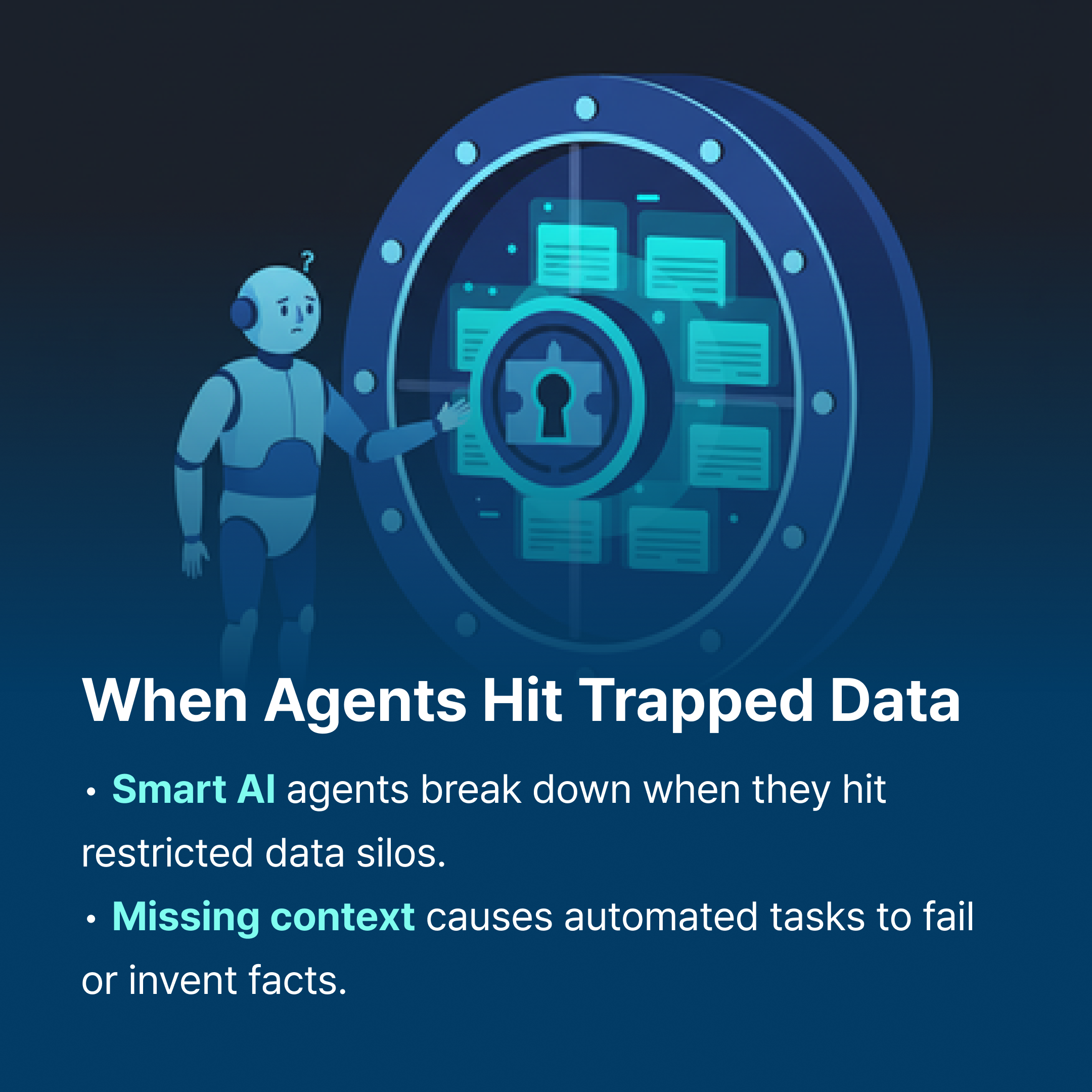
Autonomous agents completely fail when they encounter fragmented or restricted enterprise data. These systems require continuous access to high-quality, fully integrated context to execute tasks safely. Traditional data silos represent the exact point where agentic workflows break down and cause critical errors.
NetSuite recently rolled out AI updates specifically designed to help finance teams automate workflows with strict control. Control is the absolute operative word here. You cannot automate complex financial operations if the agentic AI data quality requirements are not met.
Finance agents need to cross-reference multiple tables to reconcile accounts accurately. They might need to pull transactional data from a European server and match it against customer profiles in a North American database. If one dataset is restricted by regional rules and another has broken formatting, the agent loses context. It either fails silently or generates a completely fabricated reconciliation report.
CUBIG transforms unusable data into usable data. The compliance wall disappears. CUBIG restructures trapped data into a regulation-friendly format so your agents have the context they need to function safely.
Most organizations simply abandon the PoC when they hit this wall.
Why Data Engineering Teams Are Evolving
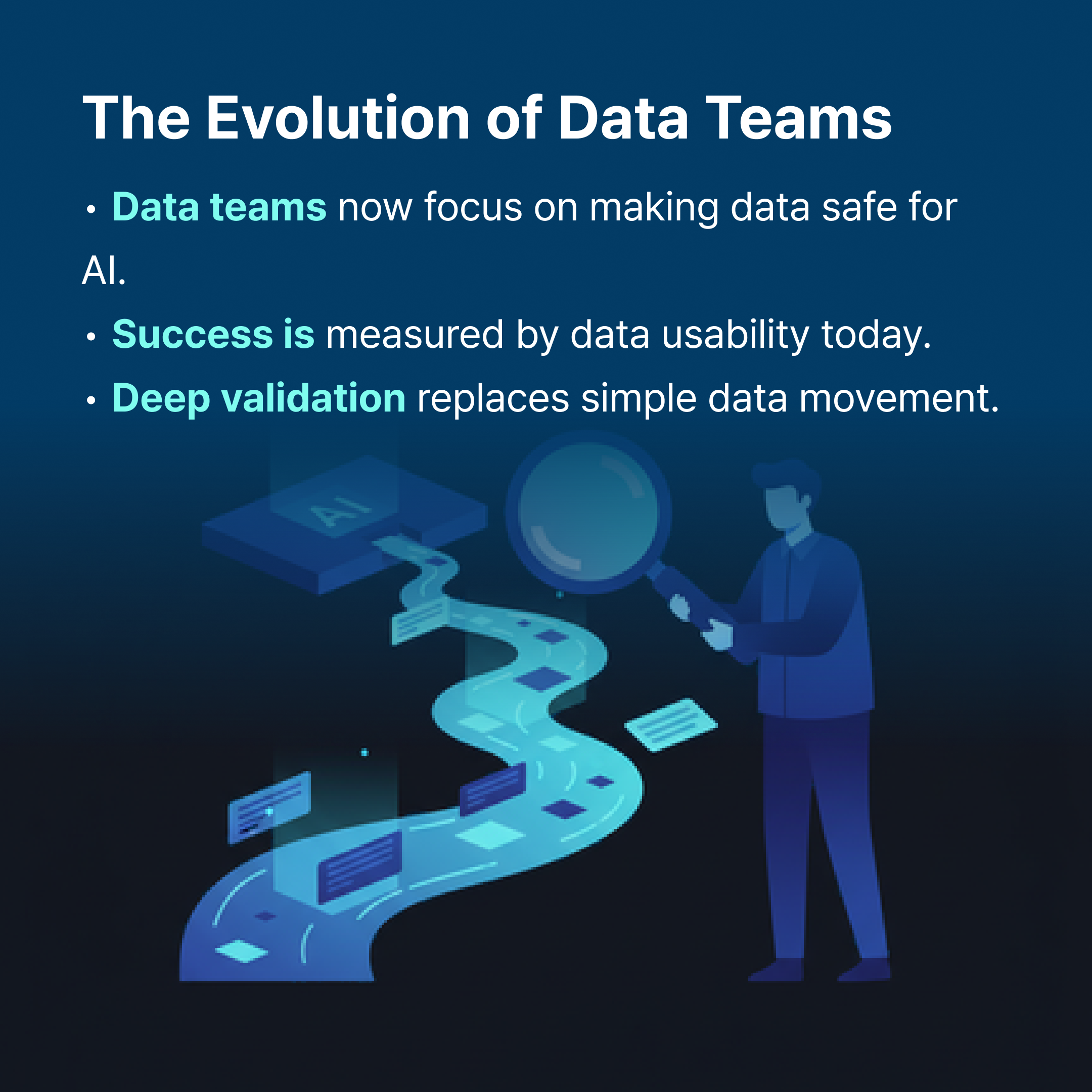
Data engineers are actively shifting their focus from basic ETL movement to complex data restructuring and AI enablement. The job is no longer just about piping data from point A to point B. It requires ensuring that data is actually usable and safe for model consumption.
A viral discussion on Hacker News recently showed data practitioners joking about rebranding themselves as AI Collaboration Partners. The humor hides a massive industry shift. We used to measure success by pipeline throughput and uptime. Now we measure it by data usability. Nobody cares if you can move a terabyte of logs across regions. They care if you are converting unusable data for AI. Building a functional enterprise AI data pipeline requires replacing legacy data movement tactics with deep structural validation.
We are writing data validation contracts instead of simple Airflow operators.
The Reverse-Engineering Problem And Legacy Masking
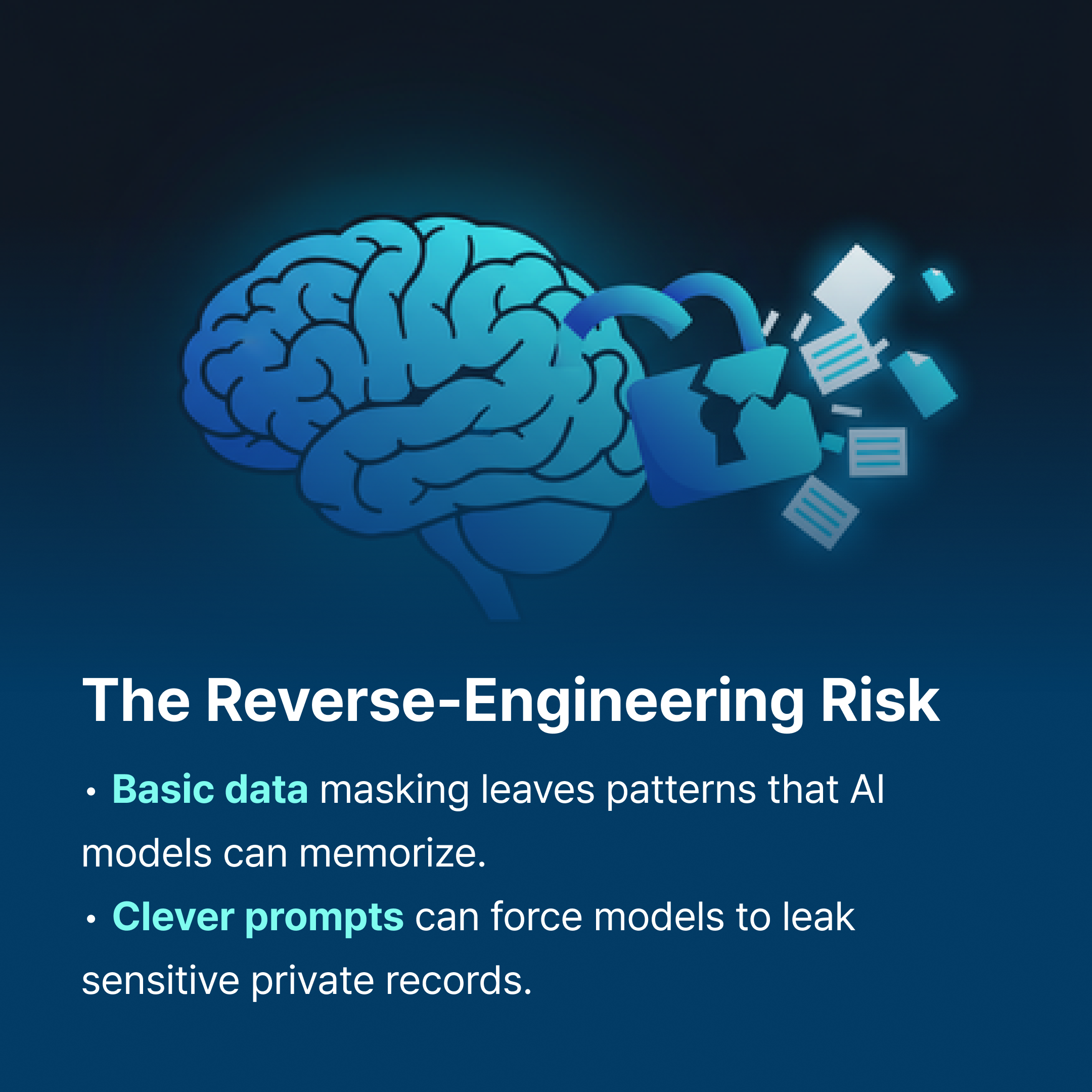
To prevent model memorization and reverse-engineering of sensitive inputs, data engineering teams are shifting away from traditional masking toward original-replacement data generation and deep data restructuring. Traditional data masking techniques leave patterns that can be easily memorized and extracted by modern machine learning models.
One data engineer on Reddit recently noted a terrifying reality about large language models. Input data can literally be reverse-engineered directly from model weights. This observation keeps compliance departments awake at night. You might think you are safe because you hashed the email addresses and scrambled the phone numbers before training. A clever prompt can still force the model to spit those exact operational records back out in plain text.
This is where the enterprise data pipeline bottleneck solution becomes obvious. You have to replace the raw data completely.
Legacy masking is dead. Original-replacement data generation is the only viable path forward for regulated industries.
Escaping The PoC Graveyard With Data Restructuring
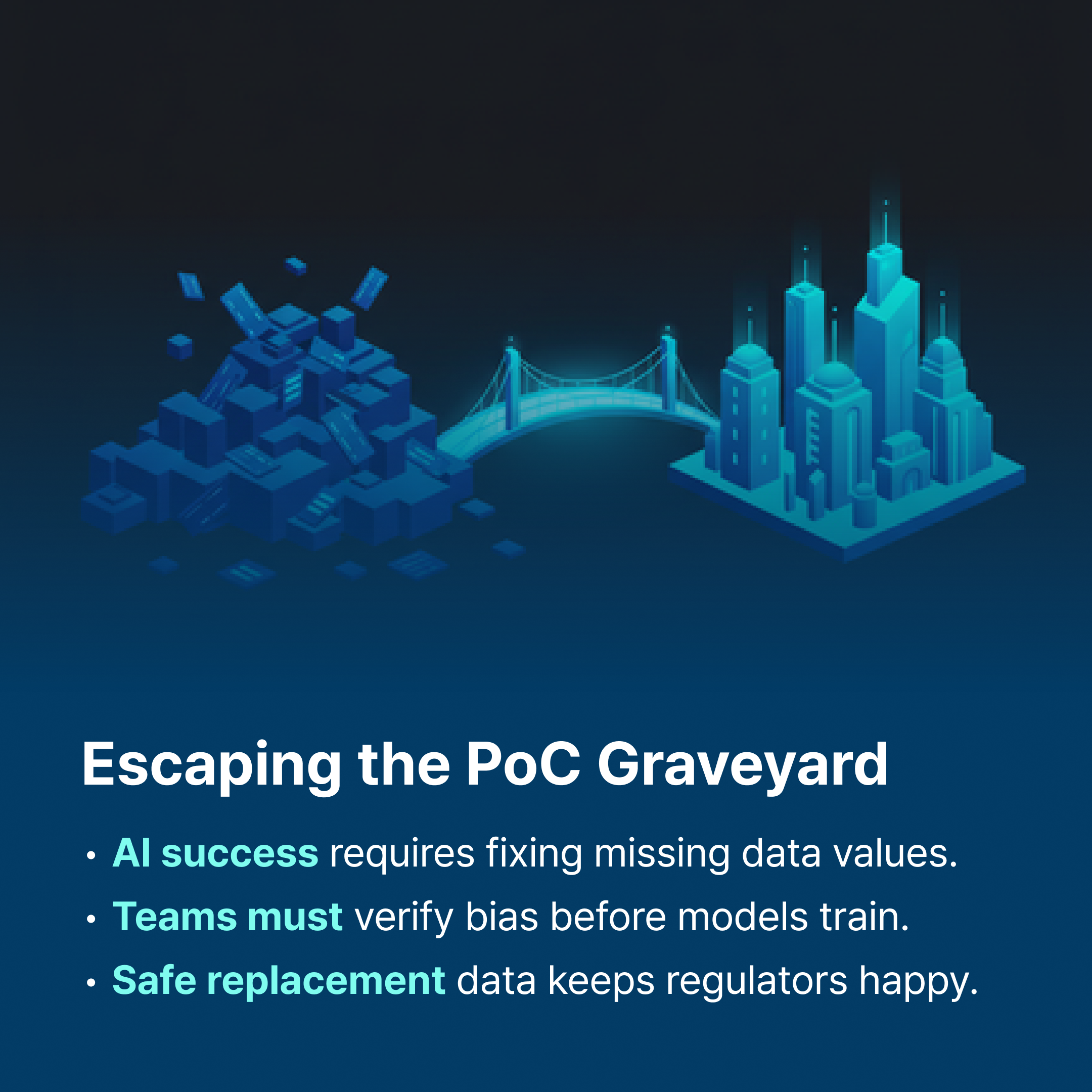
Successful AI deployments require a clear shift from hoarding raw data to actively restructuring it into verified, usable formats. Organizations that implement robust data restructuring for AI pipelines successfully bridge the gap between experimental staging environments and live, automated production systems.
Data activation is the only way forward. Your enterprise AI data pipeline needs to do more than move bytes from a lake to a warehouse. It needs to repair missing values at the source. It must verify bias profiles before the data ever reaches the compute layer. It requires creating original-replacement data that keeps regulators happy while maintaining statistical value for the models.
Stop building pipelines for information that your models cannot even legally touch.
Start building infrastructure that generates truly usable assets.
How CUBIG Addresses This
If you have been dealing with endless pipeline rebuilds and failed deployments, you know the exhaustion of trying to feed AI with broken information. You have tables everywhere. They are messy, incomplete, or trapped heavily behind compliance rules. Your AI models are starving while sitting on a mountain of raw data.
Think of Syntitan as the engine that actually makes your enterprise AI data pipeline work. Syntitan takes your messy, regulation-restricted data and makes it usable without exposing a single sensitive record. Missing values and structural biases get fixed automatically in the background. The result is clean, AI-ready data your team can actually trust.
Imagine your upcoming Monday morning. Instead of spending three days cleaning spreadsheets and fighting with governance teams for data access, your engineers are running models on data that is already verified and ready. You stop debugging staging failures and start pushing real automated workflows to production.
Related Reading
- The CapEx Trap: Why Your Enterprise AI Data Pipeline Fails
- Fix Your Enterprise AI Data Pipeline Before Buying Compute
- The 2026 AI Crisis: Why Your Enterprise AI Data Pipeline Keeps Crashing
FAQ
How do you handle schemas that drift every week?
Schema drift is a massive pain point for any enterprise AI data pipeline. You need automated structural validation at the ingestion point. Modern pipelines use dynamic mapping to detect changes in raw tables instantly. This ensures your downstream models do not suddenly ingest malformed inputs when a source database adds an unexpected new column.
Can we just use open-source masking tools for compliance?
Open-source masking is rarely enough for modern models. Community discussions consistently highlight that model weights can often be reverse-engineered to reveal masked inputs. You need true original-replacement data generation. Syntitan restructures the entire dataset to preserve statistical value while completely severing the link to the original raw records.
Why are my data scientists still complaining about data access?
Your governance approval process is probably manual. Even if the enterprise AI data pipeline technically works, compliance teams take weeks to review raw tables. You have to eliminate the raw data exposure entirely. Providing structurally identical but completely synthesized data drops governance approvals from months to mere hours.
Do we need a separate pipeline for agentic AI workflows?
You do not necessarily need a separate infrastructure, but your quality standards must be much higher. Agentic AI takes autonomous actions based on context. If your current enterprise AI data pipeline allows null values or unverified formatting to pass through, your agents will inevitably trigger catastrophic downstream errors.
How do we measure if our transformed data is actually usable?
You measure usability by testing the statistical parity between your raw source and your output. If your data restructuring process breaks the underlying correlations, your models will learn the wrong patterns. Your pipeline must include automated certification steps that quantify how well the restructured data preserves original business logic.