Massive Compute Budgets Cannot Fix AI Production Failure
Table of Contents
Summary
Wall Street is throwing a massive party for AI hardware while data teams try to prevent AI production failure by digging graves for their latest proofs of concept. In the second quarter of 2026, Micron Technology saw a 196% revenue surge driven entirely by enterprise demand for high-bandwidth memory. CoreWeave watched its AI cloud platform backlog swell to an absurd $67 billion. Millions of dollars are flowing directly into the physical infrastructure required to run large language models at scale.
The disconnect between hardware spending and data usability practically guarantees a disaster at deployment time. You cannot scale your way out of a broken pipeline with faster processing units. The foundation is cracked. Usable data barely exists inside the modern enterprise.
Why Do We Buy $41B Cloud Rigs for Broken Data?
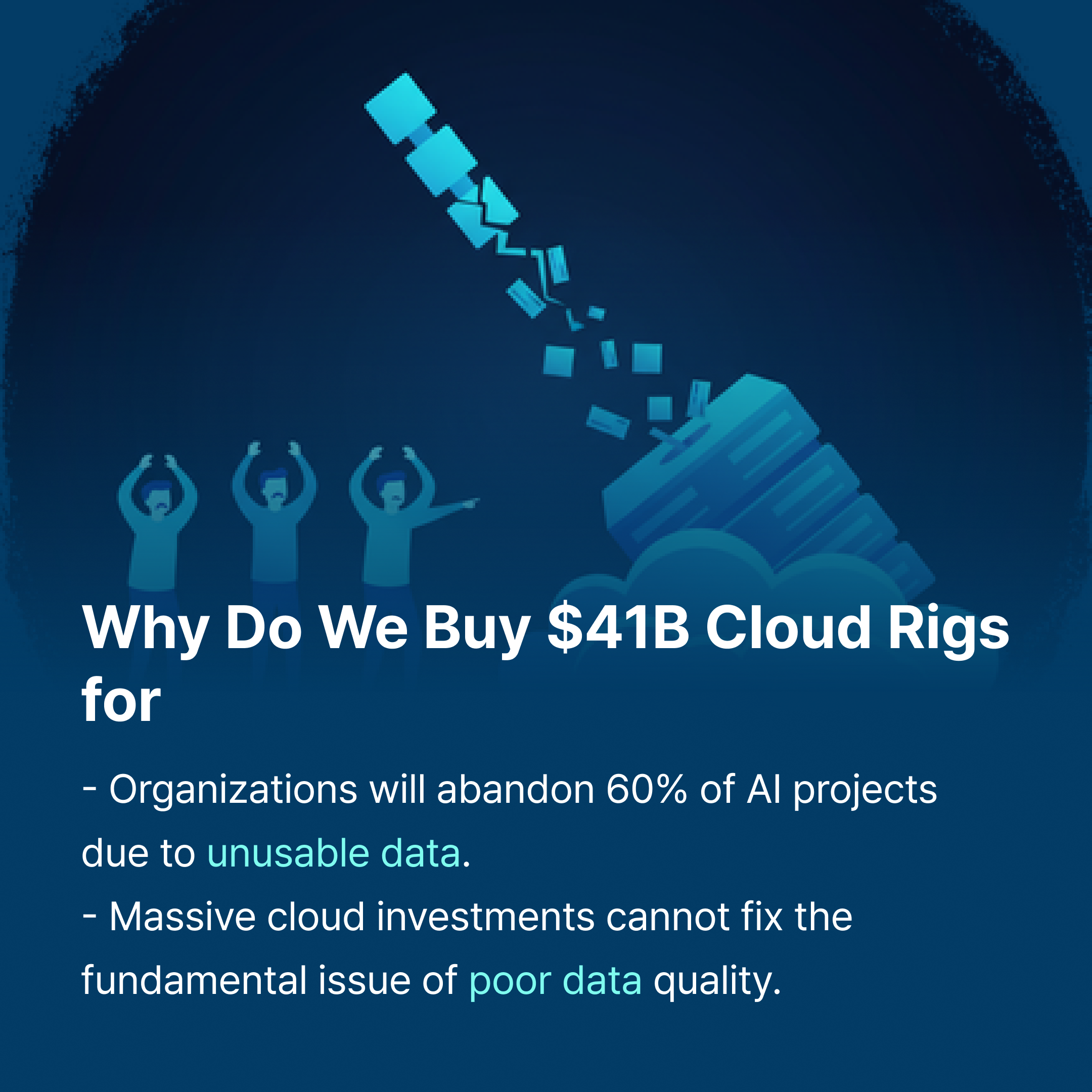
According to Gartner’s 2026 analysis, organizations will abandon 60% of their AI initiatives primarily due to unusable data rather than limitations in AI compute or model architecture. Buying expensive processing power to crunch chaotic logs just accelerates the speed at which your models fail.
We are watching a fascinating misallocation of enterprise capital. While enterprise spending on AI infrastructure like CoreWeave and Micron memory has surged by over 100%, developer communities report that enterprise data restructuring remains the most insurmountable bottleneck for AI deployment. We provision highly expensive compute clusters to run advanced models. Then we feed those same models CSV files full of missing values, biased user behavior, and disjointed system events.
The physical hardware side of the equation is largely solved.
Nobody fails today because they cannot rent enough processing units. They fail because 88% of enterprise information remains deeply unusable. Trapped data creates a hard ceiling on model performance that no amount of memory bandwidth can punch through.
The Insurmountable Part: Real Talk from the Trenches
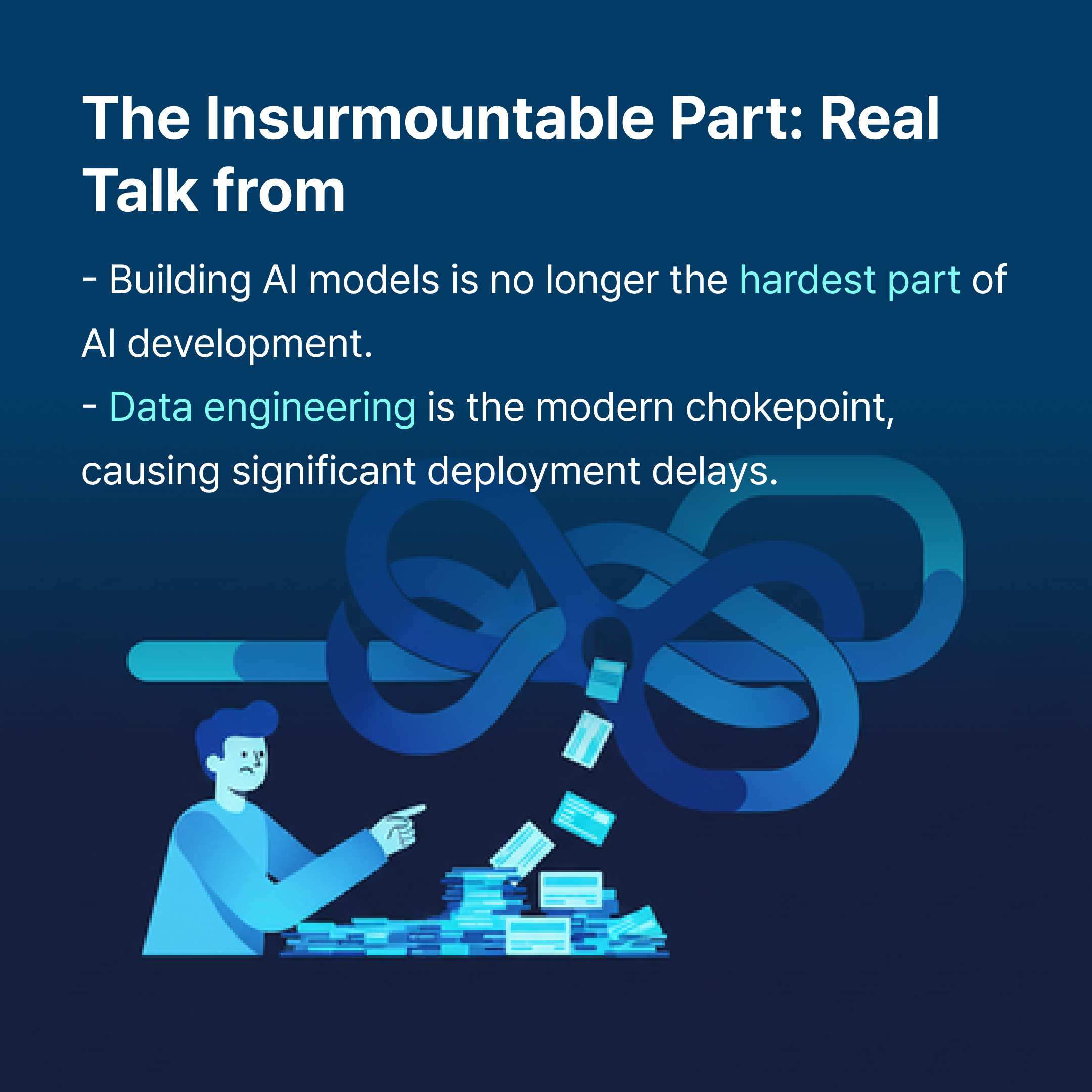
Practitioners acknowledge that building models is no longer the hard part of modern deployments. Data engineering has become the actual chokepoint because transforming unusable data into usable data requires solving deep structural messes before a single token gets processed by the AI. You have to fix the foundation first.
Browse any technical forum and you will see the frustration bleeding through. During a recent Hacker News discussion about a highly anticipated distributed AI release, one top engineer pointed out a dark truth. Everyone hypes the model architecture, but often the hard and insurmountable part of this is the data engineering. Practitioners know who the real enemy is.
A viral Reddit post recently joked that data engineers should rename themselves “AI Collaboration Partners” just to get their infrastructure budgets approved. That identity crisis stems from a very real corporate dynamic.
Leadership buys a multi-million dollar LLM setup and expects immediate magic. They get garbage instead because the underlying records are heavily restricted by regulations or completely broken in legacy formats. The engineers get blamed for the bad output.
Fixing this enterprise data pipeline bottleneck solution starts with admitting the raw information is toxic. Restructuring it prevents AI production failure before the first test epoch begins.
What Happens When Agentic Loops Hit Trapped Data?
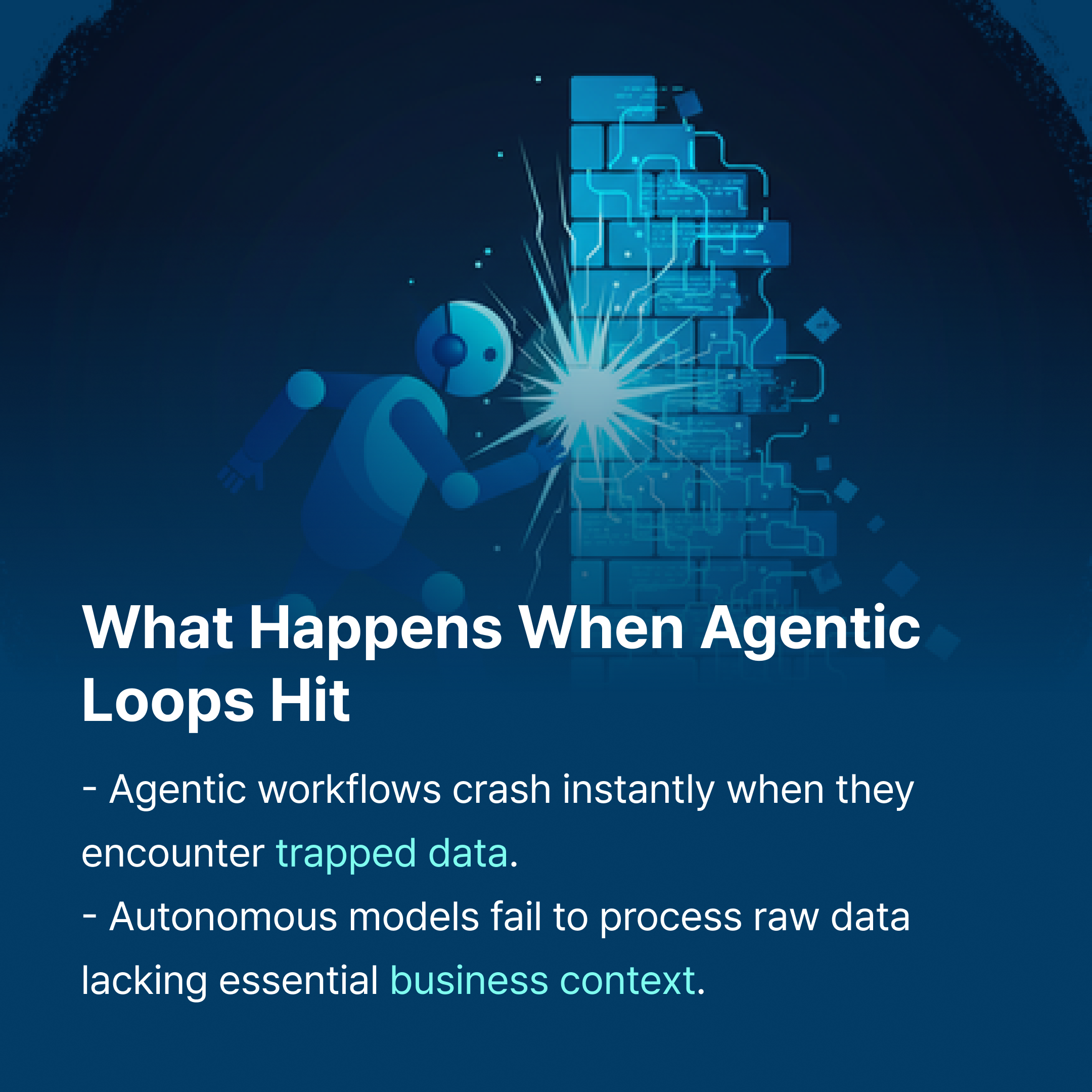
Agentic workflows crash instantly when they encounter restricted or context-free datasets. Raw data lacks the necessary business context to guide autonomous models, meaning developers must restructure their organizational knowledge into AI-ready formats that preserve both statistical relationships and specific domain expertise.
We recently saw the National Science Foundation award $45 million to a water-focused initiative in the Great Lakes region purely to wrangle unstructured environmental metrics. The public sector understands something enterprise leaders often ignore entirely. Collecting mountains of raw data achieves absolutely nothing if the context is lost. An autonomous agent scanning a lake depth chart without geological context will make terrible predictions.
Another recurring theme in data engineering communities is the realization that domain knowledge now heavily outweighs pure coding ability. Models write decent Python scripts today. They completely fail to infer the unwritten business logic behind a legacy database schema from 2012. You must restructure the records to explicitly encode that business context.
Original-Replacement Data Generation vs. The Legacy Masking Trap
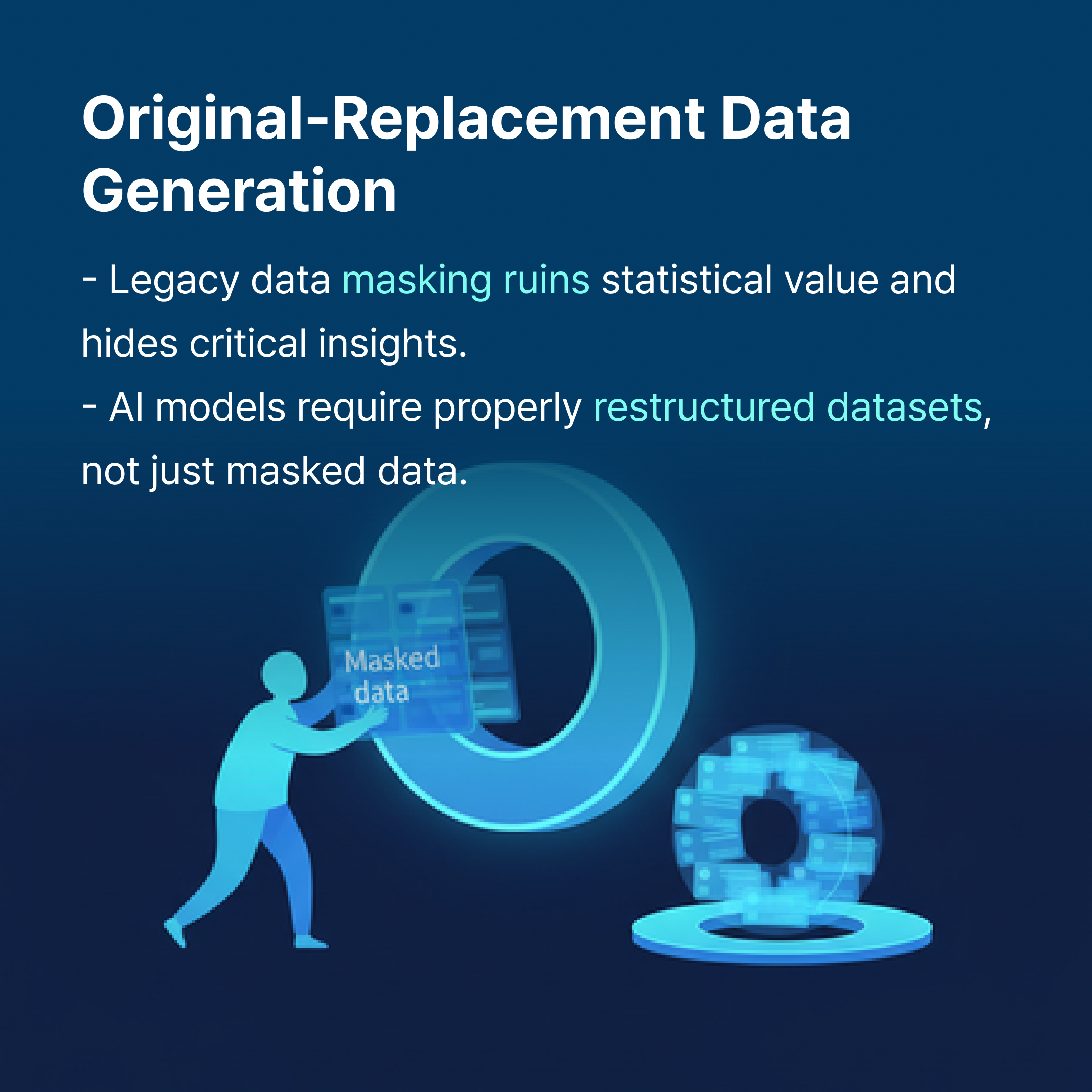
Legacy redaction techniques destroy the statistical value of datasets while failing to solve AI production failure. When evaluating data restructuring vs data masking, original-replacement data generation solves this by entirely restructuring unusable records into new, compliant data assets that retain full analytical value without exposing raw organizational secrets.
Replacing unusable information with usable data changes the entire deployment trajectory. Too many teams rely on crude redaction. You drop the names, hash the IDs, and feed the mangled remains into a training job. The AI learns nothing useful because the structural integrity is gone. Restructuring creates a mathematically identical twin of the information that models can actually learn from.
How to Stop Fixing Models and Start Restructuring Data
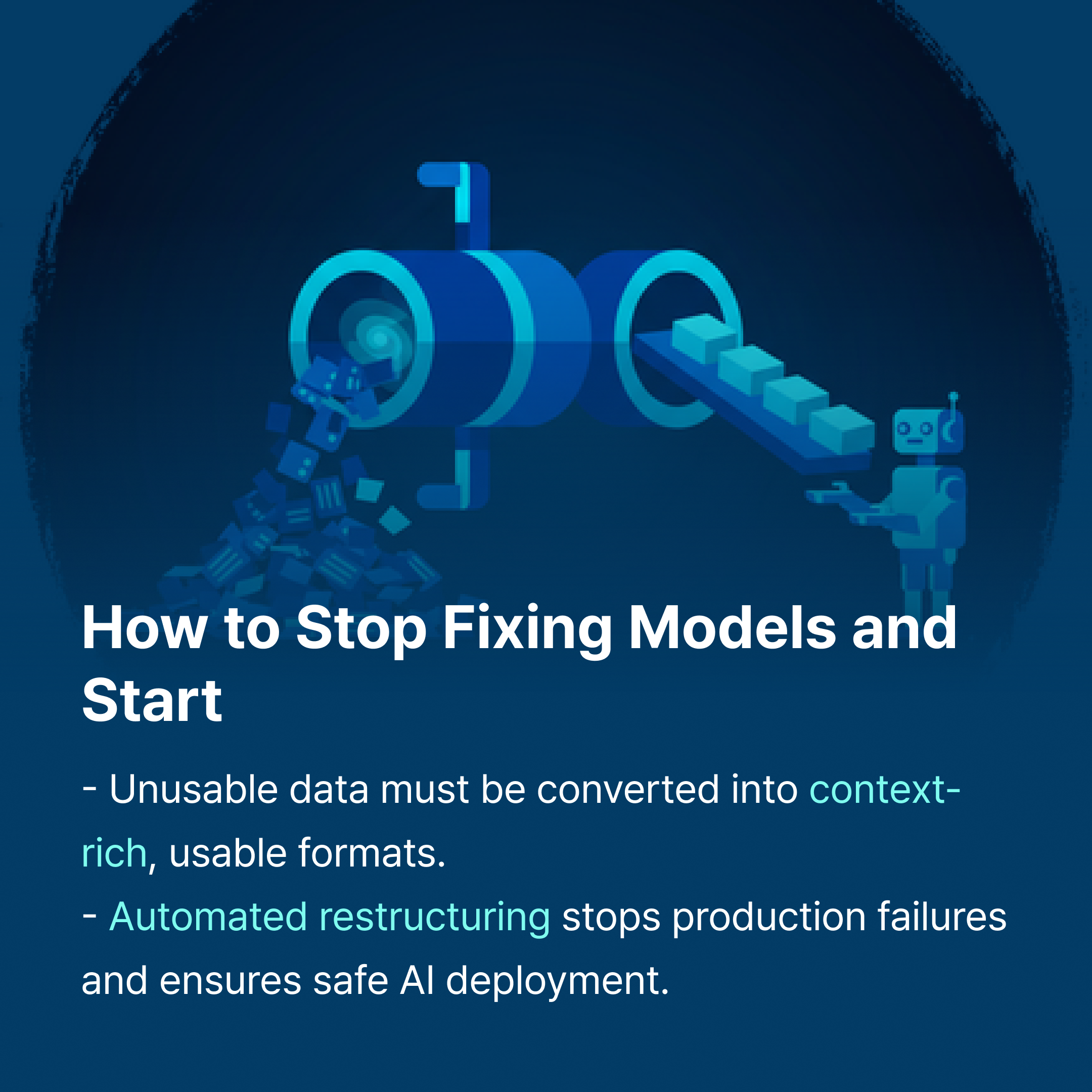
Transforming unusable data into context-rich, usable formats through automated data restructuring is required to prevent AI production failure and align AI workflows with business domain expertise. Enterprises must shift their focus from buying more compute to systematically verifying the state of their data at execution time.
The financial projections back this up. IDC forecasts 45% of AI use cases will fail ROI targets by 2026 specifically due to poor data foundations.
That number should terrify any CDO planning their next budget cycle.
Your models are starving for high-quality inputs. High-performing teams filter out useless logs and only feed restructured, high-fidelity data into their pipelines. Stop obsessing over massive context windows and start looking at how to fix unusable data for AI before it ever enters the compute cluster.
How CUBIG Addresses This
If you have ever tried to get approval for AI training data and hit a wall of compliance objections, you know how this feels. You have data everywhere across the organization. It is messy, incomplete, and trapped behind heavy regulations. Your AI models are starving while petabytes of valuable information sit idle in the warehouse.
SynTitan makes that data usable. Think of SynTitan as a purification plant for your raw logs. Sensitive information gets handled without exposing a single personal record. Missing values and bias are automatically fixed. The result is clean, AI-ready data your team can actually trust to build reliable applications.
Imagine your Monday. Instead of manually cleaning spreadsheets or begging legal for access, your team is running models on data that is already verified and ready. SynTitan restructures the trapped information into a regulation-friendly format so you can finally unblock your deployment queue.
Most AI projects fail not because of bad models, but because the data was not ready. Activating that trapped data changes everything.
Related Reading
- The AI Production Failure Trap: Why Petabytes of Storage Won’t Save You
- The 2026 AI Crisis: Why Your Enterprise AI Data Pipeline Keeps Crashing
- Why 60% of AI Projects Fail: The Shift to Agentic AI Data
FAQ
Why do AI projects fail in production after working precisely in staging?
Models in staging typically run on carefully curated, static datasets that do not reflect reality. When these models hit production, they immediately encounter uncollectable rare events, missing values, and severe data drift. The execution state of the data is completely different from the training environment. This exact mismatch causes the AI production failure as the model hallucinates or crashes entirely. You must verify your data state at execution time.
What is the difference between data restructuring and data masking?
Masking simply hides or scrambles specific columns like names or social compliance numbers. This crude approach often destroys the deep statistical relationships models need to learn patterns. Data restructuring entirely replaces the original records with new, mathematically identical data. This generated data contains no actual sensitive information but trains models precisely. You get all the analytical value without the compliance headaches.
How does SynTitan prevent deployment delays for heavily regulated teams?
SynTitan takes your messy, regulation-restricted data and makes it usable without exposing a single personal record. It automatically fixes missing values and freezes the AI-ready data into an immutable release state. Your data science team can run autonomous models on this certified data safely. They know exactly what inputs generated what outputs, which makes reproducing and debugging errors a straightforward process.
Why can’t we just buy more compute to process messy data faster?
Faster hardware simply processes garbage at a higher velocity. No amount of high-bandwidth memory will fix a dataset that lacks critical business context or carries deep biases against minority classes. Fixing the data foundation is a structural requirement for machine learning. It is never a speed issue. Throwing more processing power at unusable records just burns your cloud budget while delivering zero actual business value.
How do we prove to leadership that our pipeline strategy is working?
Track the time it takes to move a model from a local proof of concept into a live production environment. If your data is truly AI-ready, legal reviews drop from months to days. The best metric of success is how quickly your data science team can access usable data without filing IT tickets. Fast data access proves your enterprise data pipeline bottleneck solution works.

CUBIG's Service Line




Recommended Posts