What Is an Execution State? The Missing Concept Behind Reproducibility
Table of Contents
Hello, this is CUBIG. We help enterprise data become usable in real AI operations.
For enterprise AI to perform in production, model quality alone is not enough.
It requires AI-Ready Data Infrastructure. And when the same model produces different outcomes in production, the first thing to examine is not just the model itself, but the Execution State.
The real problem in AI operations does not begin when a result is wrong. It begins when no one can explain why that result happened. At first, the issue looks small: a result changes only in a specific case, or the same input produces slightly different outputs over time. But once this pattern repeats, teams lose confidence in the output, and AI slowly moves away from the center of decision-making. NIST’s AI Risk Management Framework emphasizes that trustworthy AI requires ongoing monitoring, documentation, explainability, and lifecycle risk management after deployment.
📃NIST AI RMF 1.0
Why does the same model behave differently in production?
To understand this problem, we need to change the lens through which we view AI. AI is not a system that runs on a model alone. In practice, it runs on top of the entire environment in which data enters, is processed, and is served.
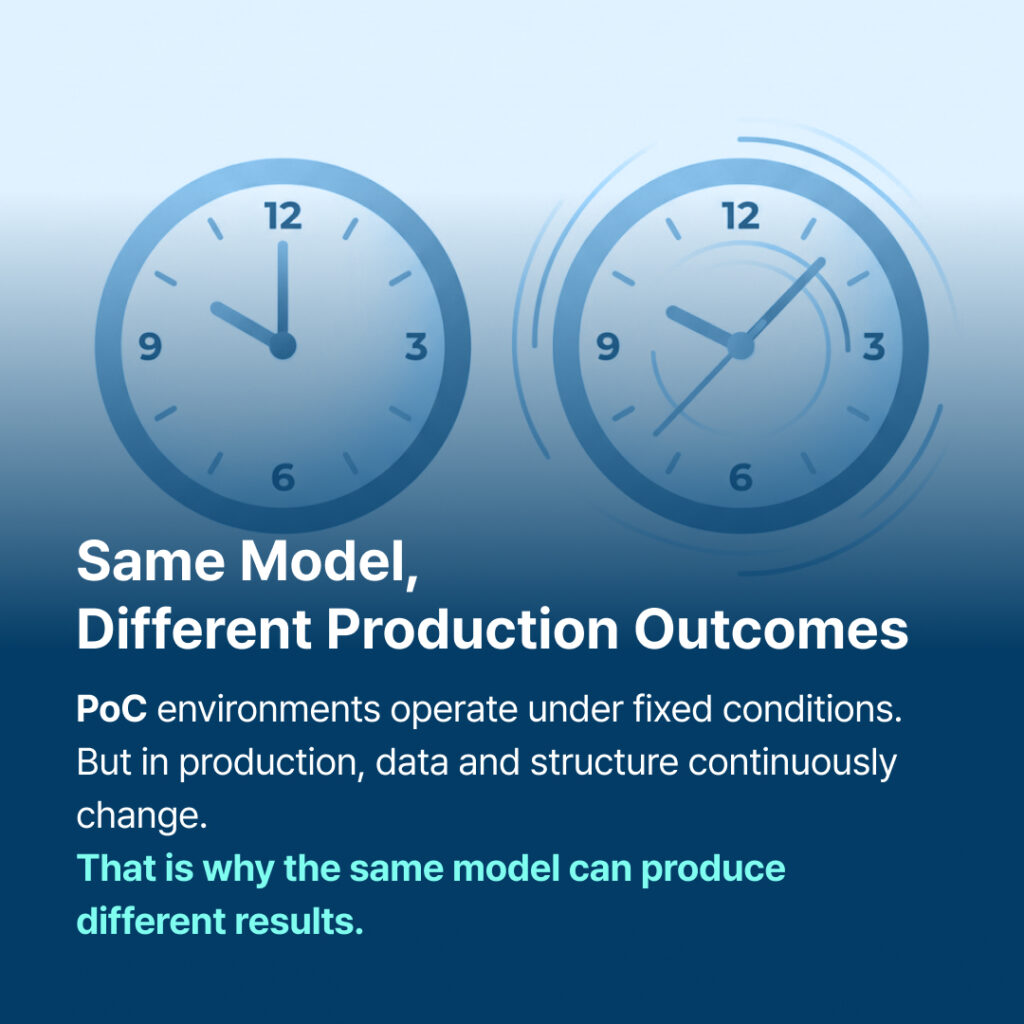
In a PoC environment, many of these conditions are relatively fixed. In production, they are not. Data keeps arriving, structures evolve, processing logic gets updated, and operational rules change over time. On the surface, it may look like the same model is still running. In reality, the model is being executed under a different set of conditions each time. That is when outcomes begin to drift.
This is consistent with the argument in Hidden Technical Debt in Machine Learning Systems, which explains that real ML systems are shaped not only by the model, but also by surrounding infrastructure, data dependencies, configuration issues, and changes in the external world.
What is an Execution State?
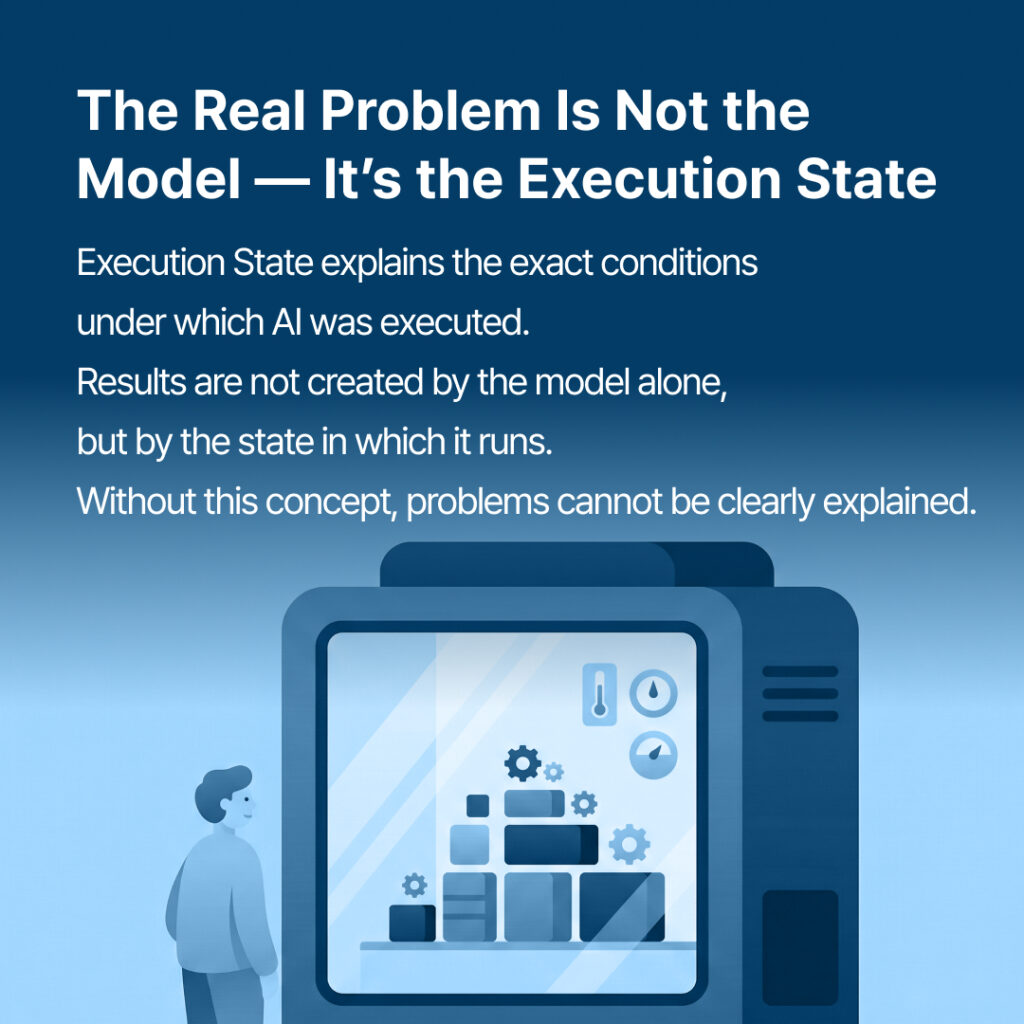
Execution State is the concept that groups together the full set of conditions present at the moment an AI system runs. It includes the data snapshot, schema, preprocessing logic, runtime environment, dependency versions, and access policies that shape how the model behaves.
What matters is not only which model was used, but under what state that model was executed.
Results are not created by the model alone. They are produced jointly by the model, the data, the transformation process, and the execution conditions around them. Without this perspective, most production AI problems remain difficult to explain.
Research on reproducible machine learning pipelines supports the same point: to fully reproduce a pipeline, teams must preserve more than the model itself. They must also retain the code, software versions, data, feature generation logic, configurations, random seeds, and execution environment.
📃Building a Reproducible Machine Learning Pipeline
Small changes can change outcomes
This idea may sound abstract, but in production it appears in very concrete ways.
A dataset that was included yesterday may be partially excluded today. An access policy may have changed. A small data collection gap may have appeared upstream. A preprocessing rule may have been updated, causing the same input to be transformed differently before it reaches the model. Even a change in how datasets are joined can create duplicated or missing records.
None of these changes alter the model architecture itself. But they can directly change the result.
This is why the difference in output often comes not from the model, but from the difference in the data and execution state behind the model. Major cloud platforms now treat this as an operational reality, offering production monitoring for data drift, skew, and data quality because these changes can degrade model reliability over time.
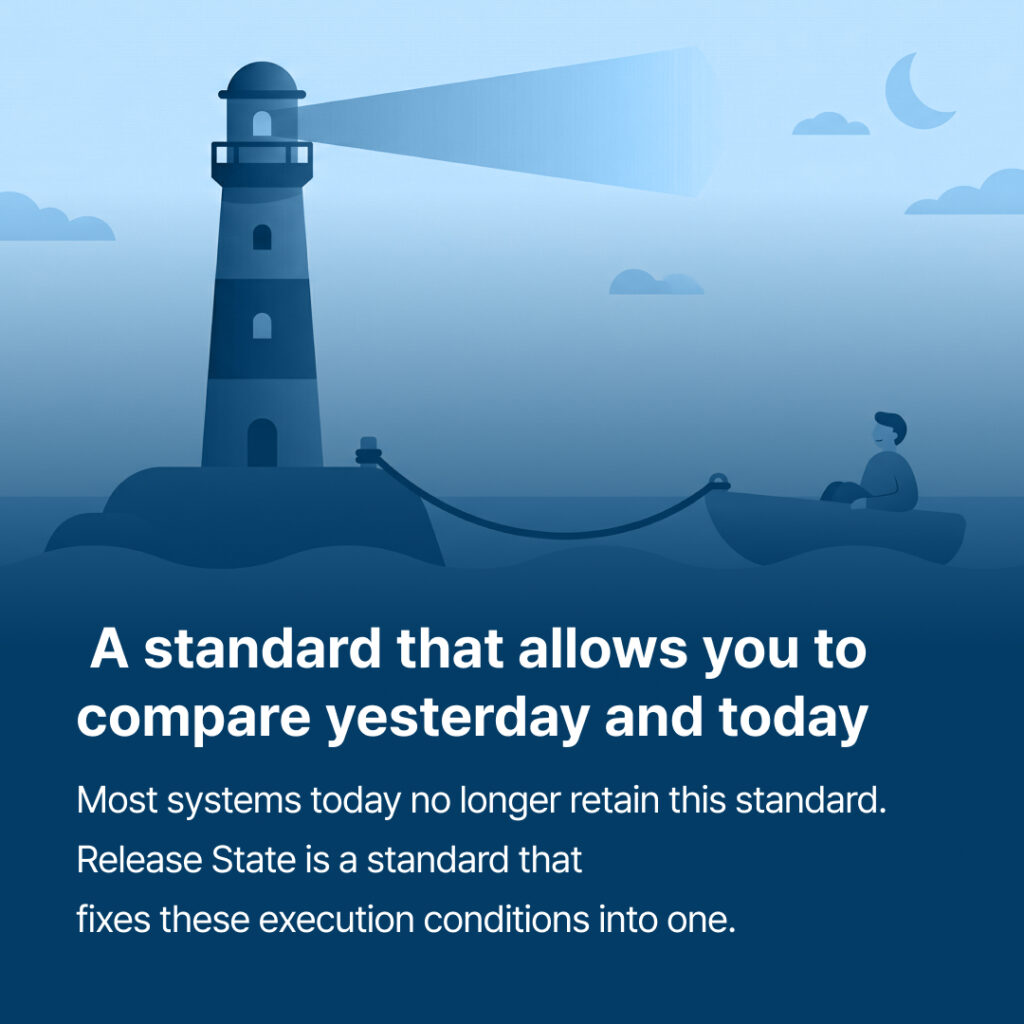
Why teams need a baseline to compare yesterday and today
The real difficulty is that, in many systems, these changes happen without leaving behind a reliable operational baseline. Teams cannot clearly explain why the output changed, and they cannot easily rerun the system under the same conditions.
This is why Release State matters. A Release State is a fixed reference that binds together the data, execution environment, preprocessing conditions, and operational context into one controlled state. With that reference in place, teams can compare what changed between releases, rerun the same conditions, and validate whether the result is still trustworthy.
In production, reproducibility does not emerge automatically. It is built on top of a stable reference point. NIST similarly stresses that AI risk management is not a one-time exercise, but an ongoing lifecycle responsibility.
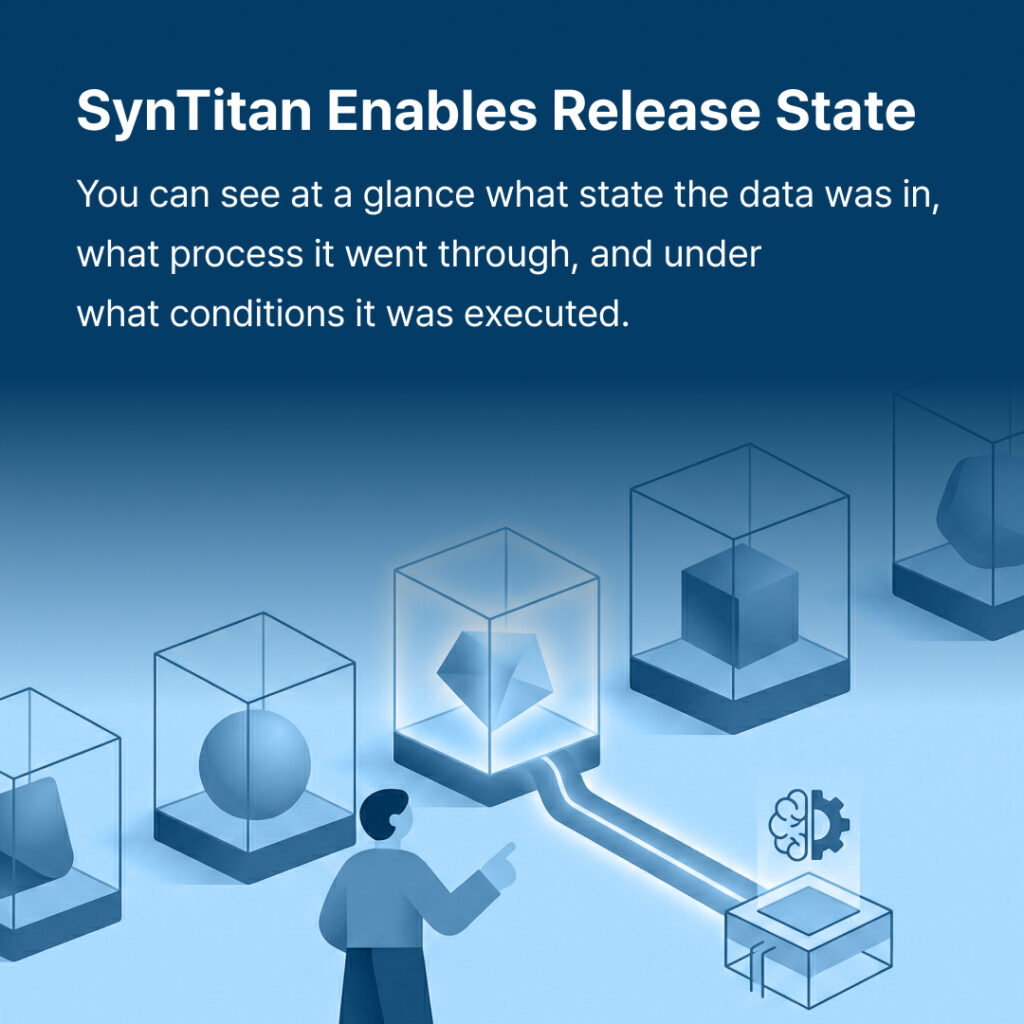
How SynTitan makes Release State operational
However, defining a Release State is not enough by itself. That state must be connected to actual execution results. Teams must be able to compare release-to-release differences and reproduce the same conditions when needed. In other words, what is required is not just a defined state, but an operational structure that works inside real production systems.
This is where SynTitan becomes meaningful.
SynTitan connects the full flow of execution: what state the data arrived in, what process it went through, and under which conditions the final result was produced. Where teams once had to infer the cause by looking only at outcomes, they can now explain the outcome through the state behind it.
That changes the nature of AI operations. Output variation is no longer just uncertainty. It becomes a change that can be examined, compared, and explained.
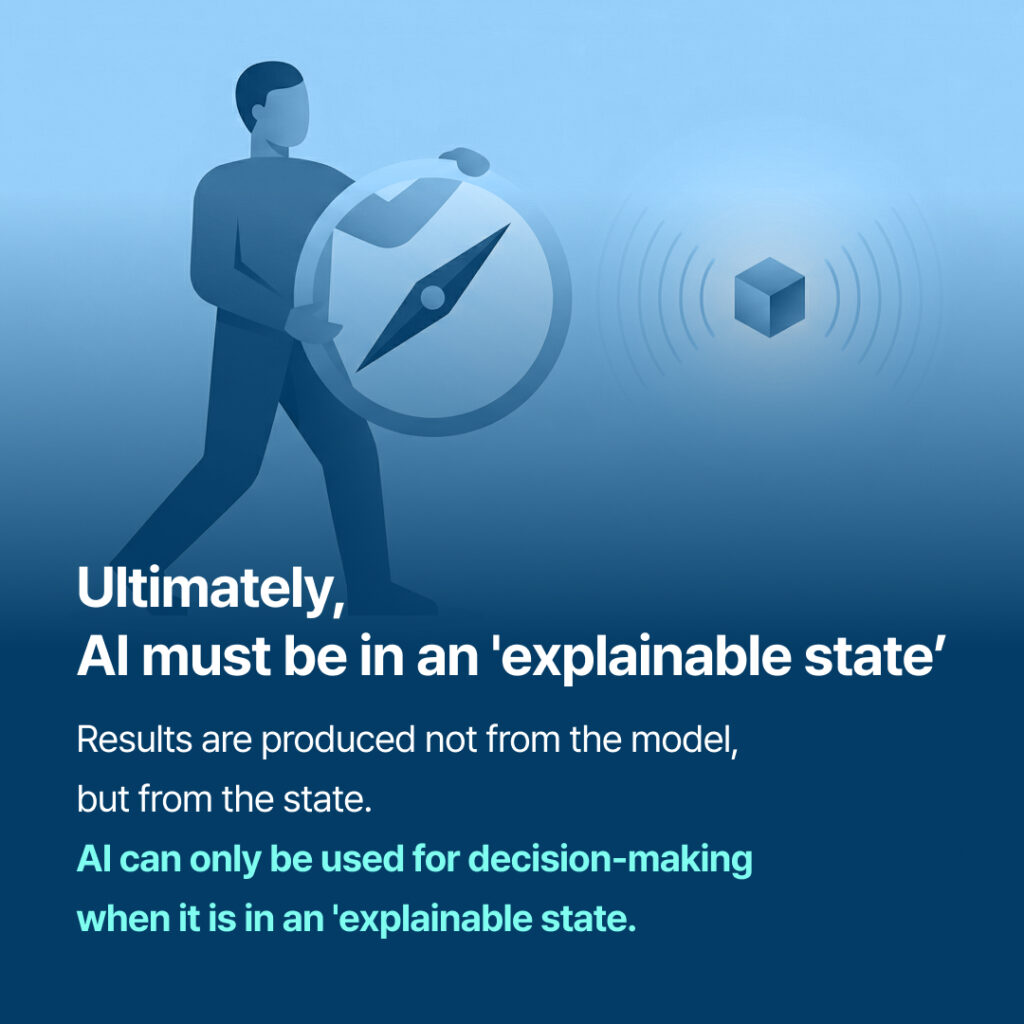
AI becomes useful for decisions only when its state is explainable
AI in production does not stop being useful because the model lacks accuracy alone. It stops being trusted because the result cannot be explained.
And that trust is built not only in the model, but in the state behind the result.
When teams can explain under what conditions a result was produced, AI begins to function as more than a reference tool. It becomes a decision-support system that the business can actually rely on.
If your organization needs a structure for operating AI based on data state,
SynTitan is where that operational flow becomes visible.

Summary
- The same model can produce different results in production.
- In many cases, the root cause is not the model itself, but the Execution State.
- Execution State includes data, schema, preprocessing, runtime, and access conditions.
- To compare and reproduce outcomes, teams need a fixed reference point called Release State.
- SynTitan connects that state to real execution results so changes become traceable and explainable.
- AI-ready infrastructure is not about advertising features. It is about making enterprise data usable, explainable, and operational.
FAQ
What is an Execution State?
Execution State is the full set of conditions that shape how an AI system behaves at the moment it runs, including data, preprocessing, environment, and access conditions.
Why does the same model produce different results?
Because the execution conditions may have changed. Even if the model is identical, changes in schema, preprocessing, runtime, or available data can change the output.
Why is Release State necessary?
Release State provides a fixed baseline for comparing changes, reproducing results, and validating whether a production outcome is still trustworthy.
What does SynTitan do?
SynTitan connects data state and execution conditions to the result, so teams can trace, compare, and explain how a production output was created.
What is the difference between Execution State and Release State?
Execution State describes the conditions under which AI is running right now.
Release State fixes those conditions into a stable reference for comparison and reproducibility.
CUBIG's Service Line



Recommended Posts