The CapEx Trap: Why Your Enterprise AI Data Pipeline Fails
Table of Contents
Summary
According to Gartner, 60% of enterprise AI projects will be abandoned by 2026 because they are deployed on infrastructure that lacks AI-ready, usable data. We are watching companies pour billions into hardware while their actual data remains completely trapped. The underlying data layer is entirely broken at the source.
Executives celebrate the delivery of new computing clusters and expensive software licenses. They expect instant automation. The reality on the engineering floor is much darker. The data required to feed these models is heavily restricted, full of missing values, or legally untouchable by the engineering team.
Your infrastructure budget is a massive sunk cost if your inputs are unreadable. The problem is not data scarcity. The core issue is data unusability.
The Billion-Dollar CapEx Disconnect
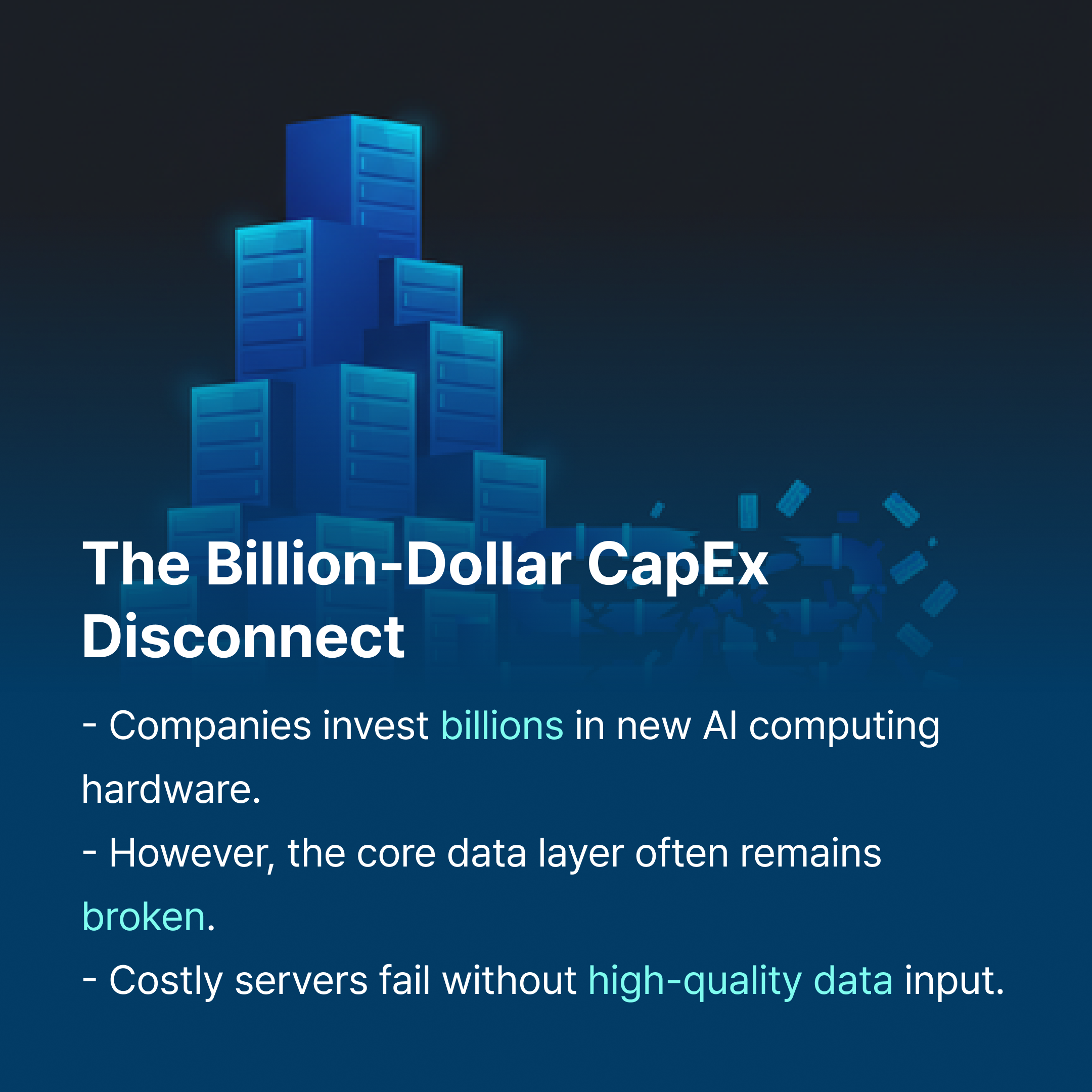
Companies are spending billions on AI computing hardware while ignoring their broken data layer. Your new servers are entirely useless if they ingest restricted, broken records. The core failure point is the lack of an enterprise AI data pipeline capable of restructuring raw inputs into highly usable formats.
We saw the recent financial reports showing staggering investments in physical infrastructure. Wall Street is thrilled about institutional money flowing into massive computing environments. Research on 📃Vertiv expansion reports shows a 46 percent organic sales growth driven by AI-ready data center demand. Everyone is buying the engine. Nobody is refining the fuel.
You can spin up a massive computing cluster in a single afternoon.
You cannot magically make your fifteen-year-old customer records regulation-friendly by tomorrow. Institutional investors are pouring millions into hardware while data engineers are still writing ad-hoc Python scripts to handle missing values. We all know the drill. A stakeholder demands a new predictive model. You spend three weeks begging compliance for access to the source tables. They say no. The expensive hardware just sits there idling while you try to scrape together a synthetic test set.
The disconnect is staggering. An enterprise data pipeline bottleneck solution has to start with the data itself. Buying more compute power to process unusable data just gives you wrong answers much faster.
Why Does the Enterprise AI Data Pipeline Fail for 42% of Projects?
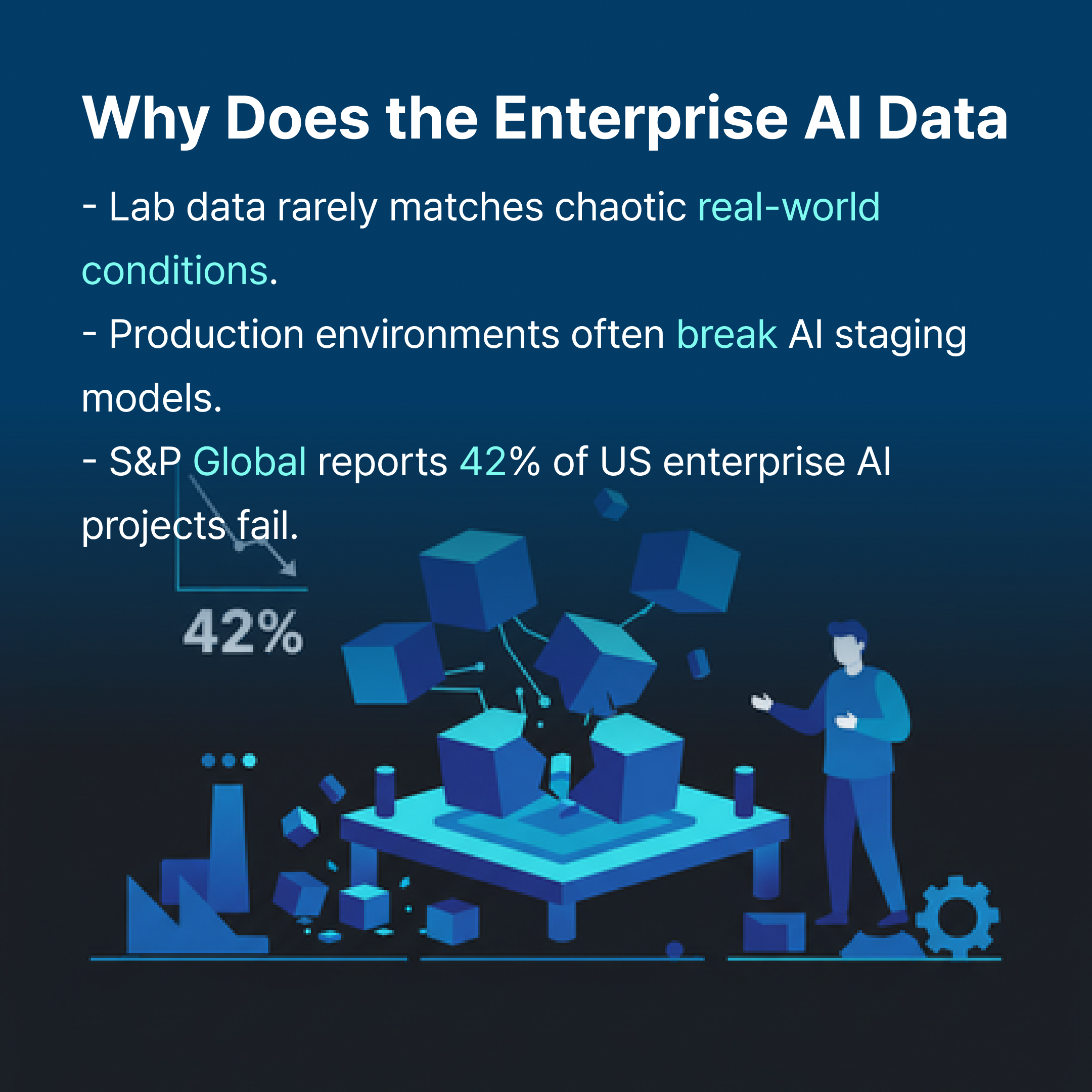
Projects die because the pristine data state in staging never matches the chaotic reality of production. Research from S&P Global shows that 42% of US enterprises abandoned their AI initiatives. The primary cause is always testing on clean samples and deploying into a fragmented, broken system.
The average sunk cost per abandoned AI initiative has reached 7.2 million dollars. That number should terrify any CDO. A team builds a beautiful prototype using scrubbed records. The demo goes great on a laptop. Then they connect it to the production enterprise AI data pipeline and everything collapses. Missing values crash the ingestion script. Regional compliance rules block the entire query. The model outputs complete nonsense.
Real enterprise data is a chaotic mess of silos. It includes uncollectable data and low-quality broken records. You try to train an agentic loop on historical finance transactions. The legal department steps in and halts the Jira ticket because you cannot run real customer names through the endpoint. The project stalls out for six months. It eventually dies in the staging graveyard.
The Open-Source Reality and Commoditized Moats
Foundational models are rapidly commoditizing, leaving your proprietary company data as the only real competitive advantage. Because foundational LLMs have become highly commoditized, enterprise AI success now relies almost entirely on converting unusable data into usable formats through data restructuring and original-replacement data generation.
A recent massive thread on Hacker News made this brutally clear. The engineering community largely agrees that Silicon Valley is quietly running on highly capable open-source models. The vendors selling proprietary algorithms are getting squeezed from both ends. You do not need to build a better math equation than the tech giants. You just need better inputs.
The model is just a commodity processor.
If you feed it trapped data, it chokes. If you feed it AI-ready data, it prints value. You have to focus on data activation to survive this shift. Raw records must be transformed into a regulation-friendly format.
“The barrier to entry for AI is zero. The barrier to entry for good AI is having an execution architecture that actually works.”
Why Are Data Teams Rejecting the Executive AI Push?
Data practitioners are exhausted by executive rebranding that ignores the grueling reality of data preparation. One data engineer on Reddit noted that changing titles to AI Collaboration Partner felt insulting when they are still stuck manually fixing broken data pipelines at 2am.
There is a massive gap between boardroom strategy and ground-floor reality. Executives are talking about 📃national K-Moonshot strategies and massive leaps in automation. Engineers are desperately trying to figure out which tables are actually safe to join together. We are watching the workforce scramble to take prompt engineering courses. You can train employees to write perfect prompts all day long. The output will still be completely worthless if the LLM is querying garbage. We see tools rolling out 📃NetSuite AI updates to help finance teams automate. Those workflows will fail instantly if the historical ledger data is full of nulls and regional locks.
Converting Unusable Data Into AI-Ready Fuel
IDC predicts that by 2027, 70% of IT teams will be forced to pause advanced AI initiatives and return to basics, focusing specifically on enterprise AI data pipeline automation to salvage failed deployments. The only path forward is comprehensive data restructuring.
You have to stop treating data preparation as a manual chore. It needs to be a systematic conversion process. Unusable data comes in three frustrating flavors. Some of it is uncollectable rare events. Some of it is trapped behind regional boundaries. Most of it is just low-quality and mathematically broken.
You fix this through original-replacement data generation.
You take the unusable source material and completely restructure it. The output preserves the exact statistical reality of your business without exposing the raw underlying records. This is how you escape the infrastructure trap. You take the billion-dollar hardware investments and finally give them the fuel they need. The foundation is usable data.
How CUBIG Addresses This
If you have ever tried to get approval for AI training data and hit a wall of compliance objections, you know exactly how this feels. Your data is sitting right there. It is messy, incomplete, and buried behind endless regulations. Your models are starving while your hardware just runs idle.
Think of SynTitan as the engine that actually makes your enterprise data usable. Your compliance wall disappears. SynTitan restructures trapped data into a regulation-friendly format. Sensitive data gets handled automatically without exposing a single personal record. Missing values and bias are cleaned up before ingestion. The result is verified, original-replacement data your team can safely use.
Imagine your engineering team on a Monday morning. Instead of spending hours writing ad-hoc scripts to clean spreadsheets or begging compliance for access, they are running models. The data is already verified, precisely structured, and frozen in a state you can reproduce every single time. Your queries just work.
Most AI projects fail not because of bad models, but because the data was not ready. Your records go from unusable to completely AI-ready. Your infrastructure finally starts paying for itself.
Related Reading
- Fix Your Enterprise AI Data Pipeline Before Buying Compute
- The 2026 AI Crisis: Why Your Enterprise AI Data Pipeline Keeps Crashing
- The 2026 AI Reckoning: Fixing the Enterprise AI Data Pipeline
FAQ
What causes an enterprise AI data pipeline to fail in production?
Pipelines fail because staging environments rarely reflect the chaotic state of production. Models are trained on clean, precisely formatted sample batches. When they connect to live enterprise systems full of missing values and restricted tables, the execution state breaks down completely. You must verify the data state before execution runs.
How do we fix the AI infrastructure ROI data bottleneck?
You stop buying more servers and start investing in data restructuring. Expensive hardware is a massive sunk cost if your algorithms are starved of usable data. By converting raw, restricted records into original-replacement data, you ensure your compute resources actually have high-quality material to process.
What makes data unusable for AI systems?
Unusable data generally falls into three distinct categories. Uncollectable data involves rare events that have not happened yet. Trapped data is restricted by compliance rules or regional boundaries. Broken data contains missing values, massive bias, or outdated formatting. All three types will instantly derail a machine learning model.
What is the difference between data restructuring vs data masking enterprise?
Masking simply hides or redacts columns, which often destroys the statistical relationships an algorithm needs to learn. Restructuring deeply rebuilds the dataset. It creates original-replacement data that maintains the exact mathematical properties of the source material while remaining completely regulation-friendly for your compliance teams.
Why do 60% of AI projects fail according to research?
They fail because organizations deploy them on infrastructure that lacks AI-ready data. Companies build complex algorithms and then realize they do not have the legal clearance or the data quality to feed them. The project stalls out during the final integration phase and is eventually quietly abandoned by management.
How can SynTitan help recover an abandoned PoC?
Most proofs of concept die because compliance teams block access to production records or the data quality is too poor. SynTitan revives these projects by transforming that unusable data into a verified, usable state. It auto-cures broken tables and handles sensitive information so your team can deploy safely.
Are open-source models replacing enterprise algorithms?
Yes. Foundational models are heavily commoditized now. A recurring theme in the engineering community is that building a better algorithm is a losing game. Your company’s proprietary, restructured data is the only real moat left. If your data is usable, almost any off-the-shelf model will perform exceptionally well.
How do we verify data is actually AI-ready for the enterprise AI data pipeline?
You need a quantitative certification process. You cannot just look at a few rows and guess. The data must be checked to ensure it preserves the original structure, matches the correct statistical distribution, and carries no biased profiles. Only then is it safe to push into production.

CUBIG's Service Line




Recommended Posts