The AI Readiness Gap: Why Data Alone Isn’t Enough
Table of Contents
Hello, we’re Cubig – helping enterprise data become truly usable for AI and data analytics.
AI agents and generative AI are now central to enterprise conversations across Europe.
Whether it’s strategic planning sessions, data governance reviews, or digital transformation roadmaps, artificial intelligence and data analytics have become inseparable topics.
From pilot projects to department-level implementations, more organisations are gaining hands-on experience with AI in the enterprise. Yet, a common refrain echoes across boardrooms:
“We’re using AI, but our ways of working haven’t fundamentally changed.”
AI isn’t absent, but neither is it truly embedded. Many enterprises find themselves in this uncomfortable middle ground.
AI Adoption Is Already Here

Recent global industry research shows that *over 70% of organisations worldwide are already using AI in at least one business function.
Generative AI and AI agents are also spreading rapidly, with many enterprises having moved beyond experimentation into pilot programmes or early operational stages.
AI is no longer an experimental technology.
For most organisations, it is something they have already adopted and tested at least once.
Yet despite this widespread adoption, AI is still rarely embedded deeply into day-to-day workflows and decision-making structures.
The question is no longer whether to adopt AI.
It is why AI adoption so often fails to translate into meaningful changes in how organisations actually operate.
📃McKinsey & Company – The State of AI / Global AI Survey
Data Exists, But Utilisation Remains Challenging

Most organisations aren’t held back by a lack of data. ERP systems, operational databases, logs, and document repositories contain vast information assets accumulated over years.
The problem isn’t volume – it’s state.
AI for data analytics doesn’t simply read raw data and draw conclusions. Effective artificial intelligence models require context: how data is defined, how entities relate to one another, and how information connects to actual business decisions.
In reality, data is fragmented across systems, defined differently by departments, and often accumulated without clear purpose. When you layer in privacy regulations, security policies, and legacy infrastructure, data exists but remains difficult to operationalise.
Under these conditions, even when AI produces analytical outputs, they rarely trigger meaningful action. Analysis happens, but insights remain reference materials rather than drivers of change.
This is where data governance becomes critical – not as a compliance exercise, but as the foundation for AI readiness.
AI-Ready Data: A New Standard
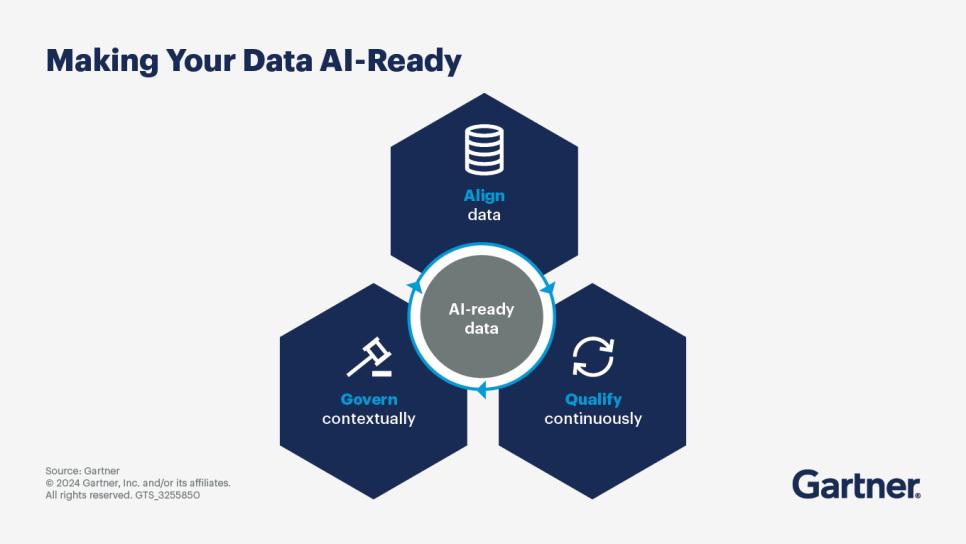
What’s needed now is a clear definition of AI-Ready data.
Gartner defines AI-Ready data not merely as stored or accessible information, but as data prepared and managed for specific AI use cases. This isn’t about big data and AI in general terms – it’s about purposeful alignment.
Key characteristics include:
→ Clear use case alignment
Data must be prepared for defined AI applications, whether real-time analytics, predictive modelling, or AI agents performing autonomous tasks.
→ Representativeness and context
Data must reflect actual business scenarios with proper metadata, relationships, and lineage that artificial intelligence models can interpret accurately.
→ Sustainable management
AI-Ready status must be maintained continuously, not achieved once and forgotten. This requires ongoing data governance and quality processes.
In short, AI-Ready data means information structured for artificial intelligence to learn from, analyse, and act upon effectively.
For enterprise environments, this involves integrating data mesh architectures, establishing robust data governance frameworks, and ensuring data quality at scale. The shift from centralised data warehouses to distributed data mesh patterns allows domain teams to own their data while maintaining standards – essential for AI in the enterprise.
📃 Learn more about Gartner’s AI-Ready data definition
European Enterprise Environment:
GDPR and Data Governance as the Foundation

In European enterprises, particularly in the UK, GDPR compliance and data governance aren’t optional – they’re foundational.
Data processing legality, data subject rights, and the emerging *EU AI Act requirements must be addressed from day one, not retrofitted after deployment. For organisations operating across borders, this often means navigating both UK GDPR and EU GDPR simultaneously, while adhering to ICO (Information Commissioner’s Office) guidelines on AI transparency and fairness.
Recent surveys indicate European enterprises’ top concerns when deploying AI and data analytics:
- Data privacy and GDPR compliance (65%)
- Lack of AI explainability and trustworthiness (58%)
Brexit has added complexity for UK businesses, requiring dual regulatory alignment. Meanwhile, the EU AI Act introduces risk-based obligations for AI systems, particularly those involving personal data or affecting fundamental rights. High-risk AI applications must demonstrate technical documentation, risk management systems, and human oversight mechanisms.
When these considerations emerge late in the process, projects stall or contract. That’s why enterprise AI discussions have shifted from model performance to data governance frameworks and regulatory compliance architectures.
This isn’t just about legal risk – it’s about building trust in AI agents and artificial intelligence models that operate at scale within regulated environments.
📃Learn more about EU Artificial Intelligence Act
What’s Actually Needed: Infrastructure to Connect AI

Synthesising these challenges, most organisations aren’t stuck because they lack AI. They’re stuck because data, workflows, and compliance requirements aren’t properly connected.
The solution isn’t adding another AI feature or deploying more AI agents. It’s building infrastructure where data is securely governed, continuously refreshed, and readily accessible for AI in data analytics and real-time analytics use cases.
This requires:
→ Data mesh principles to decentralise ownership while maintaining quality
Domain-oriented ownership ensures those closest to the data maintain it, while federated governance ensures consistency across the enterprise.
→ Clear data governance to define accountability and standards
Without governance, AI models train on inconsistent, outdated, or biased data – undermining trust and regulatory compliance.
→ AI-native architectures that integrate security, privacy, and explainability by design
Rather than bolting compliance onto existing systems, build with GDPR, explainability, and auditability as core requirements.
Only then can AI transition from experimental pilots to embedded capability – from projects that generate reports to systems that drive decisions. This is what separates organisations successfully deploying AI for business intelligence from those perpetually stuck in proof-of-concept cycles.
SynTitan: Built for This Challenge
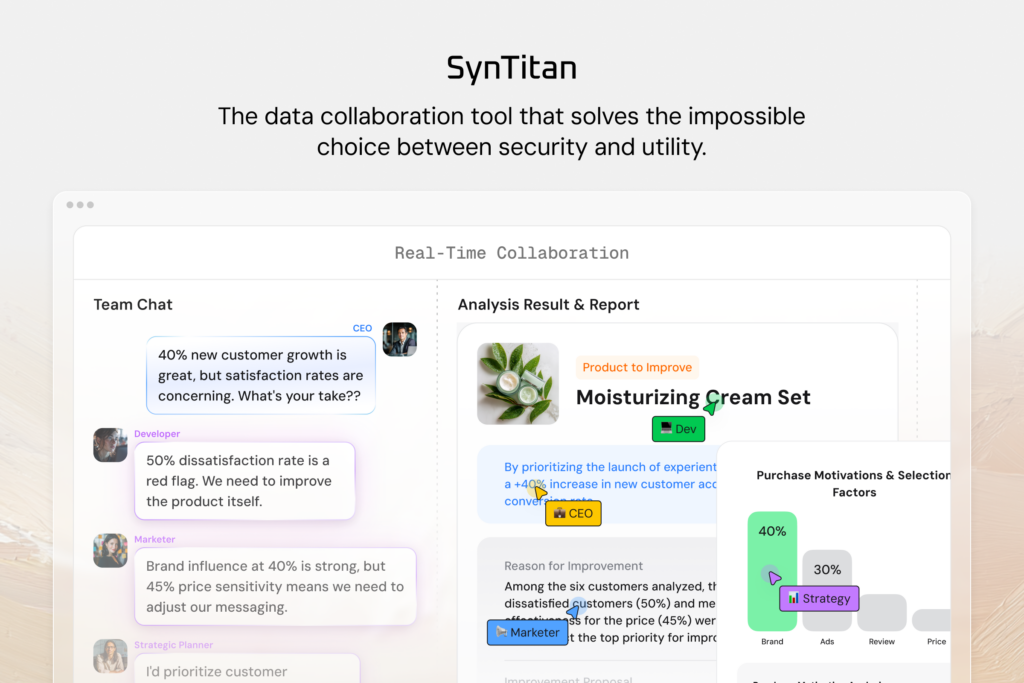
The problem is not the AI model itself, but where AI is expected to operate.
Data exists, but it is not immediately usable.
Analysis is possible, but it rarely translates into actual workflows.
And security and regulatory constraints are always part of the equation.
This is the point where CUBIG’s SynTitan begins.
SynTitan is designed as an enterprise intelligence layer that enables data and AI to move into real operational workflows within public-sector and enterprise environments.
It is built to support analysis without exporting data externally,
to enable AI usage without directly exposing personal information,
and to ensure that outcomes are not confined to individual users, but instead shared and validated within organizational workflows.
So the question is:
Is your organization’s data truly in a state where AI can be used in real work?
What matters more than whether AI has been adopted
is whether the conditions are in place for AI to actually function within day-to-day operations.

CUBIG's Service Line



Recommended Posts