
Operating control is the layer that records which data state each AI run executed on and lets you reproduce that run exactly, a job generic MLOps leaves undone because it versions pipelines and models while treating the data behind each run as a moving target.
Generic MLOps solved the engineering half of machine learning: build a pipeline, deploy a model, monitor it, repeat. It did not solve the question a regulated team gets asked after something goes wrong, which is what exactly this run read and whether you can rebuild it. The discipline is thoroughly mapped, with the MLOps overview by Kreuzberger et al. cataloging the principles, components, and roles it takes to move ML from development into production operation, and the distance between that map and a reproducible run is a large part of why regulated teams get stuck.
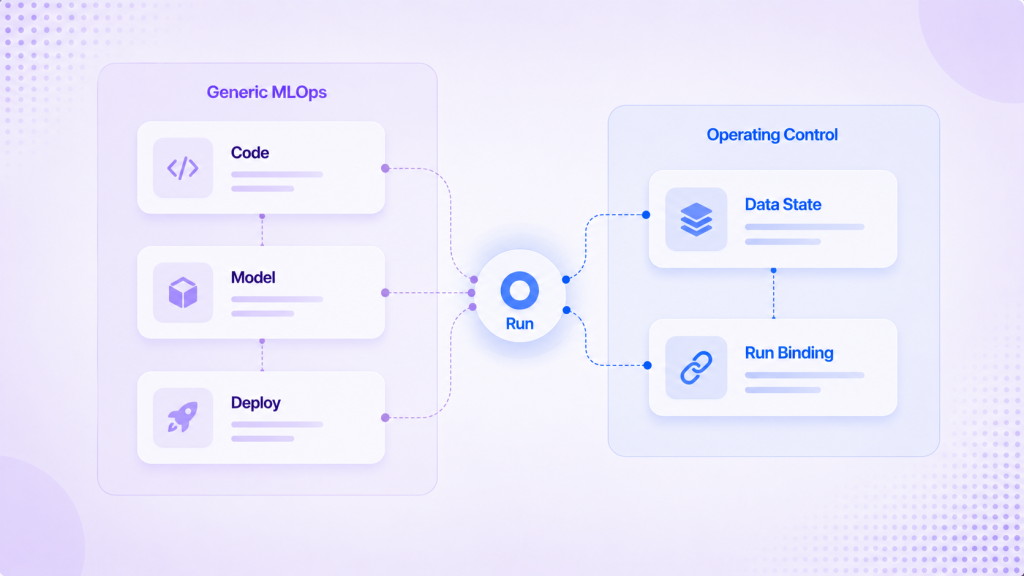
What generic MLOps covers well
A generic MLOps stack does real work, and none of it is in dispute. It runs continuous integration for models, tracks experiments and hyperparameters, packages and deploys artifacts, and watches latency and error rates in production. That machinery is how teams ship models at all, and pulling it out would be a step backward. Google Cloud’s MLOps guide gives that machinery a maturity scale, defining levels 0 to 2 and adding continuous training to CI/CD as the practice unique to ML systems.
The scope is the point. Generic MLOps versions the things that engineers change on purpose: the code, the container, the model artifact. It assumes the data is an input that flows through, not an object that needs to be pinned. On a static benchmark that assumption holds. Production breaks it.
What generic MLOps leaves out
The same pipeline, unchanged, produces different results when the data underneath it moves. Four things sit outside what most MLOps tools capture per run:
- The data window. Which rows and values the run actually read, not the live table that has since changed.
- The schema. Column types and constraints as they stood at run time, before a migration reshaped them.
- The preprocessing version. The exact feature logic that turned raw inputs into what the model saw.
- Reference data. The lookup tables, thresholds, and enrichment sources the run depended on.
A pipeline definition tells you these steps ran. It does not freeze what passed through them on a given Tuesday. When an output drifts, the pipeline log says nothing changed while the result clearly did, and that gap is where days of debugging disappear.
Why the gap costs you at the worst moment
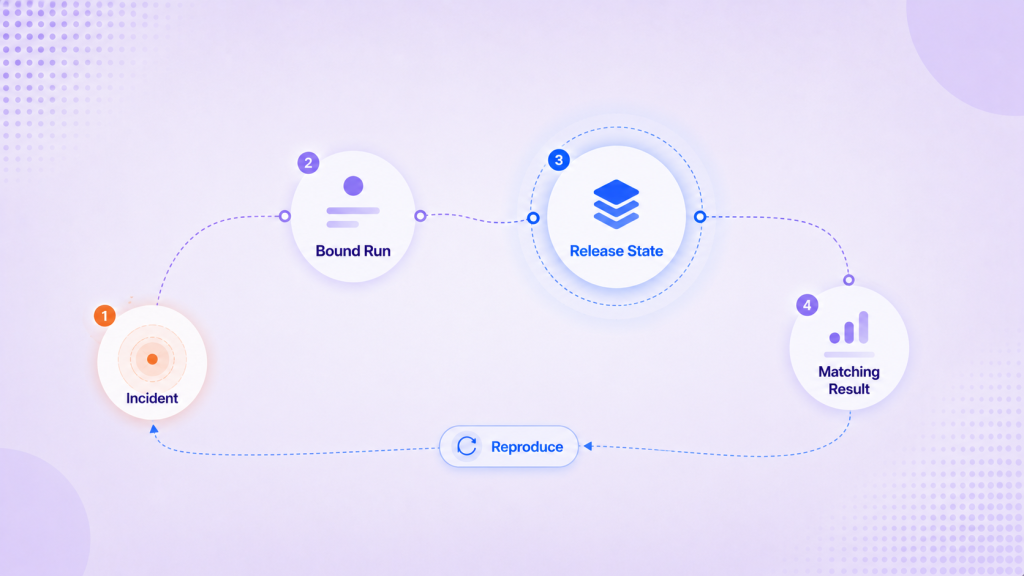
The failure rarely shows up in a demo. It shows up when a customer disputes a decision, or an auditor asks you to justify one from last quarter. A generic MLOps stack can show which model version served the request and which pipeline processed it, then goes quiet on the reference tables, thresholds, and enriched attributes the model actually read, all of which have since been updated. You are left reconstructing the past from memory, which is not evidence. The scale of the downside is documented: RAND’s interview study of engineers and data scientists puts the failure rate of AI projects above 80%, twice the rate of IT projects that involve no AI, and ranks data quality and availability among the five leading root causes.
This is not a monitoring problem. Monitoring tells you an output looked off. It does not let you rebuild the conditions that produced it. Reproducibility is a different capability, and generic MLOps was never designed to provide it.
What operating control adds
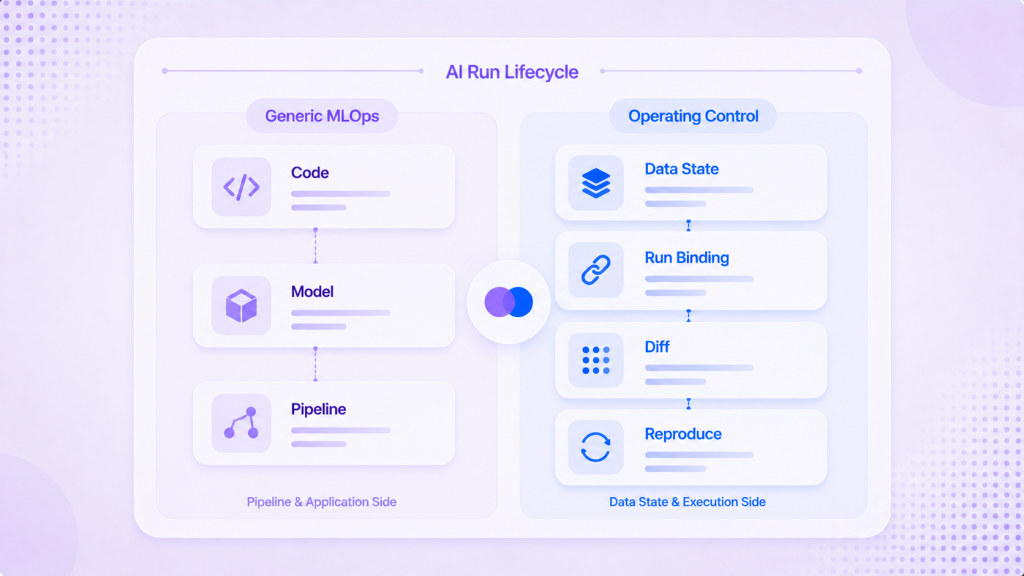
Operating control treats the data state as a first-class, versioned object. Each run captures a Release State, the resolved data, schema, and configuration it executed on, and every run records the state it consumed through Run Binding. When two runs disagree you compare their states with Diff, and you restore a prior one with Reproduce. The readiness axes this preserves are Usability, Integrity, Context, Consistency, Reproducibility, and Traceability, the last two of which a pipeline version does not touch.
None of this replaces your MLOps stack. A pipeline tool answers which code ran; operating control answers which data state produced the result. Production reproducibility needs both, so you keep the pipeline and add the state.
Is your MLOps stack missing the data half?
Run this quick check against a real production model you own:
- For an output from last quarter, can you name the exact data state it read?
- When a metric moves on an unchanged pipeline, can you diff the data before you touch the model?
- Can you rebuild a past run without the original engineer or a lucky backup?
- Would your reconstruction survive an auditor asking for the same evidence twice?
A no to two or more means the reproducibility your MLOps stack promises stops where most production failures begin.
Where operating control fits
At incident time, knowing which model ran is the easy half; the hard half is knowing which data state and execution conditions produced the result. That harder half is the layer CUBIG operates in. Syntitan, CUBIG’s AI-Ready Data Platform, scores enterprise data on the six axes, rebuilds what blocks execution, and binds every AI or agent run to a data state you can Diff and Reproduce. It sits alongside your MLOps tooling rather than competing with it, filling the half a pipeline tool leaves out.
For the fuller picture, see what separates AI-ready data from clean data, why model versioning is not enough on its own, and how operating control compares to a model registry.
Any performance figure you see is representative until you reproduce it on your own data.
Try it on your data for free. Run a sample proof and see it on your own workflow.