
Model versioning answers one question well, which model ran, but it does not answer the question that actually breaks production AI: which data state produced the result.
Versioning the model is necessary, and most teams already do it well: MLflow Tracking alone records parameters, metrics, code version, and artifacts for every run. The trouble is that a pinned model artifact creates a false sense of reproducibility, because the thing that usually moves between a working result and a broken one is not the model, it is the data state around it. Google researchers call this effect underspecification: models that score identically on held-out tests can behave very differently once deployed, and much of that gap traces back to results no one can explain or rebuild. This article sets out what model versioning captures, what it silently misses, and why production reproducibility needs both halves.
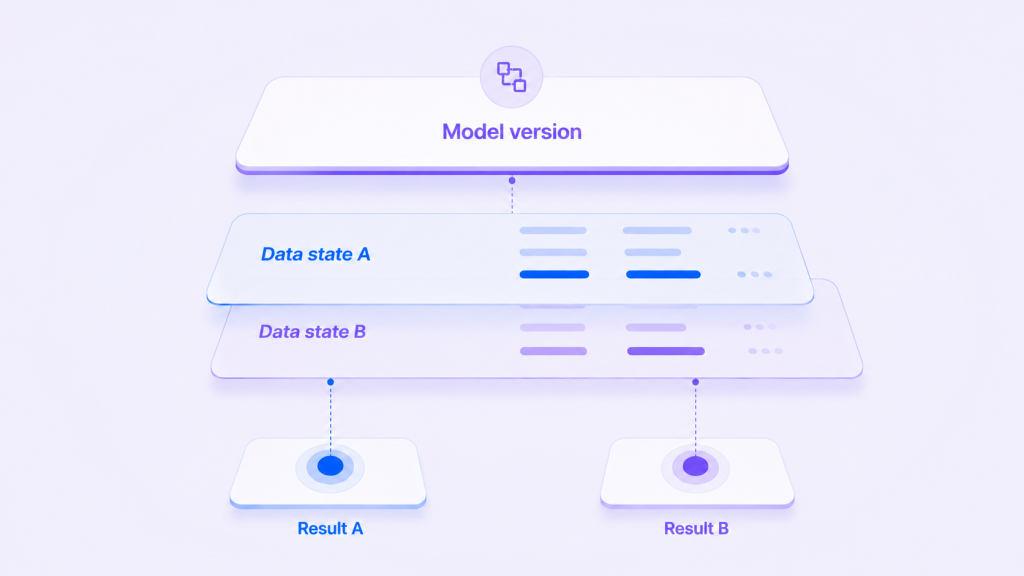
What model versioning captures
A model version records the trained artifact: the weights, the architecture, and often the training configuration. Redeploy that exact version and you get the same function back. That is genuinely useful for rollback, for comparing model iterations, and for auditing the model itself. None of that is in dispute.
It is also where most reproducibility setups stop, and that stopping point is the problem. The model is the one part of a production AI system that usually does not change between a result that worked and one that did not.
What model versioning misses
The same model version can produce different outputs whenever anything underneath it moves. Four shifts do most of the damage:
- The data window. Which slice of data the run actually saw. A model scored on last quarter behaves differently on this one, even with identical weights.
- The schema. A renamed or retyped column that the data team treated as routine, which the model reads as a different feature entirely.
- Preprocessing. A changed imputation rule, a scaler refit on newer data, or an upgraded tokenizer, so the same raw value reaches the model as a different number.
- Permissions and context. What was accessible and trusted at run time, which can quietly narrow or shift the view the model ran on.
None of these moves the model version. So when output drifts, the version log states that nothing changed while the result clearly did. The distance between those two statements is where days of debugging disappear, and where teams retrain a model that was never the cause.
Why the reproducibility gap stays invisible
Reproducibility is widely assumed to be solved once models are versioned, which is exactly why the gap survives. The change that breaks a result is usually made by a different team, through a different process, and logged as routine data work rather than a change to the AI system. The model registry faithfully reports an unchanged version; the data change sits in a migration log no one connects to the output.
You end up with two accurate records, neither of which explains why the AI behaved differently. The registry says the model held steady, the migration log says the pipeline ran as scheduled, and the result still moved. Most of these failures are unversioned state, not unversioned models, so the fix has to sit on the data side.
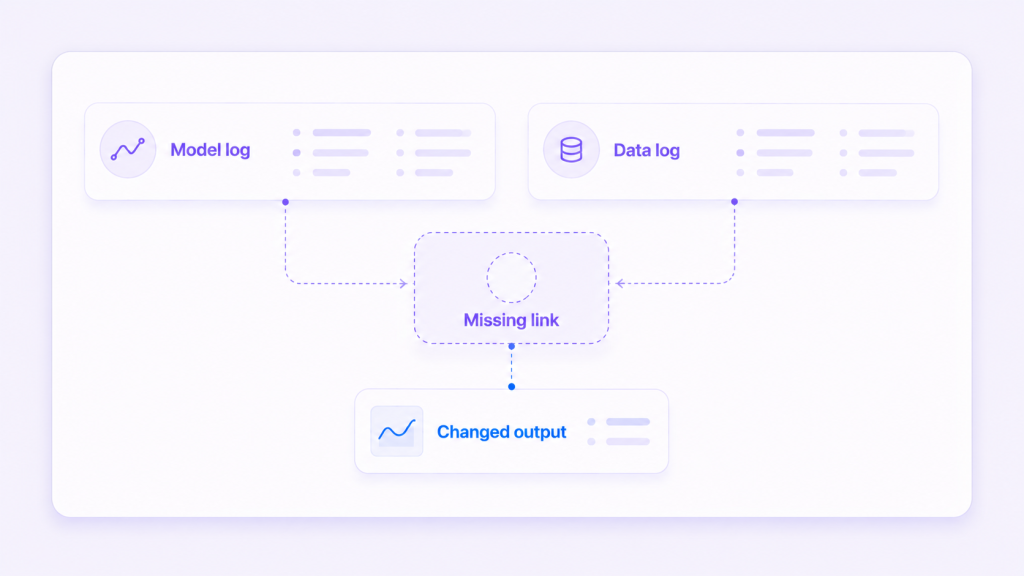
Versioning the state, not just the model
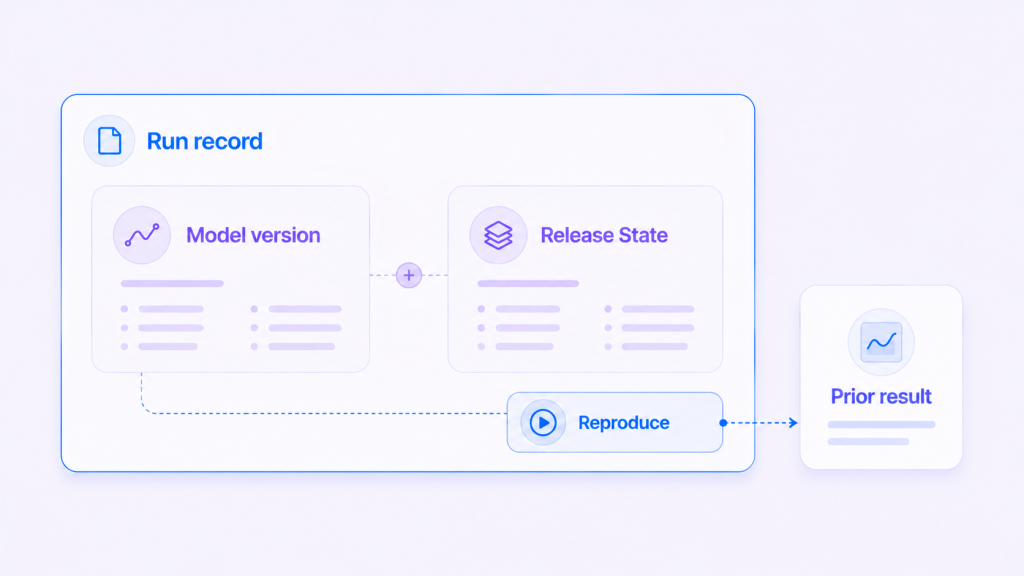
The fix is to make the data state a first-class, versioned object: a fixed reference point captured at run time, against which any result can be explained. In Syntitan this is a Release State, and every run connects to the state that produced it through Run Binding. When two runs disagree, you compare their states with Diff and restore a prior one with Reproduce.
For production AI the question is not only which model ran but which data state and execution conditions produced the result. Syntitan, CUBIG’s AI-Ready Data Platform, scores enterprise data on six axes, rebuilds what blocks execution, and binds every AI or agent run to a data state you can diff and reproduce. The readiness axes this really preserves are Consistency, Reproducibility, and Traceability, the three a model version never touches.
Model registry vs Release State: complementary, not competing
This is not an argument against model registries or experiment trackers. A registry answers which model; a Release State answers which data state; and production reproducibility needs both. Keep the registry and add the state. The teams that can actually reproduce a six-month-old result, under audit, after a drift, or on request, are the ones that versioned both halves. Google’s ML Test Score points the same way: the 28-test production-readiness rubric scores data and infrastructure checks with the same weight as model checks, a bar you cannot clear from a model version alone.
A quick test on your own setup
Run this diagnostic against your current stack. If the honest answers point at the model only, your reproducibility stops where most production failures begin.
- Take a result from last quarter. Can you reproduce the exact data it ran on, or only the model that produced it?
- When output drifts on an unchanged model version, can you diff the state to find what moved, or do you start by retraining?
- For any run, do you know which data state it was bound to, or only its model version and a timestamp?
- Can a different team reconstruct a past result without asking the person who first built the pipeline?
Where it fits in CUBIG’s operating layer
Syntitan supplies the half a registry leaves out. It scores data on the six axes, rebuilds what blocks execution, and binds every AI or agent run to a Release State you can diff and reproduce, so alongside “this model version was live,” you can also say “this data state produced this result, and here it is, restored.” That arc, make the data ready and keep it reproducible, is the job of an AI-ready data operating layer, the layer that sits between data management and AI execution. Any performance figure you see is representative until you reproduce it on your own model and data.
Try it on your data for free. Run a sample proof and see it on your own workflow.
Related reading: What is Release State?, Release State vs Model Versioning: Why Registries Aren’t Enough, Release State vs Dataset Snapshot, and Operating Control vs Model Registry.