Table of Contents
Summary
Here’s a number that should make any CDO lose sleep. Gartner predicts that by 2026, 60% of AI projects will be abandoned. Not because of a lack of GPU power or a flawed algorithm, but because of a failure to reliable AI-optimized, usable data. We’ve all seen it. The brilliant PoC from the data science team that gets a standing ovation, only to wither and die when it meets the messy reality of our production data streams. The executive mandate for “AI everywhere” rings hollow when your teams spend 80% of their time just trying to stitch together usable datasets.
The core problem isn’t our models or our infrastructure. The issue is that we’re trying to run Formula 1 race cars on a dirt road. Our data estates were built for a different era—an era of human-in-the-loop reporting and historical analysis. They were never designed for the continuous, autonomous reasoning that AI agents demand. This creates a fundamental gap in AI data readiness that is quietly killing innovation and wasting billions in investment.
We keep talking about MLOps and model governance, but we’re ignoring the source code of every AI system: the data itself. Until we shift our focus from just cleaning data to creating a verifiable, repeatable, and truly usable data state for our AI systems to execute against, we’re going to keep adding to the project graveyard.
The PoC Graveyard and the Myth of AI Readiness
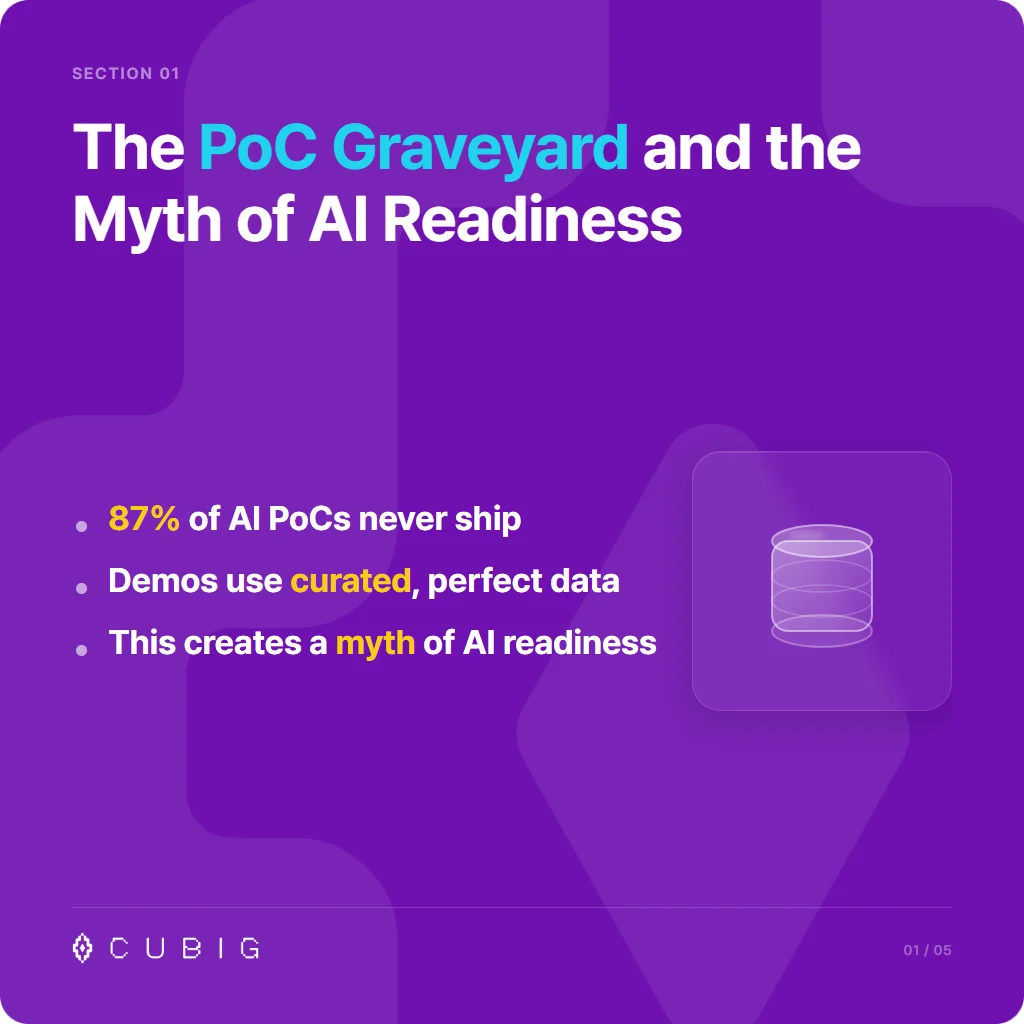
Every data leader I know has a story about the “robust demo.” The one where the model predicts customer churn with uncanny accuracy or identifies a supply chain anomaly in a carefully curated, hand-cleaned dataset. Everyone gets excited. Budgets get approved. Then, the project moves toward production.
That’s when everything breaks.
The data streams are dirtier than anyone admitted. The compliance team flags half the features as too sensitive to use. Latency issues make real-time inference impossible. According to S&P Global’s 2025 reporting, 46% of AI proofs-of-concept are discarded before ever reaching production. 42% of US enterprises have simply abandoned most of their AI initiatives altogether. This isn’t a failure of vision; it’s a failure of foundation. It’s a failure of AI data readiness.
We’ve created an entire industry around the idea of “AI-ready infrastructure,” with vendors happy to sell us faster chips and bigger clusters. But as a recent announcement from CBTS and HPE highlighted, the focus is often on the hardware. This completely misses the point. The fanciest server rack in the world is just an expensive space heater if the data feeding it is unusable.
The community feels this disconnect keenly. One data engineer on Reddit put it bluntly, describing the endless cycle of “building a great model on a CSV, then spending the next six months failing to rebuild the 15 legacy pipelines that created it.” That’s the reality gap where projects go to die. We celebrate the sprint of the PoC, then get bogged down in the marathon of data integration and remediation, a race we almost never win.
Your Data Estate Was Built to Fail AI
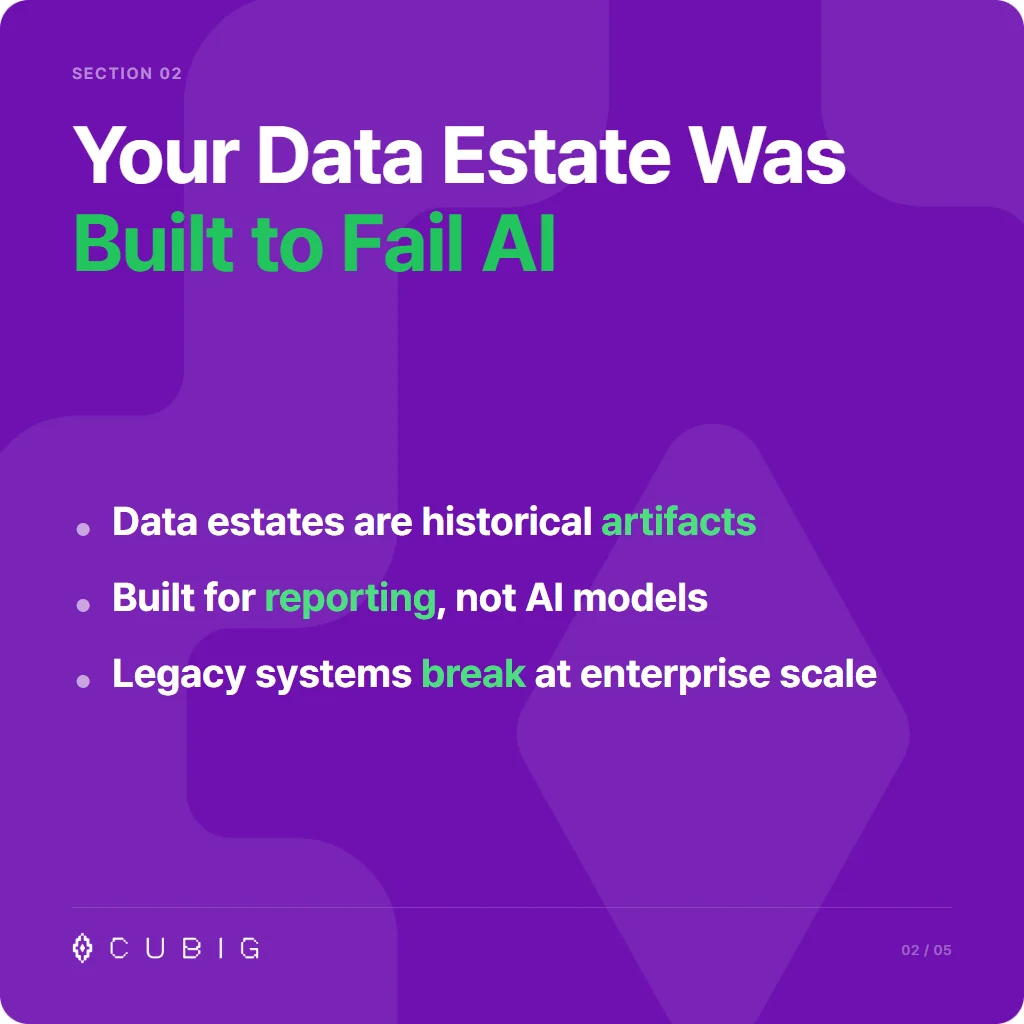
Let’s be honest with ourselves. Our enterprise data architecture is a collection of historical artifacts. We have transactional databases optimized for speed, data warehouses built for quarterly reports, and cloud data lakes that are often just schema-on-read dumping grounds. None of these were designed for what we’re asking of them now.
Arun Ulag, President of Azure Data at Microsoft, nailed it in a recent Forbes piece. He stated, “Most data estates were designed for reporting, transactions, and human decision-making, not for continuous reasoning or autonomous systems operating inside the business.” This is the architectural mismatch at the heart of the AI adoption crisis. A human analyst can look at two slightly different customer records from different systems and use context to know they’re the same person. An AI agent can’t. It sees two different realities, and its decisions will be based on that fragmented view.
This isn’t a theoretical problem. Microsoft’s own reporting found that around 50% of agentic AI projects are stuck in pilot stages specifically because of fragmented data. The agents literally can’t get a straight answer from the systems they are supposed to automate. They are built on a foundation of sand, operating from what one VentureBeat article called “different versions of reality.” When an agent responsible for inventory management has a different definition of “in-stock” than the agent handling logistics, the entire business process breaks down.
We are trying to build autonomous systems on a data architecture that requires constant human translation and intervention. That’s a recipe for failure. The problem isn’t a lack of data. Gartner has pointed out that only 12% of enterprise data is actually used. The rest is trapped, unusable because of quality issues, regulatory restrictions, or legacy formats. That 88% represents a massive reservoir of untapped value, but our current tools and pipelines can’t activate it for AI.
The very design of our systems perpetuates this state of low AI data readiness, making every new project a heroic effort of custom engineering rather than a repeatable process.
📃Microsoft Expands Fabric For Enterprise AI, Deepens Nvidia Partnership
Fragmented Teams, Fragmented AI Reality
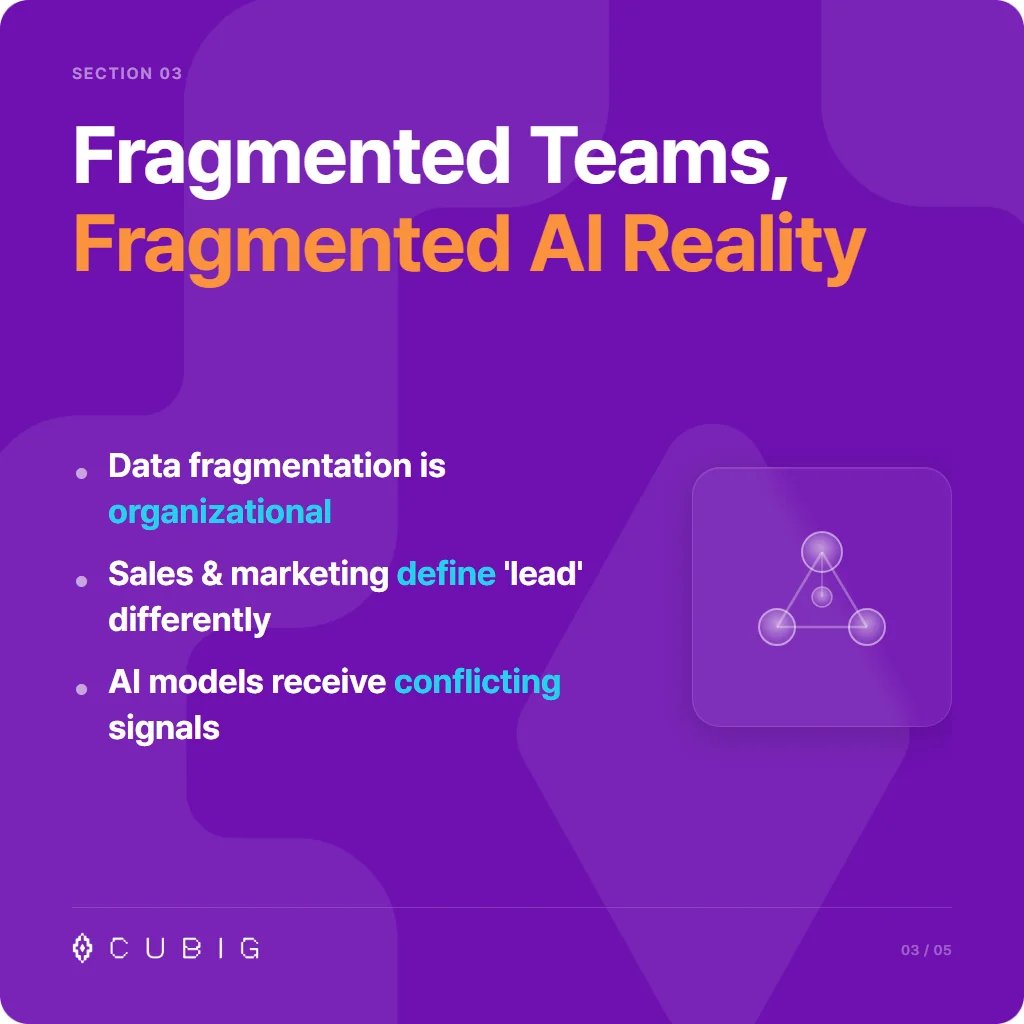
The data fragmentation problem isn’t just technical; it’s organizational. The marketing department defines a “lead” one way. Sales defines it another. Finance has a third definition for revenue recognition. For decades, we’ve papered over these differences with spreadsheets and manual reconciliation meetings. Humans acted as the final semantic layer.
AI agents don’t have that luxury. As a VentureBeat analysis from March 2026 pointed out, “Agents built on different platforms, by different teams, do not share a common understanding of how the business actually operates.” This creates a workforce of AI agents that are constantly disagreeing with each other, leading to chaotic and untrustworthy outcomes. It’s the root cause of what many call “business logic hallucinations,” where the AI isn’t making up facts, but is applying the wrong business context because it was trained on an inconsistent view of reality.
This is a pain point I hear constantly from practitioners. A recurring theme in Hacker News discussions is the sheer difficulty of getting an AI agent to perform a seemingly simple task, like booking a multi-leg flight, because it can’t reconcile data from the airline, the hotel booking system, and the corporate expense policy. Each system provides a piece of the truth, but no single source provides the complete, usable context required for autonomous action. It’s the digital equivalent of trying to assemble a product using three different sets of instructions.
This organizational chaos directly impacts our ability to achieve true AI data readiness. You can have the cleanest data in the world within each silo, but if the silos don’t speak the same language, the data remains unusable for any cross-functional AI initiative. The goal can’t be just to clean data; it has to be to create a single, shared, and verifiable data reality that all agents can operate from. Without that, we are just automating our own internal confusion.
Beyond Pipelines: The Data Execution Architecture AI Needs
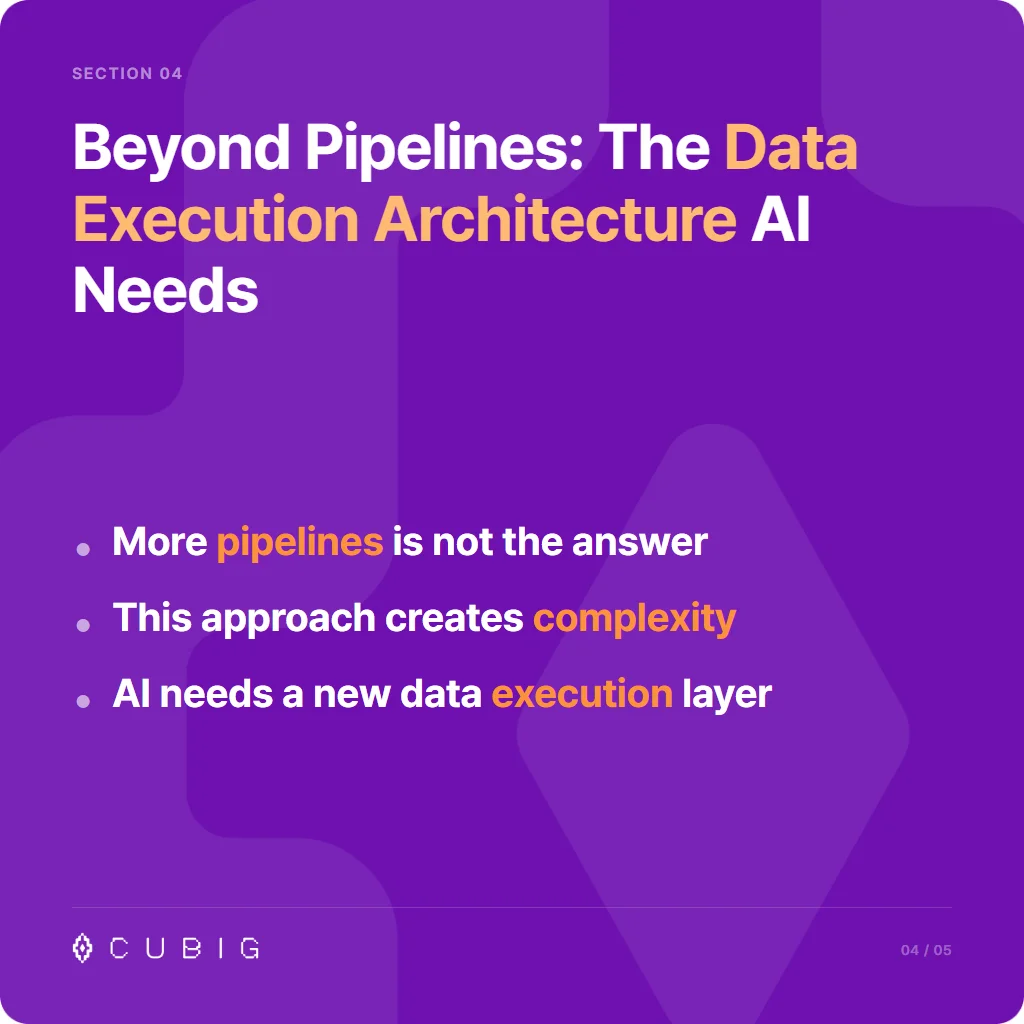
For the last decade, our solution to every data problem has been to build another pipeline. We have ETL pipelines, reverse ETL pipelines, and a complex web of data transformations that are brittle, hard to maintain, and almost impossible to debug. This pipeline-centric view of the world is holding us back.
AI doesn’t just need data delivered to it. It needs data in a consistent, reliable, and verifiable state at the moment of execution. Think of it like a compiled program. You don’t ship the source code and a bunch of libraries to a customer and hope they can build it. You ship a compiled binary that runs predictably every time. Our data for AI needs to be treated the same way.
This requires a shift in thinking from data pipelines to a data execution architecture. The goal is not just to move data, but to transform raw, unusable data into a certified, AI-ready state that is frozen, versioned, and bound to a specific AI model run. This is the only way to guarantee reproducibility. It’s the only way to debug a model’s bad decision by precisely recreating the exact data state it saw. And it’s the only way to ensure that two different AI agents are operating from the same version of reality.
This approach moves beyond simple data quality checks. It involves a systematic process of data restructuring to handle regulatory constraints, fill in gaps where data is uncollectable, and standardize definitions across the enterprise. It’s about creating a definitive, usable dataset.an original-replacement dataset.that becomes the bedrock for all AI operations. This is the essence of building genuine AI data readiness into the fabric of your organization, not just treating it as a pre-processing step for each new project.
How CUBIG Addresses This
The challenges of data unusability and the need for a stable data state are precisely why we built Syntitan. It’s not another pipeline tool or a data quality dashboard. Syntitan is an AI-Ready Data Platform designed to create a reliable data execution architecture for enterprise AI.
The process begins at its Data governance Gate. This initial layer uses our DTS engine and LLM Capsule pre-processing to perform regulation-friendly data restructuring. It handles sensitive information and PII not by simply removing it, but by converting it into a usable, structurally-preserved format that allows models to train on patterns without exposing the raw, restricted data.
From there, data moves through layers for Data Quality & Standardization and AI-Ready Transformation. This is where Syntitan automates the heavy lifting that kills most AI projects. It systematically cures issues like missing values, bias, and imbalance, transforming trapped, broken data into a clean, optimized state. This isn’t a one-off manual fix. It’s a repeatable, policy-driven process that ensures consistency.
The final and most critical layer is the Verifiable Data State, which we call the Statehouse. Here, Syntitan freezes the prepared data into an immutable “Release State” with a unique ID. Every AI training run or inference call is then bound to a specific `release_id`. This creates an unbreakable audit trail. If a model behaves unexpectedly six months from now, you can instantly diff the data states between runs and reproduce the exact conditions that caused the issue. This moves us from guessing to knowing.
This architecture is built on a core belief. AI systems fail in production not because of models, but because of the data state at execution time. By ensuring that state is verifiable, clean, and consistent, Syntitan provides the stable foundation that enterprise AI has been missing.
FAQ
How is a ‘verifiable data state’ different from just versioning datasets in S3 or a feature store?
Versioning datasets is a great first step, but it only tracks the data itself. A verifiable data state goes further by creating an immutable, cryptographically-bound link between a specific data “Release State” and every single operational run that uses it. This means you have a complete, auditable record of not just what the data looked like, but precisely which version of the data was used by which model for which decision, making true root-cause analysis possible.
We’re seeing our AI agents ‘hallucinate’ business logic, not just facts. How does fixing data solve that?
This is a classic symptom of fragmented context. The agent isn’t “making things up” so much as it’s operating on an incomplete or contradictory understanding of your business reality drawn from siloed data. By creating a unified, usable data layer where “customer” or “active project” is defined consistently, you eliminate these contradictions at the source. The AI then operates from a single source of truth, drastically reducing these kinds of contextual errors and improving its reliability.
My team is already swamped. Isn’t an ‘AI-Ready Data Platform’ just more complexity?
It’s a shift from reactive complexity to proactive simplicity. Your team is swamped fighting fires.debugging pipelines, manually cleaning data for each project, and responding to compliance audits. A platform like Syntitan automates the creation of clean, usable data states. This front-loads the work into a repeatable, policy-driven system, which reduces the downstream chaos and frees up your top engineers from doing remedial data work to focus on building actual AI value for the business.
What’s the first practical step our data team can take towards AI data readiness without a huge investment?
Start by changing your documentation mindset. Don’t just catalog your data sources by where they live (e.g., “Salesforce DB,” “Marketo API”). Instead, start a new catalog that defines data sources by their intended AI use case (e.g., “Data for Churn Prediction Model,” “Data for Supply Chain Optimization Agent”). This small shift forces your team to think about data from the perspective of the AI consumer, immediately highlighting inconsistencies and gaps in your current approach.