Hello, this is CUBIG the company behind Syntitan, the AI-ready data platform for enterprise AI. 💎
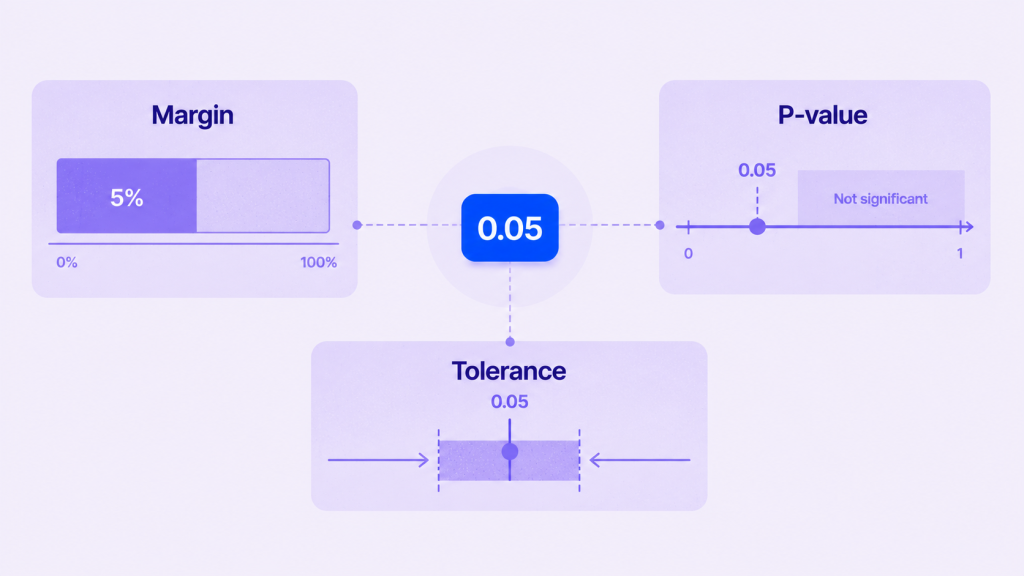
The number 0.05 is a margin rate to a retailer, a significance threshold to a pharma team, and a machining tolerance to a manufacturer. An AI model sees one number.
Domain context is the meaning data carries from the field that produced it: what a value measures, under which rules, over what period, and for which decision. BCG put a weight on it in From Potential to Profit, its January 2025 report on the AI impact gap. In the companies that get returns from AI, only about 10 percent of the effort goes to algorithms and 20 percent to data and technology. The remaining 70 percent goes to people, processes, and transformation: the domain side. The same research found only about a quarter of executives saying their companies have created significant value from AI. This piece reads those two numbers through a delivery lens: why AI results refuse to travel between clients, and what that costs anyone whose business is deploying AI across ten of them.
The 28 percent problem
Start with how rarely enterprise AI delivers what was promised. Gartner surveyed 782 infrastructure and operations leaders in late 2025. Only 28 percent of their AI use cases fully met ROI expectations, and one in five failed outright. The causes were plural, which is worth being honest about: 57 percent of leaders who hit failures said they had expected too much too fast, and 38 percent named poor data quality or limited data availability as a direct cause. Meanwhile McKinsey’s State of AI survey puts enterprise AI adoption near universal, with 88 percent of organizations using AI in at least one function, while nearly two-thirds have not begun scaling it across the enterprise. Fivetran’s survey of 401 data leaders adds the delivery texture: 42 percent of enterprises say more than half of their AI projects were delayed, underperformed, or failed on data readiness issues, and 41 percent say the lack of real-time data access keeps models from timely insights.
Different surveys, different populations, same shape. The models clear their benchmarks, the infrastructure scales, and the value still arrives for a minority. Whatever the missing variable is, it is not compute, and BCG’s 10-20-70 split names the leading candidate. The thin slice of effort everyone funds is the algorithm. The thick slice that decides value is the domain, and the domain is precisely what a general-purpose model does not know.
Ten clients, ten different failures
Here is the pattern as a composite scene, assembled from the survey findings above and the engagement stories every cross-industry team collects. A consulting team ships an inventory-prediction model for a retail client: point-of-sale data, seasonal demand curves, 92 percent accuracy, sign-off. The next engagement is a pharma company, and the team brings the same modeling approach to clinical data. The first review meeting ends early because the medical team refuses to move forward. Under FDA criteria, these numbers mean something entirely different. The engagement after that is an energy utility, where a predictive-maintenance model keeps flagging out-of-range sensor readings. A field engineer glances at the alerts and shrugs. That is seasonal variation. It is normal.
Same team. Same architecture. Three industries, three different failures, and not one of them is a modeling error. The number 0.05 illustrates the mechanism. In the retail engagement it is a margin rate, in the pharma engagement a statistical significance threshold, in the manufacturing supply chain a machining tolerance. Nothing in the value distinguishes the three. The meaning lives outside the number, in the domain that produced it, and a model that never receives that meaning will treat all three as the same quantity. An engineer on Hacker News described the general case: “You can’t just deploy an AI to a big company and it will magically guess all the endpoints which exist.” His conclusion is the one that matters for delivery economics: “Whoever knows the most context about a system has the advantage.”
Domain context is the part that refuses to transfer
A delivery business earns its margin on what repeats between clients. That is what makes the 10-20-70 split commercially uncomfortable, because the parts of an AI engagement that repeat are not the parts that carry the value.
| Part of an AI engagement | Transfers to the next client? | Why |
|---|---|---|
| Model architecture | Yes | Same APIs and capabilities everywhere |
| Prompt patterns and playbooks | Mostly | Methodology, refined and resold across engagements |
| Preprocessing pipeline | Partly | Code carries over; assumptions baked into it often do not |
| Field meanings, units, thresholds | No | 0.05 changes meaning at the industry boundary |
| Regulatory interpretation of the data | No | FDA, Basel, and grid rules read the same value differently |
| Tacit knowledge in analysts’ heads | No | Leaves the building with the people |
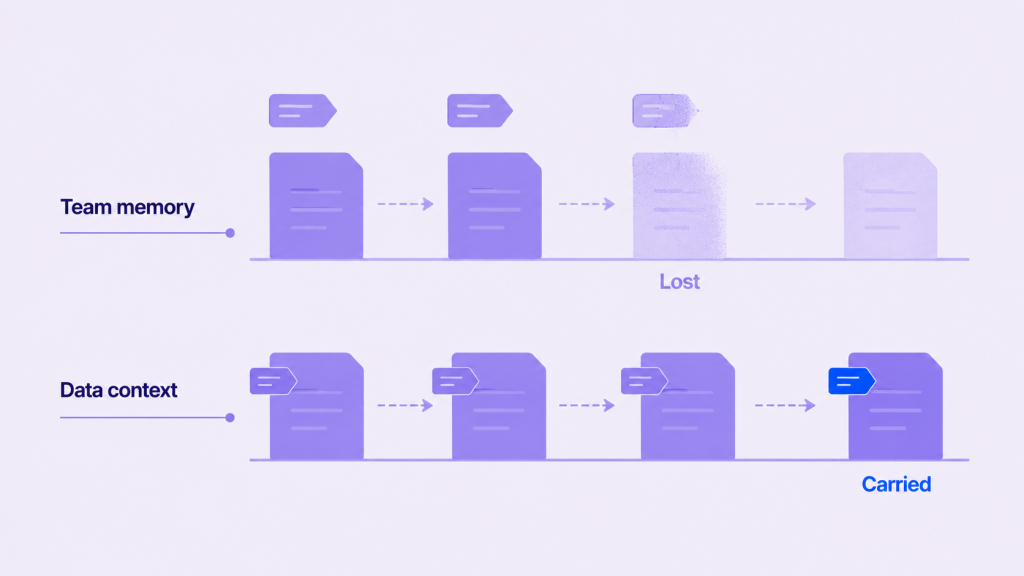
The bottom three rows are relearned by hand at every new client. Workshops, shadowing sessions, interview notes, a data dictionary in a PDF that someone half-maintains. When the engagement ends, that understanding leaves with the team, and the eleventh client costs as much to onboard as the first. Deploy across ten clients and you pay the domain tax ten times, which is exactly the arithmetic behind BCG’s finding that only a quarter of enterprises capture the value. The 70 percent slice does not compound.
More experts in the room is not a scaling strategy
The standard fixes both help and both stall. Fix one is staffing: put domain experts in every review. It works for one engagement, and it caps there. Experts are scarce, their knowledge stays tacit, and their corrections arrive after the model has already produced something wrong. Fix two is domain adaptation on the model side: fine-tune weights to a domain corpus. That solves a real problem, and it operates one layer away from this one. It is a per-client, per-domain cost, and after the tuning, the client’s tables still do not say what their values mean. A tuned model reading an unlabeled 0.05 is still guessing, just with better priors.
Notice what both fixes have in common. They put the knowledge in people or in weights, and both are expensive to move between clients. The alternative is to put the knowledge where the value question actually lives: in the data itself. That is BCG’s inversion made practical. Organizations fund the 10 and the 20 because those line items are legible, while the 70 gets whatever is left. Making the domain slice cheaper to carry is how it stops being the neglected remainder.
What data with domain context looks like
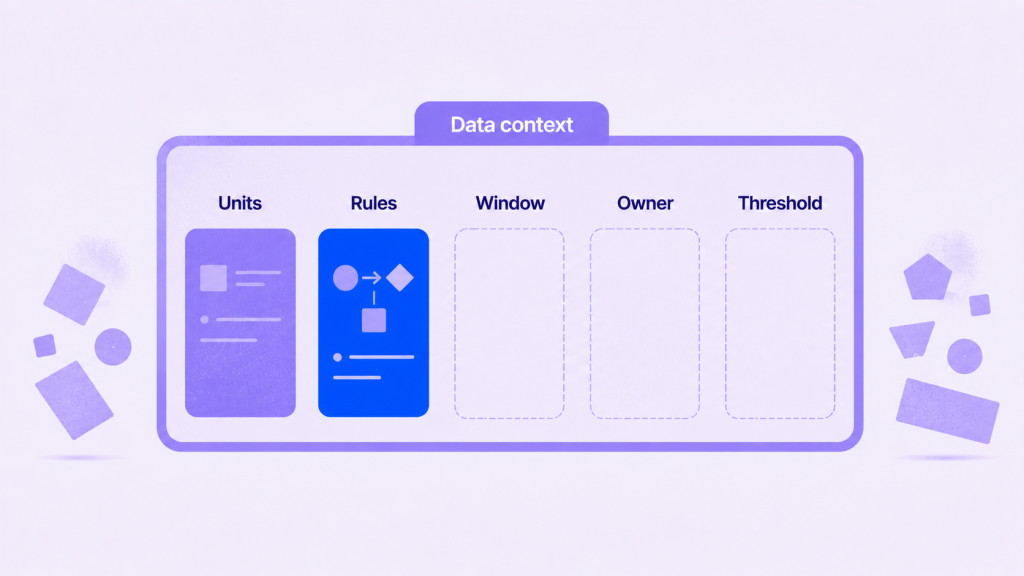
Without context, 0.05 is a bare value. With context, the same field arrives marked as a p-value, thresholded for significance at alpha 0.05, defined by the trial’s statistical analysis plan, valid for this study window. A model reading the second version does not need to guess, and neither does the new analyst who joins the account in month three. Domain context, carried structurally with the data rather than in a slide appendix, survives handoffs: between teams, between engagements, between the pilot and whatever touches the data in an AI-ready state a year later.
This is the layer Syntitan operates. It attaches domain context to data structurally, so what a field means, in which domain, under which rules, travels with the data instead of with the staffing plan. For an enterprise, that is the difference between AI that interprets and AI that pattern-matches. For a delivery firm, it changes the shape of the domain tax: context captured at client one becomes an asset the engagement keeps, rather than a cost the next engagement repeats. The quarter of enterprises that capture AI value are not running better models. They are feeding models data that carries its own meaning.
Before your next cross-industry deployment
Five questions for anyone running AI across multiple clients or business units. Each “no” marks domain context that currently lives in someone’s head.
- Could a new team member tell what each critical field means, in units and thresholds, without booking a meeting?
- Do your data fields carry their regulatory frame, or does that live in a slide appendix?
- When an engagement ends, does the domain understanding stay with the client’s data or leave with your team?
- Has the same model produced different-quality results across industries with no code change in between?
- Is domain onboarding rebuilt from zero at each new client?
About CUBIG
CUBIG is an AI-ready data operating layer for regulated enterprises and the firms that deploy AI for them. Between where data management ends and AI execution begins sits a missing layer: making data usable by AI, and making sure AI can interpret what that data means in its domain. CUBIG fills it. Its platform, Syntitan, carries domain context with the data itself, so the same value reads correctly in retail, pharma, and manufacturing without the meaning being rebuilt by hand each time.
Does your data carry its domain context? Try it on your data, free. Run a sample proof and see what your data tells an AI, and what it leaves out.