Why Reversible Data Layers Define AI Risk Management Now
Table of Contents
Key Takeaways
- According to ArmorCode’s 2026 industry survey, 86% of IT leaders claim to have a complete AI inventory, yet 59% admit shadow usage runs entirely ungoverned.
- Traditional restricting strategies break enterprise document intelligence and push employees toward unapproved tools, adding severe financial exposure.
- LLM Capsule, developed by CUBIG, acts as a reversible AI data gateway that ensures Zero Exposure while restoring original context for true AI risk management.
Our analysis of the latest 2026 market data indicates a massive shift in how enterprises govern their artificial intelligence adoption. The old playbook of restricting access completely has failed to stop unauthorized usage across corporate networks. Employees simply bypass the corporate firewall to get their work done.
Organizations must adopt an enablement mindset rather than a restrictive one. Replacing rigid prohibitions with reversible data capsulation allows teams to process sensitive documents safely. This structural change redefines the baseline for operational governance going forward.
Is Your Organization Blind to the Shadow AI Explosion?
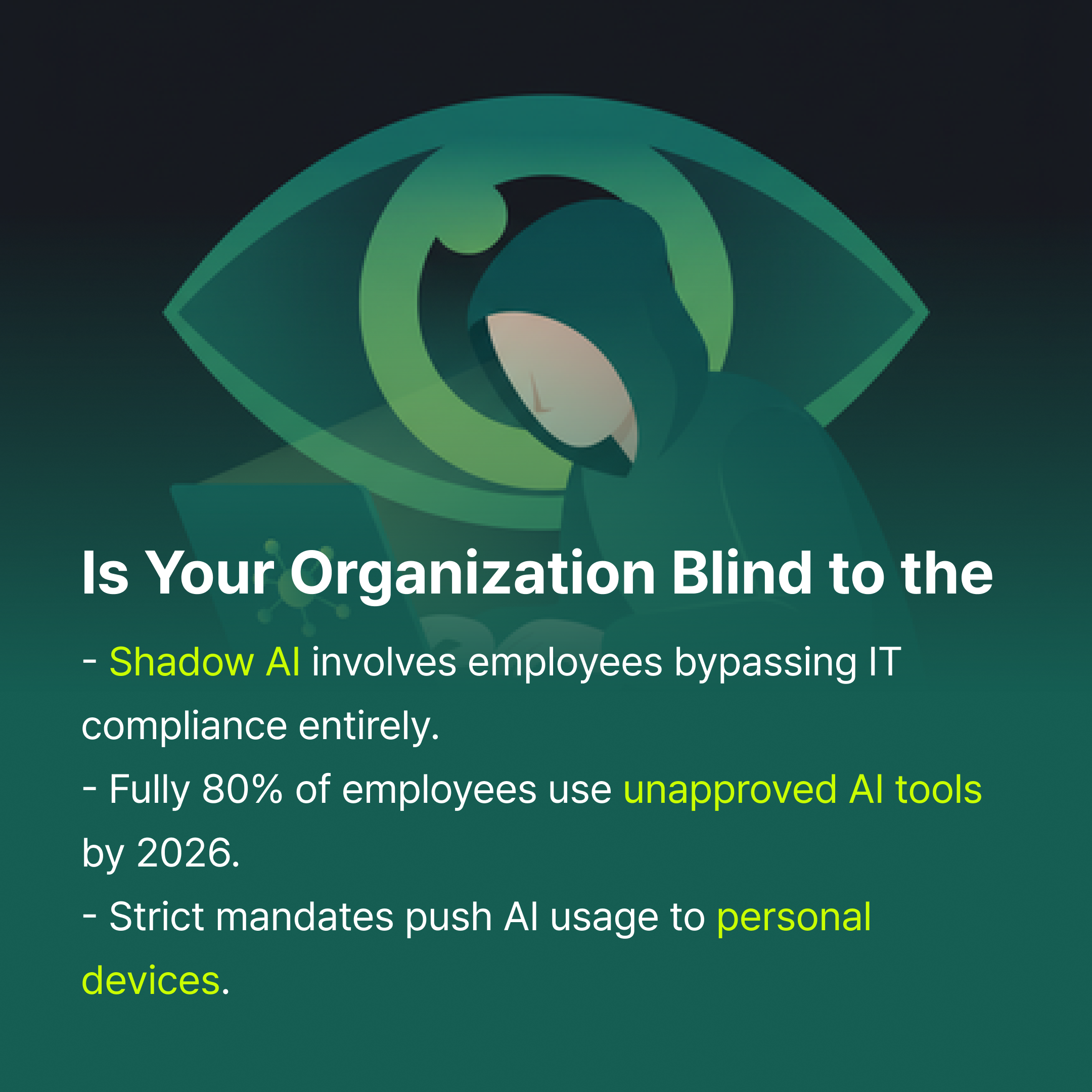
Shadow AI refers to the unauthorized use of AI tools by employees without IT oversight, bypassing established compliance frameworks entirely. According to UpGuard, 80% of enterprise employees currently use unapproved AI tools in 2026, forcing a complete reevaluation of AI risk management strategies.
Data leaders issue a top-down mandate. They watch usage move directly to personal devices. The 2026 ArmorCode study reveals a massive industry confidence gap. A full 86% of IT directors claim a complete inventory, yet 59% admit unapproved usage runs rampant.
“A full 86% of IT directors claim a complete inventory, yet 59% admit unapproved usage runs rampant.”
Platforms like CUBIG’s LLM Capsule take a deeply different approach to this dilemma, acting as an AI data gateway that enables reversible capsulation to keep employees productive without exposing assets. Finding a path forward requires acknowledging that prohibition policies fuel the very problems they try to solve.
The Machine-Speed Threat of Agentic Data Sprawl
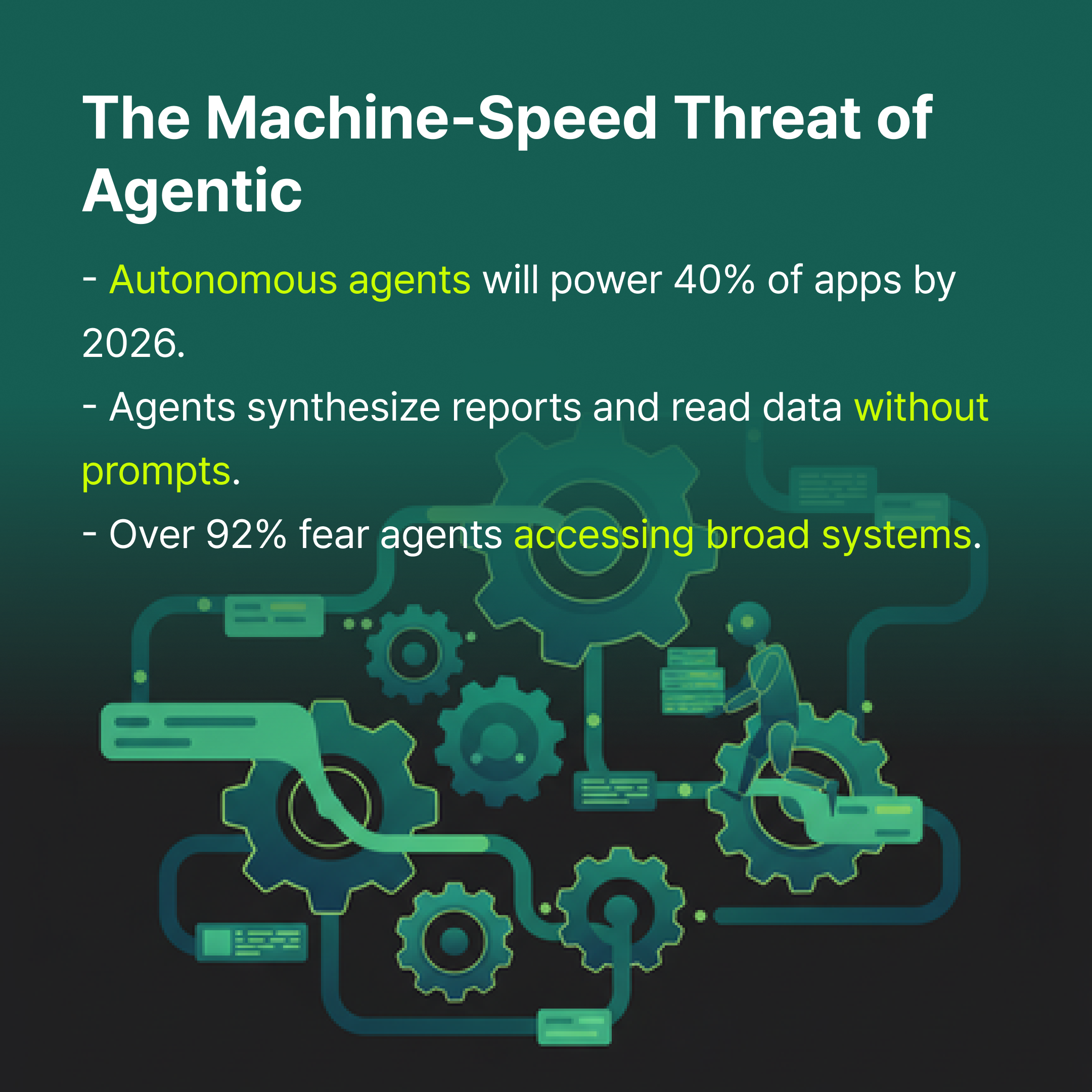
Agentic systems alter how information moves across corporate networks. Task-specific agents (which Gartner projects will be in 40% of enterprise applications by the end of 2026) act autonomously. They read databases without prompting. They synthesize reports and interact with external APIs entirely on their own.
This automation scale terrifies governance teams. According to Darktrace, 92% of data professionals express high concern regarding autonomous agents accessing broad workforce systems. Traditional oversight cannot scale to monitor thousands of machine-speed API calls per minute.
The rapid adoption of the Model Context Protocol amplifies these visibility challenges. Developers rapidly connect local agent servers to external cloud endpoints.
Effective agentic AI data governance requires monitoring these dynamic cross-boundary connections rather than static storage silos. Visibility alone solves nothing if remediation breaks the underlying workflow. IT departments must evolve their AI risk management frameworks to handle continuous multi-directional flows.
Why Do Traditional Redaction Methods Break Enterprise AI Workflows?
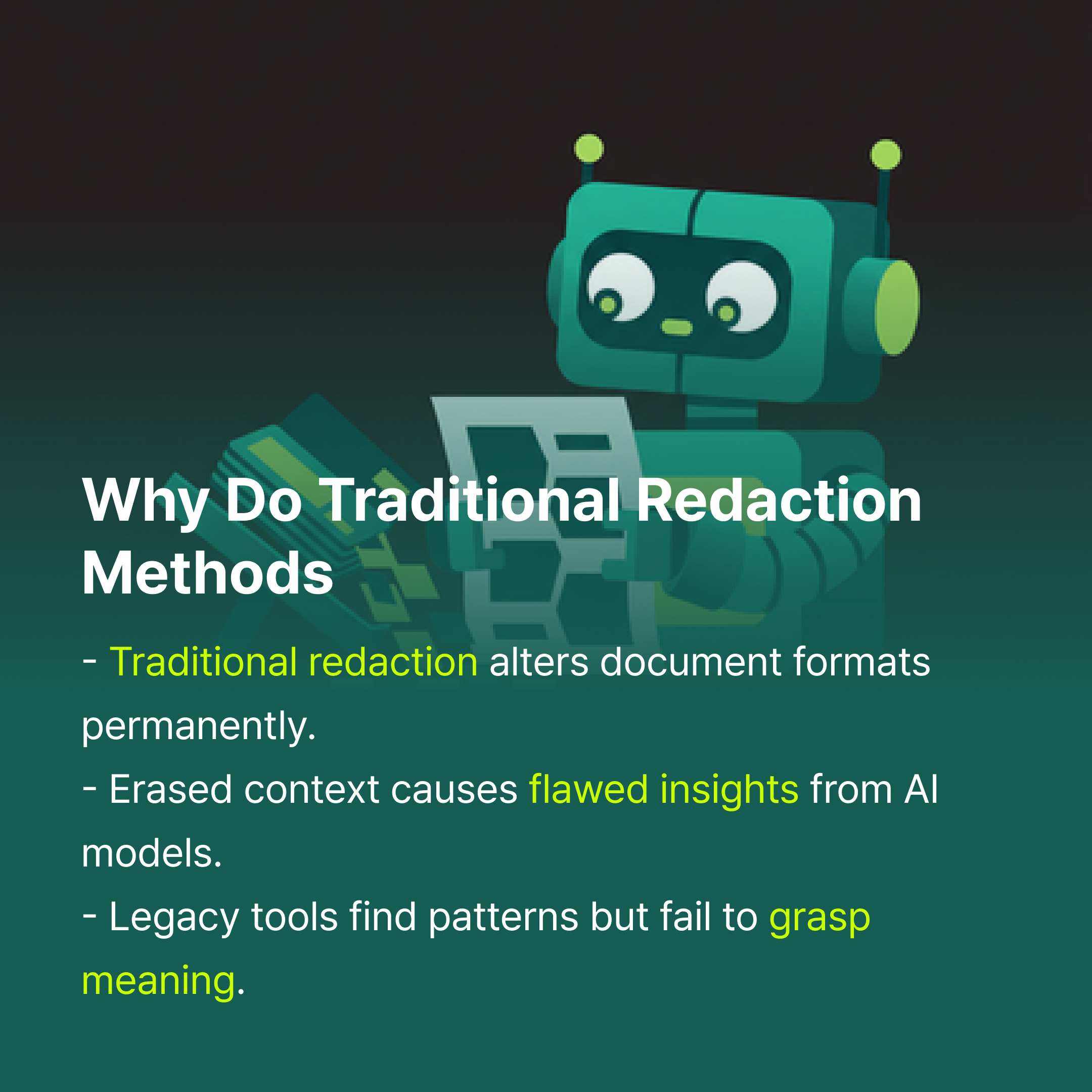
Traditional redaction methods permanently alter document formats and remove context. This causes models to misinterpret structural relationships and generate flawed insights. When a financial spreadsheet has its core metrics replaced with placeholders, the mathematical logic disintegrates. Language models rely on adjacent tokens to understand meaning.
Legacy capsulation platforms look for patterns; they do not understand context. A basic filter might scramble a client name while leaving the highly specific pricing structure completely visible. The remaining information still allows external vendors to reconstruct the client identity through secondary inference.
Complex documents suffer even worse degradation. Contracts and technical manuals lose their hierarchical relationships during aggressive filtering. CUBIG categorizes this phenomenon as trapped/Restricted Data. This represents a massive chunk of the 88% of enterprise data that Gartner estimates remains unusable.
Employees notice immediately when their document analysis platforms return gibberish. Frustration builds rapidly across business units.
The resulting friction becomes the primary driver for off-network adoption. Solid shadow AI prevention requires delivering tools that actually work for the end user. If the approved system fails to process a standard vendor contract accurately, the user will find a consumer tool that can.
The Rise of the Vendor-Neutral AI Risk Management Gateway
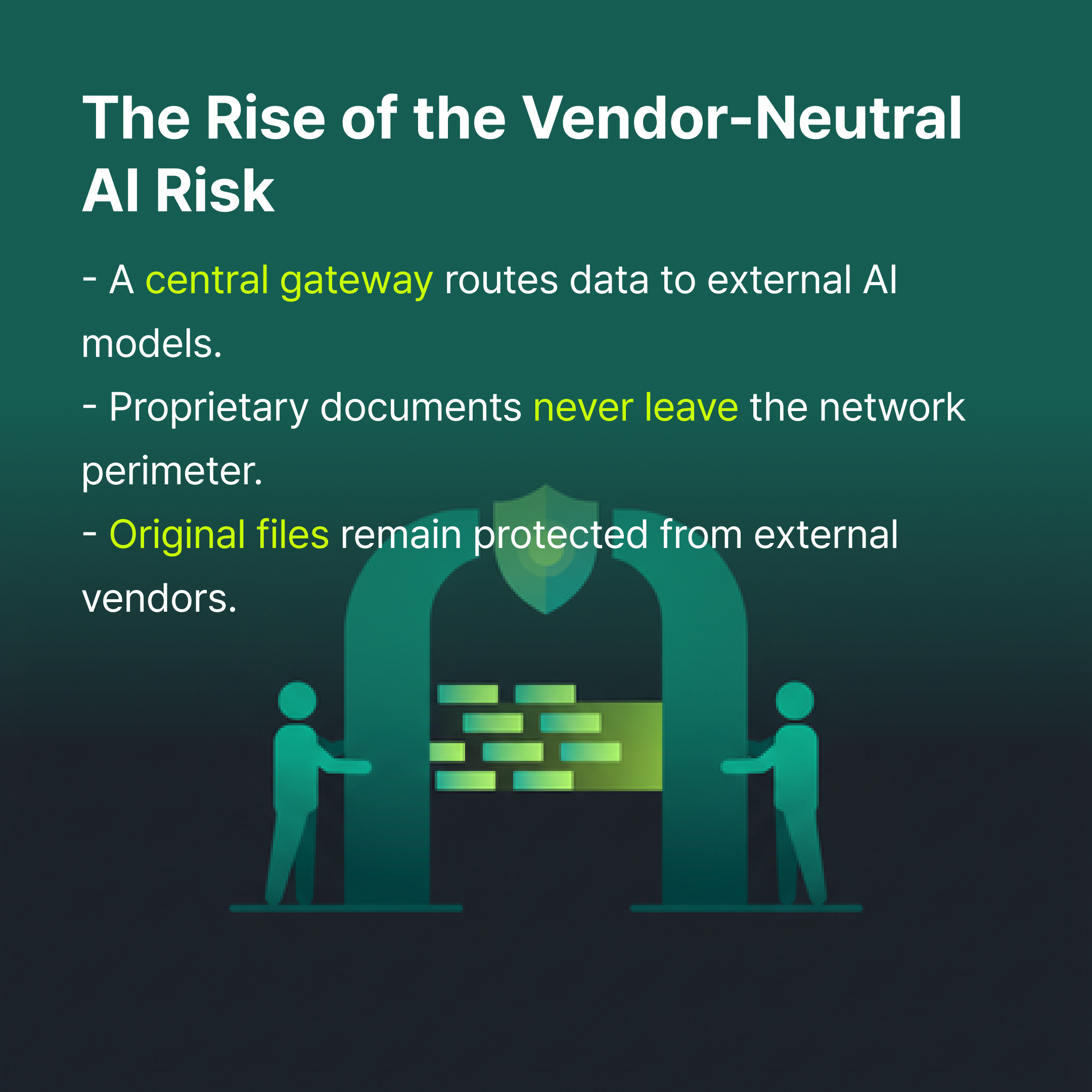
The gateway architecture acts as a central control plane. It routes traffic between internal repositories and external language models. Data flows out, answers flow in . Across any boundary. Unlike legacy vault systems, this setup manages bidirectional translation smoothly.
One setup gaining traction for AI risk management is the AI Gateway model. CUBIG’s implementation ensures Zero Exposure, meaning your original proprietary documents never leave your environment while the external vendor processes only capsulated structures.
How Do Teams Unblock Document Intelligence Without Exposure?
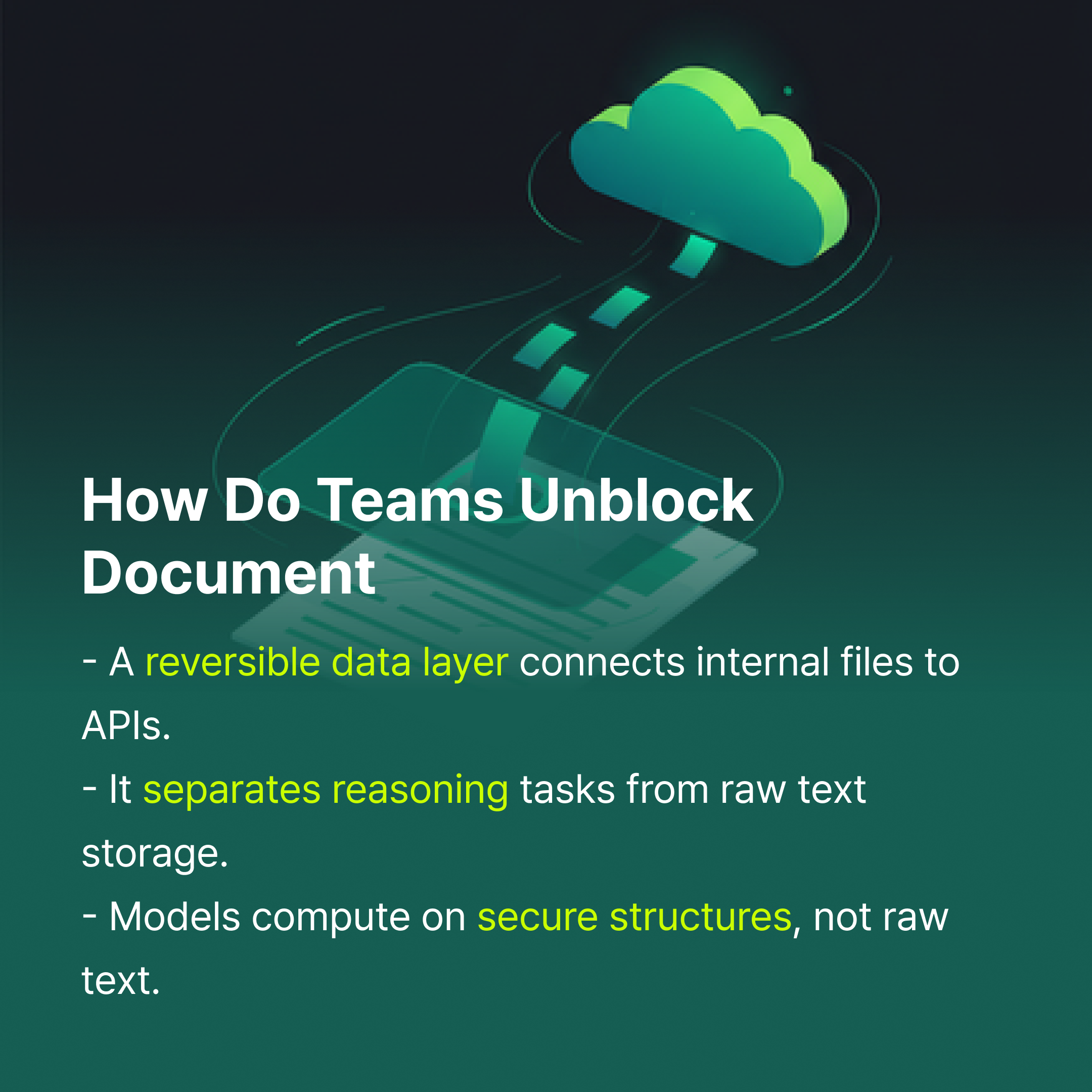
Organizations resolve the document intelligence bottleneck by deploying a vendor-neutral reversible data layer that sits between internal repositories and external model APIs. This approach separates the reasoning capability from the raw text storage. The model computes on capsulated structures instead of raw text. LLM Capsule is a document-based AI data gateway that restructures organizational documents into LLM-friendly form without exposing originals.
Reversibility changes the entire equation for data teams. Enterprises hold vast repositories of unstructured text; activating it requires a new methodology. Capsulation preserves the mathematical shape of the file for the model, then restores the specific details upon return.
Legal departments can finally process sensitive M&A documents through external providers. The original contract never hits the cloud provider servers.
The organization maintains complete control over the context boundary. This infrastructure directly supports robust agentic AI data governance. Agents can crawl internal wikis and summarize findings without accidentally leaking proprietary roadmaps into public training datasets.
The Economics of Agentic Data Sprawl
Financial consequences dictate the urgency of modernizing enterprise infrastructure. According to a 2025 IBM report, unsanctioned workflows add an average of $670,000 to the total financial impact of a corporate data breach. The bill for these workarounds is steep . Impacting the bottom line directly. Companies bleed capital when they ignore the operational realities of their workforce.
Gartner indicates that 84% of enterprises expect to increase funding for GenAI initiatives in 2026. Pouring money into new models while relying on outdated governance guarantees failure.
“Pouring money into new models while relying on outdated governance guarantees failure.”
Capital must flow toward foundational enablement layers. True AI risk management treats data usability as a core business metric. Restricting access to the vast majority of your corporate intelligence wastes the massive investments made in data engineering over the past decade.
Moving Toward Quantitative AI Risk Management Models
Regulatory bodies now demand measurable mathematical proof of data control rather than qualitative safety checklists. The UC Berkeley Agentic AI Risk-Management Standards Profile (published February 2026) models these precise vulnerabilities to ensure true accountability.
Frameworks emphasize preventing unauthorized privilege escalation across autonomous systems. A specialized agent trained on public relations material should never access the draft earnings report. Controlling the data flow directly prevents this exact scenario. Dynamic routing provides the necessary quantitative metrics.
Teams can audit exactly which document structures interacted with which external API. This visibility transforms abstract governance into measurable network telemetry.
Establishing an independent routing plane ensures you remain adaptable. You dictate the rules of engagement regardless of which underlying foundation model wins the benchmark wars next month. Future-proofing your infrastructure requires decoupling your context boundaries from the engines themselves.
Effective shadow AI prevention relies on giving teams the best possible environment to execute their work natively. When the approved path is the easiest path, unapproved usage disappears.
📃Gartner 2026 CIO and Technology Executive Survey
📃IBM Cost of a Data Breach Report
📃UC Berkeley Agentic AI Risk-Management Profile
How CUBIG Addresses This
Your teams want to work faster. When they need to analyze a massive vendor contract or extract insights from internal roadmaps, telling them “no” just pushes them toward unauthorized consumer tools. They experience intense frustration when legacy systems return garbled, heavily redacted answers that miss the entire point of their query. You need them to stay productive while keeping proprietary information strictly internal.
Your documents stay inside your walls. The AI gets what it needs to give capable answers. That’s it. Through Rehydration Restoration, your AI answers actually make sense. Names, financial figures, and critical internal metrics come back completely intact for your employees.
At the same time, you guarantee Zero Exposure. The external AI vendor cannot reconstruct your original data under any circumstances. You hold the keys to Enterprise Context Control, deciding exactly what matters to your business.
Think about your complex spreadsheets and nested legal agreements. Because your files keep their original format through Structure-Preserving Processing, the AI reads them flawlessly without missing structural cues. Best of all, this architecture guarantees Cross-Model Execution.
Your developers can toggle freely between GPT, Claude, and Gemini without rewriting governance protocols. We see this working in highly sensitive environments right now. The Gangnam District Office successfully processes air-gapped government documents, and DB Insurance manages complex customer data analytics. They found a way to say ‘yes’ to adoption.
FAQ
What defines an AI data gateway?
An AI data gateway operates as a centralized routing plane between enterprise applications and external language models. It standardizes API calls, manages rate limits, and capsulates sensitive information before it reaches third-party vendors. Deploying this architecture establishes a vendor-neutral boundary that controls how organizational context flows into artificial intelligence pipelines, forming the backbone of modern AI risk management.
How does agentic AI data governance differ from standard data governance?
Legacy data governance systems scan static files and restrict transfers based on rigid pattern matching. Agentic AI data governance monitors continuous, autonomous machine-to-machine interactions. Autonomous agents rapidly chain multiple API calls together, requiring dynamic capsulation that modifies data structures on the fly without breaking the logical execution of the agent’s core task.
Why does shadow AI prevention require usability?
Employees adopt unauthorized consumer tools when enterprise systems fail to process complex documents effectively. If internal governance policies mandate aggressive redaction that ruins the output quality, users will actively bypass those controls. Providing high-quality, unhindered model access via platforms like LLM Capsule eliminates the primary incentive for off-network behavior entirely.
Does reversible capsulation degrade language model reasoning?
Reversible capsulation preserves the grammatical and mathematical structures of the original document. Language models receive the spatial relationships and contextual framing necessary to compute accurate probabilistic responses. The AI performs its reasoning on the capsulated structure, and the gateway restores the specific proprietary details on the return trip to the user.
How does Cross-Model Execution reduce vendor lock-in?
Organizations frequently hardcode their governance protocols to specific language model APIs. Cross-Model Execution abstracts these controls to a centralized plane sitting above the endpoint. Teams can hot-swap between different foundation models without rewriting their entire infrastructure, maintaining consistent AI risk management policies across all external vendors simultaneously.
Can we deploy this layer over existing RAG pipelines?
Yes, a vendor-neutral reversible data plane integrates directly into existing Retrieval-Augmented Generation workflows. The gateway capsulates the retrieved document chunks before they enter the prompt context window. The system processes the query normally, ensuring the organization maintains Enterprise Context Control while the external model generates the final synthesized response.
What happens to structural formatting in spreadsheets during processing?
Legacy masking often breaks column logic and numerical relationships in complex files. Systems like CUBIG’s LLM Capsule employ Structure-Preserving Processing to maintain the exact layout and mathematical hierarchy of the original file. The language model reads the document precisely, analyzes the relationships, and returns answers that fit back into the original format.

CUBIG's Service Line



Recommended Posts