
Hello, this is CUBIG the company behind Syntitan, the AI-ready data platform for enterprise AI. 💎
A line that keeps circulating among data leaders puts a number on something they already feel in their quarterly reviews: the $1.5 trillion problem with AI is that most companies’ data isn’t ready. It is the kind of round, oversized figure that invites an eye-roll. Then you read Gartner’s 2025 finding that 63% of organizations either lack the data management capability to support AI or do not know whether they have it, and the eye-roll stops. The number is not describing a budget shortfall. It is describing money going to the wrong place.
Last week this series looked at what happens when nobody checks data at the entrance to a pipeline. The result is model collapse, the slow degradation that sets in when low-quality inputs feed each new round of training. A quality gate at the entrance stops that. This piece is about a failure the quality gate never touches, the one that appears after the data is already clean.
That is the part that derails budget conversations. The data usually is clean. It passed every check, cleared governance, satisfied the auditors. And the model still underperforms. When that happens, the reflex is to assume the model is the problem, so the next purchase order is for a bigger model or more compute. The model was rarely the problem.
The board sees pilots, not production
Open a CDO’s quarterly deck and you tend to find a slide titled something like “AI investment ROI.” On it: three pilots in flight, and zero in production. The pattern holds across industries, and the explanation is the same each time. The team cleaned the data, governed it, satisfied compliance, and then the model would not perform well enough to ship.
The hard part is the conversation that follows. When a data leader argues for more investment in data, the answer that comes back is some version of “we already spent tens of millions on the data lake.” Both people are right and they are talking past each other. Storing and cleaning data is one job. Carrying the context a model needs through that cleaning is a completely different job, and the second one was never funded because no one named it. The data leader wants to show the gap in numbers, and the tooling that would produce those numbers does not exist in the stack.
The tools are bought. The layer is missing.
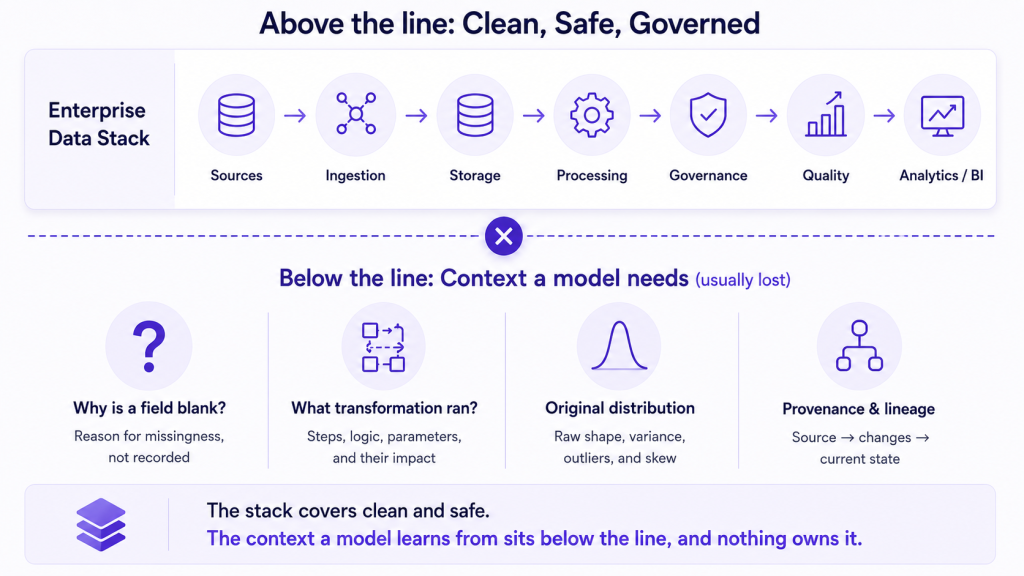
Walk into almost any enterprise that has spent real money here and the stack looks familiar. Snowflake or BigQuery for the warehouse. Databricks for the lakehouse. A data lake underneath, plus cataloging, access control, and governance. Storage, movement, and compliance are handled, the vendors have been paid, and the architecture diagram is full.
What that stack does well is make data orderly and safe. What it was never designed to do is keep the information a model learns from. Those are different objectives, and the distance between them is where a large share of that $1.5 trillion disappears.
The common pattern is the medallion architecture: bronze for raw, silver for cleaned and conformed, gold for curated and business-ready. Each promotion makes the data cleaner, more consistent, more compliant. Each promotion also strips out signal the model was relying on. By the time data reaches gold it is in excellent shape for a dashboard and poor shape for a model, because the two consumers want opposite things. A human reading a report wants tidy categories and suppressed outliers. A model wants the full distribution, including the parts a human would dismiss as noise.
Three ways cleaning removes context
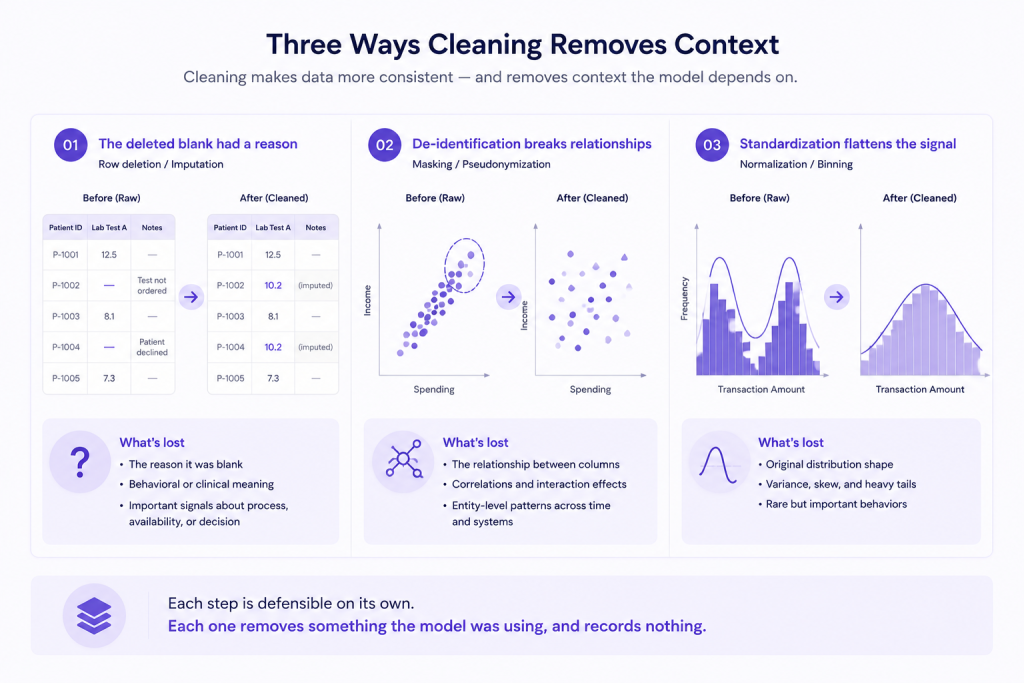
The loss is not abstract. It happens in specific transformation steps that every team runs, and each one is defensible on its own terms.
The deleted blank had a reason
A field is empty, so the row is dropped or the value is imputed to a column mean. Standard hygiene. But a blank is rarely pure absence. In a clinical dataset a missing lab value can mean the test was never ordered, the patient declined, the result was withheld under a regulatory hold, or the instrument was offline. Each of those carries meaning, and the fact that a test was not ordered is itself a clinical signal. Drop the row and you tell the model nothing was there. Impute the mean and you tell it something false.
A model cannot separate “this field is empty” from “this field is empty for a reason that correlates with the outcome you are trying to predict.” In a lot of real problems that distinction is the prediction. Remove it and the model learns from a flattened world where every absence looks identical.
De-identification severs the links between columns
Compliance requires anonymizing names, exact dates, and precise locations, and there is no argument to be had about whether to do it. The difficulty is that de-identification protects each column in isolation, while the value a model extracts usually lives between columns. The relationship between a patient’s age and the interval to diagnosis. The link between a narrow region and purchase frequency. The joint pattern across several fields that, together, describe a behavior.
Generalize age into a ten-year band, collapse a date into a quarter, redact the region, and every field passes its privacy check individually. The joint structure the model was actually learning from is gone, and nothing in the pipeline raises a hand to say it left.
Standardization erases the shape of the data
Normalize a feature to a [0,1] range and it becomes comparable and well-behaved. It also loses its distribution. A bimodal column that told the model “two distinct populations exist here” becomes a smooth ramp. A heavy tail that flagged rare but consequential events gets compressed into the body. The model then trains on a silhouette of the data instead of the data.
None of these steps is a mistake. Skipping any of them creates compliance and quality problems of its own. The trouble is that the information they remove is never written down anywhere. It just disappears, and the disappearance stays invisible until a model trained on the residue fails in production.
A practitioner’s version of the same story
A trading team’s account, widely shared online, described buying premium historical market data, feeding it into their model, and getting back results they called garbage. The comments reached for the obvious explanation, that the data must have been low quality. It was not. It was clean, complete, and expensive.
What it could not do was tell the model why a price sat in a particular range during a particular regime, or what conditions produced a given pattern. The context a human analyst supplies from experience had been removed somewhere between the vendor and the model. The team paid for clean data and received exactly that, with none of the surrounding information that would have made it usable. One team, one dataset, and the $1.5 trillion problem in miniature. The failure was read as a model or data-quality issue. It was a context-preservation issue.
The academic version is arriving now
A June 2026 arXiv paper on synthetic data (“Synthics”) builds its method around exactly this requirement: that generated data faithfully reflect the structure of the real observations, validated feature by feature. The lesson runs both ways. When synthetic generation does not preserve that structure, it carries the same context loss forward, and a model trained on it learns a distribution that never existed.
The connection is direct. Teams often reach for synthetic generation precisely to escape the privacy and scarcity problems that aggressive cleaning creates. If the generation step does not carry the original structure forward, it repeats the same context loss one level up, now wrapped in a layer of statistical plausibility that makes it harder to catch. Whether you clean real data or generate synthetic data, the deciding question is identical: does the structure, and the explanation behind it, survive the transformation?
What the missing layer actually holds
If cleaning is what removes context, the answer cannot be to clean more carefully, because cleaning is the cause. The answer is to preserve what cleaning takes out, in a form both a model and an auditor can read. Two things have to travel with the data.
The first is context carried as metadata. When a field is blank, the record should also carry why: regulatory hold, declined, not applicable, instrument offline. When a value is transformed, the record should carry the original range and the method used. When a distribution is reshaped, the record should carry what it looked like before. This is not a documentation page written for humans after the fact. It is structured information bound to the data itself, so the model receives the explanation alongside the value.
The second is lineage and integrity. Where did this record come from, through which pipeline, under how many transformations, and can that chain be verified rather than asserted? In a regulated environment this stops being a convenience. If you cannot demonstrate how a piece of data arrived in the training set, you frequently cannot use it for AI at all, no matter how clean it is. The inability to prove provenance is its own blocker, and it sits ahead of any decision the model makes.
Put together, these turn “the data is clean” into “the data is clean, and here is everything that was done to it and why.” The second statement is the one a model can use and a board can defend.
The numbers point in one direction
No single statistic carries this argument. The weight comes from how many independent measurements land in the same spot.
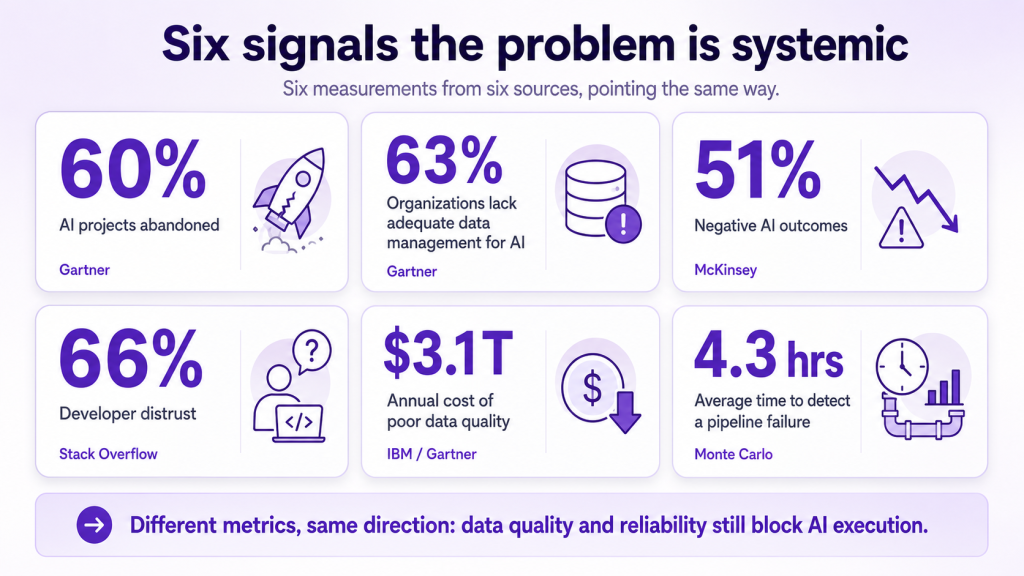
Gartner expects 60% of AI projects to be abandoned through 2026 because the data behind them is not AI-ready. The same body finds 63% of organizations lack adequate data management for AI or are unsure they have it.
McKinsey reports 51% of organizations seeing at least one negative AI consequence, with nearly a third of all organizations citing inaccuracy specifically.
Stack Overflow’s 2025 developer survey finds only 33% of developers trust the accuracy of AI output, and 46% actively distrust it. IBM’s widely cited estimate puts the cost of poor data quality in the US at $3.1 trillion a year. And when a pipeline does break, Monte Carlo’s State of Data Quality survey finds 68% of teams take four hours or more just to detect it, long enough for a model to run on context-stripped data through most of a working day before anyone notices.
Different institutions, different methods, different definitions. The conclusion keeps repeating. The constraint on enterprise AI is not model capability or compute. It is that the data reaching the model has been cleaned of the context it needed, and nothing in the standard stack was ever accountable for keeping that context.
Where this leaves a data leader
The uncomfortable implication for anyone funding this work is that the next investment probably should not go toward a better model or a larger cluster.
It should go toward the layer between clean and AI-ready that most organizations never built, because no vendor sold it as a line item and no architecture diagram had a box for it.
That layer has a plain job description. Keep the explanation attached to the data through every transformation, and keep the provenance verifiable from end to end.
Build it and the money already spent on storage, governance, and tooling starts to earn its keep, because the clean data finally reaches the model with its meaning intact.
There is one more failure waiting past this one. Suppose you preserve context well and a model performs. Some time later the same transformation, running on data that has shifted underneath it, begins producing different results, and nothing in the stack tells you what moved or when. That is the subject of the next piece in this series.
For now the question worth carrying into the next planning meeting is narrower and more useful than “do we need better AI.” It is this: in your gold tables, can you still say why a given field is blank? If the answer is no, the context is already gone, and no amount of further cleaning will bring it back.
Is your data clean, or AI-ready? A free five-minute assessment will tell you which.