
A restorable AI data boundary is an execution architecture where only the structure of a task crosses out to the model and the result is rebuilt back inside your environment, so the boundary carries work in both directions instead of only stopping data on the way out.
The stakes are not academic. Latanya Sweeney’s foundational work found 87% of Americans are uniquely identifiable from just ZIP code, sex, and date of birth, and Narayanan and Shmatikov later de-anonymized a supposedly anonymous dataset from only a few outside facts; in regulated firms the response is mundane: the sensitive data the workflow needs is never allowed to reach the model. The workflow does not fail on model quality. It fails at the edge of the network, where a one-way control says no and the work stops there.
The word that carries the weight in a restorable AI data boundary is restorable. Most boundaries an enterprise puts around its data exist to stop things. A restorable boundary is built to let work through and bring it home, which is a different shape of thing, so it is worth being precise about why the two behave so differently.
The boundary most teams already have is one-way
Consider how data-loss prevention behaves. It watches the edge of the network, and the moment something sensitive tries to leave, it blocks the request. The logic is a gate: sensitive value detected, request denied. That is a one-way boundary, and for its own purpose it works well enough.
What it cannot do is get the work done. When an analyst wants to run a confidential contract through a model, a one-way boundary has exactly one answer, which is no. It cannot let the task out and bring a result back, because it was never designed to bring anything back; it only knows how to stop. So the AI project stalls at the perimeter, and the work either dies quietly or leaks out through a side channel nobody is watching.
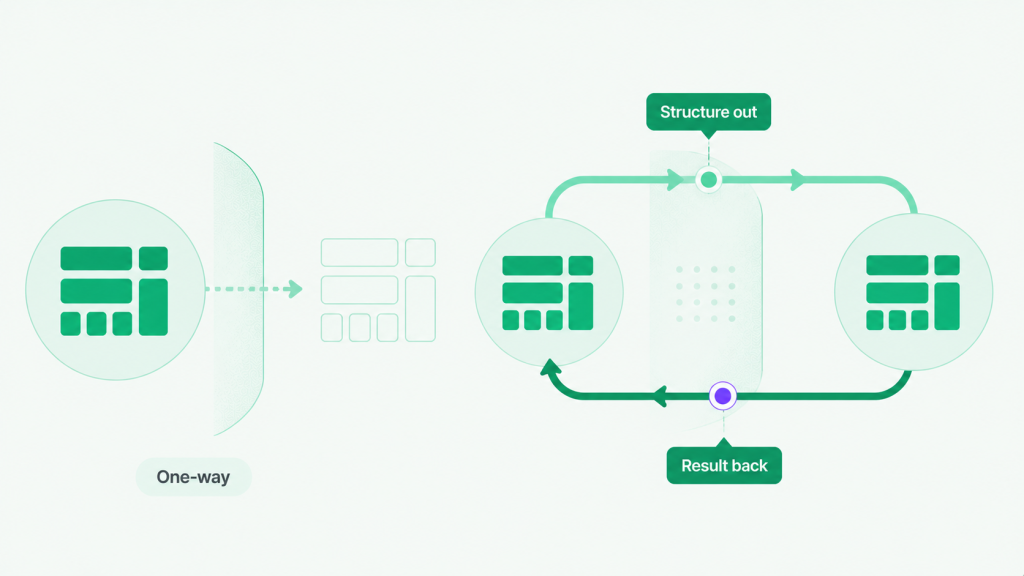
That gap is the whole problem. A blocking control protects the data by making the workflow impossible, and the question a restorable boundary asks runs the other way: how do you let the workflow run while the sensitive values stay inside the entire time.
What crosses the boundary, and what comes back
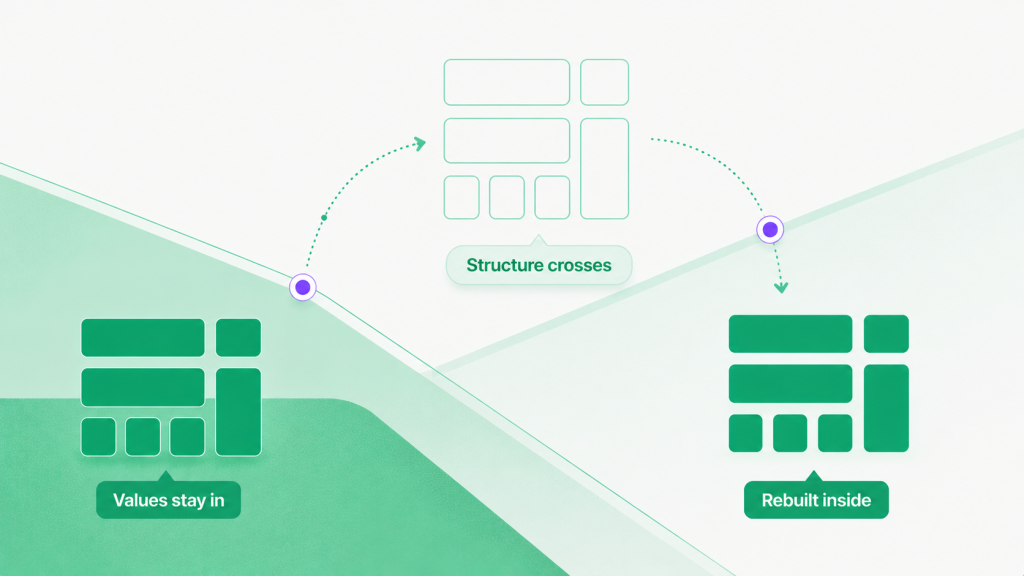
A restorable AI data boundary splits the request into two things that a blocking control treats as one. There is the confidential value, and there is the structure of the work. The value stays in. The structure goes out.
On the way out, sensitive content is substituted with structure-preserving stand-ins, so what crosses the boundary is a coherent task with the identifying values swapped. The model receives a real problem to solve; it does not receive your data. The model runs, its output crosses back in, and here is the move that makes the boundary restorable: the stand-ins are resolved to the real values, in their original context, inside your environment. The output reconstructs into your actual document.
So the boundary is two-way by design. Structure out, result back, and the original values never cross in either direction. Set that against the one-way gate, which owns a single move and spends it saying no. The restorable boundary owns two moves, substitute on the way out and reconstruct on the way back, and it spends them handing you finished work.
Restorable versus blocking, side by side
The contrast comes down to what each boundary is measured by. A blocking boundary is judged by how much it stops, so more blocks read as more wins. A restorable boundary is judged by how much previously off-limits work it lets you complete. Those are not the same metric, and they do not even point the same direction.
This is why a restorable boundary is not a security control with extra features bolted on. It is an enablement architecture. Security and privacy reviewers do gain something real from it, because the original values stay inside and never cross out, which gives them a basis to approve the workflow. GDPR Article 32 speaks the same language, requiring technical and organizational measures appropriate to the risk, with pseudonymization named explicitly and regular testing of those measures. That approval is a by-product of the design rather than its purpose. The purpose is to make the work run.
Why reconstruction has to happen inside
Reconstruction is the half of the boundary that blocking controls simply do not have, and it only holds up if it happens inside your environment. The mapping between each original value and its stand-in is what turns the model’s output back into a real document. If that mapping lived outside your walls, you would have relocated the exposure rather than removed it.
So the boundary keeps the mapping local, and reconstruction runs where your data already lives. The result is rebuilt in place, and nothing has to travel out to be restored. That single design choice, keeping the mapping inside, is what separates a restorable boundary from a masking tool that merely hides values and hopes the workflow can proceed on the redacted version. The redacted version usually cannot proceed, which is exactly why one-way controls stall so many projects.
How to tell whether your boundary is restorable
Run this quick self-check against whatever sits between your teams and their models today. If you answer no to more than one, you have a blocking boundary rather than a restorable one.
- When a workflow needs sensitive data, does the boundary return a completed result, or only a denial?
- Does a coherent task cross out to the model, rather than a redacted stub the model cannot actually use?
- Are the original values reconstructed into the final output automatically, or does someone stitch them back by hand?
- Does the mapping between values and stand-ins stay inside your environment at all times?
- Is the boundary measured by workflows completed, not just by volume blocked?
Where it fits
A restorable AI data boundary is the architecture behind sensitive AI workflow enablement. The mechanism that crosses it in each direction is set out in substitute, execute, reconstruct, where reconstruction is the step that makes the boundary two-way. The mapping that makes reconstruction possible stays in a local mapping store inside the enterprise boundary, and the shift in thinking that gets teams here is covered in from PII masking to workflow enablement. This architecture is delivered by a Context-Preserving Data Layer for AI, in CUBIG’s case LLM Capsule, and runs on the CUBIG Syntitan platform.
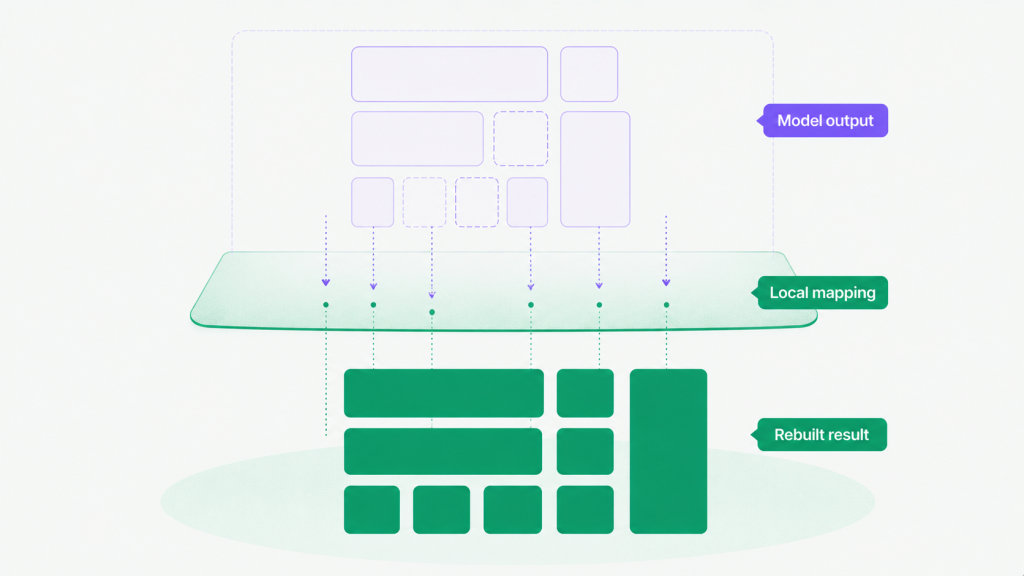
LLM Capsule is how CUBIG turns this boundary into something work can cross. The structure goes out to the model, the real values stay home, and the finished result is rebuilt inside your environment.