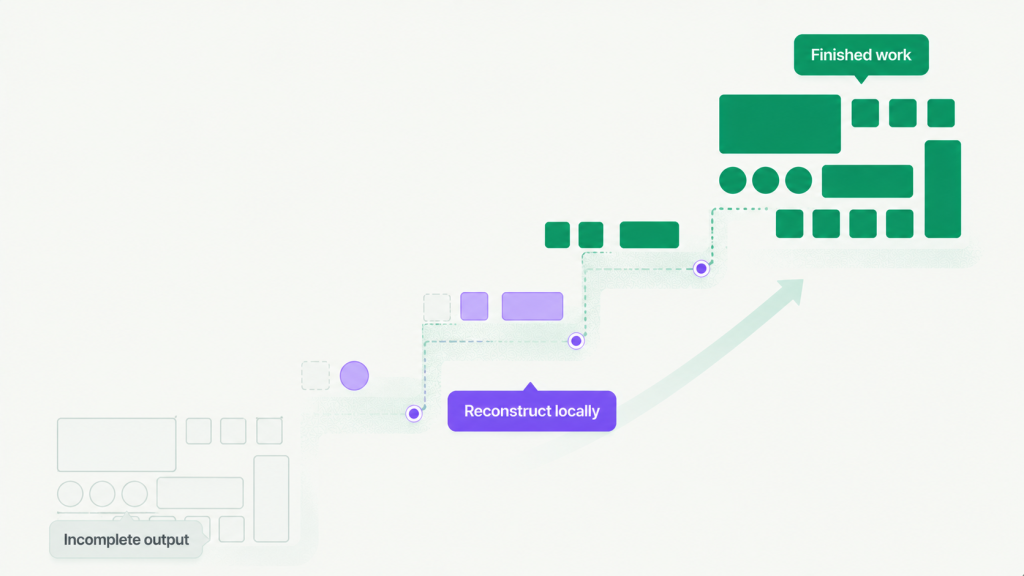
From PII masking to workflow enablement is the shift from hiding sensitive data so a model cannot misuse it, to substituting that data so a model can still complete the work, with the original values reconstructed inside your own systems afterward. Masking is built to make sure nothing sensitive is exposed. Enablement is built to make sure the work still runs. Those are not the same goal, and treating them as if they were is why many confidential-data AI projects stall.
Regulated teams did not invent the removal habit; it is codified. HIPAA recognizes exactly two de-identification paths, Expert Determination and Safe Harbor, which removes 18 specified identifiers and requires no actual knowledge that the remainder could re-identify someone. NIST frames the underlying tension plainly: de-identification attempts to balance the contradictory goals of using and sharing data while protecting privacy, which is exactly the balance plain masking gives up. The alternative keeps utility: a peer-reviewed study by Vakili and colleagues found pseudonymized data can train and fine-tune models end to end without harming performance. When the data a regulated team is allowed to send a model has been stripped of the very structure the model needs, the project rarely fails loudly. It quietly produces output nobody can act on, and then it gets shelved.
What PII masking was built to do
PII masking comes from a world of databases and reports, not language models. The original job was to take a table full of names, account numbers, and birthdates and hand it to someone who should not see the real values: a test environment, an offshore analyst, a dashboard running aggregate queries. Black out the identifiers, swap in XXXX or a random placeholder, and the recipient can still run counts and joins. For that job, data masking works well. Nobody downstream needed the real name to compute a monthly total.
A language model is a different kind of recipient. It does not run a fixed query against known columns. It reads a document the way a person would, and it leans on exactly the parts that masking throws away: who is referring to whom, in what order, and how one figure derives from another.
Why masking starves a model
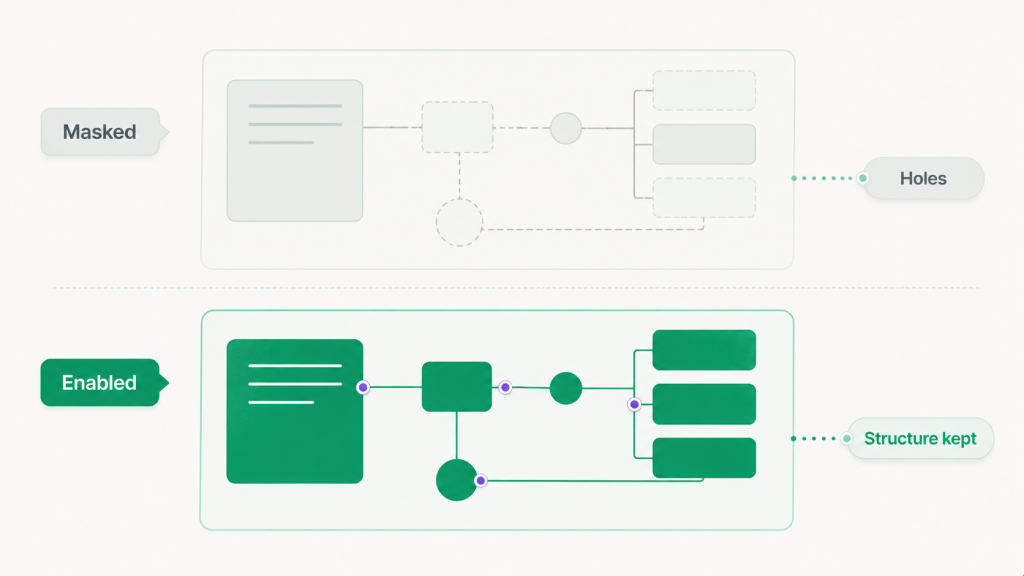
Mask a contract and you do not get a slightly redacted contract. You get a page of holes. The clause that referenced “the counterparty” now points at [REDACTED], the payment schedule lost the figures that made it a schedule, and the model has to guess at relationships that used to be explicit. Ask it to summarize and it summarizes a document that no longer holds together. The output is safe and close to useless.
The deeper problem is that plain masking treats every sensitive value as noise to be deleted. In a real workflow those values carry the structure: which party owes which amount, when each event happened, how a total was derived. Strip the values and you strip the structure with them, so the context the model needed is the first thing lost. For more on why that structure is itself the signal, see document layout preservation.
What workflow enablement does instead
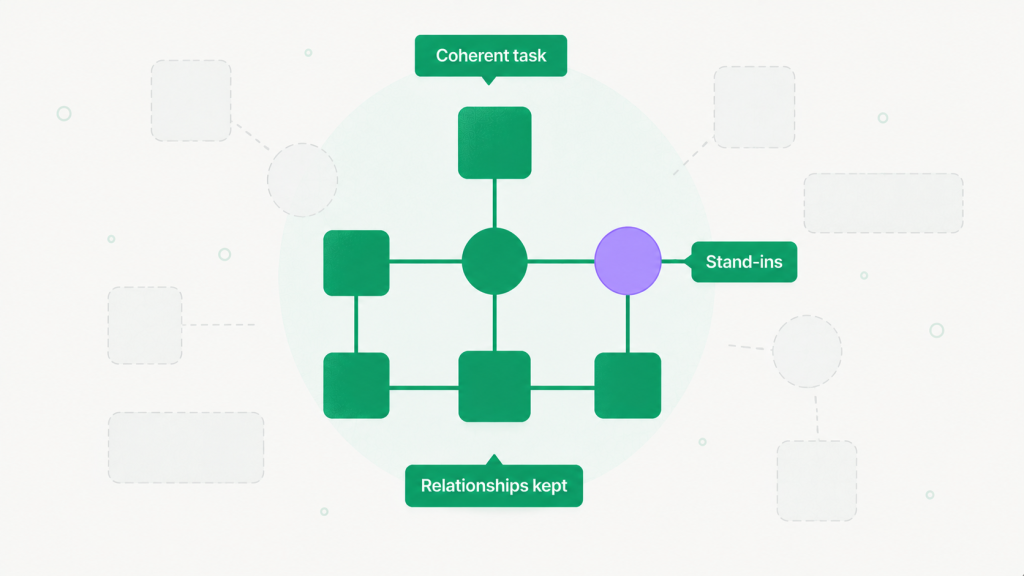
Enablement keeps the structure and changes only what the structure is made of. Sensitive values are replaced with stand-ins, and the relationships between fields stay exactly as they were. The contract still reads as a contract: two parties, a schedule, a set of obligations that reference each other correctly. The model sees a coherent task instead of a redacted blank, does the work, and the result is reconstructed with the real values back in place inside your environment. The mechanism, step by step, is covered in substitute, execute, reconstruct.
The idea is to send the model the work’s structure, not the raw values, let it run in place, and reconstruct the business meaning locally when it returns. This is delivered by a Context-Preserving Data Layer for AI, in CUBIG’s case LLM Capsule, which sits between your real data and the model. It keeps the structure intact on the way out and rebuilds the confidential business context on the way back. The contrast with plain masking is not a matter of degree: masking asks how much it can remove, while enablement asks how much work it can let through.
Masking versus enablement, side by side
The two approaches diverge on almost every dimension that matters once a language model is the consumer of the data. This table lays out where they differ.
| Dimension | PII masking | Workflow enablement |
|---|---|---|
| Primary goal | Nothing sensitive is exposed | The work still runs correctly |
| Treats values as | Noise to remove | Structure to preserve |
| Relationships between fields | Broken | Kept intact |
| Model output quality | Degraded, often unusable | Representative until you reproduce it on your own data |
| Real values restored | No | Yes, locally in your environment |
| Built for | Reports, test data, analysts | AI and agent workflows on confidential data |
How to tell which one you are actually running
If you are not sure whether your current pipeline is masking or enabling, run this quick self-check on a real document from your workflow:
- After processing, does the document still read as a coherent whole, or is it a set of disconnected blanks?
- Can the model still tell which party refers to which, and how one figure derives from another?
- Does the finished result come back with the real values restored inside your environment, or does someone re-enter them by hand?
- When output quality drops, can you trace it to lost structure rather than a weaker model?
- Do the confidential values ever have to leave your systems for the work to complete?
If the answers point to disconnected blanks, manual re-entry, and structure loss, you are masking. If the document stays coherent and the real values return locally, you are enabling the workflow.
Where it fits
This shift is the conceptual core of sensitive AI workflow enablement, the practice of running AI on confidential data without that data leaving your environment. Once you stop asking what to hide and start asking what to enable, the whole approach to confidential data changes. The local mapping store that maps stand-ins back to real values, described in the local mapping store, is what makes that reconstruction possible inside your own boundary. All of it runs on the CUBIG Syntitan platform.
LLM Capsule is what the shift from masking to enablement looks like in practice. It substitutes instead of blanking, so the model keeps the structure it needs while your real values stay inside.