
A forward deployed engineer opens a third customer’s export this year and finds the same work again: undocumented status codes, dates in two time zones, exceptions only one analyst knows. The last customer’s mappings sit in an old notebook.
A forward deployed AI engineer is a software engineer who works inside a customer’s environment to make an AI product work on that customer’s data and rules, and a recurring part of that work is preparing the customer’s data for one specific task: confirming what each field means and handling the exceptions the business already knows.
By Ho Bae, Founder & CEO, CUBIG Corp. · Updated November 2026.
Two separate job-posting datasets show demand for the role growing quickly. Comparing postings titled “forward deployed engineer” from January through October 2025 with the same months of 2024, Bloomberry found that “forward deployed engineer jobs exploded by 1,165% year-over-year.” In September 2026, Fortune reported Lightcast data showing that postings “rose more than 1000% between January and August 2026, compared to the same period last year.” Many of those roles involve customer data that someone has to prepare before the AI product’s output can be trusted.
Key takeaways
- Each customer stores the same business idea differently, so a mapping from the last deployment has to be checked again before it is used.
- Data with no missing values still needs a meaning check: in CUBIG’s analysis of the synthetic UCI AI4I 2020 dataset, 27 of 10,000 records had a failure label that did not match the failure-mode flags.
- ChatGPT, notebooks, dbt, data quality tools and integrated platforms each cover part of the work. The gap they leave is narrow: a per-use-case record of what changed in the data, why, and how results moved under the same evaluation conditions.
- Carry working records between deployments, such as how a mapping was checked and which evaluation conditions were fixed, not the customer’s data or business rules.
- Syntitan records each successful processing run as a new Version and, for supported binary classification tasks, compares results before and after preparation under the same evaluation conditions.
What does a forward deployed AI engineer do with customer data?
Joe Schmidt described the purpose of the job in a June 2025 essay for a16z: “That’s where forward deployed teams come in: to operationalize the model into a real-world solution.” Fortune’s September 2026 report quoted Dice president Paul Farnsworth on why companies struggle to make powerful AI models useful inside their business: “connecting them to proprietary data, existent systems and specific workflows can be a big roadblock to overcome.”
One posting quoted in the Bloomberry analysis puts it in plainer words, asking the engineer to “embed with customer teams to design and implement integrations, data transformations, and reporting workflows.” CUBIG’s earlier article on what a forward deployed engineer does with customer data covers that discovery work in detail. The question here comes after the discovery: where does the engineer keep the result, so the next deployment does not start from zero?
Why does data preparation restart at every customer?
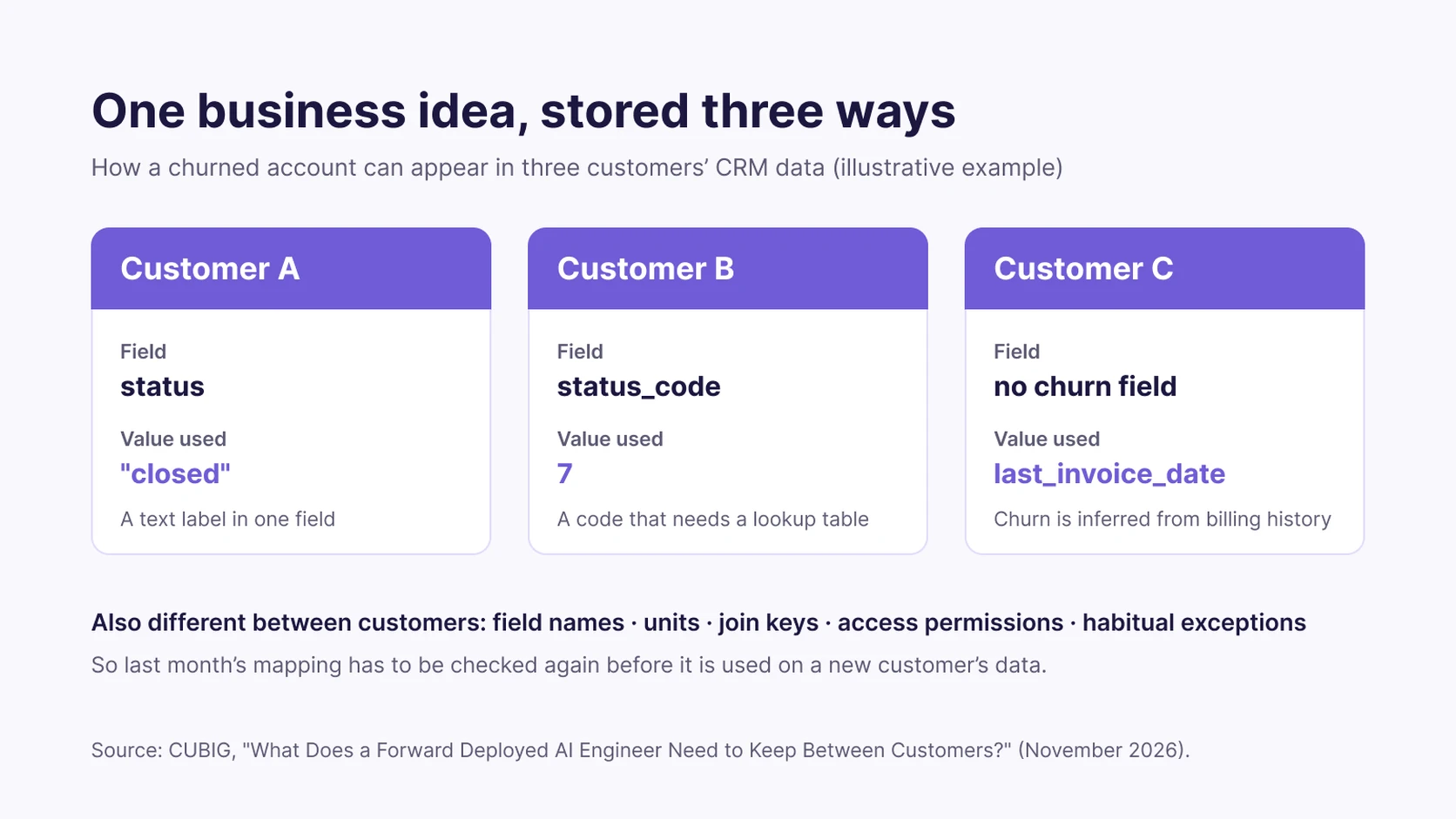
Each customer stores the same business idea differently. One CRM marks a churned account as “closed,” another uses a numeric status code, and a third leaves the analyst to infer churn from the last invoice date. Field names, units, join keys, access permissions and habitual exceptions all change between customers, so the engineer has to check last month’s mapping again before using it on new data.
Complete-looking data still needs that check. When CUBIG examined the public, synthetic UCI AI4I 2020 Predictive Maintenance Dataset in November 2026, the file had no missing values across 10,000 records, yet in 27 records the failure label did not match the failure-mode flags. In CUBIG’s analysis, 18 records carried a random failure flag with a failure label of 0, and 9 carried a failure label of 1 with no failure-mode flag. A missing-value check finds nothing wrong with that file; a check of what the failure label means for the task finds the 27 records.
Google researchers Nithya Sambasivan and colleagues interviewed 53 AI practitioners in India, East and West African countries, and the USA for a CHI 2021 paper, and wrote that “data cascades are pervasive (92% prevalence), invisible, delayed, but often avoidable.” The study covered high-stakes domains rather than forward deployed work, but a forward deployed engineer can meet the same risk at each customer, because a new dataset can bring its own upstream issues.
When a result goes wrong, the engineer still has to narrow down whether the data, the model, the evaluation conditions or the connection to the customer’s systems is the place to look.
CUBIG Shorts
The Demo, Paid 12 Times
Episode 1 of CUBIG’s short series “It Worked in the Demo.”
Which tools do forward deployed engineers use today, and what does each one leave?
Forward deployed engineering teams, and the applied AI engineer teams that do similar customer work, already rely on capable tools, and a deployment often combines several of them. The table lists what each tool does well and the part of the data preparation record that sits outside its job.
| Tool | What it does well | What is left for the FDE |
|---|---|---|
| ChatGPT or Claude | Explains unfamiliar schemas, drafts SQL and mapping code, and summarizes customer documentation quickly. | A record of which preparation rules were applied to which data version, and a before-and-after result under fixed evaluation conditions. |
| Notebooks and scripts | Give the engineer full control over any transformation and fit any customer stack. | Unless the team adds its own conventions, decisions tend to stay in one engineer’s files, and the next engineer reads code to learn what was changed and why. |
| dbt and ETL pipelines | Run tested, version-controlled transformations in production on a schedule. | Comparing an AI task’s results before and after a preparation change is a separate job from moving and transforming data. |
| Data quality and observability tools | Detect freshness, volume, schema and distribution issues and alert the team when they appear. | Deciding whether a dataset fits one AI use case, and recording what was changed to make it fit, is a separate step. |
| Integrated data platforms such as Palantir Foundry | Bring an organization’s data, pipelines, lineage and applications together on one platform. | The platform works best when the customer already runs on it; engineers who serve customers on different stacks still need a per-use-case record of preparation and results. |
| Syntitan | Prepares a copy of the customer’s dataset for one use case, records each successful processing run as a new Version, and compares results before and after preparation for supported tasks. | Production pipelines, alerting, and the engineer’s judgment about the customer’s business stay with the other tools and the engineer. |
The gap in the table is narrow: a per-use-case record of what the engineer changed in the data, why, and how the result moved under the same evaluation conditions. Syntitan works in that gap, with the same-condition comparison available for supported binary classification tasks, and sits next to the other tools rather than replacing them.
What should a forward deployed engineer keep from one deployment to the next?
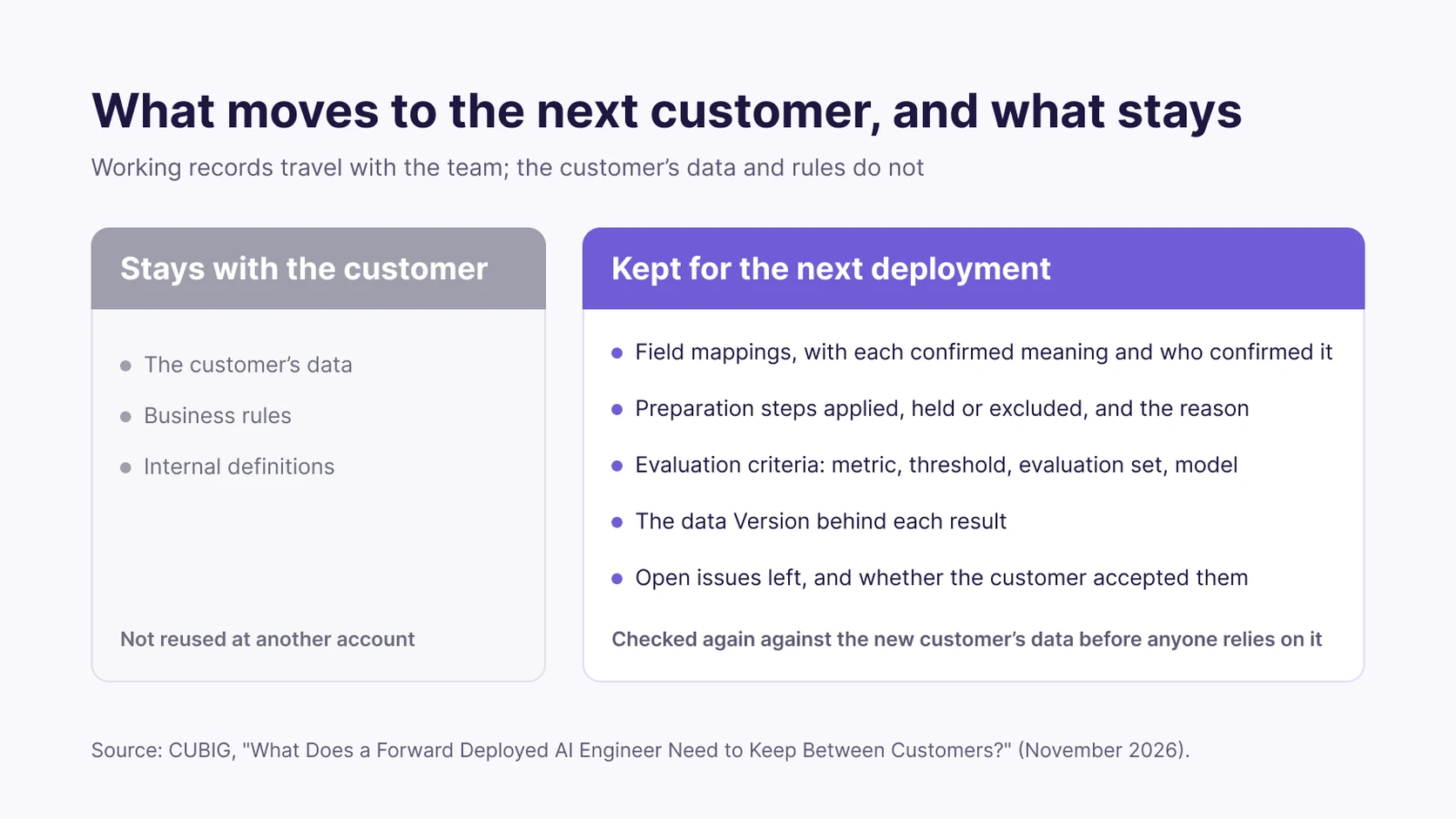
A forward deployed software engineer leaves each customer with two kinds of knowledge. Customer-specific knowledge, including the customer’s data, business rules and internal definitions, belongs to that customer and should not move to another account. Working records, such as how a mapping was checked, which evaluation conditions were fixed and which preparation steps were held back, can be written down so the team decides at the next customer what to reuse and what to check again.
Keep before the next customer
- Field mappings for the use case, with the meaning each field was confirmed to have and who confirmed it.
- Preparation conditions: each step that was applied, held or excluded, and the reason.
- Evaluation criteria: the metric, threshold, evaluation set and model used for the before-and-after comparison.
- The data Version each result came from, so a later change can be traced to a specific dataset.
- Open issues that remained after preparation, and whether the customer accepted them.
Each missing item is something the next deployment has to rebuild by hand.
How does Syntitan fit into a forward deployed engineer’s workflow?
Syntitan is an AI-ready data platform that prepares and checks enterprise data for a specific AI task and keeps a record of each change. When the engineer adds a customer’s dataset, Syntitan preserves the original Dataset and starts a Project for one Use Case from a copy, which becomes the Project’s first Version. Each successful processing run creates a new Version, so the processing applied to the data becomes a Version history instead of scattered notes.
In Ready for Raw Data, Syntitan diagnoses the copy on six axes: usability, integrity, context, consistency, reproducibility and traceability. Syntitan then proposes processing steps written as sentences, and the engineer marks each one Apply, Hold or Exclude. After the run, the new Version shows before-and-after results, what was preserved and the issues that remain. That record covers the data Version, the applied and held steps, and the open issues in the checklist above; confirmed field meanings and the customer’s sign-off still need the engineer’s own notes.
For supported binary classification tasks, Ready for Model compares results before and after preparation with four internal task models under the same evaluation conditions. The engineer can bring that comparison to the customer instead of a statement that the data looks better.
For agent use cases, Ready for Agent generates Tasks and Cases from the customer’s work materials and provides a Case CSV for review, an Agent input CSV and a run guide. The customer then tests the cases in its own agent environment.
Two other CUBIG products can be adopted on their own when a deployment needs them. DTS (Data Enablement for AI) fills in missing cases and adjusts skewed distributions, and LLM Capsule replaces sensitive values with context-preserving substitutes before data goes to an external AI model, then restores the original values in the response.
At the next customer, the engineer reviews how the previous Project was prepared and evaluated, including its preparation steps, evaluation conditions and Version history, and decides which working methods to reuse and what to check again. The previous customer’s data and business rules stay with that customer.
When is Syntitan not the right choice?
A one-off task does not need a record. If the engineer needs a quick schema explanation or a single cleanup query, ChatGPT, Claude, SQL or an existing ETL job will finish the work with less setup.
A team that already versions its prepared datasets and runs fixed before-and-after evaluations for each use case has much of what Syntitan records. That team should first list what it still rebuilds by hand at each customer, then test Syntitan on that part alone.
Syntitan also does not replace the engineer’s conversations with the customer. The meaning of a field and the exceptions the business accepts still come from people at the customer; Syntitan keeps the record of the processing the engineer applied after those conversations.
A forward deployed AI engineer will keep doing the first discovery at every customer, and no tool removes that work. The change worth testing is whether the second deployment can start from a recorded set of preparation steps, evaluation conditions and results, checked again against the new customer’s data before anyone relies on them. Start with one customer use case, run the before-and-after comparison under the same conditions where your task is supported, and judge the result yourself. Try it on your data.