DTS is CUBIG's AI-native Data Reconstruction technology. It reconstructs scarce, imbalanced, or restricted enterprise data while keeping the patterns and relationships an AI task needs, so teams can fix class imbalance, fill coverage gaps, and expand training data without moving the original. DTS can be adopted on its own and also runs as a core capability of Syntitan, applying differential privacy when the task needs it.
DTS · AI-native Data Reconstruction
Rebuild unusable data
Rebuild unusable data
into AI-Ready datasets.
Most enterprise data isn't AI-Ready.
DTS reconstructs restricted, imbalanced, or incomplete data
into an AI-Ready dataset you can actually use.
It reconstructs restricted data into a usable form,
rebalances skewed datasets with additional data,
and fills coverage gaps with new AI-Ready data.

Data problems
Four reasons data can't reach AI.
The data usually exists. It just isn't in a form the AI task can use.
DTS reconstructs it for the task.
Capability
Reconstruction first. Synthetic data is one method.
DTS reconstructs the patterns and relationships an AI task needs.
Generating synthetic records is one of the methods it uses,
with differential privacy applied when the data calls for it.
01Scarce data
Augment
Add examples of rare classes and edge cases, so the model has enough to learn from.
02Low-quality data
Repair
Fill gaps and rebalance skewed segments, keeping the relationships between fields intact.
03Restricted data
Generate
Create new records from a statistical model when the original can't be used as it is. Differential privacy applies here.
Built on
- 01Check the data first
- Automatic column classification
- 02Reconstruct
- Tabular and text data generationLLM-based missing-value repairEmbedding-based similarity evaluation
- 03Evaluate quality and fit
- TVD · 2D CorrelationCoverage · Copy RiskTSTR classification evaluation
- 04Keep the evaluation record
- Result manifest and logs
Differential Privacy
Differential privacy, where the data needs it.
What differential privacy means
Differential privacy (DP) is a mathematical framework that bounds how much any single individual's data can influence the synthetic output. This keeps re-identification risk bounded, even when someone combines the output with outside information.
When DP is applied, DTS applies it during the generation process itself, not as a masking step afterward. The privacy property is built into the generation process and does not depend on masking or field removal. It is a provable bound, not best-effort masking.
The bound
Epsilon (ε) sets how much any single record can change the output. A smaller ε means a tighter bound.
How DTS generates new records
01
Statistical profiling
DTS analyzes the real dataset's statistical properties (distributions, correlations, and other statistical patterns) without storing raw records.
02
DP where needed
Where the data calls for it, calibrated noise is added to the statistical model within a set DP bound.
03
Reconstruction
New records are generated from the model, keeping the patterns and relationships the task needs without copying real records.
04
Fit check
The result is compared with the original distribution. Inside Syntitan, it is also validated with the chosen model or agent under the same conditions.
Deployment
Use DTS on its own, or inside Syntitan.
Mode A · Direct
DTS on its own
Adopt DTS on its own, against your own data sources. It reconstructs what the AI task is missing, without touching the original records.
- Fix class imbalance: generate more examples of rare classes with distribution fidelity
- Augment sparse datasets to production-grade volume
- Generate edge cases and rare-event samples
Mode B · Integrated
DTS + Syntitan
Inside Syntitan, DTS works in Prepare Data for Use Case. The reconstructed data is validated with the chosen model or agent, released as a data version, and linked to each run.
- Restricted data stays in your environment; only the reconstructed output moves on
- Validate Data Fit with Model or Agent compares results before and after under the same model and evaluation conditions
- Release Data Version links the dataset to every run and to later revalidation
Customer cases
Finance · IBK Industrial Bank
Fraud and transaction patterns expanded for training
DTS reconstructed fraud and transaction data into additional training records for IBK's AI.
Finance · Kyobo Life Insurance
Churn prediction data reconstructed with DTS
DTS reconstructed the data Kyobo's churn prediction AI needs.
Defense
Training datasets made AI-Ready
DTS reconstructed defense data into AI-Ready training datasets.
Comparison
DTS vs. other approaches to restricted data.
| Capability | DTS | Masking / Anonymization | Data Sampling | Manual Labeling |
|---|---|---|---|---|
| Coverage expansion | ✓ Generate to the volume the task needs | ✗ Can't create new data | △ Bounded by real data volume | △ Expensive & slow |
| Rare-class augmentation | ✓ Targeted generation | ✗ | ✗ Can't create rare events | △ Very high cost |
| Distribution fidelity | ✓ Validated against real stats | △ Distorted by masking | △ Sampling-bias risk | △ Annotator variance |
| Privacy bound | ✓ Formal DP bound (ε) when DP is applied | △ Re-identification risk remains | ✗ None | ✗ |
| External sharing | ✓ Share reconstructed output instead of original records | ✗ Residual risk | ✗ | ✗ |
| Syntitan integration | ✓ Native versioning & binding | ✗ | ✗ | ✗ |
When to use
Five situations where DTS fits.
AI projects stall when data conditions block training, validation, or deployment.
DTS was built for these situations.
Restricted Data
Data exists but compliance blocks AI access.
GDPR, PIPA, HIPAA, or internal retention policies prevent the data from reaching models.
Unusable Data
Imbalanced datasets or coverage gaps distort model behavior.
Rare classes underrepresented, fraud patterns too sparse, edge cases absent from training.
Unusable Data
Retention policies delete what AI needs.
Historical data is scheduled for deletion under a retention policy, and the patterns the model learned from would be lost with it.
Restricted Data
Sensitive records can't leave your environment.
Classified, patient, or customer data cannot be exported for AI training, even internally.
Unusable Data
Training-data volume is too low for reliable AI.
The original dataset is too small to train a robust model, and collecting more takes months.
Outcome
In each case, DTS turns data that is restricted or unusable into an AI-Ready dataset without moving the original records.
See if DTS fits your data
Proof
Proof and recognition.


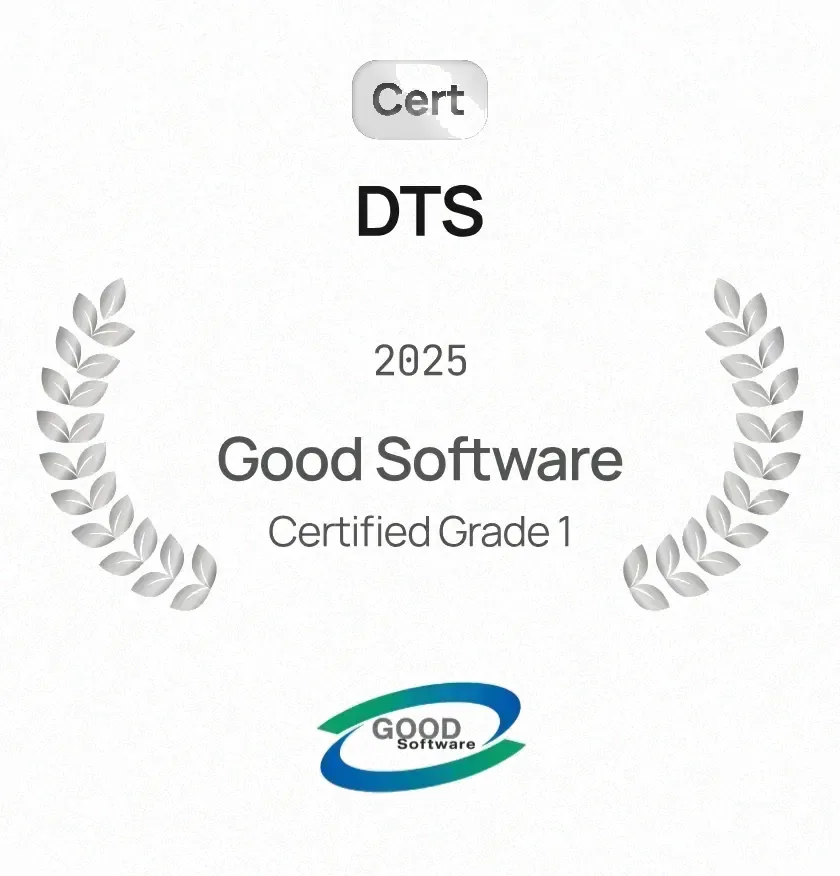




12
Customers and PoCs
Finance, public sector, defense and more
GS 1
Good Software Grade 1
Certified 2025
2
Cloud marketplaces
AWS · Naver Cloud
Listed as a Representative Vendor in Gartner®, Emerging Tech: Provider Differentiation Strategy–Trends for Hyper-Synthetic Data (2025).Gartner does not endorse any vendor, product or service depicted in its research publications. GARTNER is a registered trademark of Gartner, Inc. and/or its affiliates.
FAQ
Frequently asked questions
Differential privacy (DP) is a mathematical framework that bounds how much any single person's data can influence the output. The bound holds even when someone combines the output with outside information. When the data calls for it, DTS applies DP during generation, so datasets stay statistically representative without copying real personal records.
Yes. DTS can be adopted on its own for data reconstruction work. Inside Syntitan, the reconstructed datasets are released as data versions and linked to the runs that use them.
Four kinds: too few examples of rare cases, data that cannot be used as it is, data not in shape for the task, and data that falls short after conditions change.
Yes. DTS runs inside the customer environment and analyzes statistical properties where the data lives. Only the reconstructed output moves on, with DP applied when the data calls for it. This suits classified, regulated, or isolated network environments.
DTS is CUBIG's AI-native Data Reconstruction technology, and it can be adopted on its own. Syntitan is the AI-Ready Data Platform: it assesses data readiness, validates data fit for a use case with a chosen model or agent, and links every run to a released data version. When a use case needs data that is scarce or restricted, Syntitan uses DTS to reconstruct it.
Restricted data. Usable AI.
DTS reconstructs scarce or restricted data into the form an AI task needs.
GS Certified Grade 1 · Innovative Product of the Korea Public Procurement Service.