Mastering Enterprise AI Data Readiness for 3.4x Faster Scale
Table of Contents
Summary
Your shiny new AI initiative is probably going to die in staging. According to Gartner, 60% of enterprise AI projects will be abandoned through 2026 primarily due to poor data readiness and the inability to securely process unstructured data. Executives keep writing checks for GPUs and proprietary foundation models. They ignore the rotting data infrastructure sitting right beneath their feet.
The core issue is data unusability. We treat enterprise information like a bottomless well of clean water. It actually resembles a toxic swamp of missing values, biased records, and regulation-trapped text files. Organizations refuse to prioritize enterprise AI data readiness. They skip the hard engineering work of restructuring their historical records. You end up with a massive verification tax where humans spend hours checking the machine’s math.
Why Do AI Projects Fail in Production?
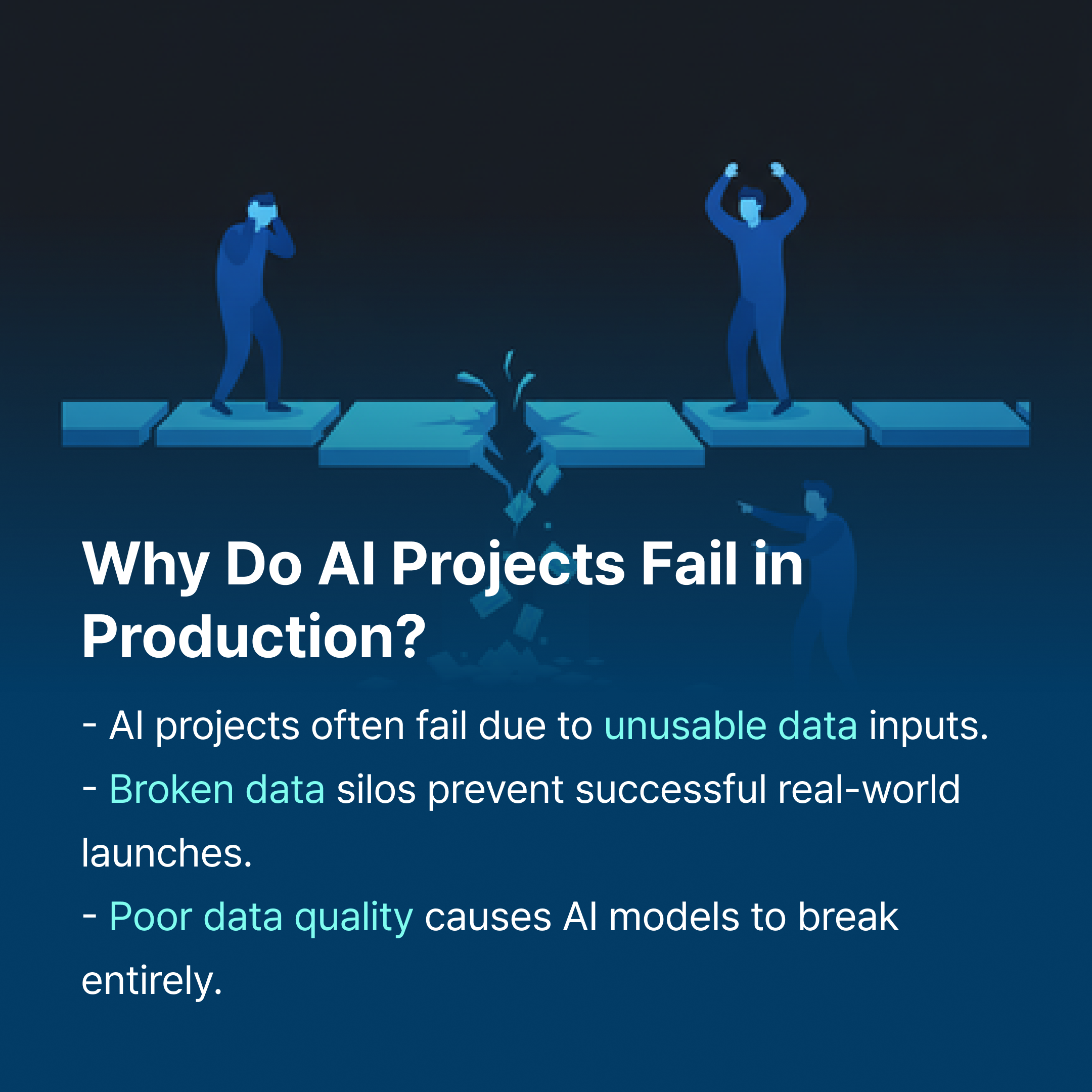
AI projects fail in production because organizations feed them unusable data. Teams build complex agentic loops on top of broken, siloed, and restricted information. When enterprise AI data readiness is ignored, models hallucinate. You get stuck in pilot purgatory instead of scaling actual business value across your company.
A top post on r/dataengineering recently mocked a management proposal to rename our job titles to “AI Collaboration Partners”. The comment section was a bloodbath of shared trauma. Data practitioners are exhausted by the hype cycle. Leadership wants flashy generative agents running over enterprise knowledge bases. We just want a week to parse broken JSON files from a legacy CRM that has not been updated since 2018.
The gap between expectation and reality is massive.
You spend three weeks building an ingestion pipeline for a high-visibility proof of concept. The raw data looks fine on the surface. You plug it into an LLM context window. Business users immediately complain that the application is lying to them about customer history. The model is fine. The enterprise AI data pipeline bottlenecks are the actual culprit. Your data was never ready for algorithmic consumption.
The AI Verification Tax Destroys Productivity
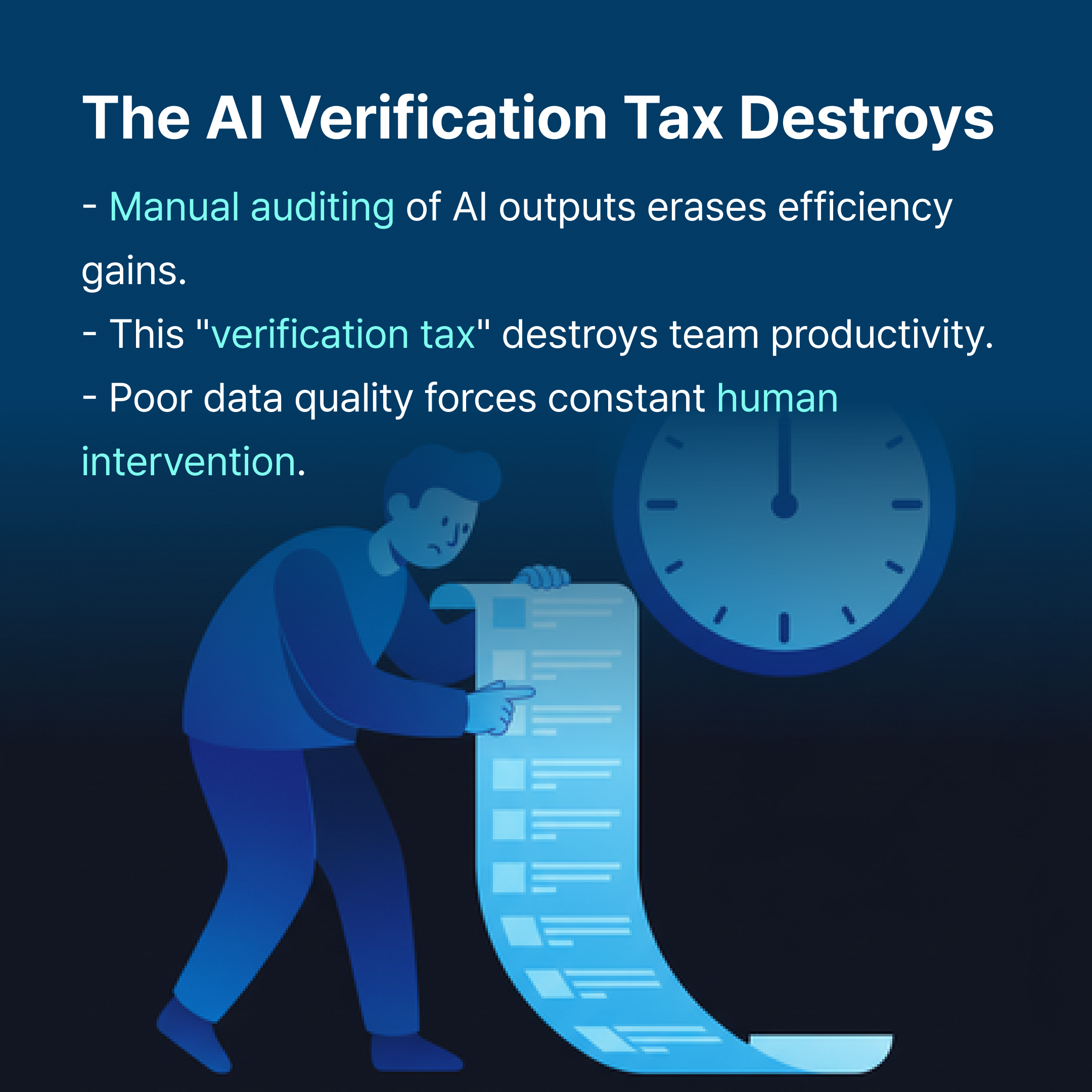
The AI verification tax happens when humans must manually audit every AI output. This negates all efficiency gains completely. If your underlying data is messy, your users will spend hours checking the machine’s work. True productivity requires transforming unusable data into a state models can compute reliably.
Industry data indicates that 89% of software engineers manually verify AI-generated outputs due to low trust in underlying data quality, creating a significant productivity bottleneck known as the AI verification tax. That number should scare you.
You spend millions on cloud compute. You deploy a sophisticated retrieval-augmented generation architecture. Then your analysts spend three hours double-checking the model’s math on a separate spreadsheet. A recent piece in The Hill highlighted this exact absurdity. Engineers are signaling where the tech fits best right now. They only trust it for low-leverage routine calculations.
We see this play out constantly in staging environments. A legal team tries to run contract summarization. They catch two hallucinations on day one. Trust evaporates instantly. Every subsequent document gets read twice. The organization just created more work for its most expensive employees. Achieving real enterprise AI data readiness means fixing the source material so verification becomes an exception, not the rule.
📃Today’s AI-ready offices are tomorrow’s tech success stories
What Happens When Agentic Loops Hit Trapped Data?
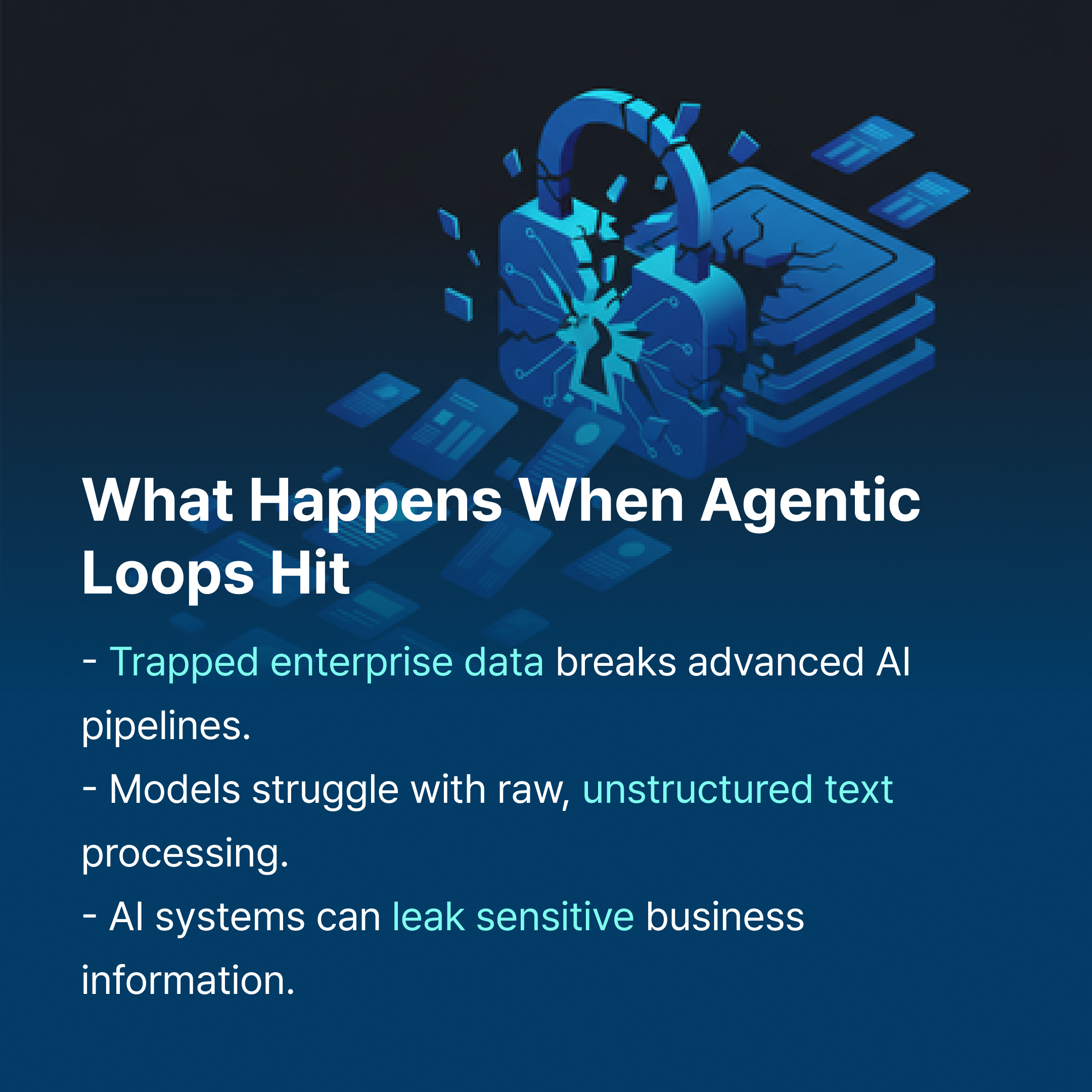
Trapped enterprise data breaks advanced AI pipelines. When models process raw unstructured text, they often memorize and regurgitate confidential information. Basic masking fails to stop this leakage. You must restructure the data entirely to maintain usability without ever exposing original records to the underlying model weights.
A recurring theme in Hacker News discussions exposes a deeper fear among practitioners. One data engineer pointed out a fatal flaw in dumping raw corporate text into an embedding model. Input data can actually be reverse-engineered directly from the model parameters. Compliance teams know this. They rightfully step in and shut down the pipeline. Your project dies right there. You cannot mask your way out of this problem. The data remains trapped, completely unusable for the business units that funded the initiative.
Converting Unstructured Data Into Usable Data
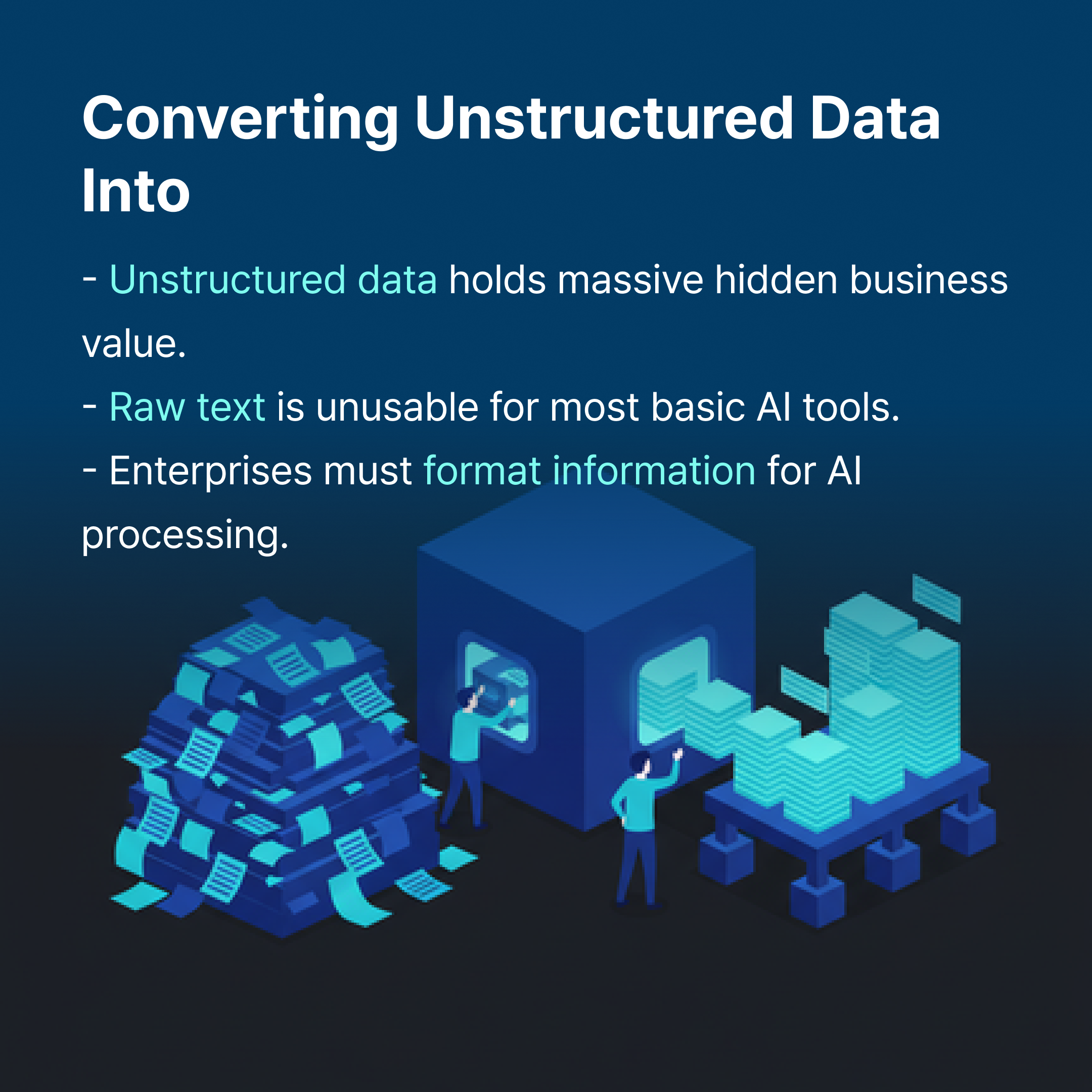
Unstructured data holds massive enterprise value but remains completely unusable for AI. You cannot just dump raw logs and documents into a vector database. You need a restructuring process that cleans missing values, strips risk, and standardizes formats before the models ever touch your information.
Structured tables in a relational database are the easy part of our job. The real nightmare lives in the dark corners of corporate storage. Support tickets, chat logs, PDF manuals, and vendor email threads make up the vast majority of organizational knowledge. CDO Magazine recently outlined a 3-step framework for managing this specific chaos. They nailed the core issue. Traditional quality metrics fail completely when applied to a dense, rambling PDF.
Most teams try to solve this with brute force regex scripts. They write endless rules to scrape out dates and account numbers. This approach scales terribly. When the vendor changes their email signature format, your entire pipeline crashes at 2am.
Figuring out how to assess data quality for AI means looking at structural integrity. Does the unstructured blob contain embedded bias? Are there massive gaps in the timeline? You have to convert that raw exhaust into original-replacement data. This gives the model the exact statistical shape of the history without carrying the toxic baggage of the raw files.
“We treat enterprise information like a bottomless well of clean water. It actually resembles a toxic swamp of missing values.”
📃How to Assess Data Quality for AI: A 3-Step Framework for Unstructured Data
The Multiplier Effect of Data Restructuring
Treating your data as an engineered product changes everything. Organizations that prioritize data restructuring over endless model tweaking see massive scaling success. When you feed AI verified, original-replacement data, you eliminate the friction that consistently kills most deployments before they ever leave your staging environment.
A 2026 Actian BARC study reveals that organizations treating their usable data as a product are 3.4 times more likely to successfully scale AI in production environments. You stop building one-off pipelines for every new application.
This is what mature enterprise AI data readiness looks like in practice. You isolate the raw source material completely. You run it through a rigorous restructuring engine. You generate a clean, highly usable data state that precisely mirrors the original business context. Your developers then build applications against this new verified product.
When an auditor asks how a specific model reached a conclusion, you have a definitive answer. You point them to the exact release state of the data product used at execution time. The mystery disappears. The constant firefighting stops. Your data engineering team finally gets to build systems that actually drive revenue.
📃Organizations Using Data Products Are 3.4 Times More Likely to Successfully Scale AI
How CUBIG Addresses This
If you have ever tried to get approval for AI training data and hit a solid wall of compliance objections, you know how frustrating this feels. You have petabytes of data sitting in your lake. It is messy, incomplete, and trapped behind heavy regulations. Your engineering team spends more time fighting access requests and writing cleaning scripts than actually deploying models. Your AI initiatives are starving right next to a full pantry.
SynTitan makes that trapped data usable. Think of it as a heavy-duty refinement engine for your enterprise infrastructure. Sensitive records? Handled cleanly without exposing a single original file to the AI. Missing values, heavy bias, and broken formats? Automatically cured. Your models finally get the clean fuel they need. SynTitan takes your messy, regulation-trapped data and restructures it into an AI-ready state.
Imagine your Monday morning shifting entirely. A business unit requests a new predictive model based on five years of unstructured customer logs. Instead of spending three months arguing with legal and writing fragile regex pipelines, your team accesses data that is already verified. The records are clean. The compliance risks are gone. You bind the model run to a specific, immutable release state. Your team actually ships the project to production.
Related Reading
- The AI Data Readiness Crisis Stalling 60% of Enterprise Projects
- Fix Your Enterprise AI Data Pipeline Before Buying Compute
- The 2026 AI Crisis: Why Your Enterprise AI Data Pipeline Keeps Crashing
FAQ
How do we measure enterprise AI data readiness before buying GPUs?
You measure readiness by auditing your data unusability score. Look at how much of your historical data contains missing values, regional binds, or restrictive compliance tags. If your data engineering team spends more than half their sprint manually cleaning text logs, your data is not ready. Fix the pipeline foundation before you spend budget on heavy compute hardware.
What is the difference between data restructuring vs data masking enterprise?
Masking simply hides specific characters, like turning a credit card number into asterisks. This breaks statistical patterns and ruins the data for AI training. Restructuring completely converts the original records into original-replacement data. It preserves the exact statistical shape, relationships, and usability of the dataset without retaining any trace of the sensitive raw source material.
How does SynTitan handle enterprise AI data pipeline bottlenecks?
SynTitan eliminates these bottlenecks by automating the curation phase. It ingests broken, trapped, or biased data and restructures it into a verified AI-ready state. You bypass the endless manual cleaning cycles. By locking the results into an immutable release state, your data team can reproduce exact pipeline conditions months later without rebuilding the environment from scratch.
Why do AI projects fail in production even with clean structured tables?
Clean tables often lack the rich context needed for models to perform complex reasoning. The valuable context lives in unstructured data, which usually remains trapped behind compliance walls. When models are forced to guess context based purely on rigid tabular data, they hallucinate. Bringing unstructured documents into a usable state is required for genuine production reliability.
How do you overcome the AI verification tax in a compliance-heavy industry?
You beat the verification tax by moving quality control upstream. Stop asking humans to audit the final AI output. Start feeding the AI verified, restructured data products from the beginning. When the source material is mathematically certified for quality and compliance before inference happens, user trust increases naturally. Verification becomes an occasional spot-check rather than a mandatory daily chore.

CUBIG's Service Line



Recommended Posts