Sensitive AI workflow enablement allows enterprises to run AI workflows on confidential data without exposing raw sensitive values to the model.
Sensitive values are replaced while the structure and relationships required for the task remain intact. The model works on that substituted representation, and the output is reconstructed inside the enterprise’s controlled environment.
It addresses a problem many enterprise teams encounter soon after a promising AI demo. The model can perform the task, but the data it needs cannot be exposed.
Contracts, customer records, pricing logic, and internal reports contain exactly the context that makes AI useful. They also contain information that legal, security, or regulatory teams may not approve for use in an external AI service.
The result is a familiar stall. The model is ready, but the workflow cannot move forward with real data. In many enterprises, that stall is where a promising pilot stops.
Sensitive AI workflow enablement removes that barrier by separating confidential values from the structure and relationships the model needs to do the work.
The rest of this article explains why the usual workarounds fall short and what changes when enterprises stop treating the values and the work as inseparable.
Why it is needed
Take one concrete case.
An analyst has a renewal contract to review, and the clauses that matter most are the ones naming the counterparty, the negotiated pricing, and the carve-outs that took months to settle. A model could flag the risky terms in seconds.
But those exact clauses are the ones the contract forbids her from pasting into an outside tool. The capability is right there. The input is locked.
Faced with that, teams usually pick one of two paths. Both fail the same way.
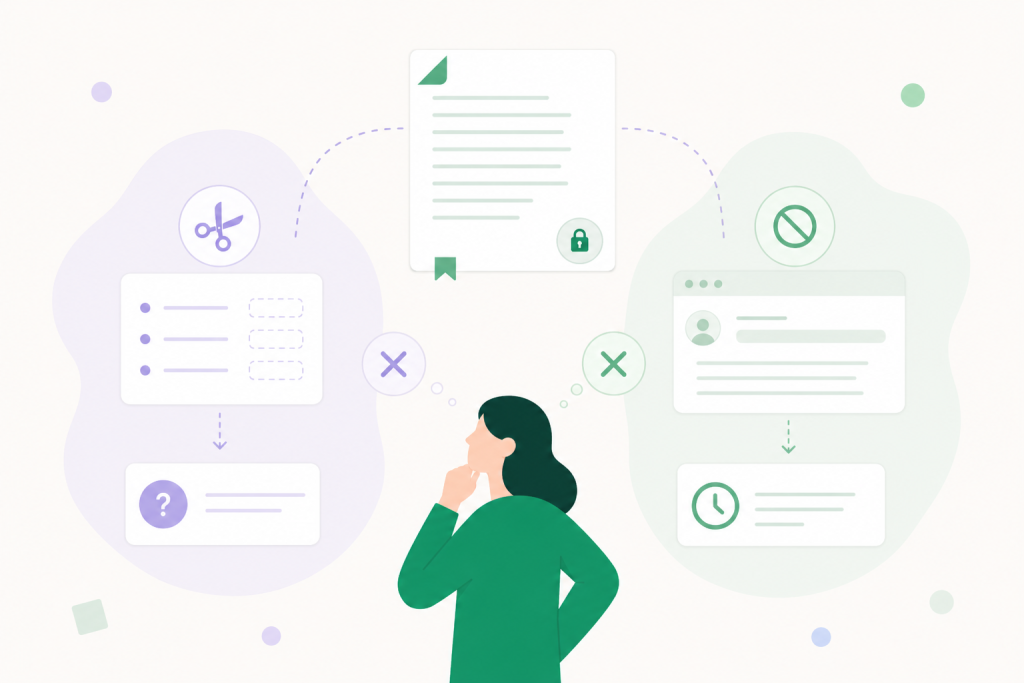
The first is to strip the data down before it goes anywhere. You redact the names, blank the numbers, cut the clauses that feel too specific, and send what is left. It feels responsible. The trouble is that you have also removed the context the model was supposed to reason about. A contract with the counterparty and the pricing taken out is no longer a contract; it is a form with the meaningful parts missing. The model reads around the gaps and returns something generic. The output comes back safe and useless, and the analyst is back to doing the review by hand.
The second path is to keep everything inside and ban the external model outright. No data leaves, so the compliance question goes quiet. But now you have given up the model that made the project worth starting, and you have not actually stopped the work. People still have a deadline. They paste a “lightly edited” version into a personal account, or they route the task through a browser extension nobody reviewed, and the exposure you tried to prevent happens anyway, off the books and out of view. A ban does not remove the risk. It just moves it somewhere you cannot see it.
This pattern is common. Some organizations ban generative AI over privacy and data-security concerns, while staff still find ways to put non-public company information into the same kinds of tools. The prohibition and the exposure sit side by side, which is what happens when the work is urgent and the only approved answer is no.
The reason both paths fail is that they share a hidden assumption: that the confidential values and the useful work are one inseparable object, so any move you make on one is a move on the other. Sensitive AI workflow enablement rejects that assumption. It separates the two. The model gets what it needs to do the job. The confidential values stay where they already live. Both paths take the fear seriously, and they are right to. Where they go wrong is in assuming you must choose between the values and the work.
How sensitive AI workflow enablement works
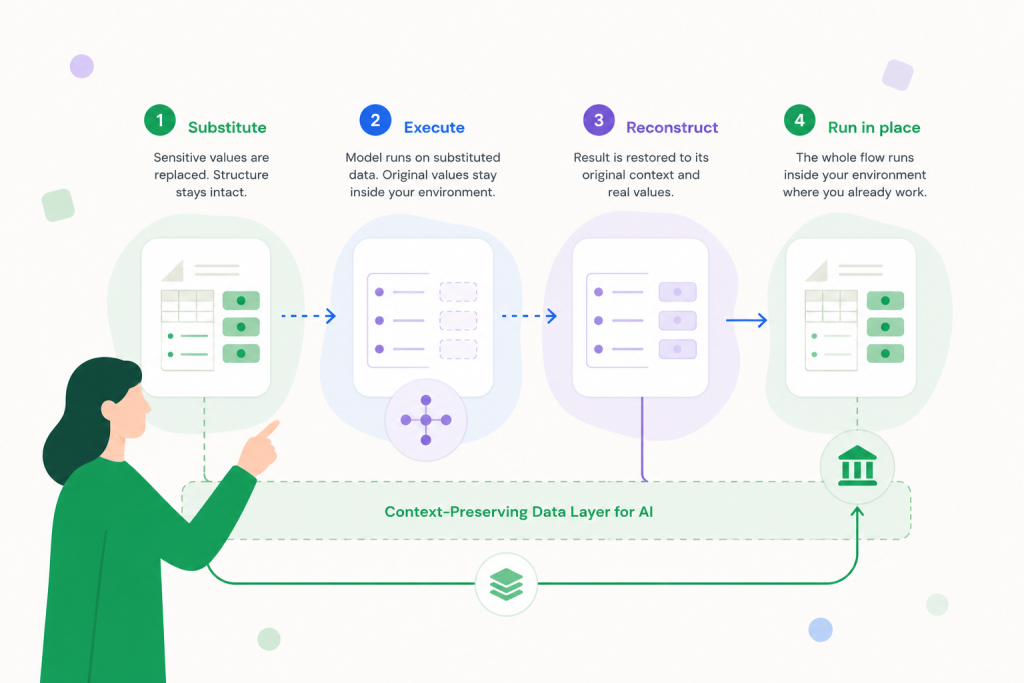
It runs in four steps, end to end:
- Substitute. Sensitive values are replaced while the document’s structure stays intact: tables, lists, hierarchy, and the relationships between fields. The model sees a coherent task, not a redacted blank.
- Execute. An external or on-prem LLM, RAG pipeline, or agent runs on the substituted data. The original values stay inside your environment.
- Reconstruct. The result is restored to its original context, so it comes back as a usable business document rather than a placeholder someone has to reassemble by hand.
- Run in place. The whole flow executes inside the environment you already run, whether cloud, on-prem, or air-gapped, instead of routing data somewhere new.
The step that decides everything is the first one, so it is worth slowing down on. Plain masking removes a value and leaves a hole. A name becomes a black bar. A price becomes a row of X’s. A clause about a specific party becomes a gap the model has to guess around. The data is now safe and also incoherent.
Structure-preserving substitution does something different. It swaps the sensitive value for a stand-in that keeps the shape of the original. A company name becomes a different but consistent company-shaped stand-in, used the same way every time it appears. A figure becomes another figure that holds its place in the table and its ratio to the numbers around it. The indentation of a clause, the row-and-column logic of a spreadsheet, the order of steps in an operating note: all of it survives. What leaves is the identifying content. What stays is everything the model reasons from. That is why the model reads a real task instead of a page full of holes, and it is the difference the rest of the mechanism depends on. The full walkthrough lives in substitute, execute, reconstruct.
Execution is the step people worry about and the step where the least changes. You run the model you already chose, on the substituted version, and from the model’s point of view the task looks complete because the structure is all there. Then reconstruction maps the result back: the stand-ins resolve to the real values in their real context, so what returns is the analyst’s own contract, reviewed, not a draft keyed to stand-ins she would have to translate by hand. The result coming back inside the boundary, rather than leaving for good, is what defines a restorable AI data boundary.
In CUBIG’s case, these four steps are delivered by LLM Capsule, which lets AI work with operational data that can’t be sent as raw data, using context-preserving substitution. Only a substituted working version goes to the approved AI, and the response is checked and connected back to real business values through an internal mapping. The mechanism is the point; the product is just where it runs.
What stays the same
The reason this is framed as an enablement layer, and not a migration, is that almost nothing about your setup has to change. The model you wanted is the model you use.
The environment you already run in is where it executes. The output lands in the format your team already works with, in the tool they already open. The aim is to avoid a new vendor model to certify, a data lake to relocate, or a workflow to rebuild from scratch.
The main thing that changes is this: raw values stop being the thing you ship out to get work done.
Everything an enablement layer adds is in service of keeping the rest of the picture exactly as it was.
How it differs from masking, DLP, or a gateway
This is the distinction that matters most, and it is easy to blur because the tools sit near each other. A masking step, a data-loss-prevention filter, and an AI gateway are all controls. Their job is to stop something: to catch the value before it leaves, to block the request that should not go out. You measure a control by how much it prevents. A good one prevents a lot.
Sensitive AI workflow enablement is not measured that way. It is an enablement capability, and you measure it by how much work it lets you run that was previously off-limits. The renewal contract that used to sit in the “cannot use AI on this” pile now goes through the workflow and comes back reviewed. That is the metric. Because the original values stay inside the whole time, security, privacy, and legal reviewers do gain a clean basis to approve the workflow, and that approval is real and valuable. But it is the by-product, not the goal. A control exists to say no safely. An enablement layer exists to make the yes possible. If you arrived assuming the answer was masking, the move from one mindset to the other is worth its own read: from PII masking to workflow enablement.
If you are weighing this specifically against a data-loss-prevention control, the line-by-line differences are set out in LLM Capsule vs. AI DLP.
What “sensitive” actually covers
One last thing the practice gets right is the scope of the word “sensitive.” Many tools treat it as a synonym for personal data: names, identifiers, the fields a privacy regulation lists by name. Those matter, but they are not the whole problem. The contract clause that reveals a negotiated discount, the pricing model that encodes years of strategy, the internal metric that would tip off a competitor, the operating note that describes how a system actually fails: none of that is personal data, and all of it is the kind of thing an enterprise cannot afford to leak. Sensitive AI workflow enablement treats business-sensitive context as first-class, because in real workflows it is usually the larger share of what cannot go out.
Where it fits
Sensitive AI workflow enablement is one entry point to an AI-ready data pipeline.
It clears the confidential-context problem first, so the rest of the work has something to operate on.
When data is not only sensitive but also scarce or structurally unusable, DTS, CUBIG’s data preparation engine, can help: it turns locked, scarce or regulated data into AI-ready data for training, testing, evaluation and sharing. Its output is a set of data candidates whose effect is checked under the same task, model and evaluation conditions.
In the most restricted settings, such as an air-gapped defense network, the same flow runs with no outbound connection at all; running an LLM inside an air-gapped defense environment walks through that case.
LLM Capsule is CUBIG’s Context-Preserving Data Layer for AI for the workflow described here. It runs substitute, execute, and reconstruct so your original values stay inside your environment while the model you already chose does the work.