
Release state is the exact, versioned snapshot of the data, schema, and configuration an AI system ran on at a given moment, captured so that any past run can be reproduced or rolled back long after it happened.
Teams rarely lose an AI system to a bad model. They lose it to a data state they can no longer rebuild. In a third-quarter 2024 Gartner survey of 248 data-management leaders, 63% either did not have or were unsure they had the data-management practices their AI work required, and Gartner expects organizations to abandon 60% of AI projects through 2026 for lack of AI-ready data. This is not only an enterprise story. A 2023 study in Patterns traced reproducibility failures caused by data leakage across 17 scientific fields and 294 papers, with the root cause sitting in how the data was handled rather than in the model.
The break usually surfaces after launch. A model that cleared every test starts returning wrong answers, and no one can rebuild the exact inputs, schema, and settings that produced them.
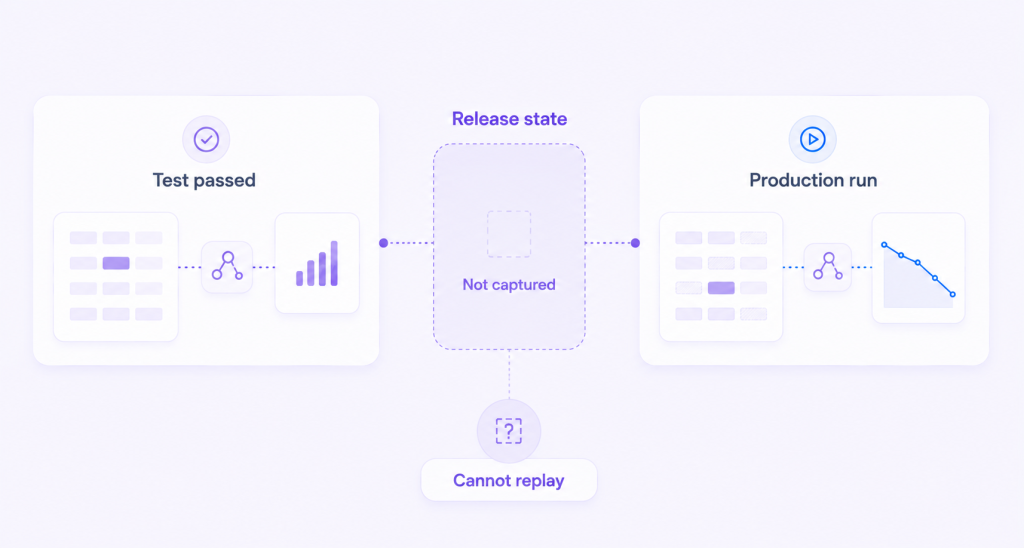
What release state captures
A model artifact on its own explains very little about a single prediction. Release state widens the lens to everything that fed the run, then freezes it as one addressable version. Five things travel together:
- Data snapshot. The precise rows and values the run read, not a live table that has since changed.
- Schema. Column names, data types, nullability, and constraints as they stood at run time, before any migration reshaped them.
- Configuration. Model parameters, prompt templates, thresholds, and feature flags active for that run.
- Transformation code. The version of the preprocessing and feature logic that turned raw inputs into what the model actually saw.
- Run binding. An identifier that ties all of the above to one production execution, so a prediction points back to the state that produced it.
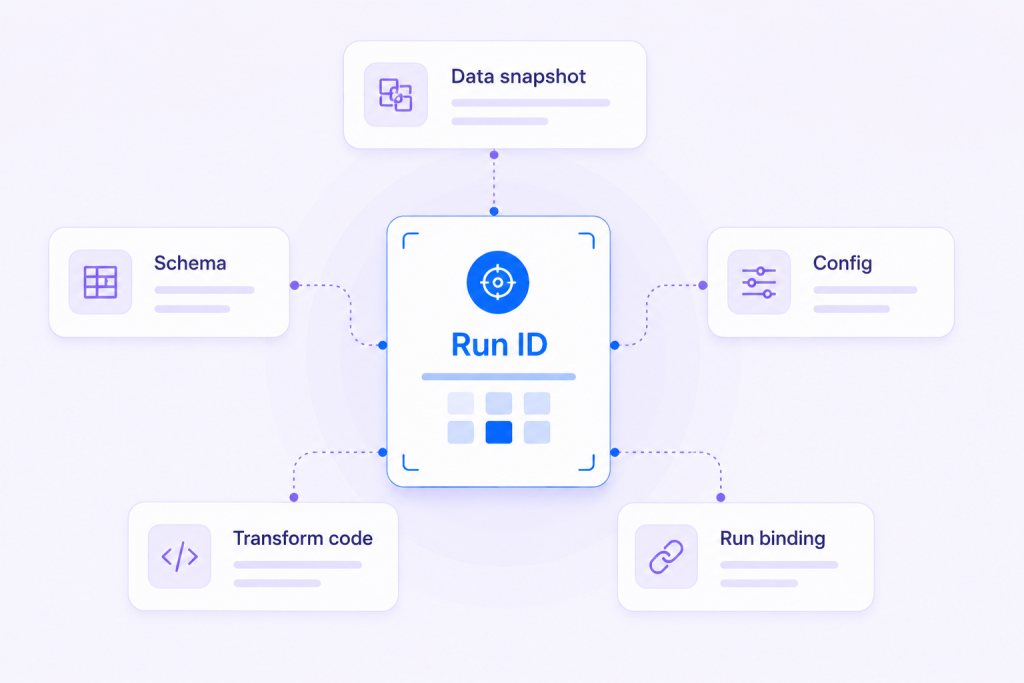
Miss any one of these and reproduction turns into guesswork. A team that saved the model but not the schema will discover that last quarter’s migration quietly changed a column type, and the earlier prediction can no longer be recreated.
Release state vs model versioning
Model versioning and a model registry answer one question well: which artifact shipped. That matters, and it falls short of reproduction. Versioning tracks the model; release state tracks the run. A registry can tell you that version 4.2 went live in March. It cannot tell you which data version 4.2 scored on a given Tuesday, what the schema looked like that day, or which preprocessing build sat in front of it. Data versioning and data lineage tools close part of the gap, though they usually stop at the dataset and leave the configuration and the run link out. Release state binds all of it to a single reproducible point.
How release state makes an AI incident reproducible
Reproducibility is the difference between fixing an incident and arguing about it. When a complaint arrives about a prediction from three weeks ago, a release-stateful system lets an engineer pull the exact state behind that run, replay it, and compare the result against current behavior. Data lineage shows where each input came from; the release state shows what those inputs actually were at execution time. Diff the two states and the cause stops hiding, whether it was a schema migration or a stale reference table feeding the model. This kind of traceability is also what the NIST AI Risk Management Framework asks for when it calls on teams to keep AI systems documented and auditable.
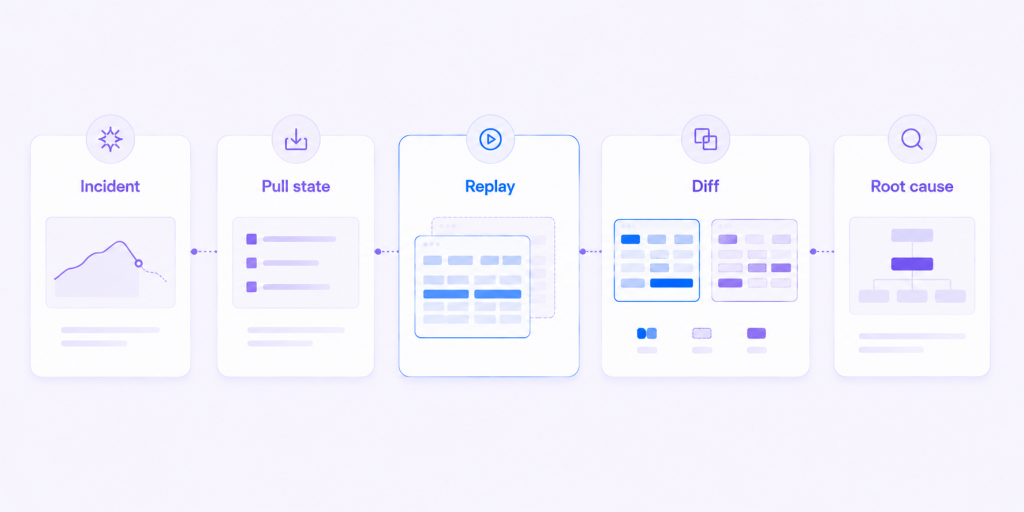
Without it, root-cause work becomes reconstruction from memory, and the answer often lands after the customer has already left.
When regulators ask, reproducibility is not optional
In regulated industries, reproducing a result is a requirement rather than a convenience. In US banking, the Federal Reserve and OCC guidance on model risk management, SR 11-7, requires a model’s development, validation, and deployment to be documented well enough to reproduce its results. In Europe, Article 12 of the EU AI Act obliges high-risk AI systems to log events automatically and to retain those logs for at least six months. Both point at the same bar: any decision has to be traceable back to the conditions that produced it. A model version and a timestamp do not clear it. You need the data state to trace back to.
Where release state sits in an AI-ready data stack
Release state is one of the properties that separates AI-ready data from data that is merely clean. Clean data is correct today; AI-ready data stays correct and reconstructable across every run, a different and harder guarantee that we draw out in AI-ready data vs clean data. For agents that act on live systems the same property underwrites trust, since an agent’s decision is only as auditable as the state you can replay behind it, a point developed in agent-ready data needs semantic context.
This is the layer CUBIG operates on. Syntitan, CUBIG’s AI-Ready Data Platform, scores enterprise data on six readiness axes, rebuilds what blocks execution, and binds every AI or agent run to a release state you can diff and reproduce, so a result from any point in the past can be rebuilt and defended.
Is your data release-stateful? A quick self-check
Pick one prediction your system made last Tuesday, then ask:
- Can you retrieve the exact rows and values that prediction read?
- Do you know the schema as it stood that day, before any later migration?
- Can you name the preprocessing and configuration version the run used?
- Does that prediction link back to a single, addressable run?
- Could you replay it today and get the same output?
A “no” to any one of these marks a spot where an incident would outrun your ability to explain it.
Try it on your data for free. Run a sample proof and reproduce a past run from end to end.