
Operating control vs model registry is not a choice between two tools: a model registry versions the model artifact and tells you which model ran, while operating control versions the data state and tells you which data produced the result.
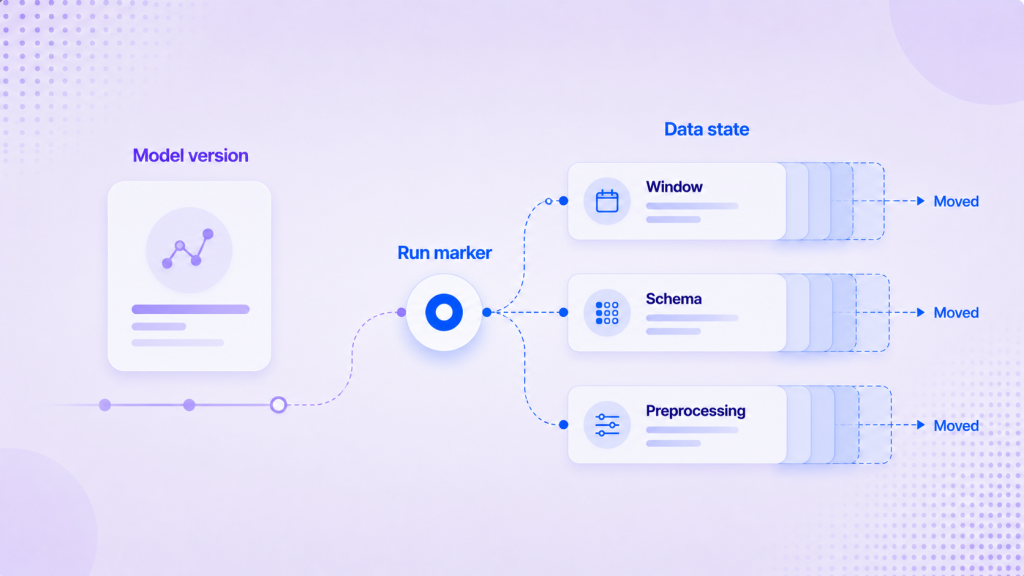
The gap is expensive because teams assume the registry covers reproducibility, and it does, for exactly one half of the picture. Consider what even best-in-class lifecycle tooling captures: MLflow Tracking records parameters, metrics, code version, and artifacts for each run, a record of what the model and code did, not of the state of the data the run consumed. A registry that logs model versions cleanly but never records the data state behind a result leaves that half unmanaged, and it is usually the half that moves.
What a model registry does well
A model registry catalogs model versions, promotes them through dev, staging, and production, and gives you clean rollback and audit of the model artifact. Popular registries, whether inside MLflow, a cloud ML platform, or a standalone tool, all solve the same real problem: they stop teams from emailing model files around and losing track of which one is live.
For governing which model is in production, moving a version through approval, and rolling back a bad model, the registry is the right tool. It answers “which model version is serving traffic” with precision, and that answer matters. The trouble starts when people expect the same record to explain a result that changed while the model did not.
Where the data-state gap sits
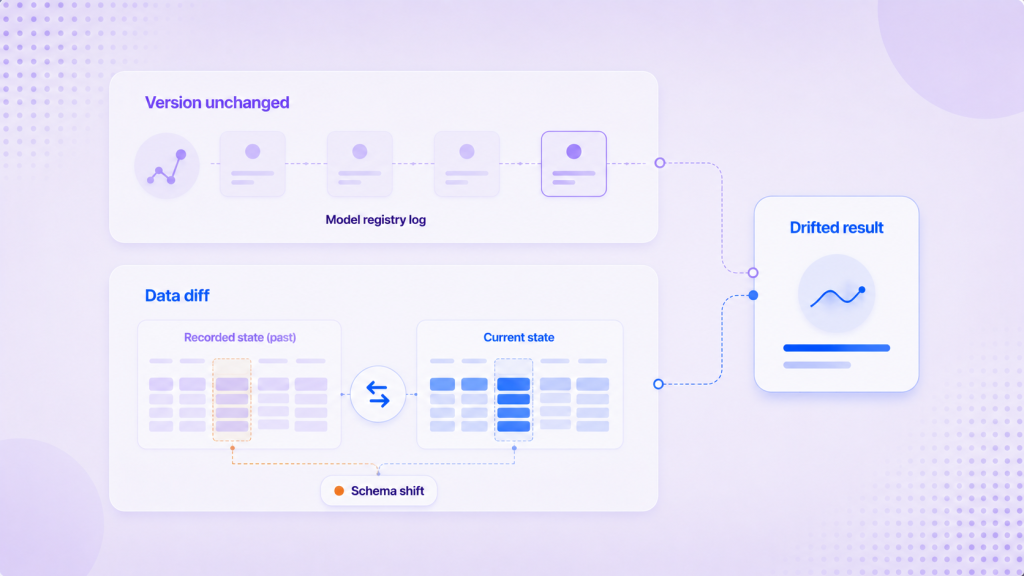
The registry’s record ends at the model. The same registered version can return different outputs when the data window moves, a schema shifts under the pipeline, preprocessing logic changes, or a permission boundary narrows what the model can read at run time. In each case the registry faithfully reports that the model version never changed, which is true and unhelpful at the same time, because the output clearly did. Google researchers documented this failure mode as underspecification: models that score identically on held-out tests can behave very differently once deployed.
“Nothing changed” is the most expensive sentence in a drift investigation, and the registry is often where it comes from. An engineer opens the version log, sees a stable model, and rules out the one place they can inspect, so the search moves to retraining or infrastructure while the actual cause, a moved data state, stays invisible. Operating control closes that gap by treating the data state as a first-class versioned object through a reproducible Release State, Run Binding, Diff, and Reproduce.
Consider a fraud model that scored a transaction as safe in March and flags an identical pattern as risky in July. The registry shows the same version both times. What moved was the reference table the model joins against, refreshed on a schedule nobody logged as a release. Without a versioned data state, the team cannot say which table the March run read, so they cannot reproduce the March decision an auditor now wants to see. The model version, the one thing the registry captured perfectly, is the one thing that did not change.
Operating control vs model registry: what each one versions
| Question | Model registry | Operating control |
|---|---|---|
| What it versions | The model artifact | The data state |
| Primary answer | Which model is live? | Which data produced the result? |
| Rollback target | A model version | A data state, via Reproduce |
| When output drifts | “Version unchanged” | “Here is the diff between states” |
| Audit scope | Model lineage | Data state at execution time |
Read across any row and the pattern holds: the two tools version different objects, so they answer different questions. Neither row makes the other redundant. A registry that also tags a dataset name does not close the gap, because a name is not a state; the same named dataset can hold different rows, a different schema, and different preprocessing on two different days. Operating control records the state itself, not a label pointing at whatever the store happens to contain now.
Registry for the model, operating control for the state
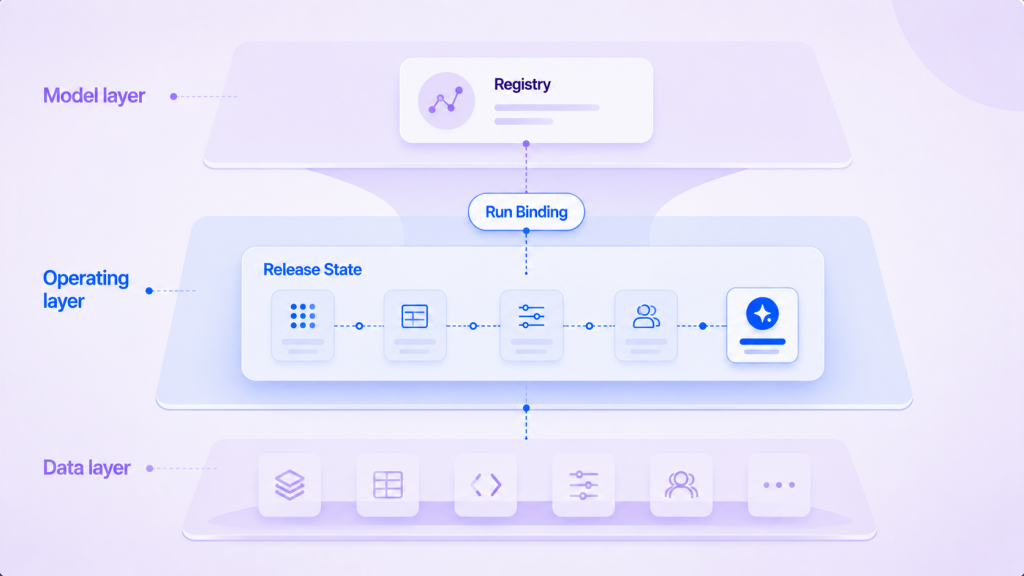
Keep the registry for what it governs, the model, and add operating control for the data state, so every run is bound to the Release State that produced it. When two runs of the same registered model disagree, you diff their states and reproduce the prior one instead of concluding “nothing changed” because the version log says so.
The axes operating control adds are Consistency, Reproducibility, and Traceability for the data, the half a registry cannot see. Production AI has to answer two questions at once: which model ran, and which data state produced the result. Syntitan, CUBIG’s AI-Ready Data Platform, covers the second. It scores enterprise data on six axes, rebuilds what blocks execution, and binds every AI or agent run to a data state you can diff and reproduce. Paired with a registry, you can say both “this model version was live” and “this data state produced this result, and here it is, restored.”
Four questions for a recent production result
Run this quick test against a recent production result. If you cannot answer cleanly on the data side, the registry is doing its job and something else is missing. The framing is not ours alone: Google’s ML Test Score, a 28-test rubric for ML production readiness, scores data and infrastructure checks with the same weight as model checks.
- For a past result, can you name both the model version and the data state it ran on?
- When a registered model drifts, do you start by diffing the data state, or by retraining?
- Could you reproduce a six-month-old result for an auditor with the data exactly as it was?
- When someone says “nothing changed,” can you prove it for the data, not just the model?
Where it fits in an AI-ready data operating layer
A model registry lives in the model layer; operating control lives in the layer between data management and AI execution. That operating layer is where a result becomes reproducible: it records the six readiness axes of Usability, Integrity, Context, Consistency, Reproducibility, and Traceability, and it binds each run to a Release State you can restore.
The arc is simple to state and hard to fake: make the data ready, then keep it reproducible. A registry gives you the model side of that arc for free. Operating control gives you the data side, and for regulated teams the data side is usually where the audit lands. Any performance figure you see is representative until you reproduce it on your own model and data.
Try it on your data for free. Run a sample proof and see it on your own workflow.
Related reading: Operating Control vs MLflow, Model Versioning Is Not Enough, and What is Run Binding?