
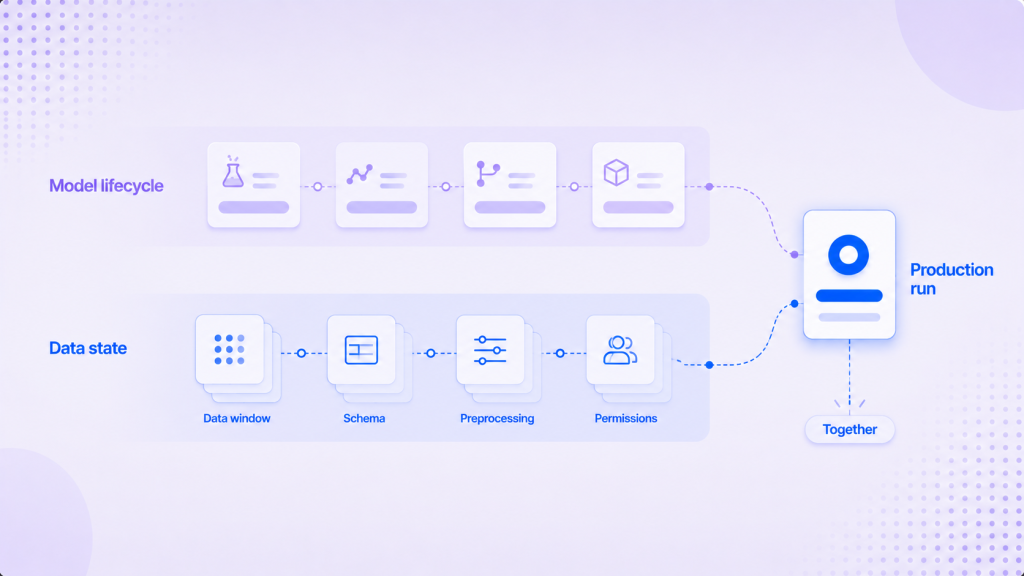
Operating control vs MLflow is not a contest between two tools: MLflow tracks the model lifecycle, while operating control records the data state behind each production run, and reproducible AI needs both.
MLflow’s own documentation is precise about what tracking captures: parameters, metrics, code version, and artifacts for each run. That is a record of what the model and the code did, not of the state of the data the run consumed, and the difference shows up after deployment, when a model that reproduced perfectly in an experiment tracker no longer reproduces in production. MLflow is usually where that reproducibility story starts, and, for many teams, where it quietly stops.
This piece maps where one layer ends and the other begins, so you stop asking either to do the other’s job. “Operating control” here means the AI-ready data operating layer: a reproducible data state built on Release State, Run Binding, Diff, and Reproduce.
What MLflow does well
MLflow tracks experiments, parameters, metrics, and model artifacts across the training lifecycle. It is genuinely strong at comparing runs during development, packaging a model, and managing the model side of a deployment. If your question is “which experiment produced this model, with which parameters and which training-time metrics,” MLflow answers it cleanly and is hard to beat.
Notice what that answer is anchored to: the model and the inputs it saw at training time. That anchor is exactly right for the development loop. It is also where a production result can slip away from you, because the thing that moved was never the model.
Where the data-state gap opens
MLflow pins the model and its training-time inputs. What it does not pin is the execution-time data state a live run actually saw: the data window in production, a schema that shifted after training, a preprocessing step that changed version, or a permission boundary that moved and quietly narrowed what the run could read.
When a deployed result drifts and the model version is unchanged, those four are the usual suspects, and they sit outside a model-centric view. The experiment that looked perfectly reproducible in your tracker is not the same object as a production result you can rebuild on demand. Model reproducibility answers half the question; the data state answers the other half. None of this is a new observation: the NeurIPS paper on hidden technical debt in machine learning argued a decade ago that data dependencies cost more than code dependencies in production ML, precisely because nothing tracks them.
Consider a concrete case. A risk model ships in March, logged cleanly in MLflow with its parameters and validation metrics. In June, an upstream team renames a column and backfills a default value, and a scheduled job starts feeding the model a slightly different window. The model version never changes, so the tracker still shows the same artifact it always did. The output, however, has moved, and nothing in the model’s own history explains why. What you need is a record of the data state each run was bound to, and a way to diff June’s state against March’s. That record is the operating layer’s job, not the tracker’s.
Operating control vs MLflow, side by side
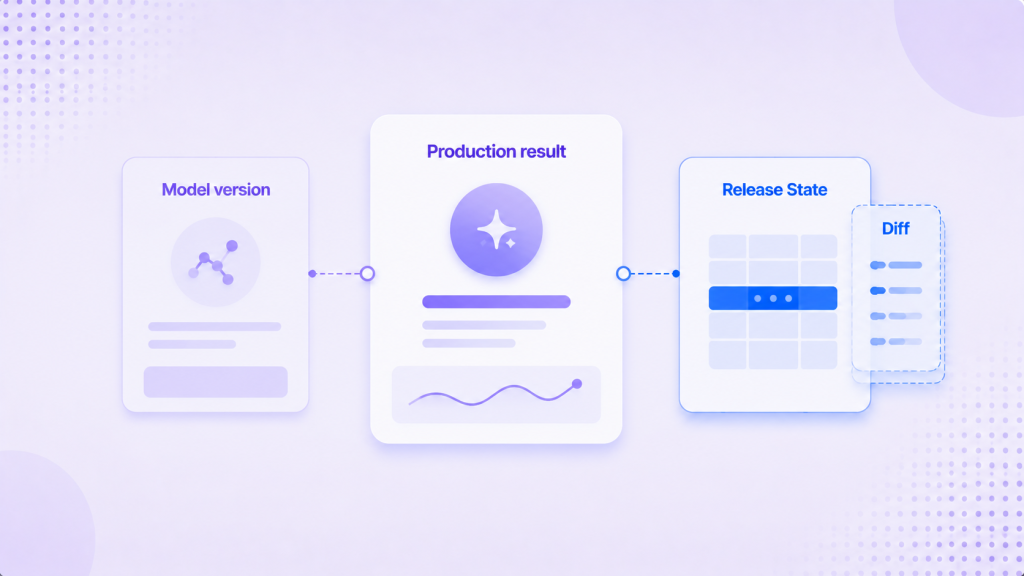
The division of labor is clean once you name it. One layer owns the model and its history. The other owns the data state each run was bound to.
Complementary, not competing
Keep tracking experiments and models in MLflow. Then bind each production run to a Release State you can diff and reproduce. Together they let you say, for any result, both which model ran and which data state produced it, which is what reproducibility actually requires in an audited environment.
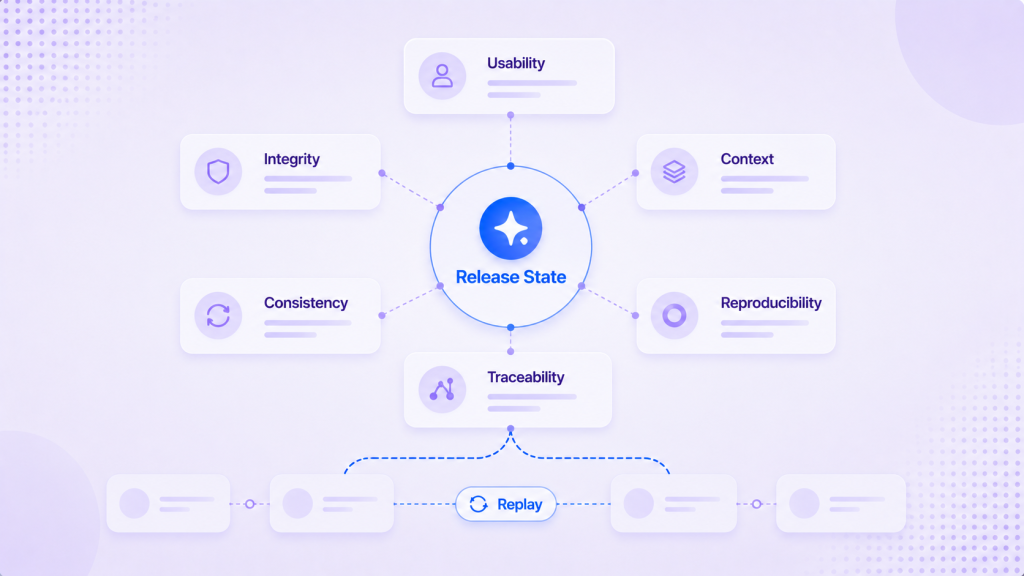
The axes operating control adds are Consistency, Reproducibility, and Traceability at execution time, not only at training time. MLflow gives you the model’s story; the operating layer gives you the run’s story. The MLOps overview by Kreuzberger et al. maps the principles, components, and roles a team needs to move ML from development into production operation, and no single component on that map covers both stories. Neither is a substitute for the other, and treating one as if it covered both is how teams end up with a green experiment log next to an incident they cannot rebuild.
How to tell where your gap is
- You can reproduce a training experiment from MLflow, but can you reproduce a production result’s exact data state?
- When a deployed model drifts on an unchanged version, does your tracker tell you what moved, or only what the model was?
- Is the live data window and schema each run saw recorded anywhere, or only the training data?
- If an auditor asked you to rebuild last quarter’s decision, could you diff the data state, not just re-list the model version?
- Do a preprocessing change and a schema change leave a trace you can point to after the fact?
If you answered “the model, not the data” to more than one of these, the gap is on the execution side, and no amount of model tracking closes it.
Where Syntitan fits
Syntitan, CUBIG’s AI-Ready Data Platform, supplies the execution-time half that MLflow leaves out. For production AI the question is not only which model ran but which data state and execution conditions produced the result. Syntitan scores enterprise data on six axes: Usability, Integrity, Context, Consistency, Reproducibility, and Traceability. It rebuilds what blocks execution, and it binds every AI or agent run to a data state you can diff and reproduce.
In practice: use MLflow for the model, and use the operating layer for the state. That arc, make the data ready and keep the run reproducible, is the missing layer between data management and AI execution. For a fuller definition of that layer, see what AI-ready data means; for the adjacent tools this sits next to, see operating control vs a model registry and operating control vs generic MLOps. Any performance figure you see is representative until you reproduce it on your own model and data.
Try it on your data for free. Run a sample proof and see it on your own workflow.