
Run binding is the practice of tying every AI or agent run to the exact data state that produced it, so the result can be diffed, audited, and reproduced later.
Most teams can tell you which model version served a prediction. Far fewer can tell you which data state the model actually read at that moment. That gap is where production AI quietly breaks. Even teams with excellent tracking stop at the model’s edge: MLflow Tracking records parameters, metrics, code version, and artifacts for each run, a full record of what the model and code did that still says nothing about the data the run consumed. Run binding closes the part of the gap nobody else records: what the data looked like when a run happened.
What run binding actually means
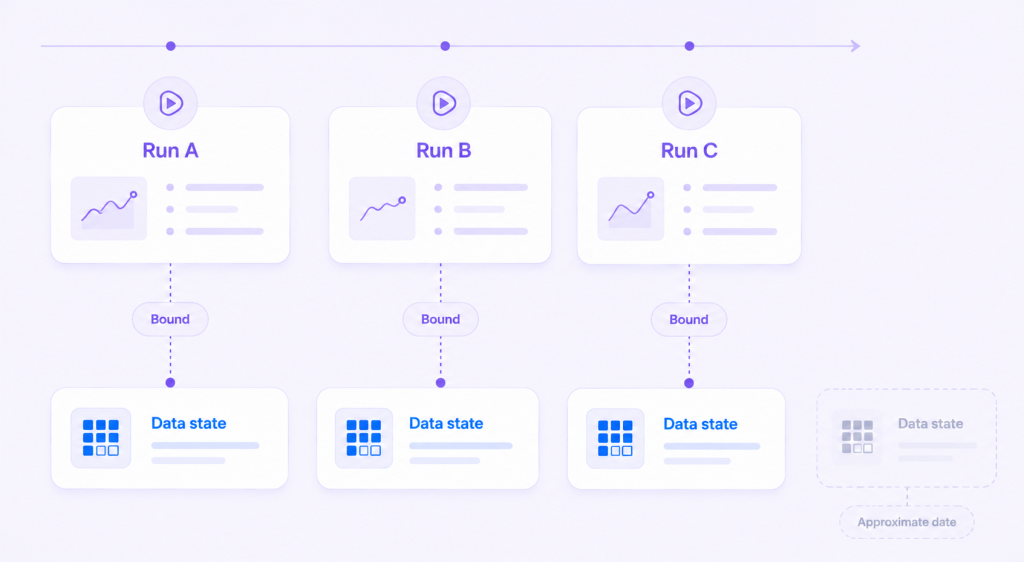
When an AI system produces an output, several things come together at once: the model, the prompt or feature vector, the runtime configuration, and the data the system reads from, meaning tables, embeddings, reference lists, retrieved documents. Model versioning captures the first of those. Run binding captures the rest, and it captures them as one linked record.
A bound run answers a precise question months later: given this specific output, which data state was live, and can I rebuild that state exactly. Not an approximation, not “the table around that date,” but the resolved contents the system saw. When you can answer that, an incident review stops being archaeology and becomes a lookup.
Why model versioning is not enough
Model versioning tools do their job well. They record weights, hyperparameters, and training lineage. The problem is scope. In production, the model is often the most stable part of the system, while the data underneath it shifts daily: a reference table gets a new row, an upstream job rewrites a column, a retrieval index gets re-embedded. The model version stays “v3.1” through all of it.
So when an output looks wrong, the model log tells you nothing changed, because on the model’s side, nothing did. The change was in the data state, and the data state was never bound to the run. You end up guessing. Run binding removes the guessing by recording the data side of the run with the same rigor teams already apply to code and model artifacts.
Here is the distinction in one view.
Run binding and the Release State
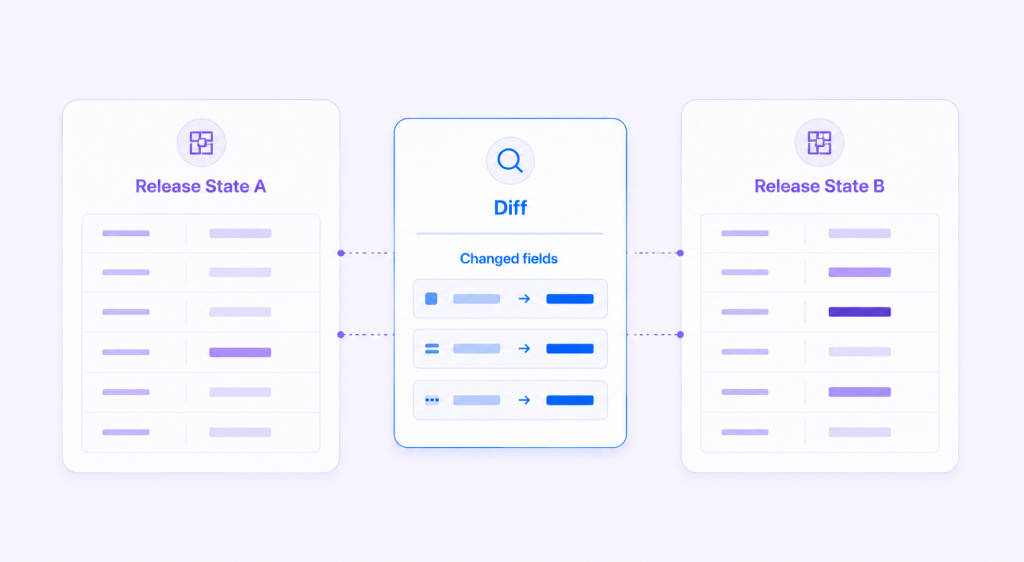
Run binding depends on there being something stable to bind to. That anchor is the Release State: a named, resolved snapshot of the data as it stood at a moment, with its contents fixed rather than left as a live pointer. A Release State is to data roughly what a tagged commit is to code.
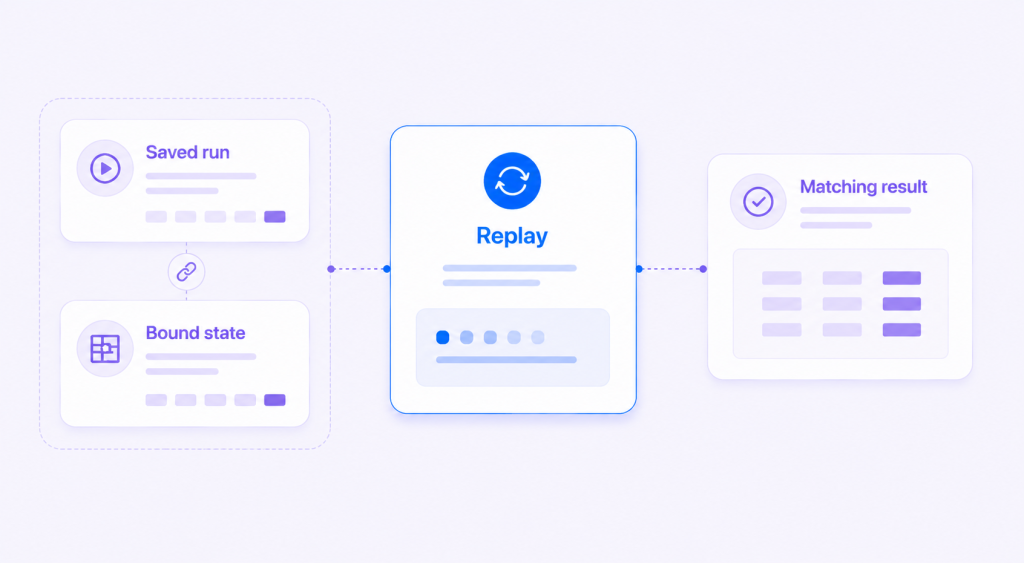
Once a Release State exists, binding is straightforward: each run records the Release State identifier it consumed, alongside the model and configuration. The run is now a Verifiable Data State, not a loose event. You can Reproduce it by resolving the same Release State and replaying the run, and you can Diff two Release States to see exactly which rows, columns, or documents moved between them.
How run binding improves AI reproducibility
AI reproducibility has a low bar and a high bar. The low bar is rerunning the same code and getting the same number on a fixed file. The high bar, the one regulated teams actually need, is reconstructing a past production result from records alone, without the original engineer, the original notebook, or a lucky backup.
Run binding is what raises you to the high bar. Because the data state is part of the run record, model reproducibility and data reproducibility stop being separate problems. This matters well beyond debugging. EU AI Act Article 12 requires high-risk AI systems to automatically record events over their lifetime; you cannot claim that traceability if the data half of every run is missing. A bound run is auditable by construction, the same property reproducible builds give software: an independently verifiable path from inputs to output.
Picture a lending model that declined an applicant in January. In March, a regulator asks the bank to justify that specific decision. With model versioning alone, the team can show which model scored the file but not the reference tables, risk thresholds, or enriched attributes the model read that day, all of which have since been updated. With run binding, the January run carries its Release State, so the team resolves that state, replays the score, and reproduces the exact decision the regulator is questioning. The difference is not cosmetic: one path is a defensible reconstruction, the other is a best-effort narrative that tends to fall apart under a second question. Binding also shortens ordinary incident reviews, because the first thing an engineer checks, “did the data move,” is answered before anyone opens the model code.
Run this quick self-test on any production AI system you own. If you answer “no” to two or more, your runs are not bound.
- For a random output from three months ago, can you name the exact data state it read?
- Can you rebuild that data state today without asking the original engineer?
- Can you show, as a diff, what changed in the data between two runs?
- When a metric moves, can you rule out silent data change before you touch the model?
- Would your answer survive an auditor asking for the same evidence twice?
What run binding is not
Run binding is not logging. Logs tell you an output happened and roughly when; they rarely let you rebuild the inputs. It is not a data catalog either: a catalog describes where data lives and who owns it, not the resolved contents of a specific run. And it is not backup or snapshotting for its own sake. A snapshot you cannot tie to a run, and cannot diff against another, gives you storage without answers. Run binding is the link, the diff, and the replay together, treated as one operating discipline.
Where run binding fits
For production AI, the question is not only which model ran but which data state and execution conditions produced the result. That is the layer CUBIG operates in. Syntitan, CUBIG’s AI-Ready Data Platform, scores enterprise data on six axes, Usability, Integrity, Context, Consistency, Reproducibility, and Traceability, rebuilds what blocks execution, and binds every AI or agent run to a data state you can Diff and Reproduce. Run binding is the mechanism behind the last two axes: it turns Reproducibility and Traceability from aspirations into something you can point at.
If your team already versions models but still argues about “what changed” during incidents, run binding is the missing half. It fits alongside your existing MLOps stack rather than replacing it, sitting where the data state meets the run. For the broader picture, see how this connects to AI-ready data, why model versioning is not enough on its own, what a Release State is, and how Release State compares to a plain dataset snapshot.
Try it on your data for free. Run a sample proof and see it on your own workflow.