Operating control vs CI/CD for ML is the difference between a pipeline that ships reliably and a production result you can reproduce: CI/CD reproduces the build, while operating control binds each run to the data state that actually produced the answer.
The gap matters because even a mature pipeline stops at the build. Google Cloud’s MLOps guide grades the practice into maturity levels 0 through 2 and singles out continuous training as the one piece that only ML systems need on top of standard CI/CD. Automate all of it and you can still ship a model flawlessly yet fail to explain the number it produced last Tuesday.
What CI/CD for ML actually reproduces
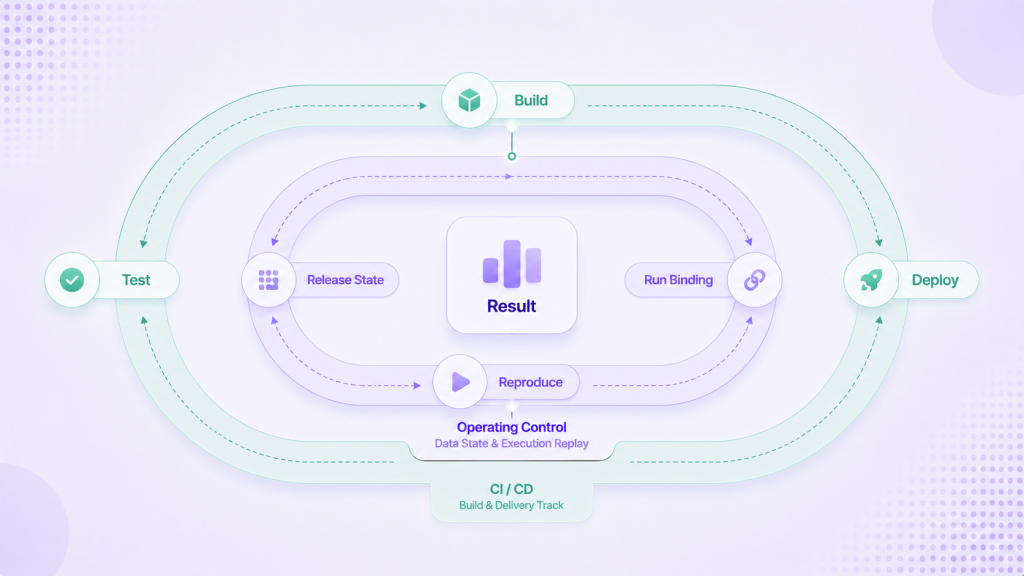
Continuous integration and continuous delivery for machine learning automates the path from commit to production. It versions code, runs automated checks, packages models, and controls rollouts and rollback. When the pipeline works, the same commit yields the same deployment every time.
That discipline is real and worth keeping. CI/CD gives teams model versioning, reproducible builds, and a clean audit of what shipped and when. If your concern is “did this exact pipeline definition make it to production,” CI/CD answers it well, and I would never suggest replacing it.
The limit is narrow and specific. CI/CD pins the code and the pipeline definition; it does not pin the live data that pipeline reads once it is running. The build is frozen, but the world the build operates on keeps moving.
Why a reproducible build still gives a non-reproducible result
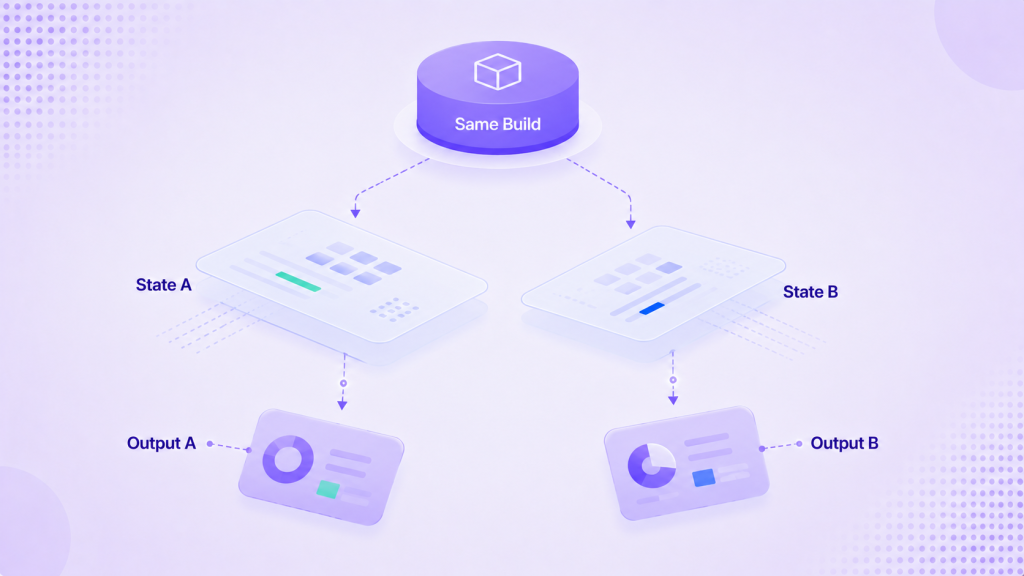
A pipeline can be byte-for-byte reproducible and still produce an answer nobody can recreate three months later. The reason sits outside the build entirely: the production data state changed after the build shipped.
Operating control vs CI/CD for ML: what each one binds
The cleanest way to see the split is to ask what each layer binds to a run. CI/CD binds code and artifacts. Operating control binds the data state and the execution conditions. You want both, because a production result depends on both.
Read the table as a division of labor, not a contest. CI/CD owns shipping. Operating control owns the run. The Partial marks are where the two overlap: CI/CD versions the pipeline that transforms data, and operating control records enough to rebuild an answer, but neither covers the other’s core job.
How the two fit together in one flow
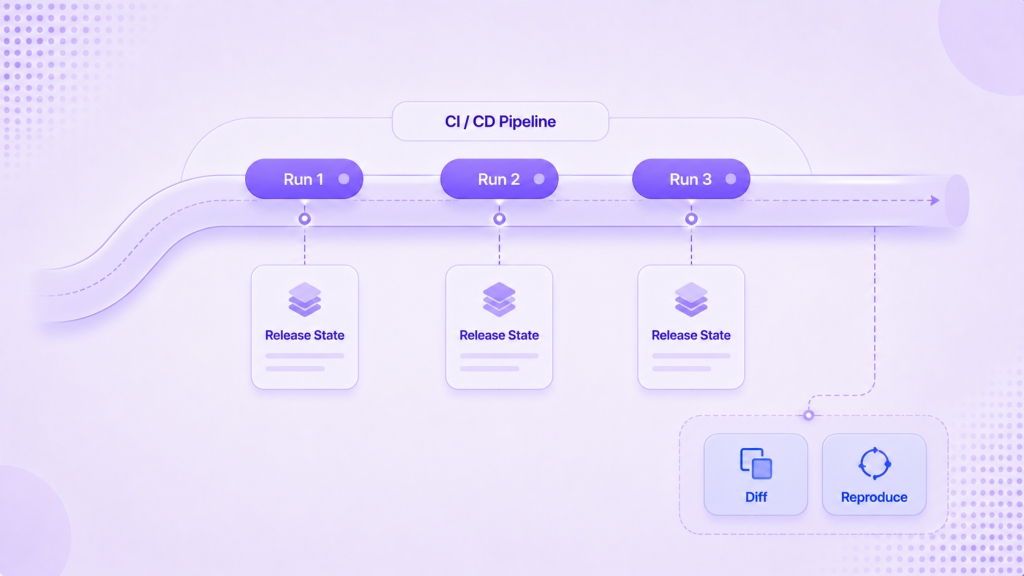
Operating control is not a replacement for your ML CI/CD; it runs inside it. Keep CI/CD for build and deploy, then add a step that binds each production run to a Release State: a captured, addressable record of the data state and execution conditions behind that run.
With both in place you can make two statements instead of one. CI/CD lets you say “this commit produced this deployment.” Operating control lets you add “this deployment, on this data state, produced this result,” and then Diff that state against another run or Reproduce it on demand. Together they cover both halves of reproducibility, the code half and the data half. The code half already has a working standard: the Reproducible Builds project counts a build as trustworthy only when a deterministic process and a documented environment let an independent party rebuild the artifact and match the output. A bound Release State brings that same bar of independent verification to the data half.
This is where the six readiness axes come in. Before a run is worth binding, the data behind it has to be operable, so Syntitan scores enterprise data on Usability, Integrity, Context, Consistency, Reproducibility, and Traceability, then rebuilds what blocks execution. Once the state is sound, every run binds to it.
A quick self-diagnostic
Run this test against your own stack. Google’s ML Test Score takes the long route, 28 tests for production readiness that weigh data and infrastructure as heavily as the model itself; the short list below covers the data-state half. If you answer “no” to more than one of these, your CI/CD is doing its job and your data state is still unbound.
- Can you name the exact data window a production run read, not just the commit it ran?
- If a source schema changed last month, would your pipeline logs show it, or would the build still read green?
- Can you Diff two runs by their data state and see what moved?
- Given a result from six months ago, can you Reproduce it, or only rebuild the deployment?
- When an auditor asks “why this output,” do you have the state, or only the code?
Where it fits
For production AI the question is not only which model ran; it is which data state and execution conditions produced the result. That is the layer operating control lives in, and it sits beneath your CI/CD rather than beside it. The Release State it binds is the same unit that diffing a data state works on, and model versioning alone leaves the same gap CI/CD does.
Syntitan, CUBIG’s AI-Ready Data Platform, is where this runs. It scores enterprise data on the six axes above, rebuilds what blocks execution, and binds every AI or agent run to a data state you can diff and reproduce, so a green pipeline and a reproducible answer finally mean the same thing. For the broader picture, see what AI-ready data means.
Try it on your data for free. Run a sample proof and see it on your own workflow.