
A diff on data state is a field-level, structural comparison between two Verifiable Data States that shows exactly what changed in the data an AI run consumed: which columns appeared or disappeared, which distributions shifted, which categories were remapped, and which preprocessing rules moved.
Most production AI teams can compare code and model artifacts, but they still struggle to compare the data state behind two runs. TensorFlow Data Validation shows why schema changes, skew, and drift need systematic checks, and data versioning tools such as DVC make the dataset itself part of the execution record.
A diff on data state brings those ideas together for AI operations: it turns “the data drifted” into a specific list of field, distribution, encoding, preprocessing, and lineage changes. Reproducible builds set the same bar for software, an independently verifiable path from source to binary, and it matters here for exactly the same reason: without a reproducible data state, teams cannot explain why one run worked and the next one failed.
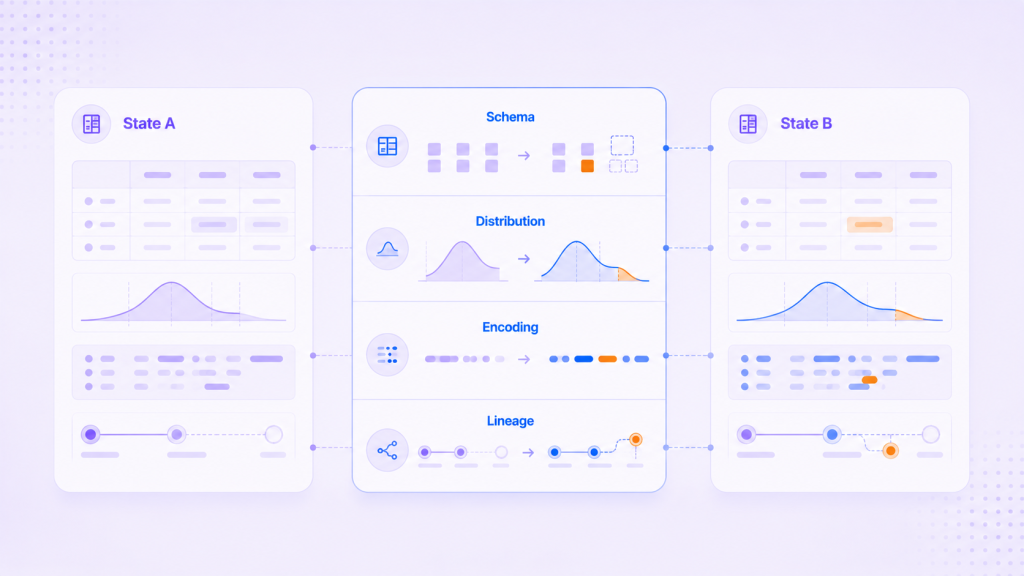
What a diff on data state actually compares
Code diffs work on text. A diff on data state works on the meaning and shape of data, so it compares things a line-by-line text tool would miss. When two states go in, the diff reports differences across a small set of concrete dimensions.
– Schema: columns added, dropped, renamed, or retyped; nullability and key changes.
– Distribution: shifts in mean, variance, and category frequency for the fields a model depends on.
– Encoding and preprocessing: changes to normalization ranges, category-to-index maps, tokenizer settings, and fill rules.
– Lineage: the upstream source or join that produced each field, so a change traces back to where it entered.
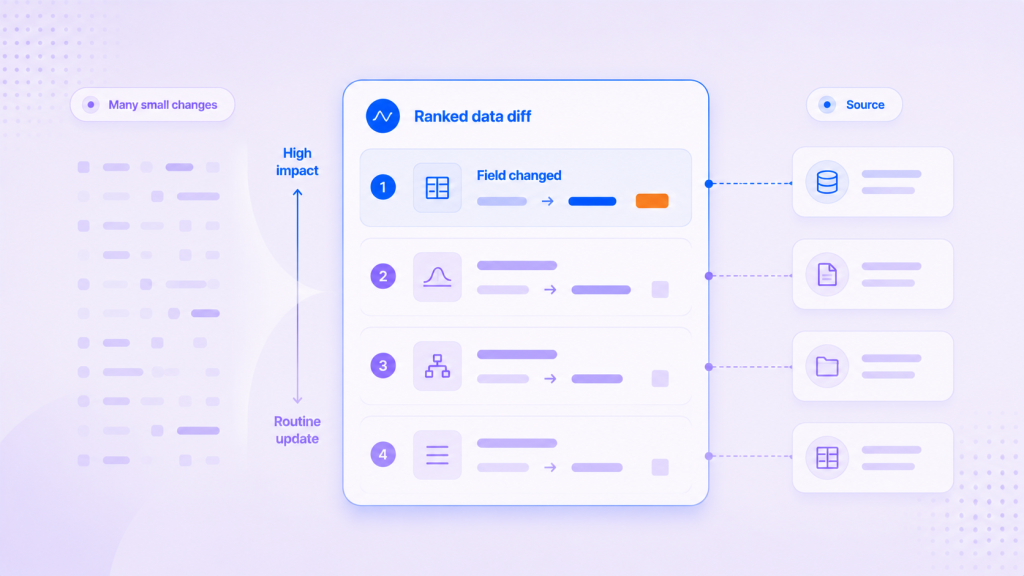
The point is not to flag every byte that moved. Reference tables update constantly, and that is normal. The point is to surface the changes that alter what a model or agent learns from or acts on, and to leave the rest quiet so reviewers are not buried in noise.
Why a data diff matters more than a model diff
When an AI system regresses, most teams reach for the model first. They compare weights, check the prompt, and re-read the config. That instinct is understandable, and it is often the wrong starting point, because the model artifact frequently did not change at all. The pipeline feeding it did.
Consider a churn model that held steady for months and then started missing obvious cases. The weights were byte-identical to the last good release. Upstream, a billing system had split one status field into two and backfilled the old column with a default, so a feature the model leaned on went flat. A model comparison shows nothing. A diff on data state shows the split, the backfill, and the collapsed distribution in one view. This is why data versioning matters as much as model versioning, and why comparing models alone leaves you looking in the wrong place.
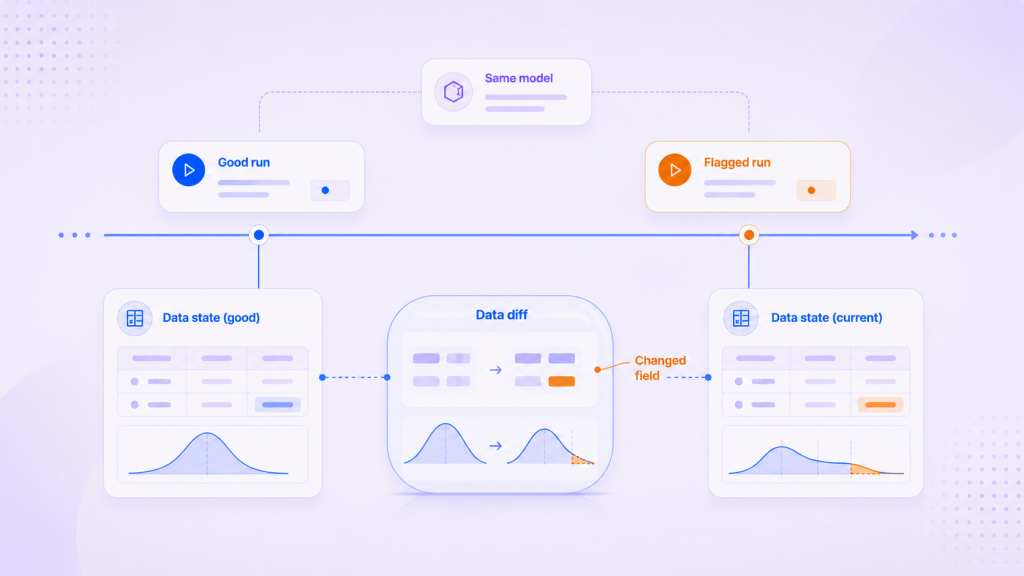
Data diff versus code diff versus model comparison
These three comparisons answer different questions, and teams get into trouble when they use one to answer another. A quick side by side makes the boundaries clear.
| Comparison | Operates on | Answers | Catches data-state change? |
|---|---|---|---|
| Code diff | Source text, config files | What did an engineer edit? | No |
| Model comparison | Weights, hyperparameters | Did the trained artifact change? | No |
| Data diff | Schema, distributions, encodings, lineage | What changed in the data a run used? | Yes |
Code and model comparisons are useful, and you still want them. But when the code is unchanged and the weights match, the difference that explains a behavior change lives in the data state, and only a data diff surfaces it.
How the diff runs against a Verifiable Data State
A diff is only as trustworthy as the two states it compares. If either side is a loose “the data as of roughly last week,” the comparison is guesswork. That is why the diff operates against a Verifiable Data State: a captured, addressable record of the data an AI run consumed, including schema, distribution summaries, and preprocessing rules.
Because each AI or agent run is bound to the exact state it used, you can name two runs and ask for the difference between the data behind them. The diff then walks both states, aligns fields by lineage rather than by position, and reports the meaningful changes. The output is not a wall of raw rows; it is a scoped, reviewable summary an engineer or auditor can act on, which is the kind of documented, traceable record the NIST AI Risk Management Framework asks AI systems to keep. Naming the two states you compare is a form of run binding, which is what makes the whole comparison reproducible instead of anecdotal.
Reading a diff without drowning in noise
A good diff ranks changes by how much they can move a model’s behavior, not by how many cells moved. This quick diagnostic tells you whether your pipeline is set up to answer the question at all.
– Can you name the exact data state behind any past AI run, not just the model version?
– When two runs disagree, can you produce a field-level diff of the data between them in minutes?
– Does the diff separate high-impact changes, such as a dropped feature, from routine reference updates
– Can a non-author, such as an auditor, read the diff and understand what changed without reading pipeline code?
– Does each changed field trace back through lineage to the source that produced it?
If you answered no to two or more, a regression today would send your team to the model when the real change is in the data, and the search would take days instead of minutes.
Where a diff on data state fits
For production AI the question is not only which model ran but which data state and execution conditions produced the result. Syntitan, CUBIG’s AI-Ready Data Platform, scores enterprise data on six axes, Usability, Integrity, Context, Consistency, Reproducibility, and Traceability, rebuilds what blocks execution, and binds every AI or agent run to a data state you can diff and reproduce.
The diff is the readable surface of that binding: it is how a team moves from “the model got worse, we think the data changed” to a specific list of what moved, ranked by impact, traceable to source.
That capability sits inside a broader picture of AI-ready data, and it pairs closely with how a Release State captures a data state and how Run Binding ties each run to one. If you are still comparing only artifacts, start with why model versioning is not enough, then see how a diff feeds directly into reproducing an AI incident.
Try it on your data for free. Run a sample proof and see it on your own workflow.