
AI governance frameworks define what an organization is allowed and required to do with AI; operating control is the run-level layer that produces the executable evidence proving a specific result met those rules. Policy and proof sit on different layers, and an audit needs both.
This is the comparison most often miscast as overlap, because both a framework and an operating layer touch words like “governance,” “traceability,” and “trust.” The policy side has never been better codified: ISO/IEC 42001, the first management system standard written for AI, spans lifecycle management, risk and impact assessment, and oversight of suppliers. A framework can name the requirement. It cannot, by itself, satisfy it on the data that a given run actually used. That gap is where most governance programs quietly stall.
What AI governance frameworks do well
Frameworks set the rules. They include internal AI policies, risk taxonomies, and external standards such as the NIST AI Risk Management Framework or the obligations written into the EU AI Act. Forty-seven governments have adhered to the OECD AI Principles, which name transparency, accountability, and robustness, security and safety among their commitments. A good framework tells the organization which use cases are permitted, what documentation each system must carry, and what reproducibility, oversight, and traceability have to exist before a model goes to production.
That alignment is genuinely valuable. It gives legal, risk, and engineering a shared definition of responsible AI, and it turns “be careful with AI” into named obligations that a review board can check against. The NIST framework, for instance, calls for AI systems to be documented, traceable, and auditable. Nobody serious argues the policy layer is optional.
Where the gap opens
The trouble starts at the word “traceable.” Article 12 of the EU AI Act goes as far as text can, obliging high-risk systems to log events automatically across their lifetime so outcomes remain traceable. A framework can restate that duty, yet neither the statute nor the framework holds a mechanism to make any single result reproducible. Between the written policy and an actual audit sits a concrete, unglamorous question: for this specific output, can you show which data state produced it, what changed since the last known-good run, and can you restore that state to inspect it?
If the honest answer is “we’d reconstruct it from scattered logs, notebooks, and a snapshot someone hopefully kept,” the policy is aspirational. The requirement exists on paper; the evidence does not exist at run time. Auditors and regulators increasingly ask for the second thing, not the first, and a binder full of principles does not survive that request.
Operating control: policy turned into evidence
Operating control is the layer that answers the run-level question. It binds each AI or agent run to a Verifiable Data State, keeps an operating record of which data produced which result, and lets you diff two states and reproduce either one. Where a framework says “results must be reproducible,” operating control is the mechanism that makes a named result reproducible on demand.
Concretely, that means three owned capabilities. A Release State captures the exact data conditions a run depended on. Run Binding ties the run to that state so the link is not a guess later. Diff and Reproduce let a reviewer replay the state, compare it against another, and see precisely what moved. The framework’s Traceability requirement stops being a promise and becomes something you can hand over.
Are AI governance frameworks and operating control competing?
No, and treating them as rivals is the mistake. They are complementary layers of the same program. The framework decides the rule; operating control supplies the proof for each run that the rule was met. One without the other fails in a predictable way: policy without evidence is unenforceable, and evidence without policy has nothing to prove against.
The clearest way to see the split is to line up who owns each responsibility.
Governance defines the rules. Operating control makes a specific AI result reproducible against the exact data state it used.
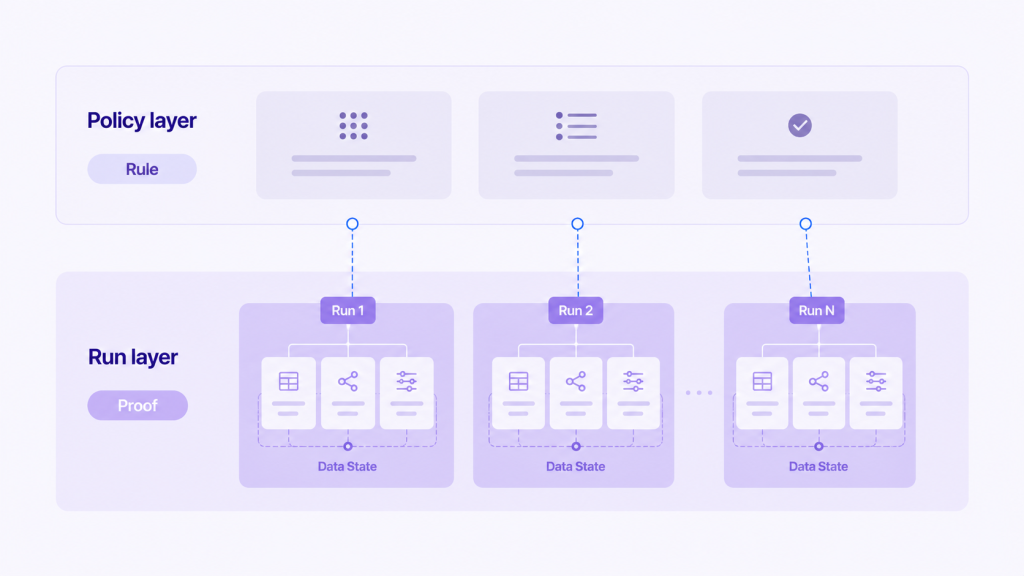
A quick self-diagnostic
Run your own program through this short test. If you cannot answer several of these with a live artifact rather than a policy sentence, your framework is ahead of your evidence.
- Pick a production AI output from last quarter. Can you name the exact data state that produced it?
- Can you diff that state against the current one and see what changed, without manual archaeology?
- Can you restore the earlier state and re-run to inspect the result?
- When your framework says “traceable,” is there a run-level record that satisfies it, or only the requirement?
- If an auditor asked “show me which data produced this decision,” would you answer with a reproduced state or a promise?
Where it fits in CUBIG’s operating layer
For production AI, the question is not only which model ran; it is which data state and execution conditions produced the result. Syntitan, CUBIG’s AI-Ready Data Platform, scores enterprise data on six readiness axes (Usability, Integrity, Context, Consistency, Reproducibility, and Traceability), rebuilds what blocks execution, and binds every AI or agent run to a data state you can diff and reproduce.
That is the operating layer beneath your governance framework. The framework names Reproducibility and Traceability as goals; Run Binding and the Traceability axis are how they become real at the moment a run happens. You keep your policy where it belongs, in risk and legal, and you gain the evidence that lets the policy stand up under review. For a deeper treatment of the run-level mechanics, see what Run Binding is and how to reproduce an AI incident.
This article compares the concepts; for the same distinction drawn at the product level, with CUBIG’s operating layer set beside AI governance platforms, see CUBIG’s operating layer vs. AI governance platforms.
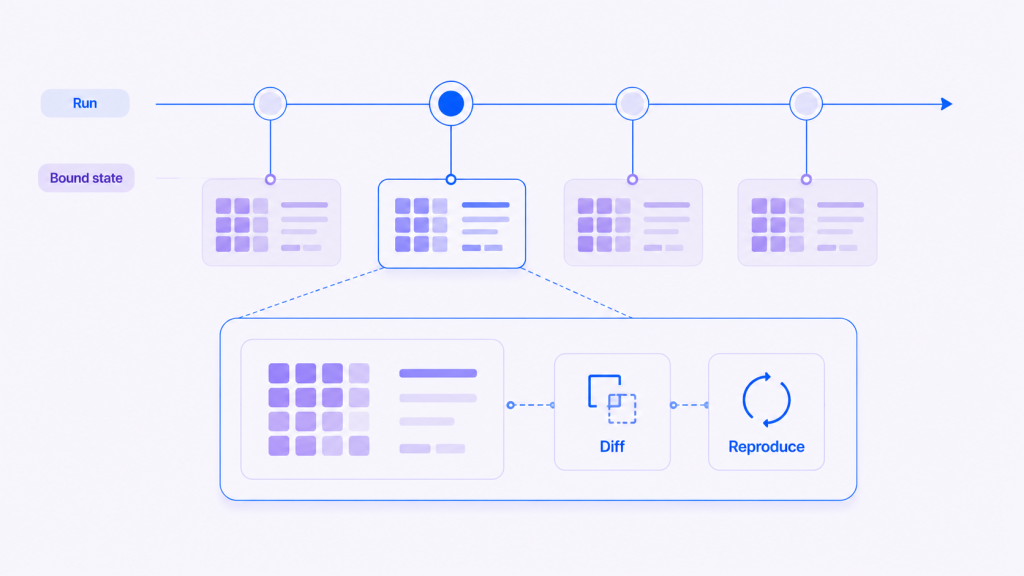
How to adopt both together
Start from the framework you already have, because it names your obligations. Then, for each requirement that uses the words “reproducible,” “traceable,” or “auditable,” ask what run-level artifact would satisfy an outside reviewer. Wire operating control to produce exactly that artifact, and the requirement moves from aspiration to something you can demonstrate on a Tuesday afternoon when the request arrives.
Teams that do this in the wrong order tend to buy more policy and more dashboards, then discover at audit time that neither can restore a past state. The order that works is: keep the policy, add the proof. Performance and coverage here are representative until you reproduce them on your own data, which is exactly the point, because the reproduction is the evidence.
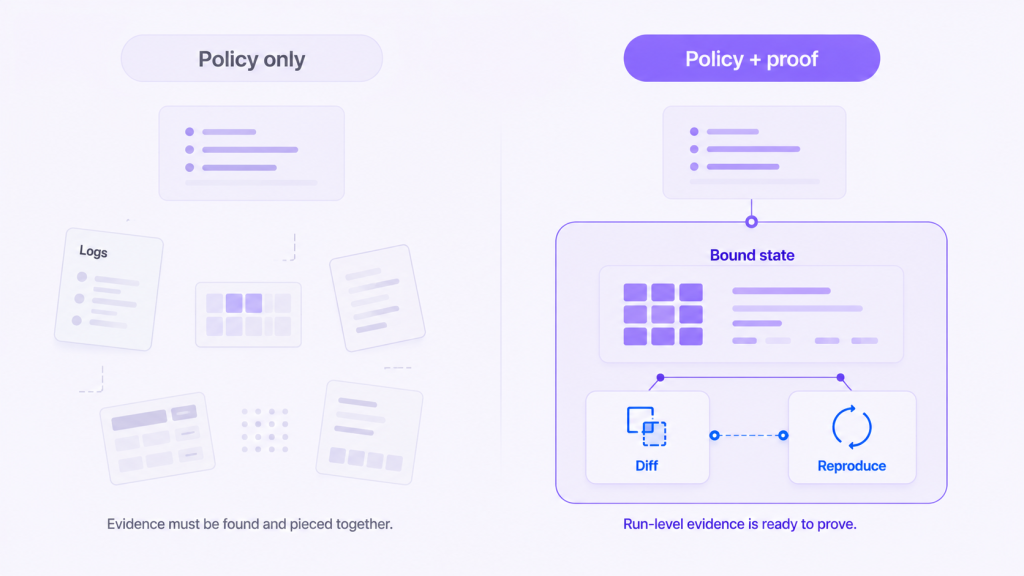
For a worked example of what that proof looks like when a decision is later challenged, see how an audit trail for AI decisions in the public sector lets a reviewer restore the exact data state and execution conditions behind a past decision.
Try it on your data for free. Run a sample proof and see it on your own workflow.