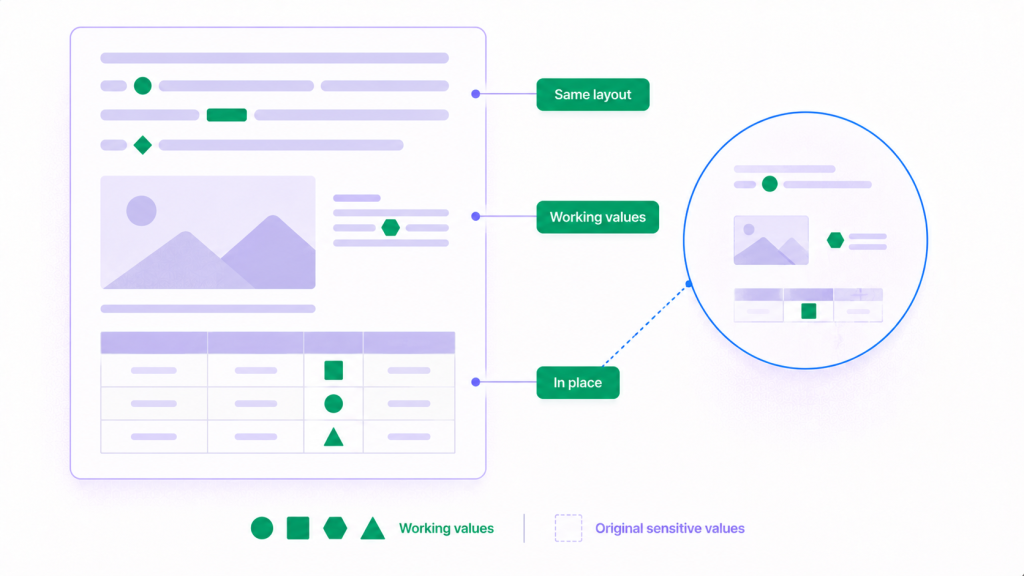
A multimodal AI data boundary is a structure-preserving data boundary for inputs that mix more than one format in the same document (typed text, images, scanned PDFs, and tables), substituting the sensitive values inside each part while keeping the document whole, so an AI model can read across all of it at once and you can reconstruct the originals in place when the result returns.
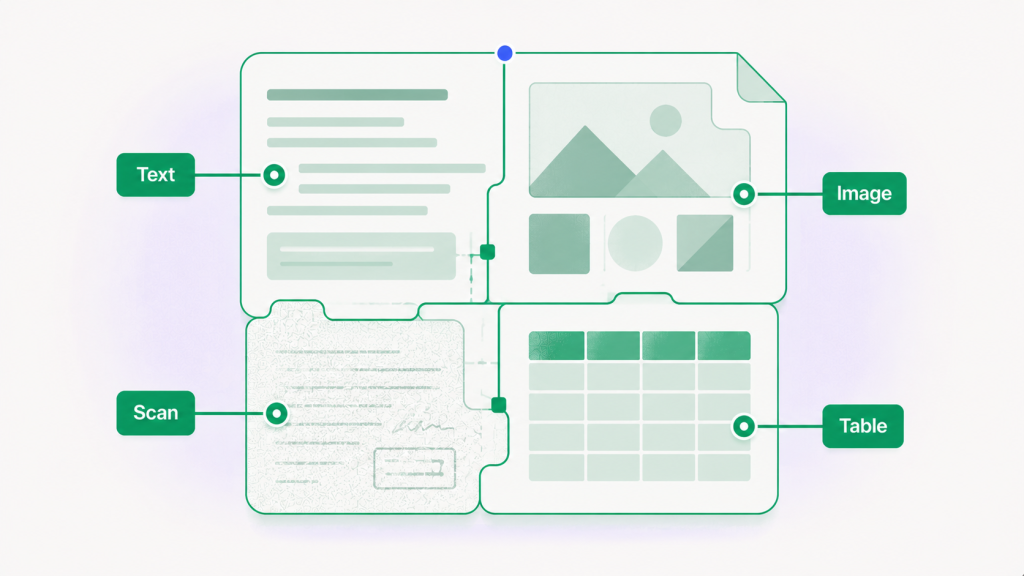
Enterprises are not short on ambition for multimodal AI; they are short on data their models can actually touch. NIST’s Generative AI Profile names data privacy and information security among twelve risks it treats as unique to or amplified by generative AI, and mixed-format documents concentrate both risks in one document. Reading such a document at all takes multimodal models: Microsoft’s LayoutLMv3 works by modeling text and image together, the unified view a format-by-format pipeline breaks apart. And converting formats to plain text is lossy in its own right: the Donut researchers note OCR errors propagate downstream into every step that follows. A single claim file might hold typed notes, a scanned form, a photo of a damaged part, and a spreadsheet of line items, with confidential values scattered across every one of them.
Why single-format inputs are the easy case
Plain text is the case everyone solves first. You find the sensitive spans, swap them for substitutes, run the model, then restore the originals. It works because text is one-dimensional: a sentence is a line of tokens, and a span has a clear start and end.
The trouble starts the moment the input stops being a tidy paragraph. An image has no spans in that sense; sensitive text lives in pixels, positioned somewhere on a page. A scanned PDF is an image wearing the costume of a document. A table carries meaning in its grid, where the link between a cell and its header is part of the content, a point we cover in document layout preservation. Each format hides confidential data in a different place, and each one breaks in a different way when you handle it carelessly.
Why splitting the document apart backfires
The tempting shortcut is to pull each format out, process it on its own, and reassemble the pieces afterward. It rarely holds up, because the meaning often lives in the seam between the parts rather than inside any one of them.
The damage photo only makes sense next to the claim note that references it. The signature image matters because of the contract clause sitting directly above it. Separate the pieces and you lose the relationships that made the document worth analyzing in the first place. A model reading the photo alone, with no idea which claim it belongs to, is doing a weaker and different job. So the boundary has to hold the document together on its way to the model, not quietly take it apart.
What a multimodal AI data boundary does
A multimodal AI data boundary applies one principle across every format at the same time. It follows a Substitute, Execute, Reconstruct pattern: sensitive values are substituted wherever they live (in the body text, inside the image, on the scanned page, within the table), the model executes on the whole coherent document, and the original values are reconstructed in place when the result comes back inside your environment. The arrangement that ties the parts together never leaves.
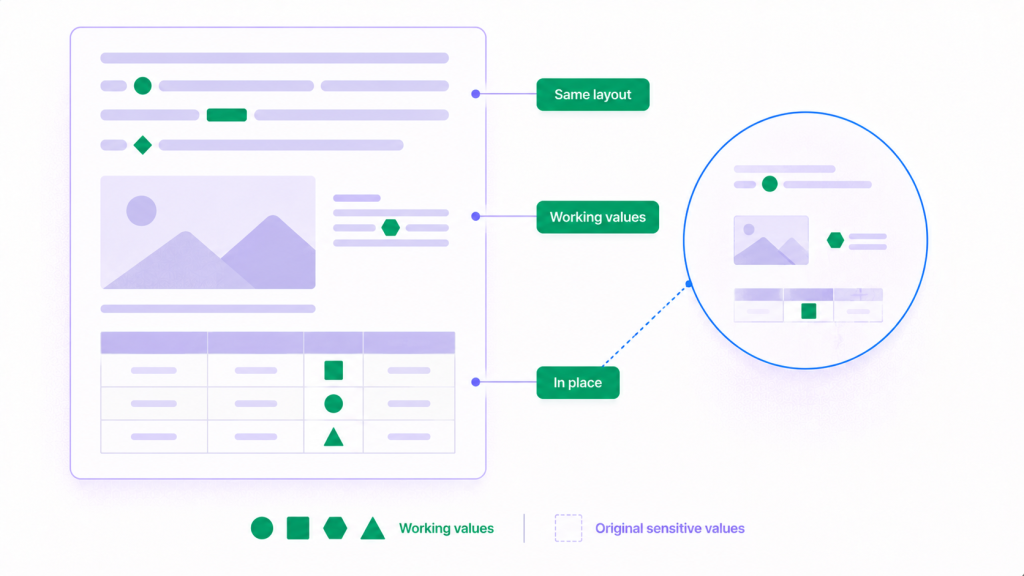
Because the substitution is consistent, the model receives a document that still reads as one thing. The note still points at the right photo, the clause still sits above the right signature, and the table rows still line up under their headers. Sensitive text baked into an image gets the same treatment as text in the body, which is its own subject in visual sensitive data. That consistency is the whole point: a boundary that protects the typed paragraph but leaks the scanned page next to it is not a boundary, it is a gap with good intentions.
How it differs from plain masking
Plain masking answers a narrower question. It blacks out or redacts sensitive characters and hands the model a document with holes in it, and it usually treats each format in isolation. The redacted output is safer to store, but it is also worse to work with: the model loses the very values it needed to reason, and the cross-format links dissolve because each part was handled on its own track.
A multimodal AI data boundary is built for enablement instead of redaction. It sends the model the structure of the work rather than the raw confidential values, keeps every part connected, then rebuilds the originals locally once the answer returns. The comparison below sets the two side by side.
How to tell if your inputs need a multimodal boundary
Not every workflow needs this. If your data is uniform text, a simpler approach is fine. Run this quick self-check against a representative sample of the documents your teams actually send to AI:
- Does a single file routinely combine typed text with images, scanned pages, or tables?
- Does confidential data appear inside images or scanned PDFs, not only in editable text?
- Would the analysis lose meaning if you split the file into separate pieces?
- Do you need the original values back, in place, after the model runs, rather than a permanently redacted copy?
- Must the confidential values stay inside your environment while the work still gets done?
Two or more yes answers is a strong signal that per-format masking will leave gaps, and that a boundary spanning all formats at once is the fit. It also reframes what leaves your network: the concern shifts from files to LLM data egress, the substituted stream that actually crosses the line to the model.
Where it fits
The multimodal boundary is the version of sensitive AI workflow enablement you reach for once your inputs stop being clean paragraphs and start looking like the documents your teams handle every day. In practice this is delivered by a Context-Preserving Data Layer for AI, in CUBIG’s case LLM Capsule, which keeps the structure of every part intact on the way to the model and reconstructs the original values, in place, when the result returns. It runs on the CUBIG Syntitan platform, alongside the rest of the AI-ready data pipeline, so a mixed document does not force you to choose between using AI and keeping confidential values where they belong.
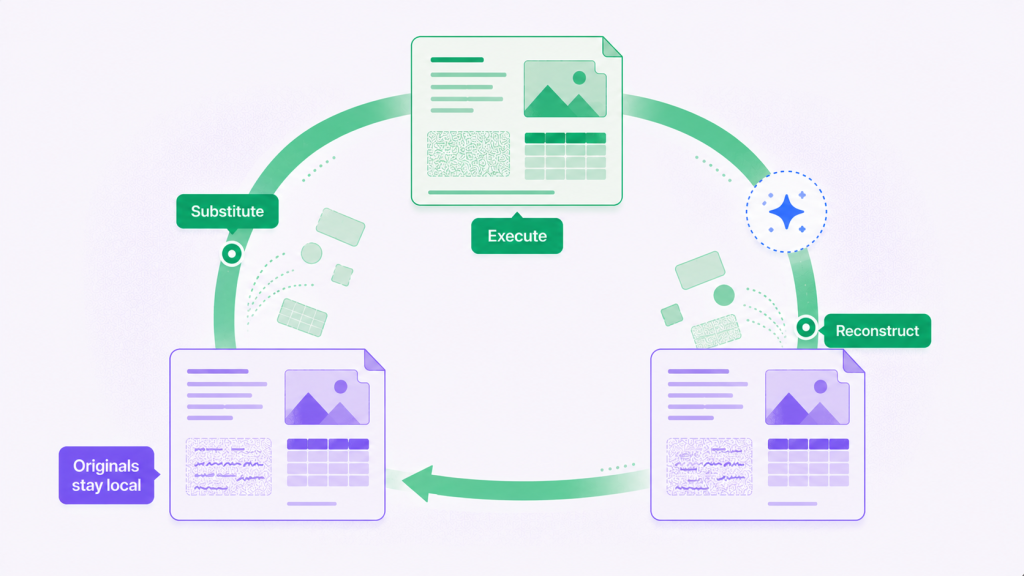
LLM Capsule holds this boundary across formats, not just text. Tables, PDFs, and images travel through as structure while the sensitive content stays inside your environment.