LLM data egress is the moment confidential data leaves your control by entering a language model’s input, which turns the prompt itself into a compliance perimeter: the AI-era counterpart of network egress, where the boundary that matters is no longer the firewall but the field you type into.
Network teams have watched egress for decades, because data leaving the network is the event you log and govern. That same logic now applies one layer up, and most enterprises have not moved their controls to match. Samsung made the gap concrete in 2023, when it temporarily banned generative AI tools on company devices after employees leaked sensitive internal data to ChatGPT, exactly the kind of crossing that happens with nobody watching.
Why the prompt became a perimeter
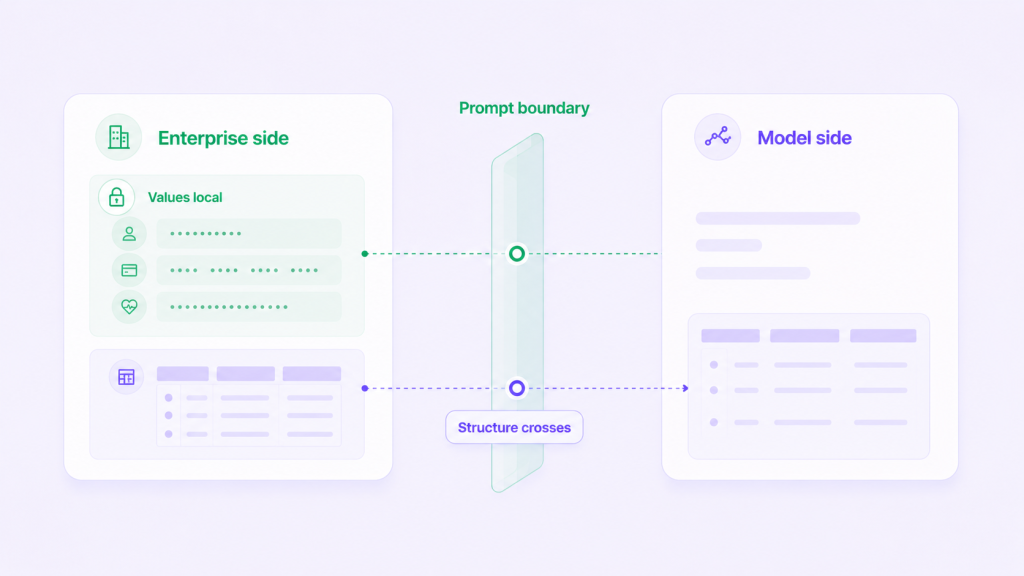
For most of enterprise history the perimeter was physical, then virtual: the building, then the network edge. AI moved it again. The models that create the most value run on infrastructure you do not own, so getting value from them means handing over the data they need to work on. That handoff is the egress event, and it happens dozens of times a day in places no one instrumented.
The hard part is that the egress is usually invisible. A reviewer pastes a renewal agreement into a chat window to summarize the obligations, or an analyst drops a quarter of internal sales figures into a model to find the outliers. Nothing alerts, no firewall rule fires, and the data is simply gone, sitting in a context window governed by someone else’s terms. The compliance event already happened, quietly, before anyone could approve it. The volume is measurable: Netskope Threat Labs found that more than a third of the sensitive data employees feed into generative AI apps is regulated data they are legally bound to protect, with source code among the most common categories exposed.
What counts as crossing the line
The trigger is not storage. It is transmission. The instant confidential values appear in a prompt, whether typed, pasted, retrieved by a RAG step, or returned by an agent’s tool call, they have crossed the perimeter. This is why the problem resists the usual controls: you can encrypt data at rest and in transit and still hand it to the model in plain language inside the request. Encryption protects the pipe, and it does nothing about what you decided to put through it.
The data that creates the most value tends to be the data you least want to send. Not only personal records, but the confidential business context that makes a task worth doing: pricing logic, contract terms, the operational numbers that describe how the company actually runs. Strip those out and the model has nothing to reason about; leave them in and you have an egress event you cannot defend. The exposure is not hypothetical: Harmonic Security measured that nearly 22% of files and 4.37% of prompts employees sent to generative AI tools in early 2025 carried sensitive content, so the prompt itself is where the crossing happens.
How to handle LLM data egress without the values crossing it
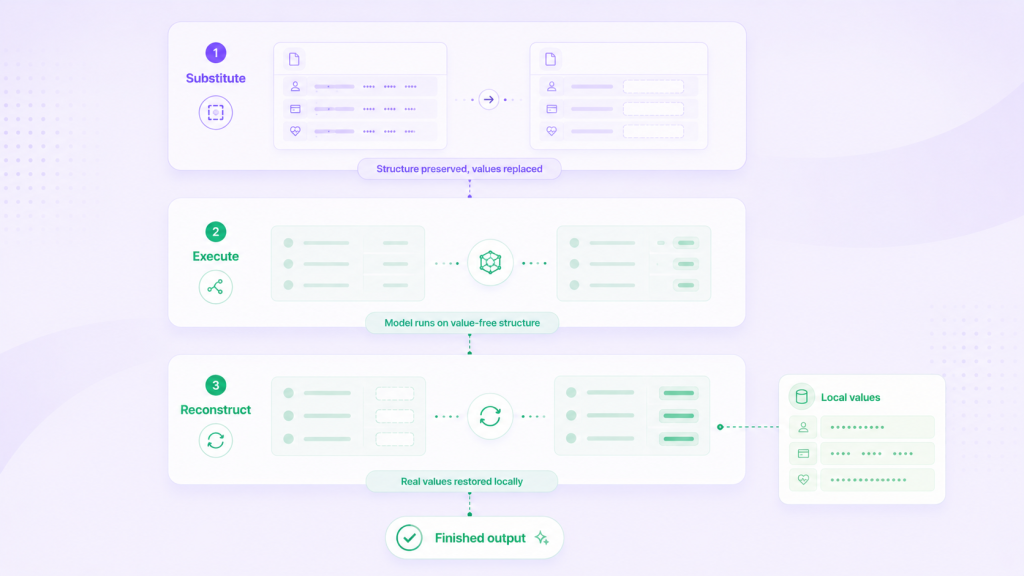
The way through is to separate two things that look like one thing. The model does not need your raw values; it needs the shape of the work, the structure and relationships and the task itself. So you send the structure across and keep the values at home. In CUBIG’s terms this is the Restorable AI Data Boundary: a checkpoint work can pass through, not a wall that blocks it.
In practice the prompt carries a structure-preserving substitution of the real document. Tables stay tables. A renewal contract stays a renewal contract, with its clauses and cross-references intact, while the counterparty name, the negotiated price, and the account numbers are stand-ins held in a protected mapping layer inside your environment. The model does real work on a faithful copy. The result comes back and the original values are restored locally, so what your team receives is a finished document rather than a placeholder. That three-part motion, Substitute, Execute, Reconstruct, is what lets the egress happen while the confidential values never join it.
How the boundary changes what you measure
Once the perimeter is a checkpoint rather than a wall, the metric changes. The old question was how much you managed to block. The better question is how many previously impossible workflows you can now run while the values that triggered the compliance event stay inside the building. That is Workflow Closure: the work actually finishes, end to end, and the finished result is an operational artifact your team uses directly.
Use this quick self-check to tell whether a workflow has an egress problem you cannot currently defend:
- Does the prompt, at any point, contain raw customer names, account numbers, or pricing that would fail an audit if logged?
- Can a reviewer paste a confidential document into a model without any approval step firing?
- Do retrieved passages from a RAG index arrive at the model with confidential values still in them?
- When an agent calls a tool, does the tool’s output flow back into the model unfiltered?
- If a regulator asked what left your environment last quarter, could you answer at the level of the prompt?
Answering yes to any of these means the boundary is real and you are already crossing it. The comparison below shows why the usual controls stop short.
Plain masking is worth singling out. It removes values, which reads as safe, but it also removes the structure the model reasons over, so the answer that comes back is weaker or wrong. Substituting instead of stripping keeps the document usable while the real values stay home.
Where it fits
Treating LLM data egress as a perimeter is the practical core of sensitive AI workflow enablement. What crosses the boundary is structure; what comes back is a reconstructed operational artifact your team can use as-is. The substitution and restoration are handled by a context-preserving data layer, in CUBIG’s case LLM Capsule, which sits between your real data and the model and runs on the CUBIG Syntitan platform. The same boundary logic extends past text: images, PDFs, and diagrams travel through a multimodal AI data boundary on the same terms. Once egress is no longer the thing blocking the project, the underlying data can become the next focus rather than the excuse.
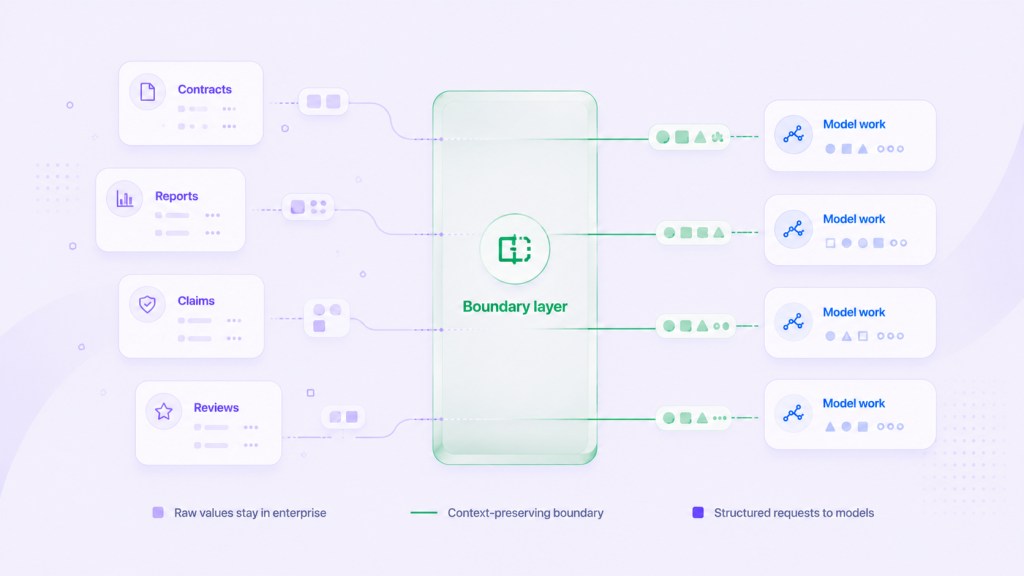
LLM Capsule is how CUBIG keeps your raw values out of the egress event. It substitutes the confidential fields before the prompt leaves and restores them inside your environment, so what crosses the boundary is structure, not data.