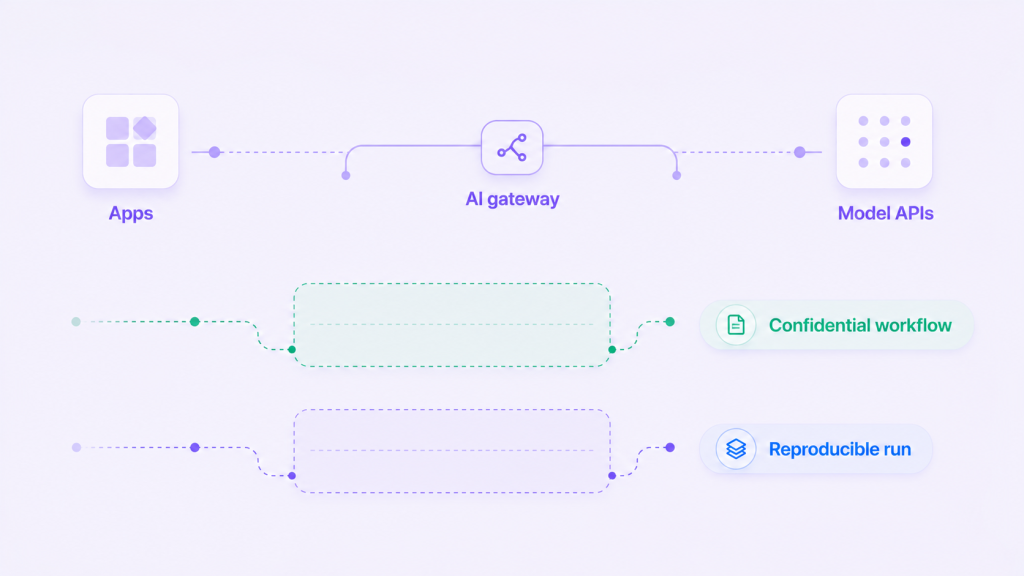
An AI gateway routes, meters, and logs the traffic between your applications and large language models, but it does not make the confidential data inside that traffic safe to send, nor does it make the run you sent reproducible later.
Most teams reach for an AI gateway first because the pain it solves is loud: shadow usage, runaway spend, no central log of who called which model. That work matters. It also stops well short of the two problems that actually keep regulated data off of production AI. Shadow AI has become a recognized factor in breach costs, and organizations that report AI-related incidents often lack proper AI access controls. A gateway sees the request go by; it cannot fix the data state the request depended on, and it cannot let the model touch data your policy says it may never see.
What an AI gateway actually does, and where it stops
An AI gateway (some vendors call it an LLM gateway) is a control point in front of one or many model providers. It handles routing across models, rate limiting, key management, cost attribution per team, caching, and a request log for audit. If your problem is that forty engineers are each holding a personal API key and finance cannot tell what any of it costs, a gateway is the right tool and you should deploy one.
The trouble starts when people assume the gateway also makes it safe to send sensitive data, and that whatever the model returned can be defended in a review six months on. It does neither. A gateway inspects and forwards; it can redact obvious patterns with plain masking, but masking a field is not the same as letting the model do the work that field was part of. And a request log records that a call happened, not the exact data state that produced the answer. Those two gaps sit on different axes, so no single gateway feature closes both.
The two problems a gateway leaves open
Break the work into what a gateway can and cannot own. The first axis is data access: can the model do useful work on records your policy forbids you to expose, such as patient identifiers, account balances, or a live contract. Samsung showed how that axis fails in 2023, temporarily banning generative AI on company devices after employees pushed sensitive internal data into ChatGPT. The second axis is execution state: if the output is ever questioned, can you reproduce the conditions that produced it, a bar EU AI Act Article 12 now writes into law by requiring high-risk systems to record events automatically over their lifetime. A gateway touches the wire between these two axes without resolving either.
Data access: sending structure instead of raw values
When a compliance rule says a record cannot leave your boundary, redaction inside the gateway does not unlock the workflow. Strip the account numbers and the model can no longer reconcile the ledger; leave them in and you have shipped regulated values to a third party. Plain masking treats the field as noise to hide, which is why work that depends on that field stalls.
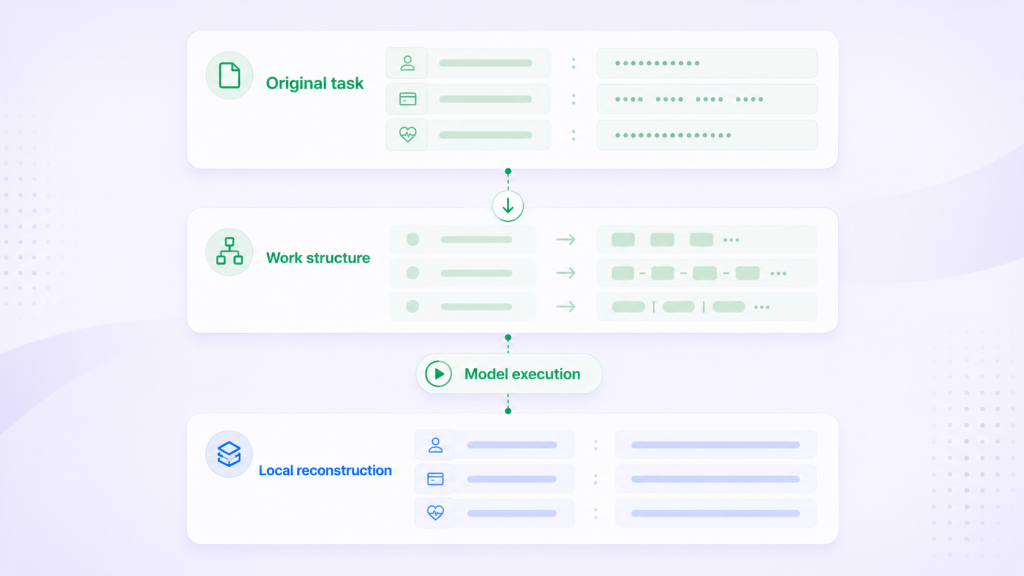
A different approach keeps the original values inside your controlled environment, sends the approved model a substituted working version of the work instead, and connects the response back to the real business values through an internal mapping that stays in your environment. In CUBIG’s case this is LLM Capsule, which lets AI work with operational data that can’t be sent as raw data, using context-preserving substitution: it detects sensitive values and applies context-preserving substitution inside your environment, sends only the substituted working version to the approved AI, checks the response, and connects the result back to real business values so the workflow actually closes. The point a gateway misses: the goal is to complete the work on confidential data, not merely to hide the data and accept that the work stops.
Execution state: what a request log cannot reproduce
Say an auditor asks in November why your model flagged a March transaction. Your gateway log shows the call, the prompt, the model version, the response. It does not show the reference table that had been half-populated that week, the preprocessing script that changed in April, or the schema migration that quietly dropped a column. Same model, different data state, and the number you defended in the board deck no longer reproduces. Performance you cannot reproduce is performance you cannot keep in a budget review.
This is the second axis, and it belongs to the data, not the wire. Syntitan, CUBIG’s AI-ready data platform, diagnoses enterprise data on six axes, Usability, Integrity, Context, Consistency, Reproducibility, and Traceability, for a specific AI task and creates a new data Version after each successful processing run, so you can see the data used at the time and compare it with the previous state. For production AI the question is not only which model ran but which data state and which execution conditions produced the result. A gateway records the first half of that sentence and none of the second.
Where the third gap sits: data that was never usable
There is a case that neither a gateway nor LLM Capsule addresses: the data you need does not exist in a form a model can learn from. Fraud labels are too rare, a clinical cohort is too small, or the only records you hold are restricted. Here the fix is to work on the data itself. DTS, CUBIG’s data preparation engine, turns locked, scarce or regulated data into AI-ready data for training, testing, evaluation and sharing: it diagnoses what is missing, then synthesizes the cases and conditions the task needs with structure-preserving synthesis, without copying restricted originals, using a non-access architecture. A gateway forwards whatever you have; it cannot manufacture the signal you never captured.
A quick self-diagnostic
Run this test before you decide a gateway is enough:
- Can your team run AI on records that policy forbids you to send to a model provider, and still complete the task?
- If an output is challenged next quarter, can you find the data state that produced it, not just the log line?
- Do you know which data state each agent run was bound to, or only that the run happened?
- When a schema or preprocessing step changes, does anything tell you the run is no longer comparable?
- Is the data you most need to model actually usable, or too rare, too small, or too restricted to train on?
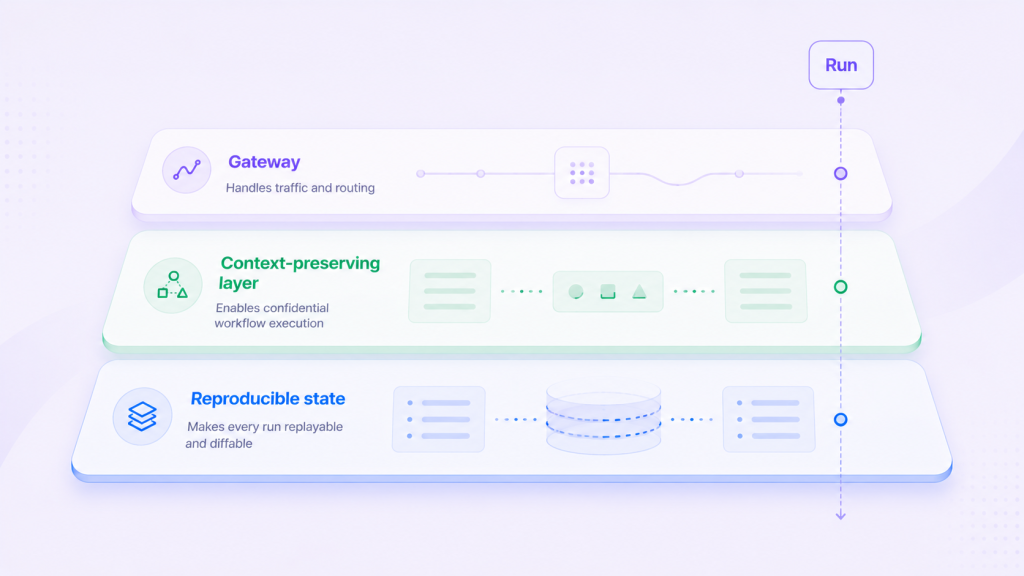
If a gateway answers the first two questions, keep it and move on. In many regulated shops it answers neither, which means the gateway is one layer and the confidential-execution and reproducibility layers are separate work.
Where it fits with CUBIG’s operating layer
Read the three tools by the question each one answers. An AI gateway governs the traffic. LLM Capsule lets AI work with operational data that can’t be sent as raw data, using context-preserving substitution.
Syntitan keeps each processed result as a new Version, so you can see the data used at the time and compare it with the previous state.
DTS turns data that was never usable into AI-ready data a model can learn on. The gateway and the operating layer are complementary: put the gateway in front for routing and cost, and use the operating layer underneath for the data the work depends on.
For the broader picture, see our primer on what AI-ready data means, the deeper treatment of sensitive AI workflow enablement, and the mechanics of LLM data egress.
Try it on your data for free. Run a sample proof and see it on your own workflow.