
Release State vs dataset snapshot comes down to one difference: a dataset snapshot is a passive copy of data at a point in time, while a Release State is a scored, run-bound reference point that lets you prove which data produced which AI result.
Both a snapshot and a Release State claim to “save the data,” so teams treat them as interchangeable until a result gets challenged. That assumption gets expensive. When Nature surveyed 1,576 researchers, more than 70% had tried and failed to reproduce another scientist’s experiment, and that was in labs built around controlled conditions. Enterprise AI teams hit the same wall with worse odds: when someone asks how a production result was produced, nobody can rebuild the conditions behind it. Storing the data and being able to tie an outcome to it are two different jobs.
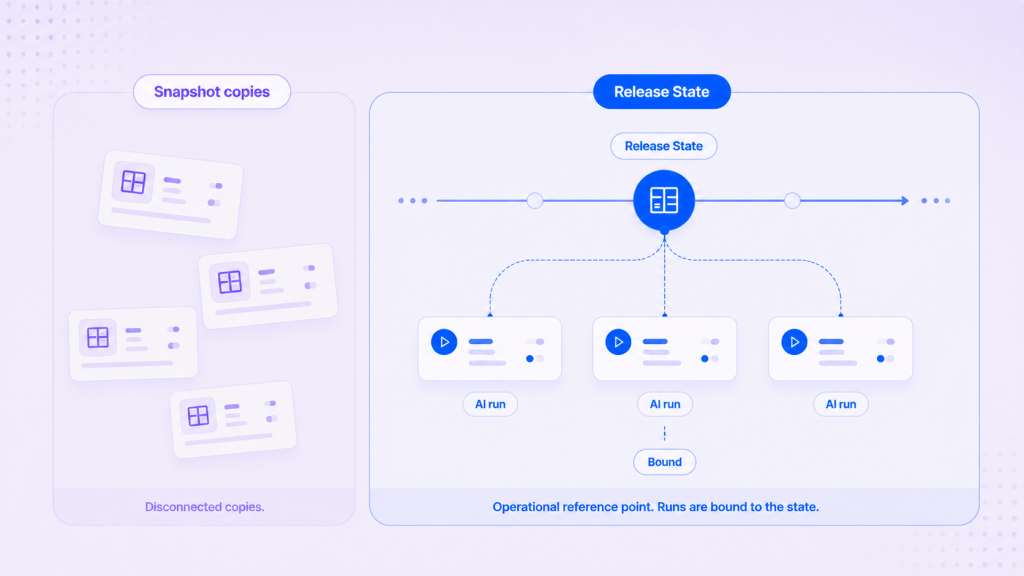
What a dataset snapshot actually is
A dataset snapshot captures data as it was at a moment in time. It is good for backup, rollback, and cheap storage, and most data platforms make snapshots trivial to take. Data versioning tools sit in the same family: they preserve bytes so you can retrieve an earlier copy.
The limit is that a snapshot is passive. It sits in a bucket, disconnected from the runs that consumed it. Nothing inside a snapshot tells you which AI run used it, under what permissions, or whether the result you are now investigating came from this snapshot or another one taken the same week. When output drifts, a pile of copies leaves you guessing, because a pile of copies is not an audit trail. This is an old warning: the NeurIPS paper on hidden technical debt in machine learning argued a decade ago that data dependencies cost more than code dependencies, precisely because nothing tracks them. “We have snapshots” is not the same claim as “we can reproduce this result.”
Teams discover this the hard way during an incident. A model output looks wrong, someone pulls the snapshots from that period, and then the questions start: which of these did the run read, was preprocessing applied before or after this copy, did the feature window include the last week of records or not? The snapshots hold the raw material, yet the one fact you need, the link from an output back to its inputs, was never captured. That missing link is why a snapshot answers “what did the data look like” but never “what produced this result.”
What a Release State adds
A Release State is the data state used as the operational reference point for AI runs, agent executions, and review. It differs from a snapshot in four ways, and each one matters precisely when something has gone wrong.
- Scored. A Release State is evaluated for readiness on six axes, so you know whether the data was fit to run on, not merely that it existed. A snapshot of unready data is still unready data.
- Bound. Through Run Binding, every run connects to the exact Release State that produced its output. That link is the entire point, and it is what a snapshot lacks.
- Diffable. Two Release States can be compared with Diff to surface what changed between a working result and a broken one, whether that is schema, time window, or preprocessing, returned as a ranked set of candidate causes.
- Restorable. You can Reproduce a prior state for inspection instead of hoping a snapshot still matches the run’s conditions.
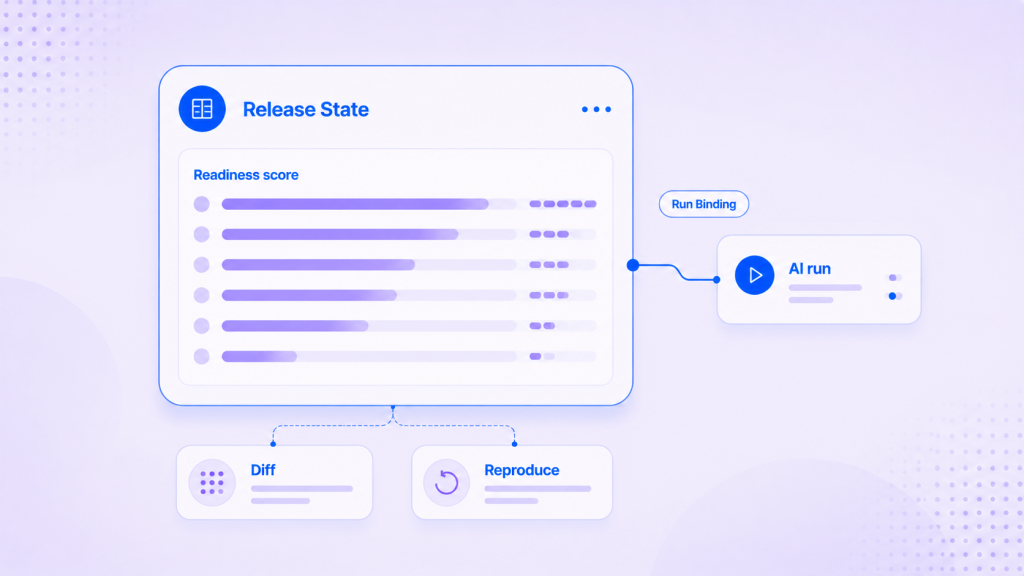
Release State vs dataset snapshot: side by side
| Dataset snapshot | Release State | |
|---|---|---|
| Nature | Passive copy at a point in time | Operational reference point |
| Bound to a run? | No | Yes, via Run Binding |
| Scored for readiness? | No | Yes, on six axes |
| Diff between two? | Manual, if at all | Built in |
| Restorable to a run’s conditions? | Partial | Yes |
| Best for | Storage and backup | Production AI reproducibility |
Why the distinction shows up under pressure
The gap is invisible on a good day and decisive on a bad one. In a regulated setting the stakes get sharper: if you cannot reproduce the exact data a result ran on, you may not be permitted to rely on that result at all. The EU AI Act’s Article 12 requires high-risk AI systems to automatically record events over their lifetime so that results stay traceable, and a passive copy sitting in cold storage does not clear that bar. A bound, restorable state does, because it answers the question an auditor actually asks: which data produced this, and can you show it to me now?
This is also where data versioning and a plain data snapshot quietly diverge in value. Versioning proves the data existed in some form; a Release State proves the run happened on a specific, ready form. When a customer disputes a credit decision or a regulator reviews a model output, the second claim is the one that holds. Banking supervisors put this expectation in writing back in 2011: the Federal Reserve’s SR 11-7 guidance on model risk management expects model outputs to be validated and monitored on an ongoing basis, which assumes you can show what a model actually ran on.
When to use which
Keep snapshots for what they do well, which is storage and backup. Reach for a Release State when the goal is production reproducibility, when you need to answer “which data produced this result, and can we restore and inspect it?” A snapshot can sit behind a Release State as raw material; the binding and the readiness score are what make the result explainable. The short version: a snapshot remembers the data, and a Release State remembers the run.
In practice the two coexist. Your storage layer keeps taking cheap snapshots on its own schedule, and that is fine. The Release State does not replace them; it sits above them, adding the score and the binding at the moment a run happens, so the copies you already keep become traceable rather than merely present. If you are choosing between the two, you are usually asking the wrong question. The real question is whether the runs on top of your data are bound to anything at all.
A quick check on your own setup
- For a past production result, can you name the exact data state it ran on, or only the day a snapshot was taken?
- Can you Diff two points in time to see what changed, or would that be a manual reconciliation across buckets?
- If an auditor asked you to reproduce a result, would you restore a bound state, or hunt through snapshots hoping one matches?
- Do you know whether the data behind a given run was ready to run on, or only that a copy of it exists somewhere?
Where it fits in an AI-ready data layer
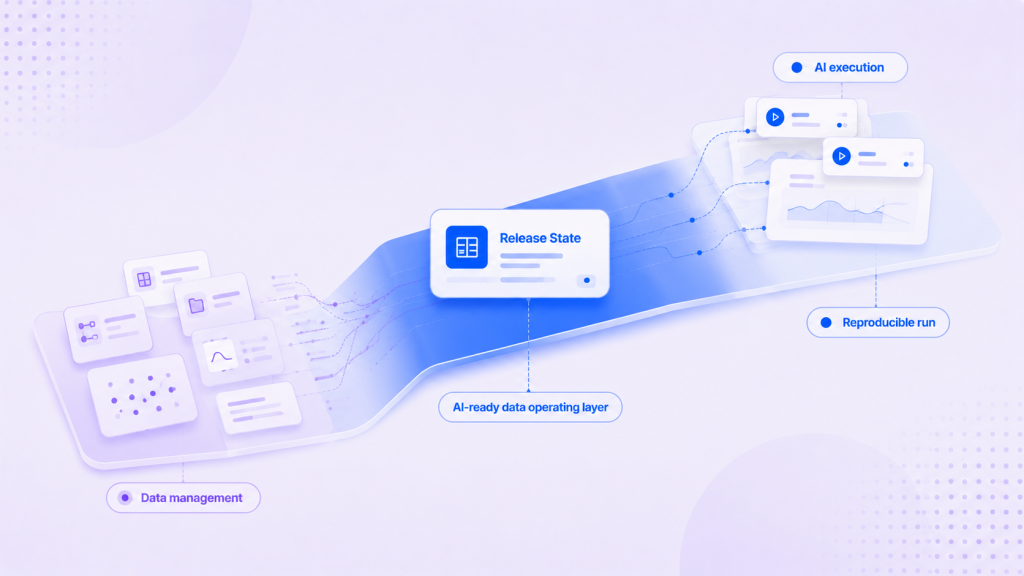
For production AI the question is not only which model ran but which data state and execution conditions produced the result. Syntitan, CUBIG’s AI-Ready Data Platform, makes the data state operational rather than passive. It scores enterprise data on six axes, Usability, Integrity, Context, Consistency, Reproducibility, and Traceability, rebuilds what blocks execution, and binds every AI or agent run to a Verifiable Data State you can Diff and Reproduce. That arc, make the data ready and keep it reproducible, is the job of the operating layer for AI-ready data, the layer that sits between data management and AI execution. Any performance figure you see is representative until you reproduce it on your own model and data.
Try it on your data for free. Run a sample proof and see it on your own workflow.
Related reading: What is Release State?, Model Versioning Is Not Enough, and How Diff Works on Data State.