
OT data reproducibility is the ability to rebuild the exact operational-technology data state, sensor calibrations, sampling rates, line configuration, and tag mappings, that produced a manufacturing AI result, so the same process outcome can be examined and reproduced later.
On the factory floor, the data a model runs on rarely sits still, and that instability is expensive. Operational technology is distinct enough that NIST maintains a dedicated guide to securing it, SP 800-82 Rev. 3, written around OT’s unique performance, reliability, and safety constraints. Manufacturing lines are among the hardest cases: sensors get recalibrated, sampling windows shift, and tag maps change after a line reconfiguration, so “the same model” quietly runs on different inputs from one week to the next.
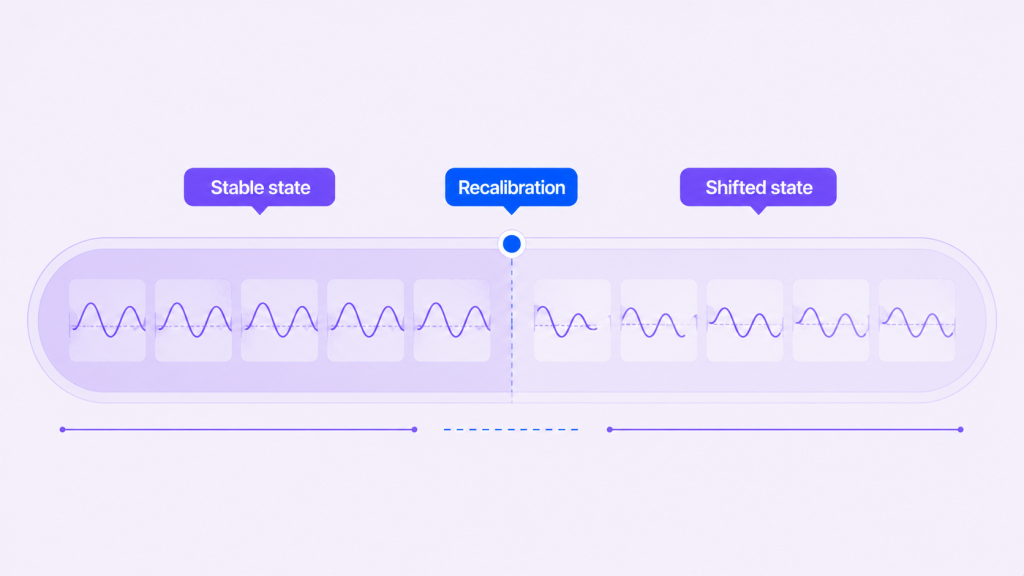
Why OT data breaks reproducibility on the plant floor
A manufacturer runs a model for quality prediction or process optimization on operational-technology data. It performs well for a while, then degrades. The model binary is unchanged, yet the results drift. A temperature sensor was recalibrated, a sampling window was shortened during a maintenance pass, or a tag was remapped after an equipment swap.
When the team tries to reproduce last month’s good result to understand the regression, they cannot. The OT data state that produced it is gone, overwritten by the live stream. This is the industrial form of the same execution-drift and schema-change patterns that undermine model reproducibility everywhere, and it is why preprocessing drift is so hard to catch on the floor: the changes are physical and easy to miss.
OT volatility is dangerous precisely because it does not raise obvious errors. A recalibration shifts a sensor’s baseline by a fraction. A sampling-rate change alters the signal’s shape without breaking the pipeline. A tag remap points the model at a different measurement while every dashboard stays green. None of this looks like a failure until the output quietly gets worse. The pattern is endemic well beyond manufacturing: in a CHI study of high-stakes AI, 92% of practitioners interviewed had experienced data cascades, compounding downstream problems triggered by upstream data issues that nobody treated as AI work.
What makes a manufacturing AI result reproducible
A model-centric view answers only which model ran. For production AI on OT data the useful question is which data state and execution conditions produced the result. When you can name and rebuild that state, a regression stops being a mystery and becomes something you can investigate.
Reproducibility on the floor rests on three things: capturing the conditions behind every run, scoring the stability of those conditions so drift is visible early, and being able to restore a past state to compare against a current one. Miss any one of them and you are back to guessing which physical change moved the output.
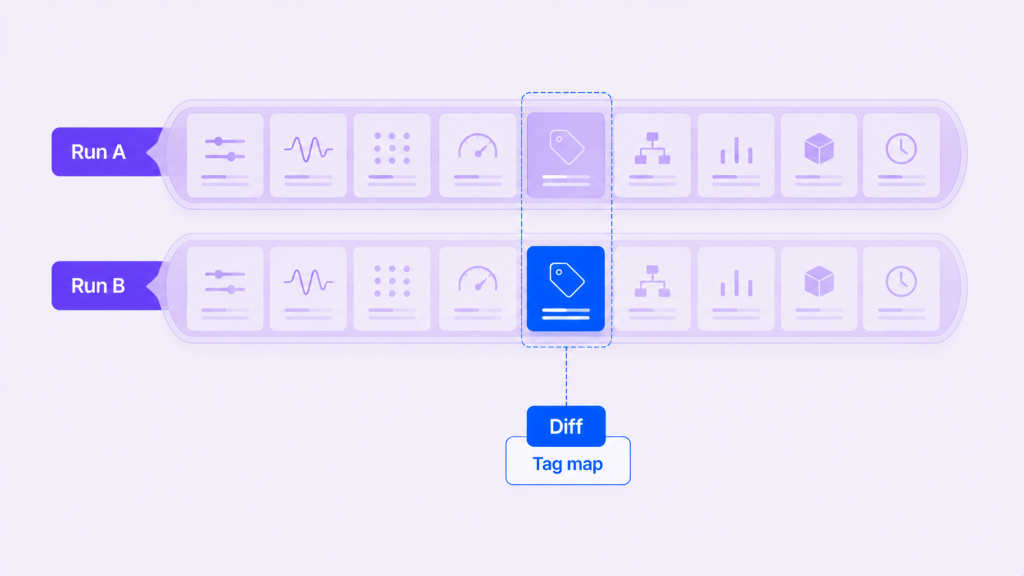
How Release State and Run Binding restore an OT data state
Binding each run to a Release State makes process results reproducible without exporting raw OT streams off-site. The plant keeps its data; the operating layer records the state and the conditions around it.
- Run Binding captures the calibration, sampling configuration, line setup, and tag mapping behind each result, so a run is tied to the exact inputs it saw.
- Reproducibility, one of the six readiness axes, keeps the stability of these conditions in view as a score you can watch trend, rather than a surprise you discover after quality drops.
- Diff pinpoints whether a recalibration or a remap explains a regression between two runs, instead of leaving the team to hunt through change logs.
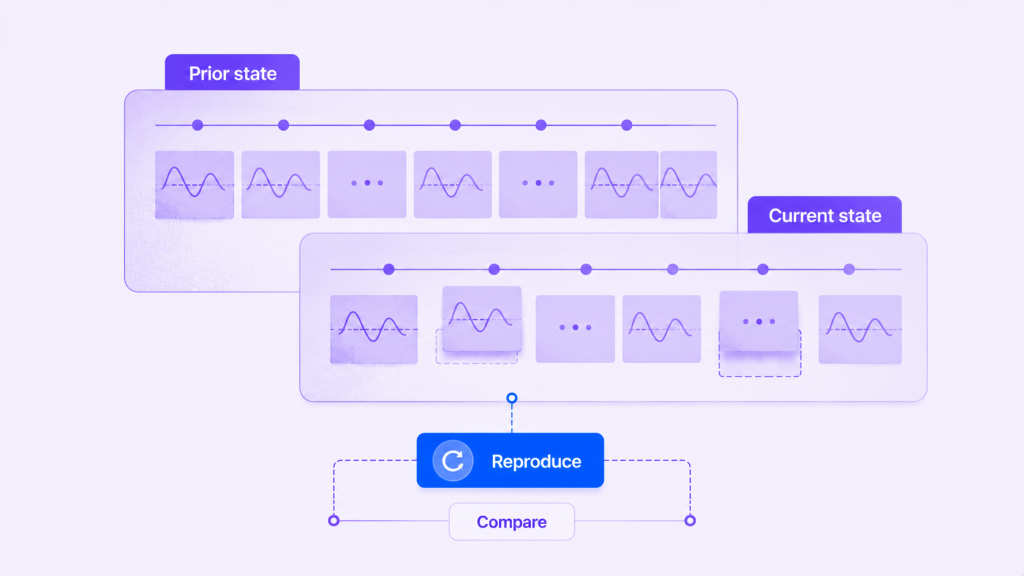
- Reproduce restores the OT data state that produced the good run, so it can be examined next to the degraded one.
For production AI the question is not only which model ran, but which data state and execution conditions produced the result. Syntitan, CUBIG’s AI-Ready Data Platform, scores enterprise data on six axes: Usability, Integrity, Context, Consistency, Reproducibility, and Traceability; it rebuilds what blocks execution, and it binds every AI or agent run to a data state you can diff and reproduce.
Release State compared with a plain data snapshot
A snapshot copies values at a point in time. A Release State records the executable conditions around a run, which is what OT reproducibility actually needs. The difference shows up the moment you try to explain a regression.
A quick self-diagnostic for your OT workflow
Run this test against one model you already trust on the line. If you cannot answer most of these in minutes, your process results are not yet reproducible.
- Can you name the exact calibration and sampling configuration behind a result from six weeks ago?
- When a sensor is recalibrated, does that event get bound to the runs it affects?
- Can you diff two runs and point to the single physical change that moved the output?
- Can you restore last month’s OT data state and rerun against it?
- Do you track a stability score for these conditions, or only notice drift after quality drops?
Where OT data reproducibility fits in CUBIG’s operating layer
This is the operating layer for AI-ready data, not a security control and not a monitoring dashboard. It sits under the model and treats the data state as a first-class, reproducible object. On the floor that means a recalibration or a remap becomes a recorded, diffable event rather than an untracked physical change that silently degrades output.
The payoff is concrete. Instead of “the model got worse on line 3,” the team can say “the temperature sensor was recalibrated on the 12th, here is the diff against the prior run, and here is that earlier state restored for comparison.” The regression turns into a process you can investigate and close, which is what separates a durable manufacturing AI program from one that erodes as the plant changes. Erosion is the default more often than teams expect: a Scientific Reports study that aged four standard model types across 32 industry datasets found temporal degradation in 91% of the combinations tested. To see how this connects to the broader foundation, start with what AI-ready data means, then read how schema changes break production AI and how AI fails after deployment.
Try it on your data for free. Run a sample proof and see it on your own workflow.