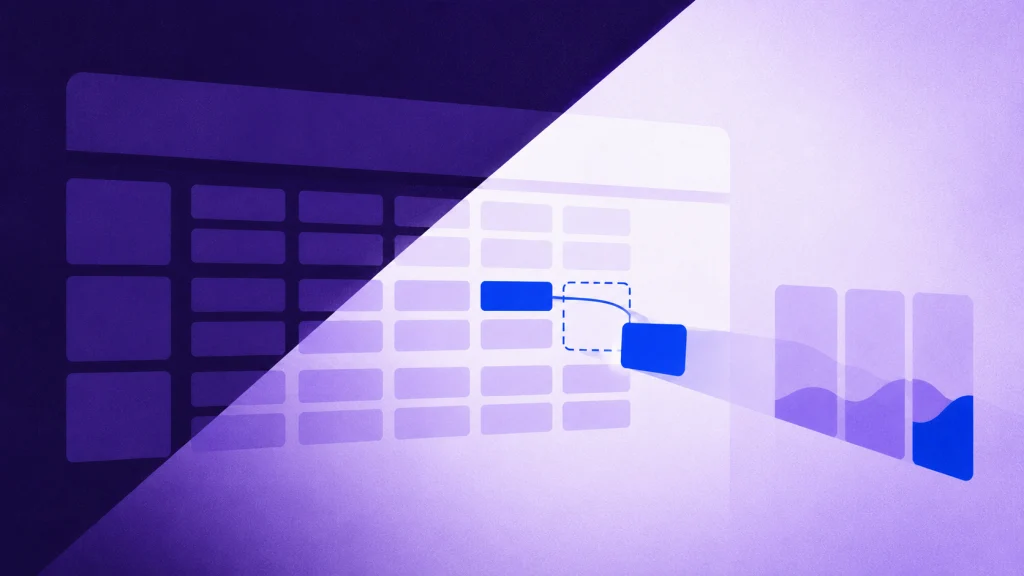
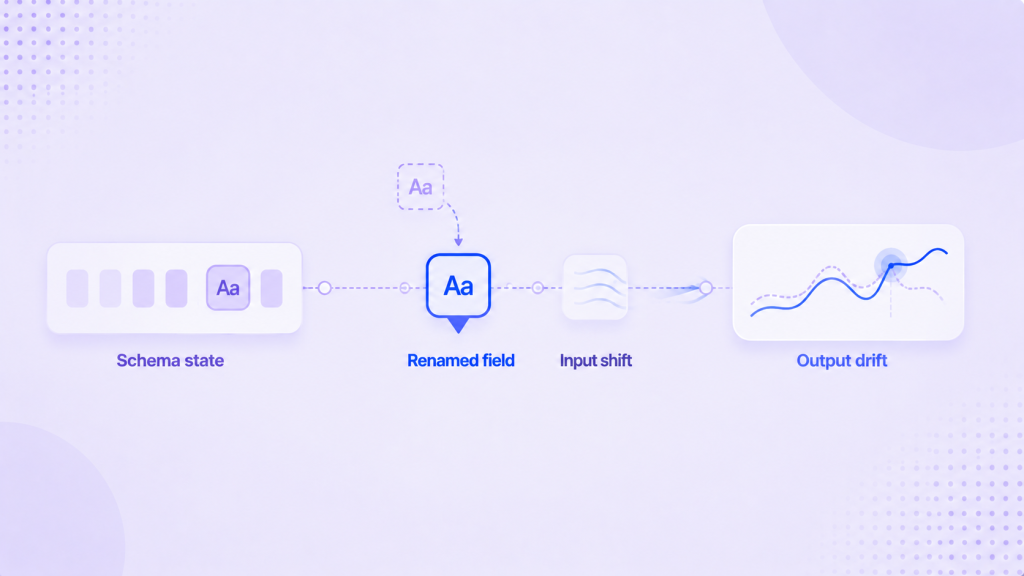
Schema changes break production AI because a renamed column, a new category, or a type shift alters what actually reaches the model, so its behavior changes while the model version stays exactly the same.
The people who make a schema change and the people who feel it sit on opposite sides of the system, which is why this is one of the most common and hardest-to-diagnose ways production AI fails. In Sambasivan and colleagues’ CHI study of high-stakes AI, 92% of practitioners had lived through a data cascade, an upstream data change compounding into downstream model failures, and a quiet schema edit is exactly the kind of event that starts one. This article explains why a schema change is effectively an AI release, why it slips past everyone, and how to make schema evolution visible instead of dangerous.
Why a schema change is really an AI release
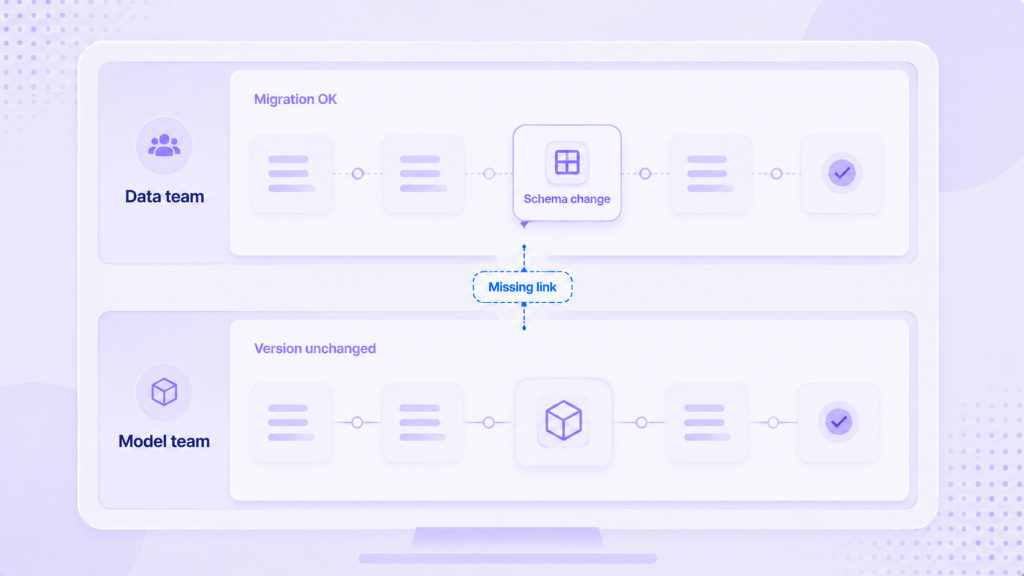
A model learns the shape of its inputs. When that shape moves, behavior moves with it, even though no one deployed a new model. The change never appears in the model registry, so from a versioning standpoint nothing happened, yet the output tells a different story.
Four edits account for most of the damage:
- A renamed field stops mapping to the feature the model expects, so a real signal silently drops to zero.
- A new category arrives that the model never saw in training, and it has no learned response for that value.
- A type or unit change, such as a number stored as text or a shifted date format, quietly alters how a value is read.
- A dropped or merged field removes signal the model relied on, or blends two distinct meanings into one column.
None of these touch the model artifact. From the output’s point of view, a release just shipped, and it shipped untested, because nothing in the workflow treated it as a change to the AI system.
Why schema changes are so hard to catch
Schema changes are routine and usually well intentioned: a cleanup, a migration, a fresh source, a column split for clarity. They pass through the data team’s process, not the model team’s, so no one evaluates them as a change to the AI system. By the time the output drifts, the edit is days old and buried in a migration log that nobody connects to the model. This is hidden technical debt in its purest form; the NeurIPS paper that named the concept priced data dependencies above code dependencies for exactly this reason.
So two teams read two correct records that disagree. The model team sees an unchanged version and starts inspecting the model, while the data team sees a successful migration and considers the work finished. Neither record says “this is why the AI changed,” and that gap is where days of debugging disappear.
What each change looks like from both sides
The same edit reads as harmless housekeeping to one team and as a behavior change to the other. Laying the two views next to each other is the fastest way to see why these events stay invisible until production moves.
| Schema change | To the data team | To the model |
|---|---|---|
| Rename a column | Cosmetic cleanup | A feature disappears |
| Add a category | More complete data | An unseen input |
| Change a type or unit | Standardization | Values read differently |
| Drop or merge a field | Simplification | Lost or blended signal |
The fix: treat the data state as versioned
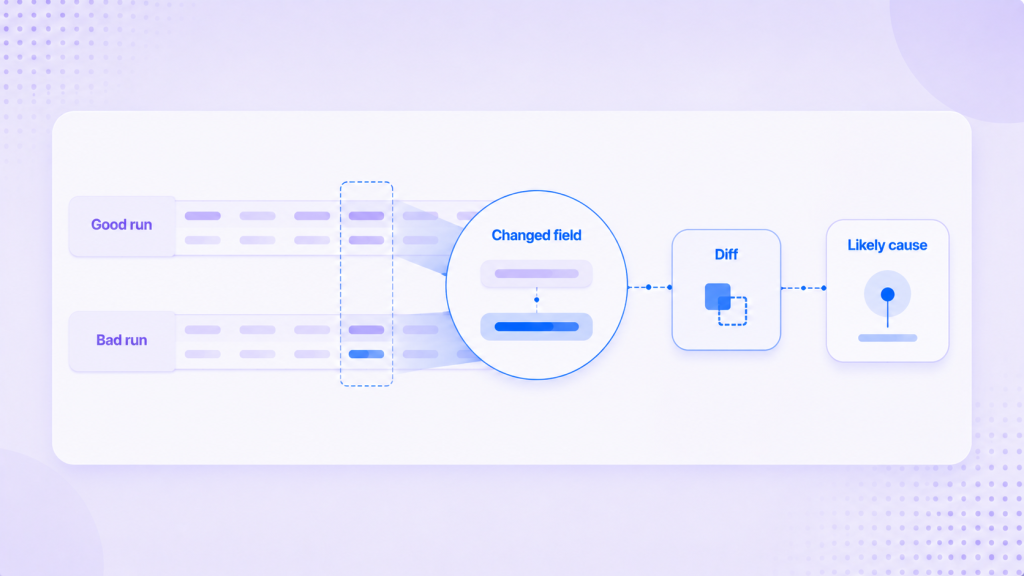
If each run binds to a fixed data state, a schema change becomes visible as a difference between states instead of an invisible event. You compare the Release State behind a good result with the one behind a bad result, and the renamed column or new category surfaces as a ranked likely cause through Diff, rather than a needle you hunt for by hand in migration logs.
Reproduce then rebuilds the earlier state so you can confirm the cause before you ship a fix. The readiness axes this preserves are Consistency, which asks whether the input shape held, and Traceability, which asks whether you can point to exactly what moved. For production AI the useful question is not only which model ran but which data state and execution conditions produced the result.
How to tell if schema changes can bite you
Run this quick self-check against your own stack. If you answer “no” or “I’m not sure” to more than one, an ordinary migration can quietly reshape your model’s behavior:
- When a model drifts, can you diff the schema between the good and bad runs, or do you read migration logs by hand?
- Do upstream schema changes notify the AI system, or only the data pipeline?
- Could you reproduce a result from before a recent migration, with the old schema intact?
- Do you know which schema version each production run was bound to?
- Does a “successful migration” ever get reviewed as a change to the model, not just to the warehouse?
Where it fits in an AI-ready data layer
Syntitan, CUBIG’s AI-Ready Data Platform, makes schema evolution safe instead of silent. It scores enterprise data on six axes, Usability, Integrity, Context, Consistency, Reproducibility, and Traceability, rebuilds what blocks execution, and binds every AI or agent run to a data state you can diff and reproduce. A schema change is then captured in the Release State and surfaced by Diff the moment behavior moves, so you get a reproducible AI-ready state rather than a mystery.
The goal is never to freeze schemas, because data has to evolve. The goal is to make a schema change with production impact as visible as any other release, which is the job of the operating layer between data management and AI execution. Any performance figure you see is representative until you reproduce it on your own model and data. For the broader pattern, see why AI fails after deployment, the related failure mode in preprocessing drift in production, and the foundation in what AI-ready data means.
Try it on your data for free. Run a sample proof and see it on your own workflow.