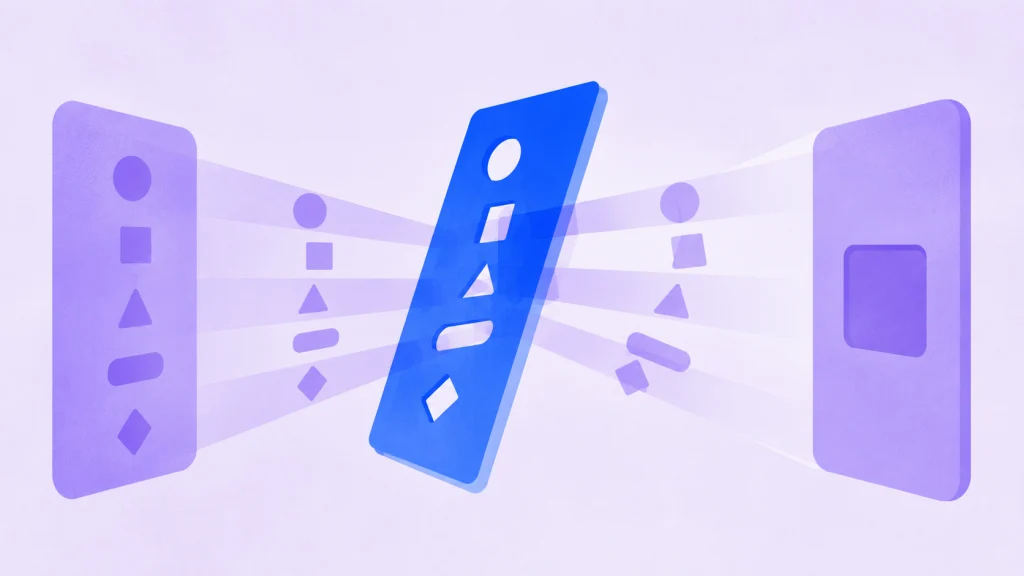
Preprocessing drift is what happens when the steps between raw data and model input change, so the model receives different inputs while its version never moves and the raw data looks untouched.
It is the quiet sibling of the schema change. The columns look the same, the model artifact is untouched, but what actually reaches the model has shifted, and the output shifts with it. Aging of this kind is common: a Scientific Reports study that followed standard model types across many industry datasets found that most of the combinations degraded over time. What ages is rarely the artifact itself; it is the untracked layer that turns raw data into model input. This article maps where the drift hides, why teams misdiagnose it, and how to bring preprocessing under the same reproducibility discipline you already apply to the model.
Where preprocessing drift actually hides
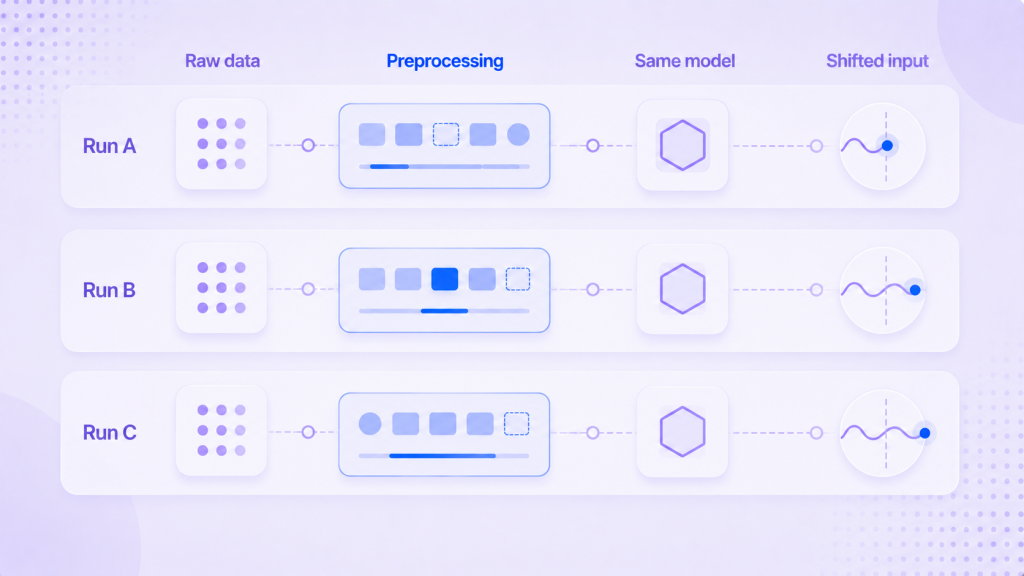
Preprocessing is a pipeline of small decisions, and each one changes the numbers the model sees. None of them is stored inside the model version, and many of them live in code or third-party libraries that are maintained on a completely different schedule than the model.
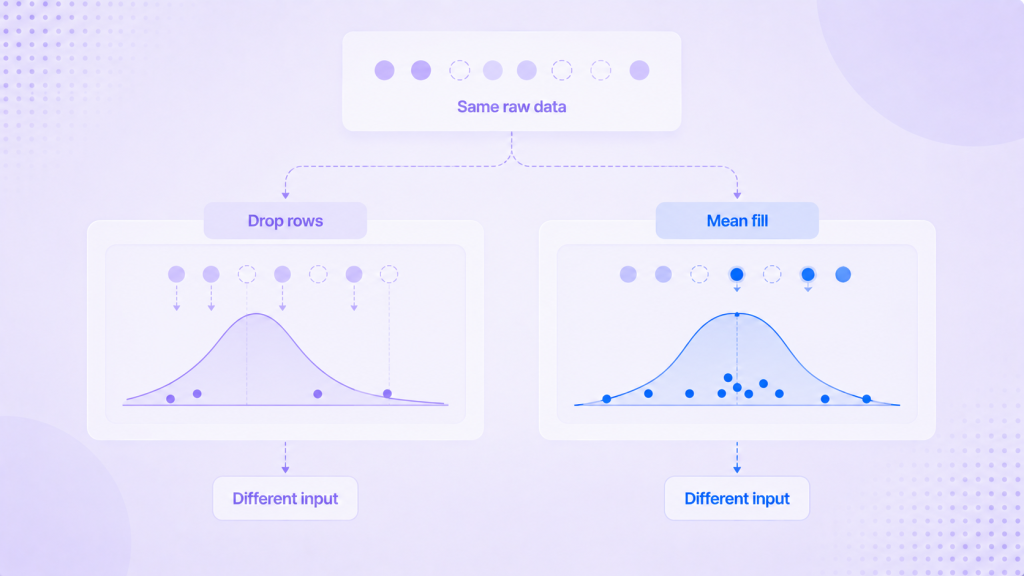
- Imputation: how missing values get filled. Switch from “drop the row” to “fill with the column mean” and the distribution moves, so the model learns a signal that was never in the raw data.
- Scaling and normalization: refit a scaler on a fresh window and the same raw value maps to a different scaled value, which means identical inputs land in different places.
- Encoding: category handling that adds, drops, or reorders levels quietly changes what each encoded position means, and the model reads those positions literally.
- Tokenization and feature extraction: a library upgrade that changes how text or signals are parsed, with effects that ripple through every downstream feature at once.
Any single one of these can move the output enough to matter. The trouble is that the change leaves no mark on anything a team normally inspects when results go sideways.
Why teams misdiagnose it
When the output drifts and the model version has not changed, most teams reach straight for a retrain or a model rollback. The reflex runs deep, and mature stacks even automate it: Google Cloud’s MLOps guide treats continuous training as the pipeline practice unique to ML, so retraining is always the nearest lever. If the real cause was a refit scaler or an upgraded tokenizer, those two remedies do nothing: the drift returns on the very next run, because the layer that changed is not the layer anyone is watching. The investigation stalls in the wrong place, and the cost keeps compounding while the true cause sits in plain sight.
This is also why preprocessing drift and data drift get confused. Data drift is a change in the incoming data itself; preprocessing drift is a change in how unchanged data gets prepared. The symptom, worse predictions with no obvious trigger, looks identical from the dashboard, which is exactly why you need to separate the two before you spend a sprint retraining against a cause that was never the model.
| Preprocessing step | A small change | Effect on the model |
|---|---|---|
| Imputation | Drop rows changed to mean-fill | Distribution shifts; a false signal is learned |
| Scaling | Scaler refit on a new window | Same raw value, different scaled input |
| Encoding | New or reordered categories | Encoded positions change meaning |
| Tokenization | Library version upgrade | Features parsed differently across the board |
Bind preprocessing to the data state
The reliable fix is to stop treating preprocessing as invisible glue and start treating it as part of the data state. A production AI result is explained as much by the data state and execution conditions behind it as by the model version, and preprocessing sits squarely inside those conditions. When the preprocessing version is captured in the data Version a run used, a change stops being a mystery and becomes a visible difference between two states.
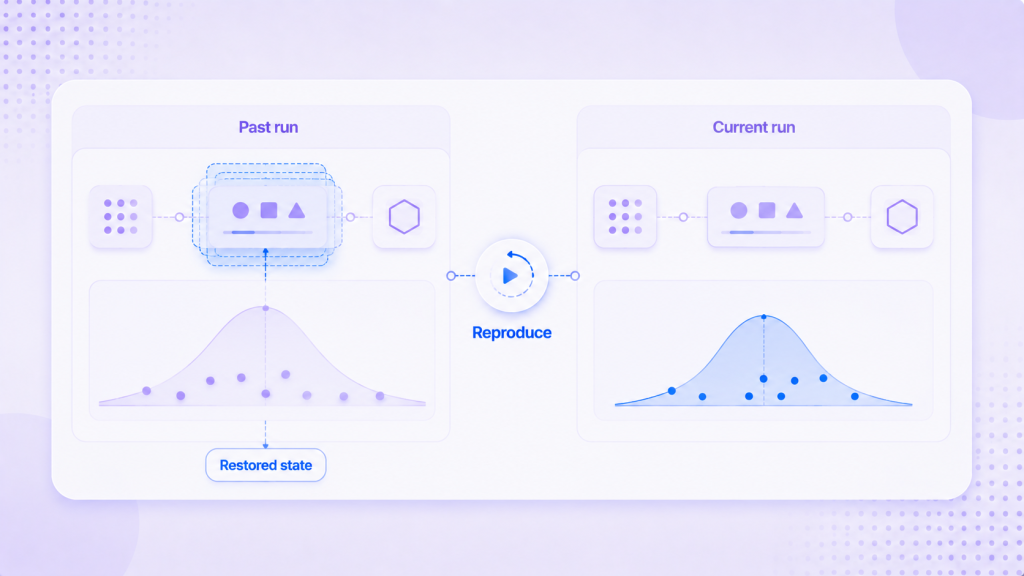
From there the workflow is concrete. Link each run to the exact data, preprocessing included, that it used. Compare two runs with the previous state and the imputation rule or the refit scaler surfaces as a candidate cause instead of something you hunt for by hand. Restore the earlier preprocessing so you can confirm the cause rather than guess at it. Of the six axes, the two this preserves most directly are Consistency and Reproducibility: the promise that the same inputs yield the same model inputs, run after run.
A quick self-diagnostic for preprocessing drift
The sharpest test is simple. Take a past run and try to reproduce it exactly. If you cannot restore the preprocessing that produced it, the imputation rule, the fitted scaler, the tokenizer version, then you cannot rule it out as the cause of your next incident. Run through this checklist and count how many you can answer with a confident yes:
- Is your preprocessing versioned alongside the model, or does it live in code that changes with no release note?
- When a scaler or encoder is refit, is that recorded against the runs it affects?
- Could you reproduce last quarter’s result with last quarter’s preprocessing, not today’s?
- When output drifts, can you tell within minutes whether the model, the data, or the preprocessing moved?
If two or more of those are a no, preprocessing drift is already a live risk in your stack.
Where it fits in an AI-ready data layer
Syntitan, CUBIG’s AI-ready data platform, prepares enterprise data for a specific AI task and validates it. It diagnoses the data across six axes, Usability, Integrity, Context, Consistency, Reproducibility, and Traceability, lets your team apply, hold or exclude each proposed fix, and creates a new data Version after each successful processing run, which you can compare with the previous state. Tracking and reusing data after later changes, including linking it to each agent run, is planned for December.
That arc, make the data ready and then keep it reproducible, is the job of an operating layer for AI-ready data, the missing layer between traditional data management and AI execution. Any performance figure you see for it is representative until you reproduce it on your own model and data.
Try it on your data for free. Start with a data diagnosis and see what to fix for your own workflow.
For the failure it sits closest to, read Schema Changes Break Production AI. For the broader pattern, see Why AI Fails After Deployment and The Hidden Cost of Stale Reference Data.