
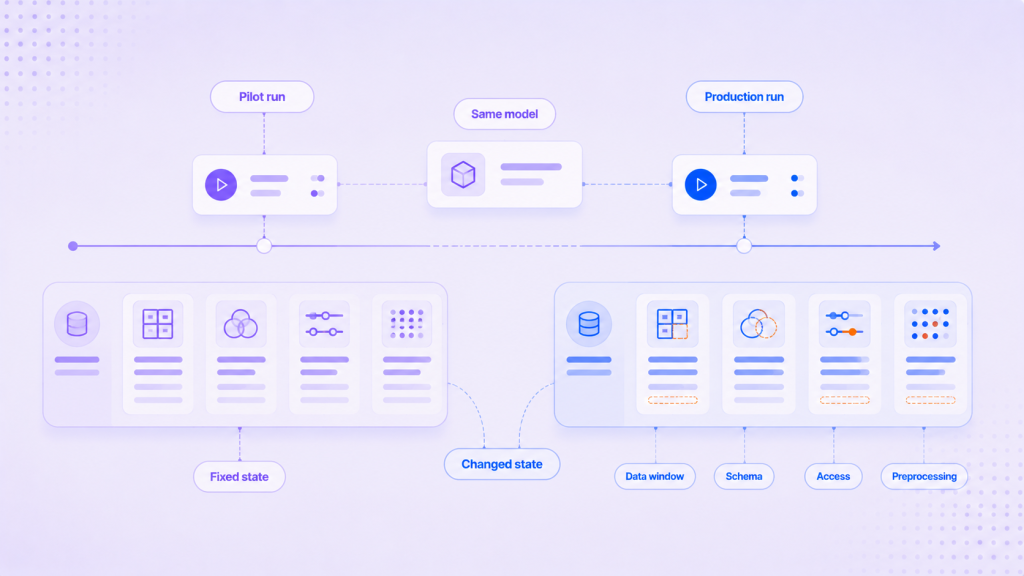
Why AI fails after deployment is often not only a model problem: the model that passed the pilot is often unchanged, and what moved is the data state and execution conditions behind each production run.
The pattern has become familiar to anyone who ships models. A system clears every evaluation, earns sign-off, goes live, and then quietly degrades the first time it meets real operating conditions. RAND’s interview study of engineers and data scientists ranks data problems among the leading root causes of AI project failure. Many of those failures surface after deployment, and many involve data, not only algorithms.
Why AI fails after deployment: the pilot proved the model, not the conditions
A pilot runs on a curated dataset that sits still while you evaluate it. That is the correct way to measure a model, and it is exactly why a strong pilot score predicts production behavior so poorly. Google researchers gave the effect a name, underspecification: models that score identically on held-out tests can behave very differently once deployed. The pilot holds constant everything production refuses to hold constant: access is open, the schema is frozen, the data window does not move, definitions are agreed, and one team owns the whole thing.
Production introduces all of that at once. Access is restricted and partial, the schema drifts as upstream teams do routine work, the data window slides forward every day, and definitions differ between the team that produced the data and the team consuming it. The output looks like a model regression, but it is often an environment the model was never shown.
What actually changes on the way to production
When a deployed result drifts and the model version is unchanged, the cause is often in the state around the model. This is common, not an edge case: a Scientific Reports study that tracked standard model types across industry datasets over time found temporal degradation in many of them. The usual suspects are mundane, which is part of why they get missed. This is the data drift that observability dashboards rarely name, because they are watching the model instead of the data state feeding it.
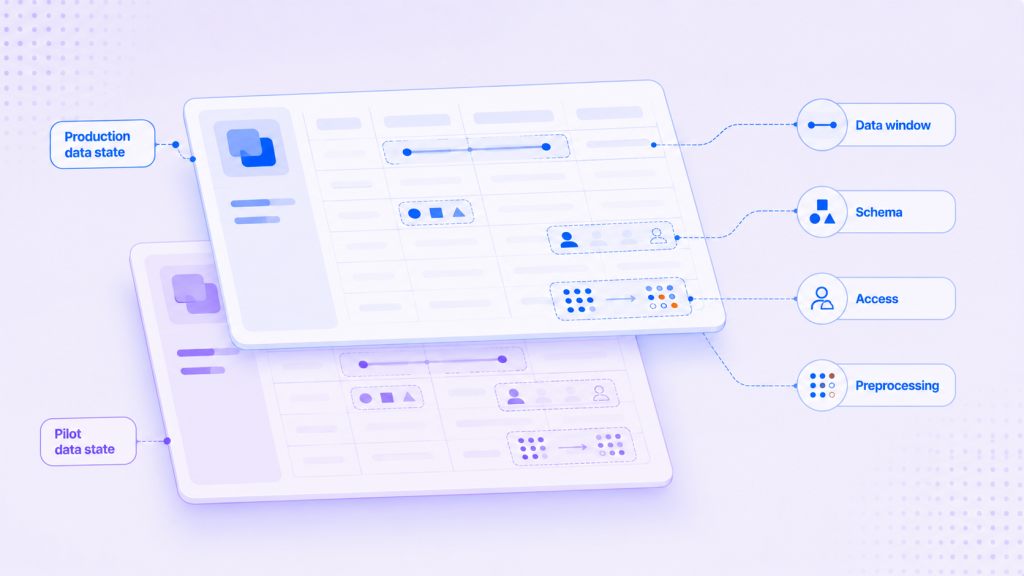
- The data window moved. The run saw a different slice than the pilot: a fresh month, a new season, a population that shifted. The same query returns different rows.
- A schema changed. A column was renamed, retyped, or split during a routine migration. For the data team it was one line; for the model it was a behavior change no one filed as a release.
- Preprocessing changed version. An imputation rule shifted, a scaler was refit on new data, or a tokenizer was upgraded, so the same raw value reaches the model as a different number.
- A permission boundary moved. What was accessible and trusted at run time changed, so the model quietly ran on a narrower or different view of the data.
None of these touches the model version. From the registry’s point of view, nothing happened. From the output’s point of view, an untested release just shipped. That gap between what the registry records and what the model actually ran on is one reason AI in production can drift without a clear cause.
| Condition | Pilot | Production |
|---|---|---|
| Dataset | Fixed, curated, sits still | Live, moving window every day |
| Schema | Frozen for the evaluation | Drifts with upstream changes |
| Access | Open to the pilot team | Restricted, partial, role-bound |
| Preprocessing | One agreed version | Refit and upgraded over time |
| What is tested | The model | The state around the model |
Why teams debug the model instead of the state
The tooling is the tell. Much of production AI observability is built around the model: version, latency, accuracy on a held-out set, sometimes input-distribution alerts. Very little is built around the data state at execution time. So when something breaks, the only instruments pointing anywhere point at the model, and the team retrains, re-tunes, or rolls back a model that may not have been the problem. The drift returns on the next run, because the thing that changed was never the thing being inspected.
The deeper reason is organizational, the pattern a CHI study of high-stakes AI called data cascades, in which practitioners described upstream data issues cascading into downstream model failures. The change that broke the result was usually made by a different team, through a different process, and logged as routine data work rather than as a change to the AI system. By the time output drifts, the change is days old and buried in a migration log that no one connects to the model. The model team and the data team end up looking at two different records of the same event, and neither record explains why the AI changed.
How to tell whether your own deployment is exposed
A short diagnostic answers this faster than a post-mortem. Run your last incident, or your next one, against these questions:
- When a result drifts, can you compare the data state between the run that worked and the run that did not, or are you correlating logs by hand?
- Can you take any past result and find the exact data used at the time: the window, the schema, the preprocessing, and the permissions?
- Do you know which data state each production run used, or only which model version was live?
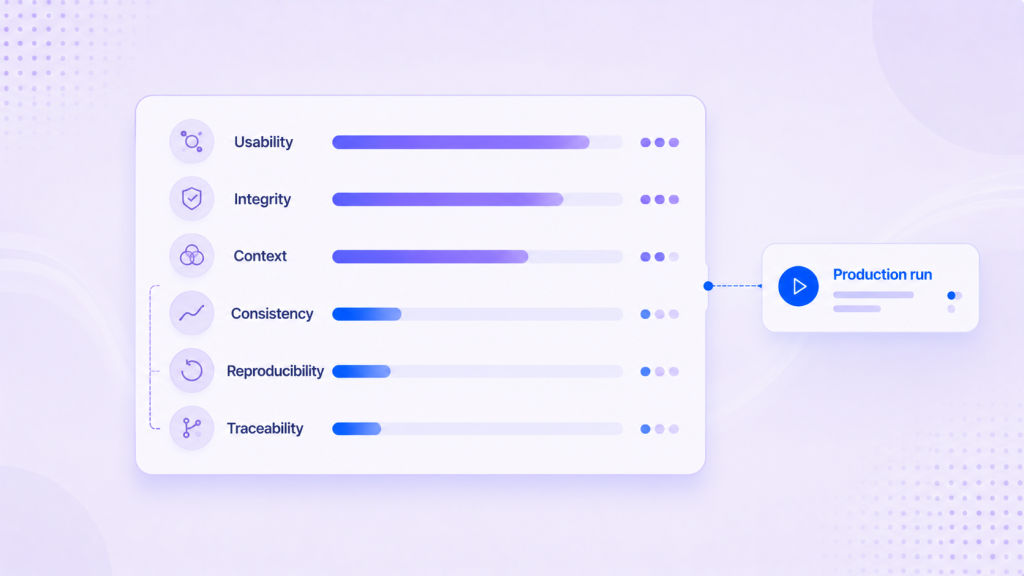
- Do you have a readout across all six axes, or only a sense that the pipeline is green?
If the answers run to no, look at the state of the data reaching the model alongside model quality. That is a different problem with a different fix. Naming that difference is the first step, and it is also why teams that keep chasing model reproducibility alone can stay stuck: the model was reproducible; the data state was not.
How readiness gets measured
Readiness is easier to discuss when you can measure it. Syntitan diagnoses enterprise data on six readiness axes: Usability, Integrity, Context, Consistency, Reproducibility, and Traceability. The axes show what to fix for a task; a high score alone does not show task fit. Deployments that fail the way this article describes can score acceptably on Integrity and Usability while scoring low on Consistency, Reproducibility, and Traceability. That is the profile of data that passes review and then drifts in production, with no clean way to prove what moved. If you want the upstream view of readiness, start with what AI-ready data actually means.
Where it fits
For production AI the question is not only which model ran, but which data state and execution conditions produced the result. Syntitan, CUBIG’s AI-ready data platform, prepares and checks enterprise data for a specific AI task, then manages later changes and the evidence behind results. It diagnoses data on the six axes, compares the data before and after preparation under the same model and evaluation conditions, and saves each successful processing step as a Version you can compare with the previous state. So when a deployed result is questioned, the answer can start from the data used at the time and what changed since, instead of a guess that the model degraded. Linking each AI or agent run to its Version and reusing past states are planned for December. That arc, make it ready and keep the evidence, is the job of an AI-ready data operating layer, the missing layer between data management and AI execution. How a run gets tied to its data state is covered in how a run is tied to its data state, and the failure modes in how schema changes break production AI.
Any performance figure you see is representative until you check it on your own data. Validated lift comes from your own model, in your own environment, not from a benchmark slide. If your AI worked in the pilot and broke in production, look at the data state alongside the model.
Try it on your data for free. Run a sample proof and see it on your own workflow.