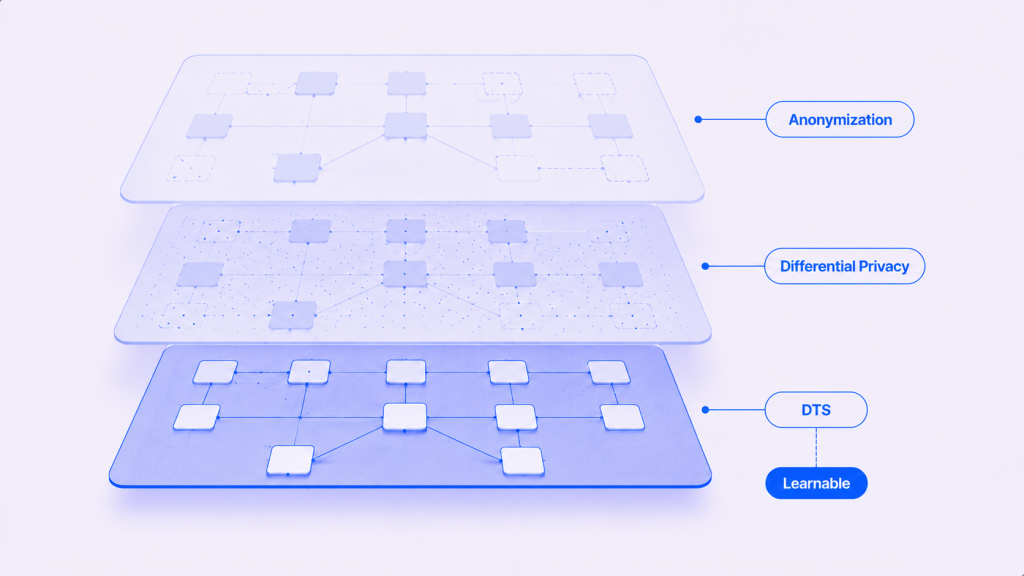
DTS, data anonymization, and differential privacy all let you work with sensitive data, but they trade privacy for utility in different ways: anonymization strips detail, differential privacy adds noise under a formal budget, and DTS synthesizes data whose structure survives for AI to learn from.
Every method for using sensitive data makes the same bargain in a different way: give up some fidelity to gain some privacy. The three approaches teams weigh most often are classical data anonymization, differential privacy, and structure-preserving synthesis through DTS. They are not interchangeable, and choosing by reflex is how a project ends up with data that is private and useless, or useful and exposed. The exposed half is well documented: re-identification research has shown that a handful of demographic attributes can be enough to single out individuals, so even heavily sampled anonymized datasets may fall short of the GDPR’s anonymization standard.
What data anonymization does
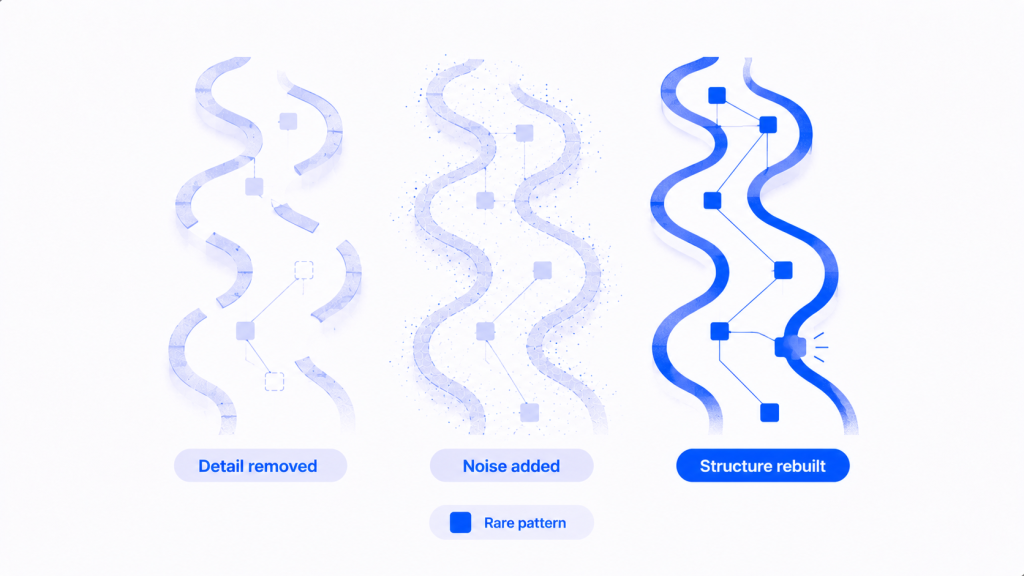
Classical data anonymization removes or generalizes identifying detail: mask a name, bucket an age into a range, drop a rare field, coarsen a location. The appeal is that it is well understood and easy to explain to a reviewer. The cost is that it works by destroying information, and the fields it coarsens are often the ones a model needed. Push anonymization hard enough to resist re-identification, and the rare patterns quietly disappear, which is exactly where fraud, defects, and rare cohorts live.
What differential privacy does
Differential privacy takes a formal route. It adds calibrated noise so that any single individual’s presence or absence cannot be inferred beyond a measured bound, tracked as a privacy budget. Its great strength is that the guarantee is mathematical rather than a matter of judgment. The trade-off is the noise itself: strong guarantees degrade accuracy, and on small or skewed datasets the noise can swamp the signal you were trying to keep. It is a powerful tool when you can afford the budget, and the data is large enough to absorb it. Implementation is its own hurdle: NIST SP 800-226 exists to help teams evaluate differential privacy guarantees, and it catalogs the common implementation mistakes it labels privacy hazards.
What DTS does differently
DTS, CUBIG’s data preparation engine, does not strip detail or blur it. It synthesizes new records using structure-preserving synthesis, preserving the joint distribution and correlations of the original without copying any real individual’s record. Differential privacy can be applied during that synthesis, so the two are not opposed: DTS can synthesize data and still carry a formal privacy bound.
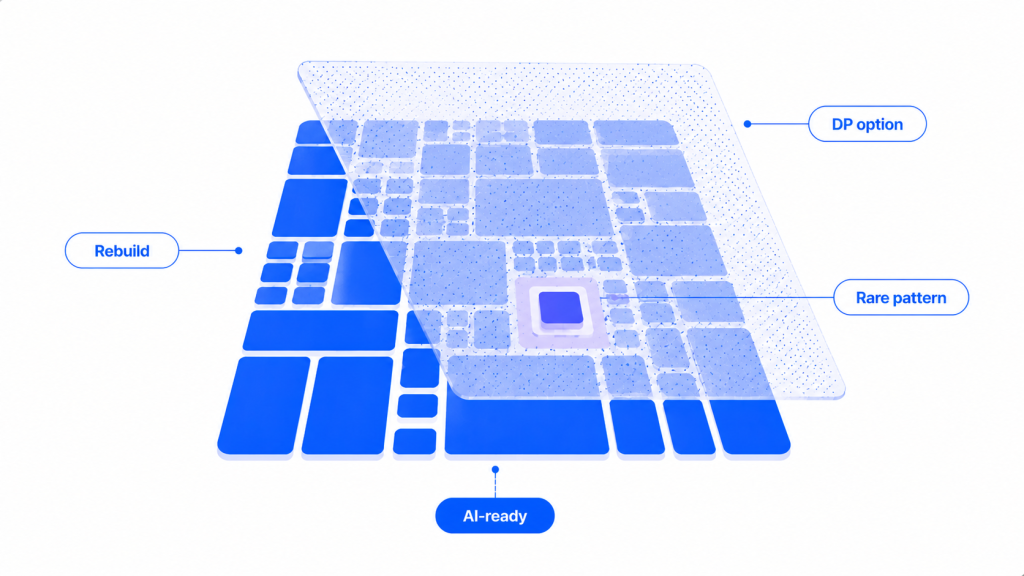
The aim is a dataset that stays learnable, including in the rare classes anonymization tends to erase. The synthesis route has a published case in medicine: a paper in npj Digital Medicine argues for patient-centric synthetic data generation because it reduces the re-identification risk of analyzing real patient records.
How to choose
Match the method to what you are protecting and what you need back. For a low-risk data release where losing detail is acceptable, anonymization is simple and defensible. For aggregate statistics or queries over a large population where a provable bound matters most, differential privacy earns its keep. For training data that has to stay useful, especially when rare classes carry the signal, structure-preserving synthesis keeps the utility that the other two spend down. These lines blur in practice, which is why DTS treats differential privacy as an option it can apply rather than a rival.
A quick self-diagnosis
- Do the fields you would anonymize carry the signal your model needs?
- Is your dataset large enough to absorb differential-privacy noise without losing the pattern?
- Are the rare cases, not the averages, what you are trying to model?
- Do you need the output to train a model, or only to publish a statistic?
If the signal lives in the detail and in the rare cases, stripping or blurring it is the wrong bargain, and synthesizing data that keeps it is the one that keeps the data usable.
Where DTS fits
DTS is the option when the goal is data that stays learnable rather than data that is merely released. For the mechanics, see what DTS is, how structure-preserving synthesis holds the statistics, and how it differs from a generic synthetic data generator.
Any figure you see for utility or privacy is representative until you reproduce it on your own data.
Try it on your data for free. Run a sample proof and see it on your own workflow.
Comparing more than one kind of tool? How to choose an AI-ready data solution sorts the options by the question each one answers.