AI monitoring tells you a model’s output has drifted; operating control tells you which data state caused the drift and lets you reproduce the run, which is the difference between detecting a problem and being able to fix it.
AI monitoring has become standard practice, and rightly so. Teams watch accuracy, latency, and input distributions, and they get alerted when something moves. The trouble starts one step later. An alert tells you the output changed; it does not hand you the data state that produced the change, so the investigation begins exactly where the monitoring tool stops. Drift is not an edge case either: a Scientific Reports study that aged four standard model types across 32 industry datasets found temporal degradation in 91% of the combinations tested.
What AI monitoring does well
Monitoring is the smoke detector of a production model. It tracks prediction distributions, flags data drift and concept drift, watches for anomalies, and pages someone when a metric crosses a threshold. For catching problems early, this is essential, and a team without it is flying blind.
What a monitor gives you is a signal in the present tense: something is off, right now, relative to a baseline. That signal is valuable and incomplete. Knowing that an output drifted is not the same as knowing why, and it is a long way from being able to rebuild the run and prove the cause.
Where AI monitoring stops
The alert fires, and the questions start. Which data did this run actually read? What did the schema look like that day? Did a reference table get refreshed, or did a preprocessing job change a default? A monitoring tool usually cannot answer these, because it observes outputs and aggregate inputs rather than capturing the resolved data state behind each run. It measures the symptom, not the cause.
So the team reconstructs. Someone tries to remember what shipped, digs through migration logs, and guesses at the reference data that was live. This is slow, and worse, it is not evidence. When the drift touches a regulated decision, “we think the reference table changed” does not hold up.
Detection without reproduction is half a loop
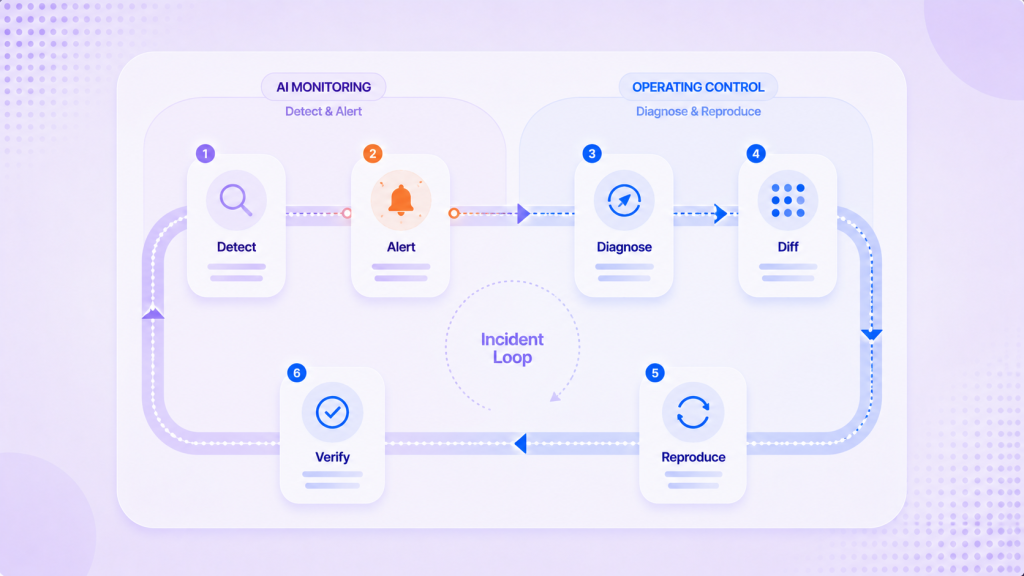
Think of an incident as a loop: detect, diagnose, fix, verify. Monitoring owns detection and does it well. Diagnosis and verification both need the data state, and that is precisely what a monitor does not keep. Without it, diagnosis becomes archaeology and verification becomes hope, because you cannot replay the failing run to confirm your fix actually addressed the cause. Google Cloud’s MLOps guide pushes the automation side of this loop, singling out continuous training as the practice CI/CD never needed before ML, yet an automated retrain still inherits the diagnosis problem when nobody can say what the failing run read.
The two tools are answering different questions. Monitoring asks, is something wrong now. Operating control asks, what produced this specific result, and can I rebuild it. You want both, in that order.
The other half of the loop
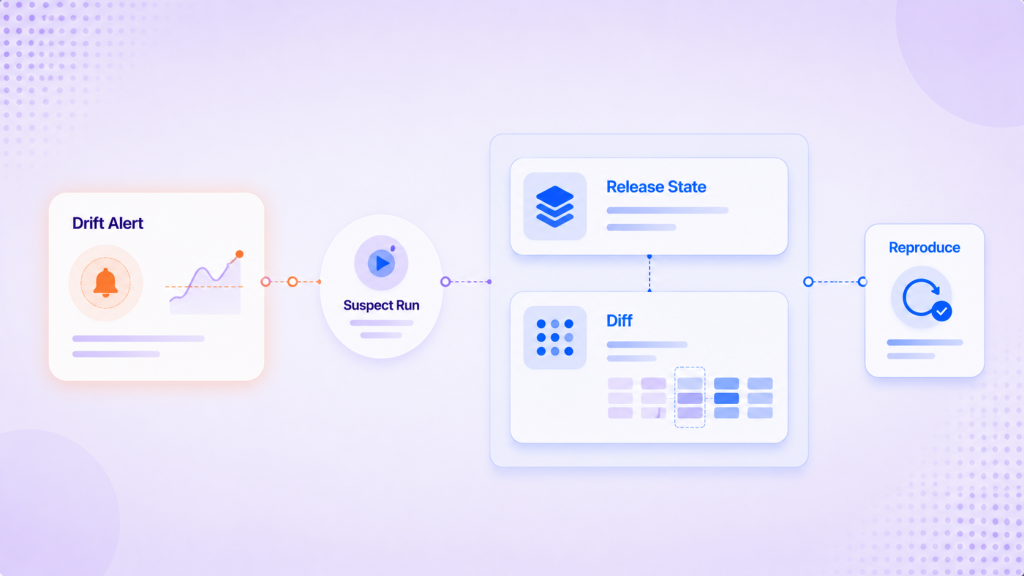
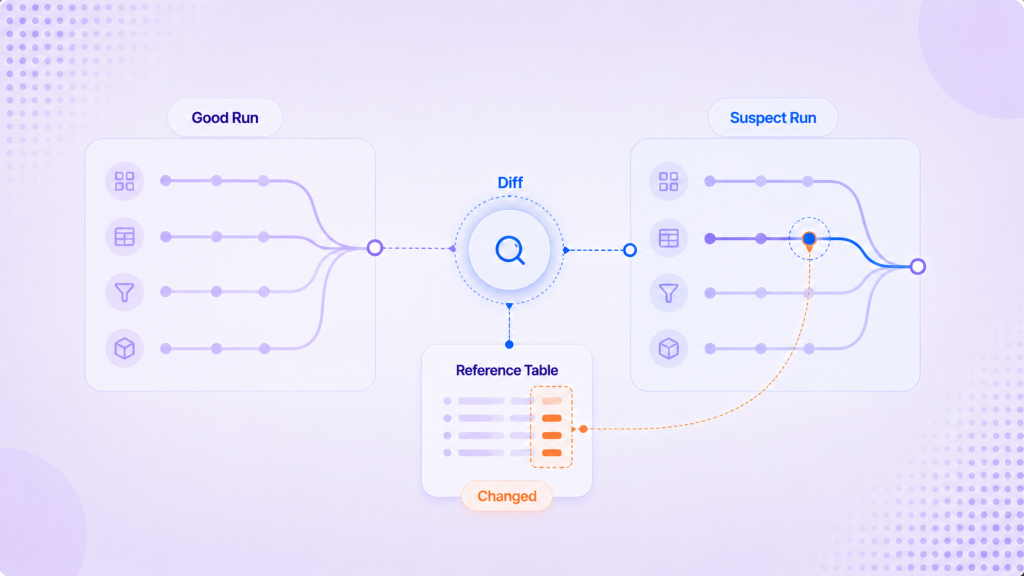
Operating control keeps what the monitor discards: the data state behind each run, versioned. Every run records a Release State, the resolved data, schema, and configuration it executed on, linked to the run through Run Binding. When a monitor flags drift, you pull the Release State behind the suspect run, Diff it against the last known-good run to see exactly what moved, and Reproduce the run to confirm the cause before you change anything. The readiness axes preserved along the way are Usability, Integrity, Context, Consistency, Reproducibility, and Traceability.
This does not replace your monitoring stack. The monitor still raises the alarm; operating control turns the alarm into a fix you can defend. Keep the smoke detector and add the ability to walk back into the room and see what burned.
Can you resolve a drift alert, not just receive it?
Run this quick check the next time your monitoring dashboard turns red. Google’s ML Test Score, a 28-test rubric for ML production readiness, scores data and infrastructure checks with the same weight as model checks, and the questions below apply that weighting to drift:
- Can you name the exact data state the flagged run read?
- Can you diff it against the last good run to see what data changed?
- Can you replay the failing run to confirm the cause before you retrain?
- Could you show an auditor the same evidence twice and get the same answer?
A no to two or more means your monitoring catches problems it cannot help you close.
Where this sits in your stack
For production AI, the question is not only that an output moved but which data state and execution conditions produced it. That gap is CUBIG’s layer. Syntitan, CUBIG’s AI-Ready Data Platform, scores enterprise data on the six readiness axes, rebuilds what blocks execution, then binds each AI or agent run to a data state you can Diff and Reproduce. It sits downstream of your monitoring, turning an alert into a reproducible root cause.
For more, see what makes data AI-ready, why AI fails after deployment, and how operating control compares to generic MLOps.
Any performance figure you see is representative until you reproduce it on your own data.
Try it on your data for free. Run a sample proof and see it on your own workflow.