
Operating control vs data catalog is not a choice between two versions of the same tool: a data catalog helps people find, understand, and govern the data an organization holds, while operating control records the exact data state each AI run used, so you can compare it with the previous state and go back to it.
Getting data ready for AI starts with knowing what you hold. AWS defines a data catalog as exactly that:
an inventory of an organization’s data, with metadata organized to support governance and discovery,
a system that enforces policies rather than sets them. A catalog answers part of that readiness problem.
It does not answer the part that decides whether a given AI result can be defended later.
Teams conflate the two because they overlap on metadata. Both touch schemas, definitions, and lineage. But they act at different moments: a catalog works before the run, describing data at rest, and operating control works at the run, recording which state actually produced a result.
What a data catalog does well
A data catalog inventories the assets an organization holds. It captures lineage, records column and table definitions, manages ownership and access policy, and makes data discoverable across teams that would otherwise duplicate work or query the wrong table.
For the questions of what data we have, what each field means, and who owns it, a catalog is the right system. Enterprises invest in cataloging because bad data is expensive, and much of that waste comes from people acting on data they misunderstood or could not find. Good discovery and clear governance cut directly into that loss. None of what follows is an argument against catalogs.
Where the gap opens: operating control vs data catalog at run time
A catalog describes data at rest. It tells you what a dataset is in general. It does not record that, on one specific run, a model consumed this window of that dataset, under this schema version, after this preprocessing step, within these permissions.
So when a production output needs explaining, whether a regulator asks, an internal review flags it, or an agent takes an action someone disputes, the catalog gives you the dataset’s general shape and lineage. It cannot give you the run-time evidence: which exact state produced the particular result you are investigating, and whether you can go back to that state to check. Discovery metadata sits one layer above the thing you actually need to explain a decision.
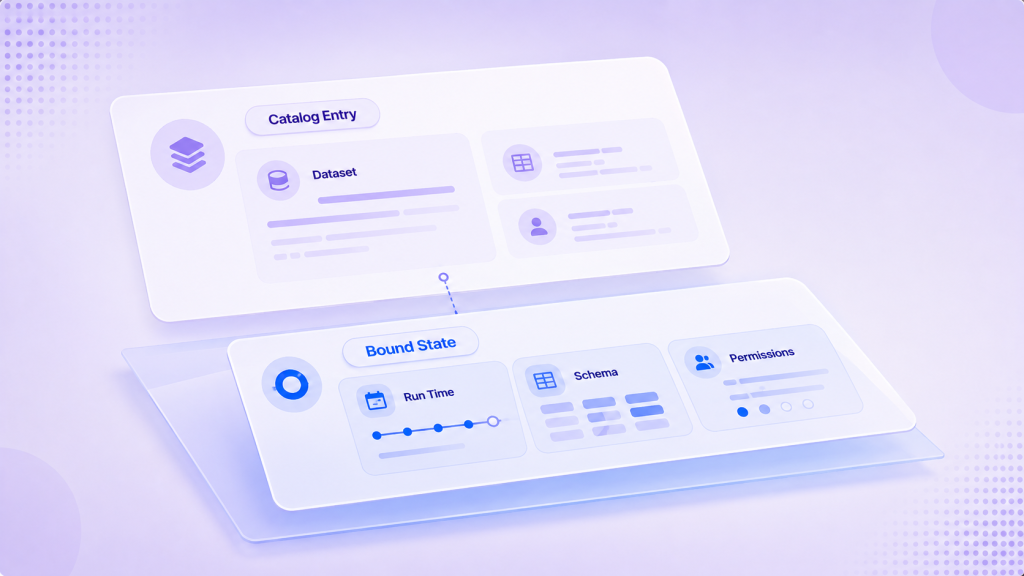
The two jobs side by side
The clearest way to see it is a direct comparison of what each system owns.
Read down the two columns and the division of labor is obvious. The catalog governs data as an asset. Operating control governs a run as an event with a fixed input you can check later.
Why lineage alone does not close it
Data lineage, the catalog feature teams reach for when they want reproducibility, tracks how a dataset was produced and where it flows. That is genuinely useful for tracing the origin of a field, and it is usually the first thing an investigation pulls up.
Lineage still describes the pipeline, not the run. It tells you the path a dataset traveled to reach a table. It does not pin the specific version of that table, plus the preprocessing and permissions in force, at the instant a model read it. Two runs a week apart can share identical lineage and still execute on different states, because a backfill landed, a schema migrated, or a reference file went stale between them. Lineage will look the same in both; the outputs will not. Operating control captures what lineage leaves out: the data state each run actually used.
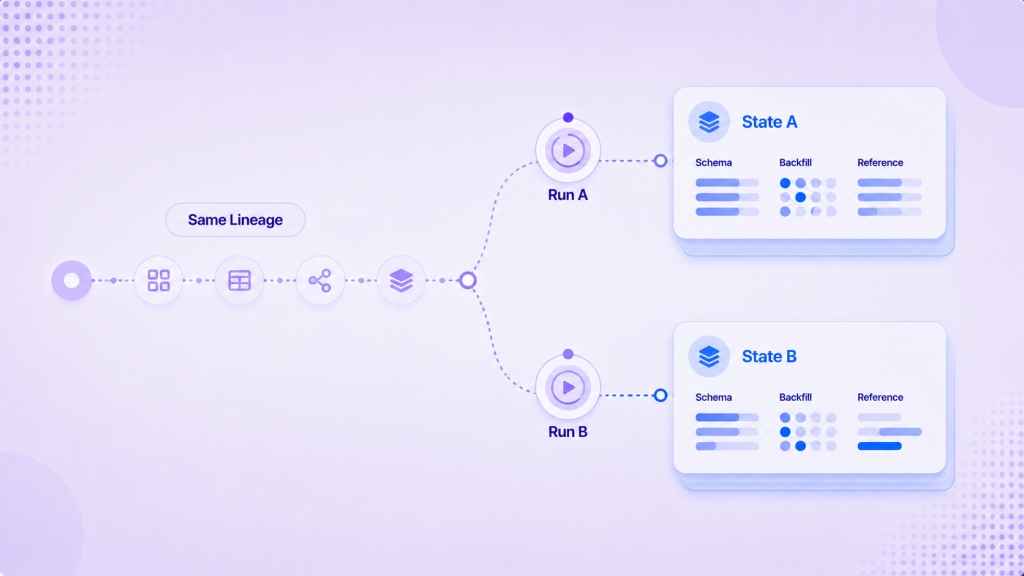
How the two work together
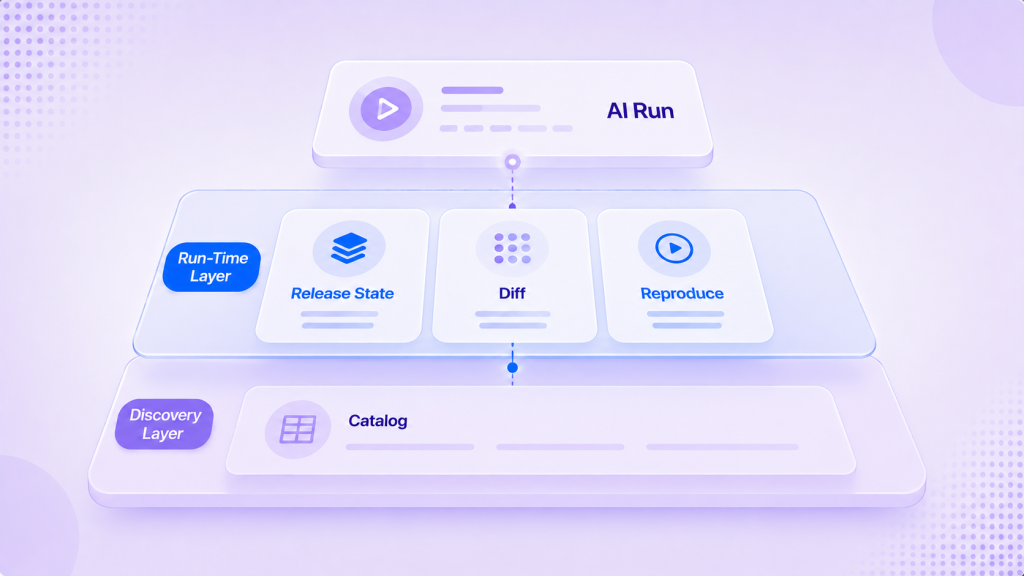
These systems are complementary, not competing. Use the catalog to find and govern the data going in; use operating control to record the data Version each run used. The catalog’s definitions and lineage feed the readiness diagnosis, especially the Context axis, since knowing what a field means is part of judging whether data is ready. Recording, comparing, and going back to the data used at the time then supply the run-time half a catalog was not designed to cover. The regulatory bar is written in the same terms: EU AI Act Article 10 requires the training, validation, and testing data of high-risk AI systems to meet quality criteria under documented data-governance practices, relevant, sufficiently representative, and as error-free and complete as possible.
A production result has two parents, the model that ran and the data state it ran on, and an audit asks about both. Syntitan, CUBIG’s AI-Ready Data Platform, covers the data parent: it diagnoses enterprise data on six axes, Usability, Integrity, Context, Consistency, Reproducibility, and Traceability, prepares and checks it for a specific AI task, and saves each successful processing step as a Version you can compare with the previous state. Linking agent runs to those Versions and reusing past states are planned for December. The catalog tells you what you have; operating control tells you what actually ran.
A quick test: which layer are you missing?
Run this on your own stack. If you answer no to more than one of these, you may have a catalog but no operating control:
- Can you name the exact data state, not the dataset, that produced a specific AI output from last quarter?
- Can you compare that state with the one a similar run used, and see what changed?
- Can you find that exact data today and run the model on it again?
- When a schema migrated or a backfill landed, did anything record that runs before and after used different states?
- If a regulator asked you to reproduce one decision, would you reach for lineage or for a record of the exact data state used?
Where it fits
Operating control is the run-time layer of AI-ready execution. It assumes you already have discovery and governance, from a catalog or elsewhere, and adds the piece those tools were never meant to hold: a record of the data state tied to each run. In Syntitan, that record is the Version: each successful processing step saves one you can compare with the previous state, with run linking and reuse planned for December, on top of whatever catalog you already trust. To see how the underlying readiness question is framed, start with what AI-ready data means, then compare the adjacent tools in operating control vs feature store.
Try it on your data for free. Run a sample proof and see it on your own workflow.