
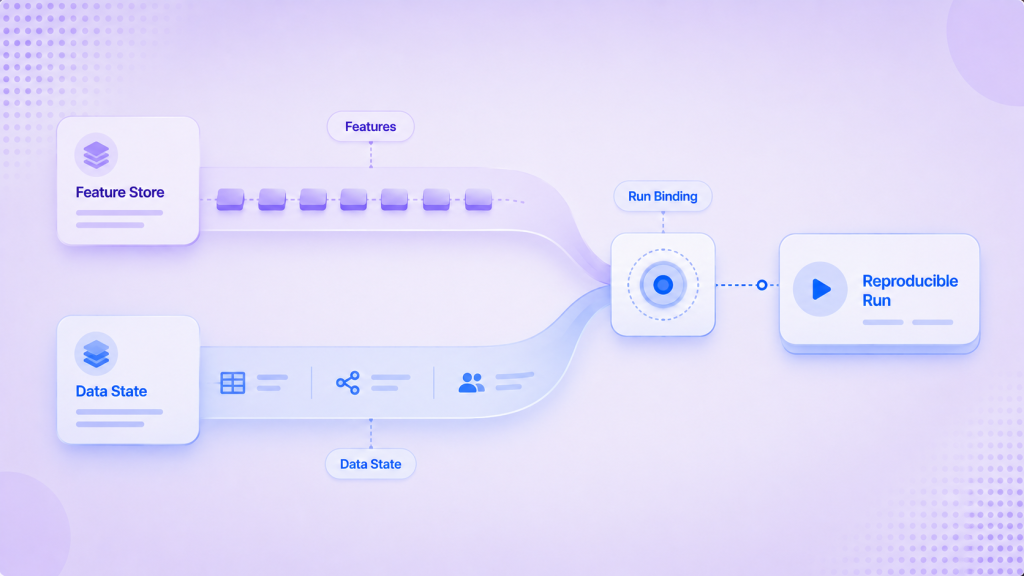
Operating control vs feature store is a division of labor, not a rivalry: a feature store serves consistent features to training and inference, while operating control records the AI-ready data state those features belonged to and binds each run to a state you can diff and reproduce.
Feature stores earned their place by killing a specific bug, train/serve skew, so the line between them and operating control deserves a careful hand. The pattern has real pedigree: Uber’s Michelangelo platform introduced the feature store, with roughly 10,000 canonical, shared features that teams consume online and offline by name. Serving the right numbers, though, is not the same as being able to rebuild the exact conditions a past run executed on. A feature store closes part of that gap. It does not close all of it.
What a feature store actually solves
A feature store centralizes feature definitions, serves the same features online and offline, and enforces point-in-time correctness so a model trained on last quarter’s data sees the values that were true then, not the values as they look today. For consistent, reusable features shared across many models, it is the right infrastructure and there is no reason to replace it.
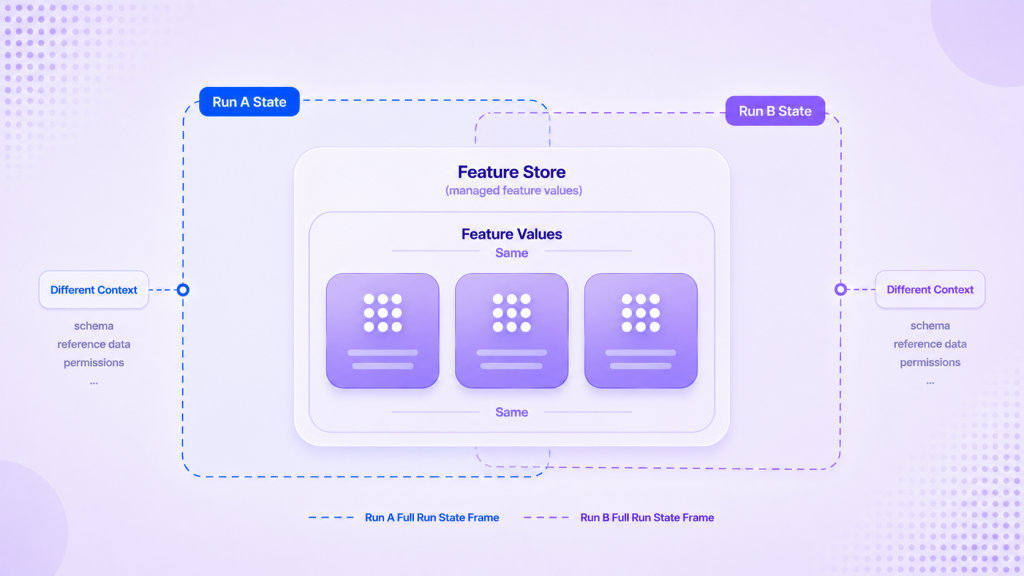
The scope is precise, though. A feature store guarantees that a named feature is computed the same way wherever it is read. That is a statement about the columns it owns. It is not a statement about everything else the run touched.
Why operating control vs feature store is the wrong fight
Two runs can pull byte-identical features from the same store and still diverge, because something outside the feature definitions moved: the reference table a feature joined against, the schema of an upstream source, the permission scope that decided which rows were visible, the wider data window the model conditioned on. The store kept its own inputs honest. It never claimed to capture the full state around them. The pattern is common enough to have a name: in a CHI study of high-stakes AI, 92% of practitioners interviewed had experienced data cascades, compounding downstream problems triggered by upstream data issues that nobody treated as AI work.
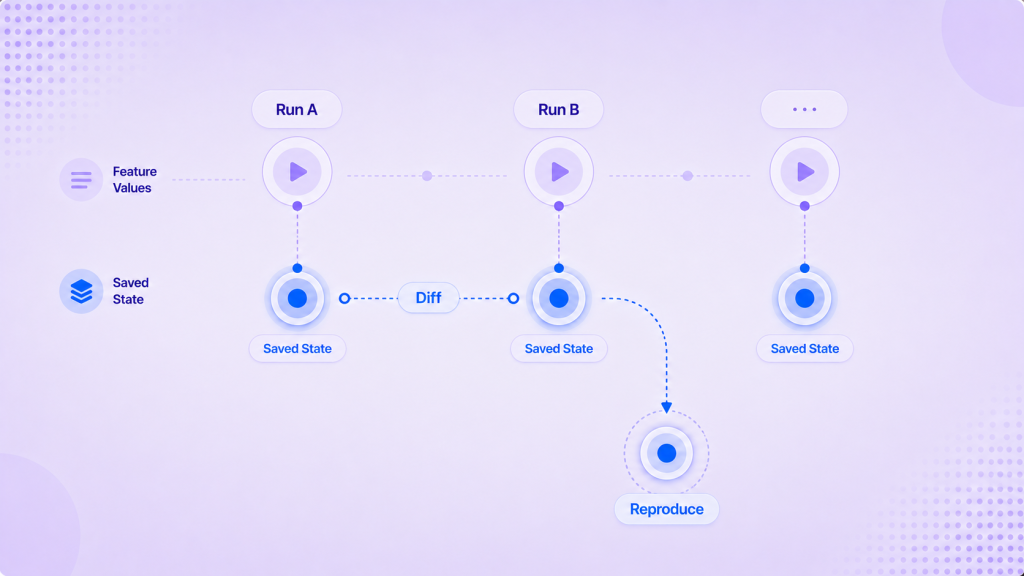
Operating control fills that space. It treats the entire data state a run executed against as one addressable object, a Release State, and it binds the run to that object through Run Binding. When a result later needs explaining, you do not reconstruct the world from memory. You open the state, Diff it against another, and Reproduce the run on the state it was bound to. Serving features and recording state are simply different jobs, and asking one tool to do both is where teams get stuck.
Feature store and operating control, side by side
The cleanest way to see the relationship is to lay the two capabilities against the questions a production team asks after a result looks wrong.
Read the table as a handoff rather than a scorecard. Everything the store owns, operating control leans on. Everything the store leaves open, operating control records.
How the two work together in practice
The pattern is straightforward once the boundary is clear. You keep serving features from the store, and you wrap each run in a Release State. The feature store guarantees consistency of the inputs it defines; Run Binding, Diff, and Reproduce cover the state of the run as a whole. When something breaks, you have both halves in front of you: the feature values, and the data state they sat inside. Google Cloud’s MLOps guide grades this march toward automation from manual level 0 to fully automated level 2, and the further up that scale a pipeline sits, the more the recorded state matters when a retrain needs explaining.
Picture a fraud model that flagged fewer cases this week than last. Your feature store confirms the transaction features were computed identically, so the usual suspect is ruled out fast. With operating control you go further and Diff this week’s Release State against last week’s. The features match, but a merchant-category reference table was refreshed midweek, and a permission change narrowed which regions the run could see. Neither shift lived in the feature definitions, yet both moved the output. Because each run was bound to its state, you can Reproduce last week’s run on this week’s data and confirm the cause in minutes instead of arguing about it for a day.
For production AI the question is rarely only which model ran. It is which data state and execution conditions produced the result. Syntitan, CUBIG’s AI-Ready Data Platform, scores enterprise data on six axes, Usability, Integrity, Context, Consistency, Reproducibility, and Traceability, then rebuilds what blocks execution and binds every AI or agent run to a data state you can diff and reproduce. The feature store makes the features trustworthy; the platform makes the whole run rebuildable.
A quick test: do features alone explain your run?
Run this check against your own pipeline before you decide the feature store has you covered. If you answer no to two or more, the gap operating control fills is already costing you.
- Can you name every reference table a run joined against, at the version it used that day?
- If an upstream schema changed last month, can you tell which runs saw the old shape?
- Can you reproduce a six-month-old run’s inputs without asking three people what changed?
- When two runs disagree, can you diff their full data state, not just their feature values?
- Is the permission scope that filtered visible rows recorded alongside the run?
Where it fits in the CUBIG operating layer
A feature store lives at the input layer, keeping specific features consistent. Operating control lives one level up, at the operating layer for AI-ready data, where the concern is the Verifiable Data State a run was bound to and whether you can return to it. The two do not overlap so much as stack. Serve from the store; record with the platform; and when a regulator, a customer, or your own postmortem asks what produced a result, you answer with a reproducible AI-ready state instead of a best guess. Performance you see today is representative until you reproduce it on your own data, which is exactly what Run Binding lets you do.
Try it on your data for free. Run a sample proof and see it on your own workflow.
For adjacent comparisons, see how operating control differs from a passive inventory in Operating Control vs Data Catalog and from experiment tracking in Operating Control vs MLflow, and read why a saved Release State beats a dataset snapshot when you need to rebuild a run.
The pillar concept sits in what AI-ready data means.