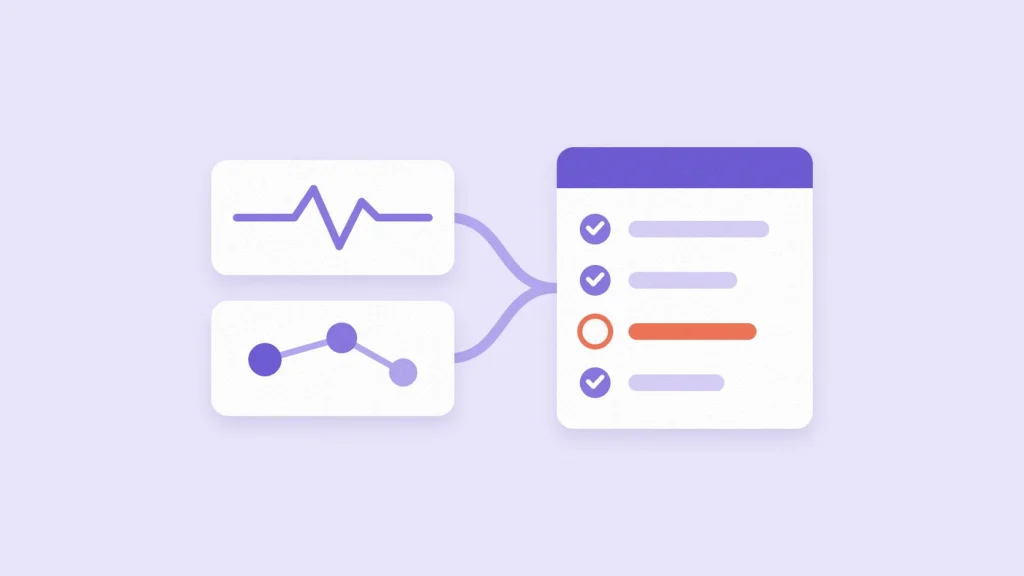
In one week this month, an integration platform announced it was acquiring a data observability company to catch data issues before they reach dashboards, models, and agents. A graph database company announced a shared context engine, now in private preview, that maps business processes for agents and records their decisions. Earlier in the month, an infrastructure vendor announced a semantic layer and knowledge graph scheduled for release in the first half of 2027. Platforms are moving to give agents data health signals and business context directly.
These tools help teams check data health and share business definitions. Teams still need to test whether an agent uses that information to answer specific business questions correctly, including exceptions such as regional refund rules.
Key takeaways
- Data platforms are adding observability and shared context layers for AI agents, so agents can see data health signals and business meaning.
- Observability answers whether data is fresh, complete, and free of anomalies. A context layer answers what the data means and how it connects.
- Freshness checks and shared definitions do not, on their own, show that an agent’s answer meets a task’s criteria, especially for exceptions the task depends on.
- Keep a small set of task cases with known answers, run them under fixed conditions, and rerun them when the data, the context, or the agent changes.
Healthy, well-described data can still give a wrong answer
Consider a support agent that answers refund questions. The policy table is fresh, every quality test is green, and the context layer maps the refund window to the right table and field. A customer in Germany asks how much time they have to request a refund. The agent answers 30 days, with a citation. Last month, a contract change gave EU customers 60 days, and that rule lives in an addendum the agent never weighs against the general policy.
- 01Health
The policy table is fresh and every quality test passes.
- 02Context
The context layer maps the refund window to the right field.
- 03Gap
A contract addendum gives EU customers 60 days.
- 04Answer
The agent tells a German customer 30 days, with a citation.
Nothing in the pipeline failed. Freshness, volume, and schema checks had no reason to fire. The context layer described the policy correctly, just not the exception this customer depended on. A test case covering the EU exception could expose the error before a customer receives the wrong answer.
Three questions an agent’s data has to answer
Each question calls for a different check. The table separates three kinds of checks. Their scope can overlap within a platform.
| Question | Typical tools | What it catches | What it can miss |
|---|---|---|---|
| Is the data healthy? | Data observability, quality tests | Stale tables, missing rows, volume drops, schema breaks | A correct, fresh value that is wrong for this task |
| What does the data mean? | Semantic layers, context layers, catalogs | Which table and field hold a business concept, and how entities connect | Rules or exceptions missing from the configured context |
| Does the answer fit this task? | Task cases with known answers, run under fixed conditions | Wrong answers on the cases the business cares about, before and after a change | Cases nobody wrote down |
A survey of AI builders that VentureBeat published in September points the same way. Teams running a semantic or context layer still reported agents giving confident answers that were wrong because of business context. A context layer helps an agent find meaning; it does not prove the meaning fits a given task. Our article on what semantic layers leave to task preparation walks through that gap with examples.
How to check the task before the agent acts
- Write 20 to 50 cases with known answers. Include the exceptions the task depends on, such as regional rules, contract addenda, and recent policy changes. A set this size is a starting point, not full validation.
- Fix the conditions. Record the data version, the context definitions, the agent configuration, and the criteria before you look at results.
- Run the cases and read the misses, not only the score. A miss on one exception can matter more than a high average.
- Rerun when something changes. When a policy changes, review the expected answers before rerunning the cases, and keep a record of what changed. A new context definition or model version is also a reason to run the same cases again and compare.
Health signals and context layers make this work easier, because a team can see which inputs changed. They do not replace the cases. For what AI-ready data means beyond clean data, see What Is AI-Ready Data?
Related product: Syntitan
For structured data, CUBIG’s Syntitan keeps this task check alongside the data. Teams set up a Project for one use case, and each successful preparation run creates a new data Version. Ready for Model compares results before and after preparation using the same model and evaluation conditions, then checks whether the agreed criteria are met. Ready for Agent organizes business material into Tasks and Cases. In December, Syntitan plans to connect real agent runs to those Cases, so teams can compare results against the same criteria, fill the gaps the runs reveal, and revalidate. Syntitan does not replace the data platforms, observability, or context tools a team already uses.