
Stale reference data is the silent failure mode where the lookups, mappings, and rules an AI model relies on for context have fallen behind reality, so the system keeps answering confidently against an outdated map while nothing on the surface looks broken.
Most drift conversations stay fixed on the primary dataset, the rows that feed the model directly. The reference layer sits underneath it: product catalogs, account hierarchies, region codes, policy rules, pricing tables. It changes slowly, rarely trips an alarm, and gets far less scrutiny than the model itself. That is precisely why it is so easy to ship and so expensive to find. More than 80% of AI projects fail by RAND’s estimate, double the rate of IT projects that involve no AI, and when its researchers interviewed the engineers behind those projects, data problems kept surfacing among the leading root causes. A reference layer no one is tracking is one of the ways otherwise healthy projects slip into that column.
Why stale reference data stays silent
When the primary data is wrong, results usually look obviously off, and someone flags them. When the reference data is stale, the model still returns a clean, plausible answer. It has simply resolved a code, a mapping, or a rule against last quarter’s version. A discontinued product still maps to its old category. A reorganized account still rolls up to the wrong parent. A region code points at a boundary that changed months ago. The output passes review because it looks completely normal; only the context behind it is wrong.
This is the same mechanism that erodes trust across AI systems generally. The answer that is almost right, correct in form and wrong in fact, is harder to catch than the answer that is visibly broken, and a confident response built on a stale lookup is exactly that kind of near-miss. Reviewers approve it, downstream systems act on it, and the error compounds without ever announcing itself.
Where the cost of stale reference data actually lands
The damage shows up downstream, well away from the model, which is why it is so hard to attribute back to its source. Three patterns recur:
- Wrong-but-confident answers that pass human review because nothing looks anomalous, so they flow straight into decisions.
- Slow erosion of trust as occasional errors accumulate without a clear cause, until people quietly stop relying on the system and route around it.
- Expensive forensics when someone finally traces a bad decision back to a lookup table nobody thought to check, weeks after the fact.
This compounding has a name. In a CHI study of high-stakes AI, 92% of practitioners interviewed had experienced data cascades, downstream problems triggered by upstream data issues that nobody treated as AI work, and a stale lookup is a canonical trigger. Because the model and the primary data both look fine, teams often burn the entire investigation in the wrong place, retraining, re-tuning, and auditing the pipeline, while a three-month-old mapping table sits untouched at the bottom of the stack. The table below shows how ordinary reference changes turn into silent errors.
| Reference data | What changed | The silent error |
|---|---|---|
| Product catalog | Item discontinued or recategorized | Maps to an old category |
| Account hierarchy | Reorganization | Rolls up to the wrong parent |
| Region or code table | Boundary or code update | Resolves to a stale region |
| Policy or pricing rules | Rule revision | Applies last quarter’s logic |
Why monitoring does not catch it
Standard monitoring watches the model output and the primary inputs. Both can look unchanged for months while the reference layer underneath goes stale, because a reference table is not part of the request the monitor sees. Accuracy metrics stay flat because the model is doing exactly what it was told; the instructions themselves are just out of date. This is one route into a well-measured outcome: when a Scientific Reports study aged four standard model types across 32 industry datasets, 91% of the combinations lost quality over time. You can add data-quality checks on the reference tables, but freshness is not a quality problem you can validate in isolation. A three-month-old region map is not malformed or incomplete. It is internally consistent and simply describes a world that no longer exists. The only way to know it matters is to connect that table’s version to the runs that depend on it.
Treat reference data as part of the data state
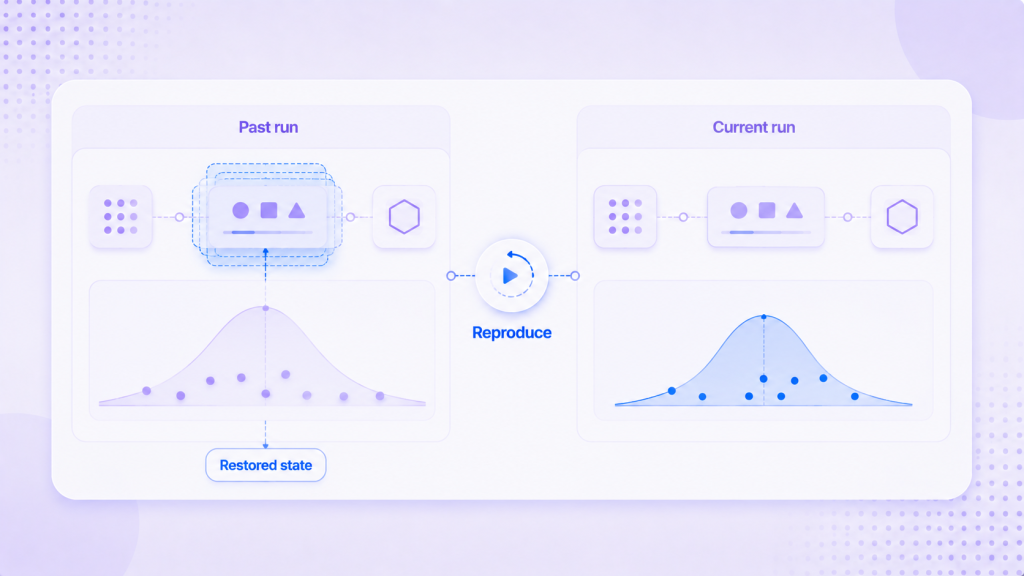
Reference data deserves the same treatment as any other input that shapes a result: a known freshness, captured in the data state a run is bound to. When the reference layer is part of a versioned Release State, staleness becomes measurable rather than assumed. The Context and Consistency axes reflect it, and a Diff between two runs can surface a plain statement like “the region mapping is three months older here” instead of leaving that fact invisible. Reproduce then lets you rebuild a past answer and confirm it was built on the reference data it should have used.
A deployed answer inherits its context from the data state behind it, which is why the reference layer belongs inside that state rather than beside it. Syntitan, CUBIG’s AI-Ready Data Platform, scores enterprise data on six axes, rebuilds what blocks execution, and binds every AI or agent run to a data state you can diff and reproduce. The reference layer stops being a blind spot and becomes one more thing you can see and compare.
A self-diagnostic for stale reference data
For any AI workflow, ask what reference data it depends on and how you would know if that data were stale. Run through this quick test:
- Is each reference table’s freshness recorded somewhere, or is it simply assumed to be current?
- When an answer turns out to be wrong, can you check which version of a lookup it used?
- Does a reference update register against the runs it affects, or does it change silently in the background?
- Could you reproduce a decision from last quarter with the exact reference data that was live at the time?
If the honest answer to any of these is “we wouldn’t know,” that gap is the hidden cost: an invisible risk sitting under workflows that otherwise look perfectly healthy.
Where it fits in an AI-ready data operating layer
Catching stale reference data is one instance of a larger job: making data ready for AI and keeping it reproducible run after run. Syntitan turns reference freshness from an assumption into a number, then holds that number as part of the state each run is bound to, so staleness shows up as a low Context or Consistency score and as a visible Diff when it moves. This is the work of an AI-ready data operating layer, the missing layer between data management and AI execution. Any performance figure you see stays representative until you reproduce it on your own model and data.
If you want to go deeper on the failure modes around it, see how preprocessing drift and schema changes break production AI, why these show up as part of the broader pattern in why AI fails after deployment, and how the same discipline supports agent-ready data. The foundation for all of it is AI-ready data.
Try it on your data for free. Run a sample proof and see it on your own workflow.