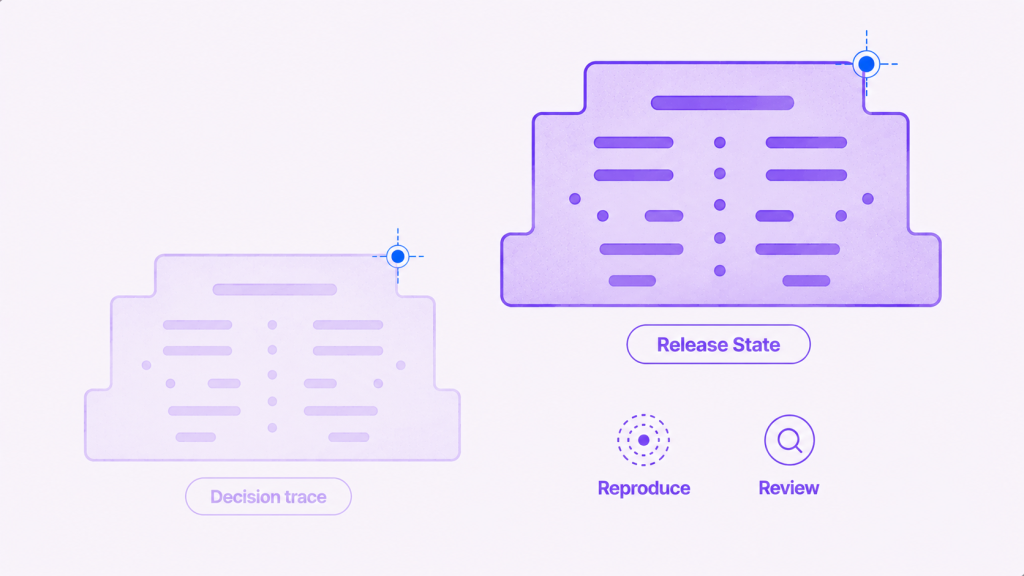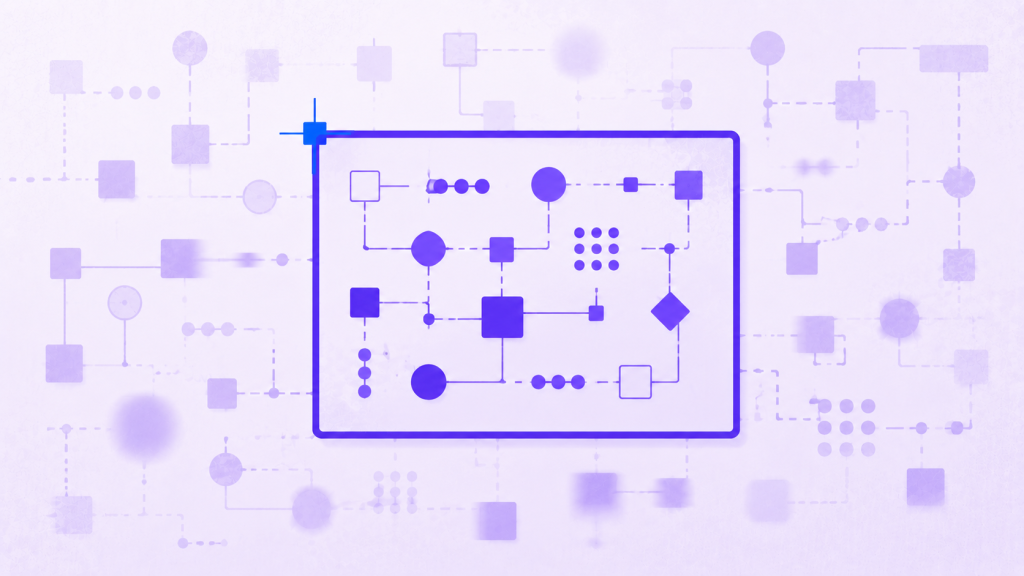
An audit trail for AI decisions is a record that lets you show, for any specific AI-assisted decision, which data state and execution conditions produced it, and then restore that state so a reviewer can examine the decision as it was made.
The stakes for an AI audit trail in the public sector are unusually high. GAO’s AI accountability framework for federal agencies is built on four principles: governance, data, performance, and monitoring. In a government context the failure mode is not just a stalled project; it is a challenged decision that no one can reconstruct months later, when the data behind it has already moved on.
The scenario and workflow below are illustrative until you reproduce them on your own model and data.
The situation: an AI decision gets challenged
Picture an agency that uses an AI workflow to help triage benefit applications, flag cases for review, or allocate limited resources. The workflow runs for months. Then one decision gets challenged, through an appeal, an oversight request, or a freedom-of-information filing.
The team pulls up its records and produces a log entry. The entry shows that a decision was made, at a timestamp, with an output. What it cannot show is the data state behind that decision: which records were in scope, which version of the eligibility rules applied, which reference tables the model read, and under which permissions. The log proves the event happened. It cannot reconstruct why.
Why a log is not an audit trail for AI decisions
A timestamp and an output describe that something occurred. Public accountability asks a harder question: can you reproduce the conditions that produced this specific outcome? Those conditions live in the data state, and by default that state is never captured. Reference tables get refreshed. Eligibility rules get patched. Upstream records get corrected. Each of those changes is reasonable on its own, and together they quietly erase the exact context a reviewer needs.
So an inquiry ends where it should not: “the system decided.” That is the precise answer public oversight exists to prevent. The gap is not a missing log line; it is a missing ability to rebuild the world as it stood at the moment of the decision. Lawmakers are writing that expectation down: EU AI Act Article 12 requires high-risk AI systems to automatically record events over their lifetime so that results stay traceable.
What a real AI audit trail has to prove
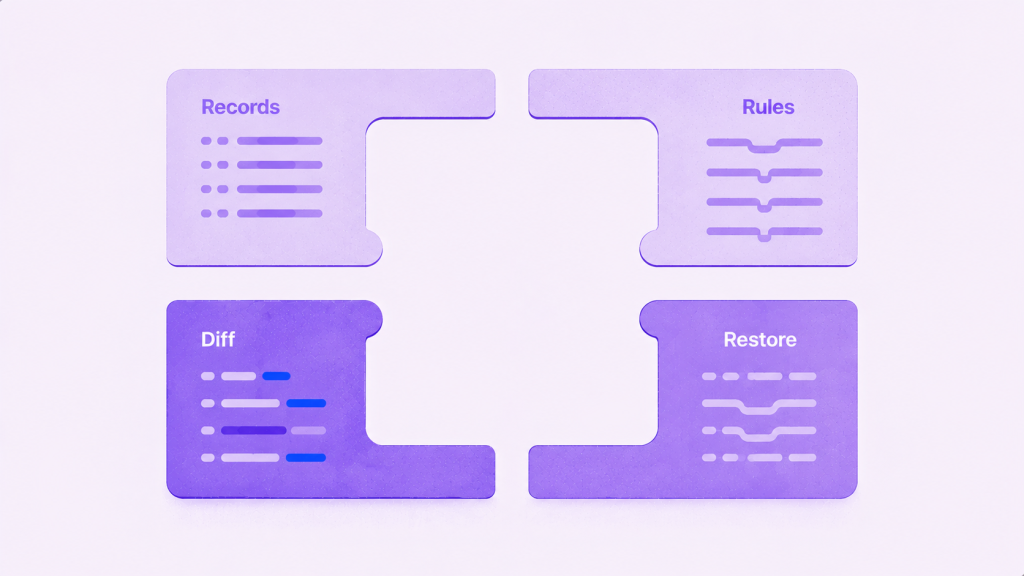
Strip away the tooling and the requirement is concrete. For any past decision, an accountable agency needs to answer four questions with evidence, not recollection. The NIST AI Risk Management Framework makes the same point in its own language, calling for AI systems to be documented, traceable, and auditable rather than merely logged.
- Which records and fields were actually in scope when this decision ran?
- Which version of the rules, thresholds, and reference tables applied at that moment?
- Would a similar case decided a week earlier have come out differently, and if so, what changed?
- Can a reviewer see that state restored, not summarized, and inspect it directly?
If those four cannot be answered from the system itself, every review becomes a forensic project: interviews, guesswork, and reconstructions that no one can fully trust.
Where operating control changes the picture
Binding each decision run to a Release State turns a log into a genuine AI audit trail. Instead of recording that a decision happened, the system records the state it happened against, and keeps that state addressable.
| Question under review | What a plain log gives you | What a bound Release State gives you |
|---|---|---|
| Did the decision happen? | Yes, with timestamp | Yes, with timestamp |
| Which data produced it? | No | Yes, via Run Binding |
| What changed since a prior case? | No | Yes, via Diff |
| Can the state be restored? | No | Yes, via Reproduce |
| Is traceability built in? | Partial | Yes, as a system property |
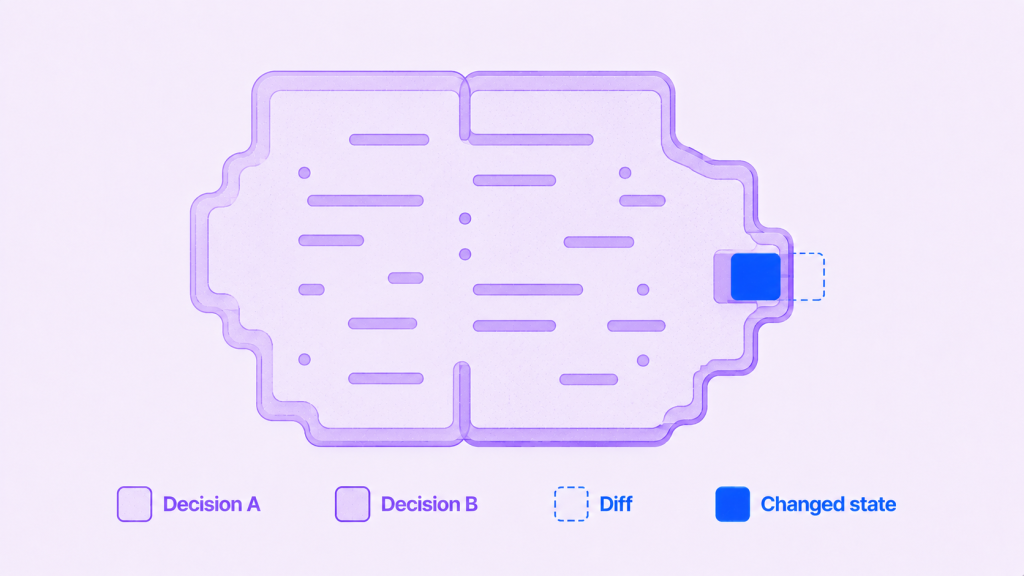
Four capabilities carry the weight here. Run Binding connects each decision to the exact data state and conditions that produced it, so the link is captured at decision time rather than reassembled later. Traceability, one of the six readiness axes, makes “which data produced this decision” a standing property of the system. Diff shows whether a rule or reference change between two decisions explains why two similar cases were handled differently. Reproduce restores the decision’s data state so a reviewer can examine it as it stood, not as it looks today.
For production AI, the question is not only which model ran; it is which data state and execution conditions produced the result. Syntitan, CUBIG’s AI-Ready Data Platform, scores enterprise data on six axes, Usability, Integrity, Context, Consistency, Reproducibility, and Traceability, rebuilds what blocks execution, and binds every AI or agent run to a data state you can diff and reproduce.
Is your AI decision trail actually auditable?
Run this quick test against your current setup. If you cannot answer yes to most of these, your logs are recording events, not evidence.
- Can you name the exact records and fields a specific past decision read?
- Can you tell which version of the rules and reference tables applied that day?
- Can you restore that state and show it to a reviewer, rather than describe it?
- Can you diff two decisions and point to what changed between them?
- Is this captured automatically at run time, not rebuilt by hand after a challenge?
The outcome: examinable, not just explainable
The accountable version lets an agency answer an oversight question with evidence: here is the decision, here is the exact state behind it, and here is that state restored for review. It does not claim the decision was correct, and it should not. It makes the decision examinable, which is the actual requirement in public administration. A citizen, an auditor, or a court can look at what the system saw and judge the decision on its merits.
Where it fits
An audit trail for AI decisions is one expression of a broader idea: AI is only accountable when its data state is operable and reproducible. This is the operating layer for AI-ready data, where a decision, a backtest, or an agent run all reduce to a Verifiable Data State you can diff and rebuild. The same machinery that answers “reproduce this incident” also answers “reproduce this decision,” which is why reproducibility work in one domain pays off in the other.
Try it on your data for free. Run a sample proof and see it on your own workflow. You can start by binding one decision workflow to a Release State and reconstructing a past decision from its bound state. For related reading, see operating control versus AI governance frameworks, how to reproduce an AI incident, and public sector citizen service workflows.