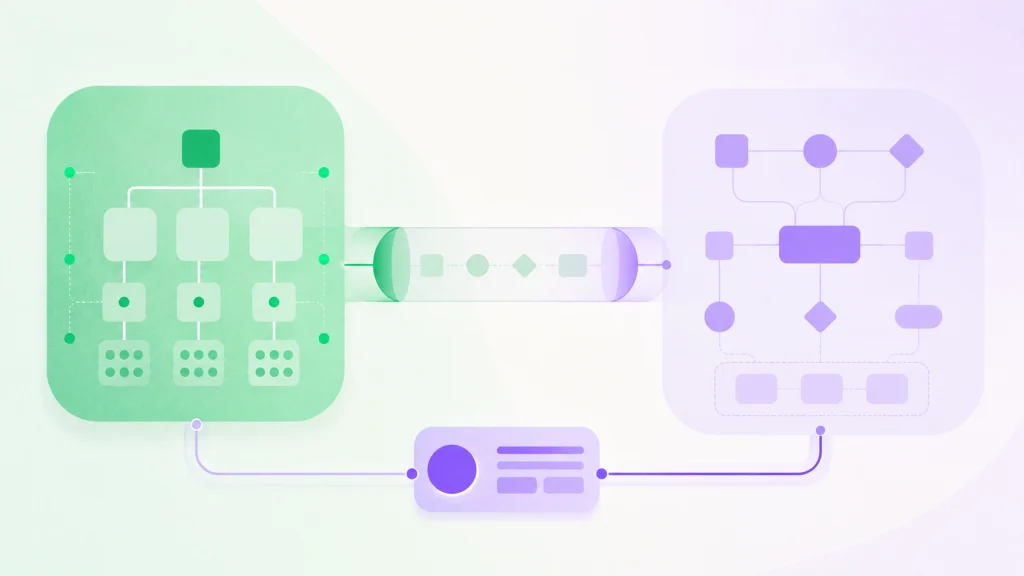
Running AI on citizen service workflows means sending an external model the structure of a case, not the resident’s real records, so a public agency can draft decisions and clear casework backlogs while citizen identifiers stay inside its own environment.
The gap between what AI could do for public agencies and what they are allowed to try is wide, and it is widening. What good looks like is already written down: GAO built its accountability framework for federal AI on four principles, governance, data, performance, and monitoring, and the data principle is where agencies get stuck. In government, the data that would make a project work is usually the data an agency is legally bound to keep in place. The result is a backlog nobody can automate and a technology nobody can point at. The appetite is already there: some public servants already use generative AI in their work, often ahead of the rules meant to govern it.
Why citizen casework resists automation
Picture a housing benefit appeal. The case file that lands on a caseworker’s desk runs to forty pages: the original application, income statements, a prior decision, correspondence, and supporting documents that name the applicant’s national ID, address, household members, and medical circumstances. Someone has to read all of it, weigh it against policy, and write a reasoned decision. There are thousands of these, and the backlog is measured in months.
A model could draft the decision and surface the governing policy in minutes. But the file is citizen data held under a legal duty, and it does not leave the agency. This is the public-sector shape of a problem every regulated organization meets: the work that would benefit most from AI sits on exactly the records that are least free to move.
The two responses that fail
Agencies usually reach for one of two answers, and both cost them the outcome. The first is to anonymize the case file before any model sees it. A benefit decision, though, turns on specifics: this household, this income, this prior ruling, these circumstances. Strip them out and the model reasons about a generic case that resembles no real applicant, so its draft is useless for the actual decision in front of the caseworker.
The second answer is to forbid the model outright and keep every file inside the agency, which is where many public bodies sit today. The backlog stays, the caseworkers stay overloaded, and the technology that could help waits outside the door. Both responses rest on the same mistaken assumption: that the citizen’s identifying details and the substance of the case are one and the same thing. They are not, and separating them is what makes government casework automation possible.
Enablement applied to a citizen case file
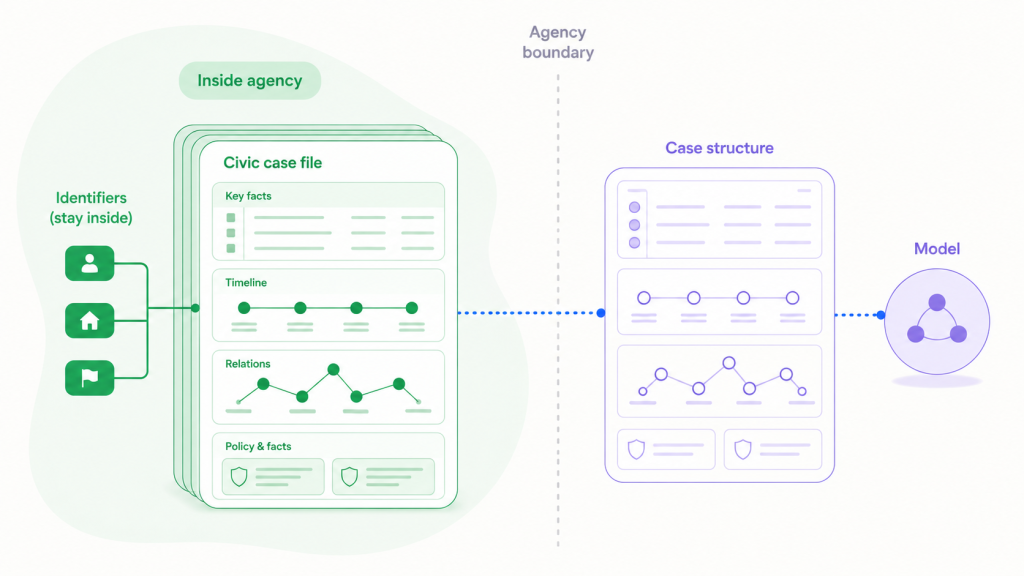
There is a third path. Send the model the structure of the case instead of the file itself. The income figures keep their relationships, the timeline of applications and decisions stays in order, and the policy-relevant facts stay intact. What gets substituted is the identifying layer: the national ID, the name and address, the household members, all replaced with consistent stand-ins before anything reaches the model. The model reads a coherent case and drafts a reasoned decision against it.
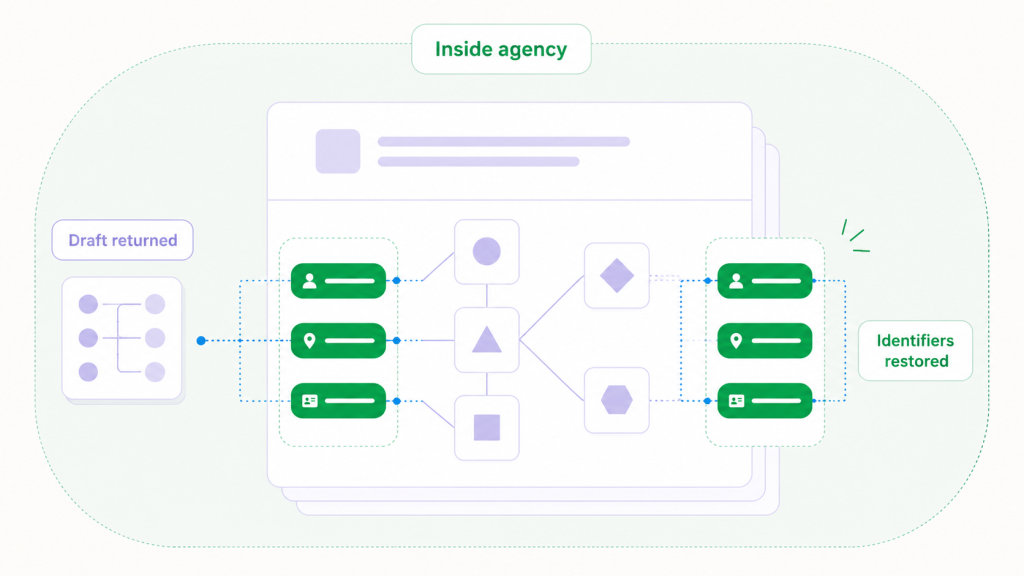
That draft is then reconstructed inside the agency’s own systems, where the real applicant’s identity returns and the output becomes a document a caseworker can review and issue. The casework ran, the citizen data stayed inside the agency’s environment, and the caseworker gets a draft grounded in the actual facts rather than a generic template. This substitute, execute, reconstruct pattern is the practical form of sensitive AI workflow enablement applied to resident records, and it is a different move from the plain masking many agencies already know: masking blanks a value, while this preserves the working structure the model needs.
What runs and what stays put
In CUBIG’s case, LLM Capsule runs this flow: it lets AI work with operational data that can’t be sent as raw data, using context-preserving substitution. The real values stay in an internal mapping inside the agency, and the model’s response is checked and connected back to them once the model has done its part. Structure goes out, identity stays home, and the reconstruction closes the loop so the workflow actually finishes rather than stopping at a redacted draft nobody can act on.
The reader test is simple. Run through this list against any citizen service workflow you want to open up to AI, and if you cannot answer yes to the first four, the workflow is not ready to run.
- Can you name which fields are true identifiers and which are the substance of the case?
- Does the substitution keep figures and timelines in their real relationships?
- Does the finished output get reconstructed inside your own environment, not the vendor’s?
- Can a caseworker act on the draft as if it were written on the real file?
- Does your data protection officer have a concrete basis to sign off?
Where AI on citizen service workflows fits
This is one public-sector view of a pattern that recurs wherever confidential records meet a regulated mandate. In telecom, the protected file is subscriber and network topology data rather than a case file; in healthcare, it is protected health information in clinical workflows. The mechanism is the same in each.
Because citizen identifiers stay inside the boundary, the agency has a clearer basis for reviewing the workflow against the data-protection duties that govern public records, and it can keep a record of how each AI-generated decision was produced. The risk being managed is a named one: NIST’s Generative AI Profile counts data privacy and information security among the twelve risks it treats as unique to generative AI or amplified by it. The data protection officer’s approval is the by-product. The point was to clear the backlog while residents’ files stay inside the agency, and to move public-sector AI from a slide deck into the casework queue.
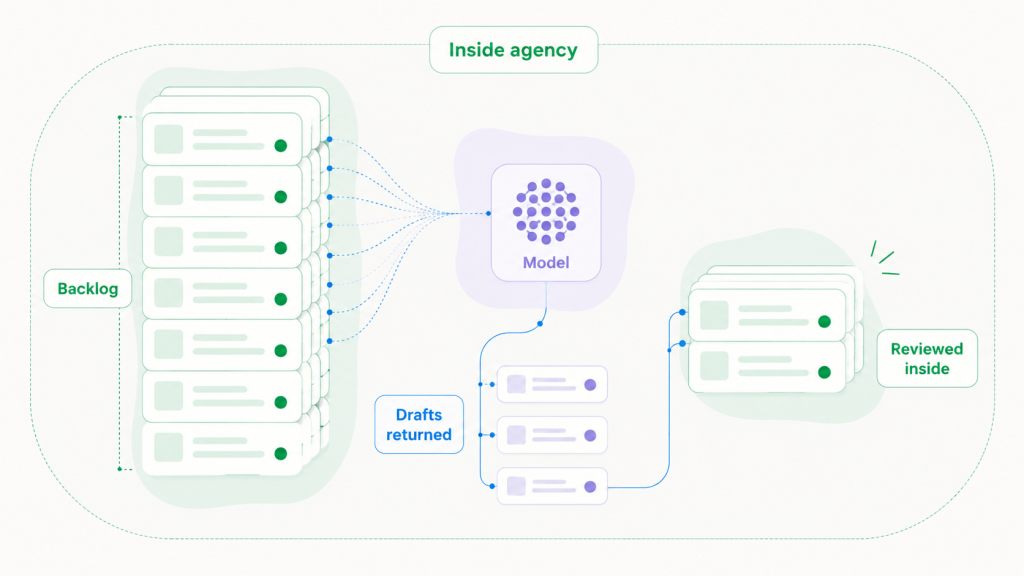
LLM Capsule puts this pattern to work on real case files. It substitutes the citizen identifiers before anything reaches the approved model and connects the drafted decision back to the real case inside the agency, so the casework runs while the records stay put.